
Your rank tracker says you're first for a query that matters. Then you search it yourself and scroll past an AI Overview, a row of videos and a stack of questions before your page shows up. Both things are true at once, and pixel ranking is the measure that explains how.
Pixel ranking counts how far down the results page your listing starts, in pixels from the top. Position numbers count results in order. They used to tell the same story, because result one sat near the top of the screen. In 2026 they often don't.
What pixel ranking measures
seoClarity, which sells rank tracking and built a pixel metric into it, defines pixel rank as "a metric that measures a webpage's position on a search engine results page (SERP) in terms of its actual pixel height." Its January 15, 2026 post puts the first screen, or fold, at about 800 pixels on desktop and 400 on mobile.
Those fold lines are a rule of thumb. Google doesn't publish them, and a laptop with a big browser toolbar shows less than a tall monitor does. They're still a fair yardstick for the question that matters, which is whether a searcher sees you without scrolling.
We call the gap the scroll tax. It's the pixels a searcher has to move past before your result appears. In our check below, it ran from 514 to 1,456 pixels for results that all ranked first.
Why position one slid down the page
Google keeps adding blocks above the blue links. Our field guide to SERP features covers each one, but four do most of the pushing. Those are AI Overviews, video blocks, local map packs and People Also Ask.
Here's a real results page for "best running shoes for flat feet."
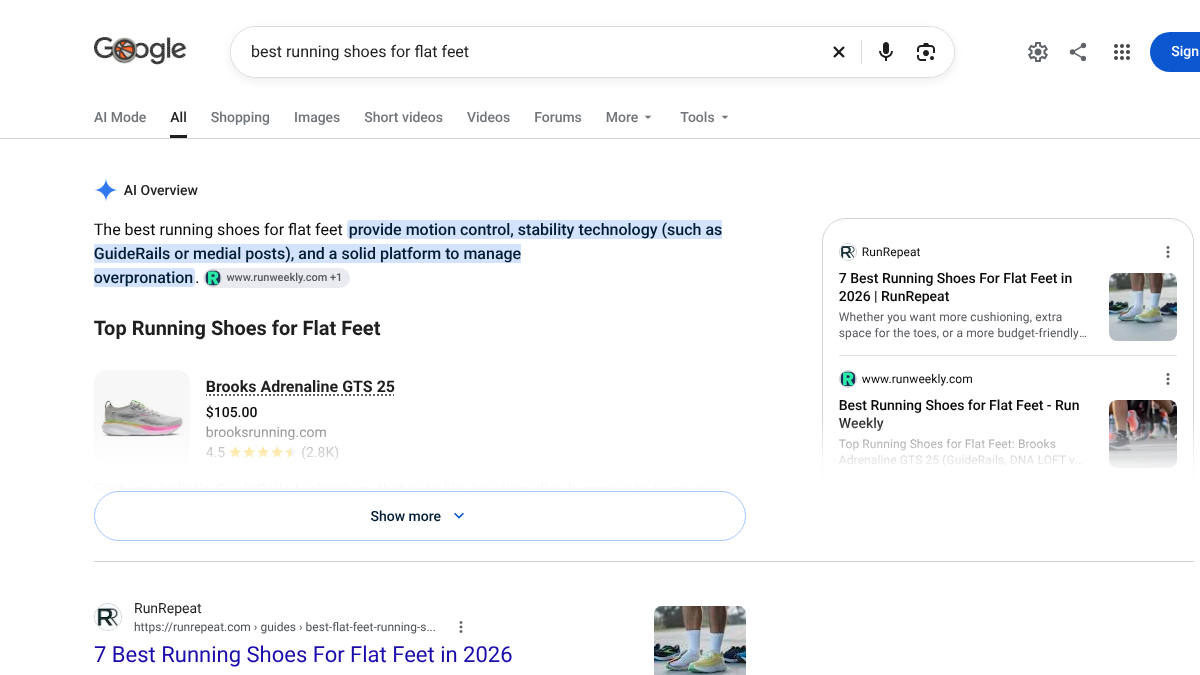
RunRepeat holds the first organic spot. On this screen you only see its title at the very bottom edge, under the AI Overview and a product block with a price in it. Anyone who reads the summary and stops never reaches it.
How big are those boxes? The same seoClarity post says AI Overviews average 1,110 pixels of desktop height and 617 on mobile. It gives no sample size or method, so treat that as one vendor's figure.
We measured six results pages
We wanted dated numbers rather than a vendor average. On October 19, 2026 we ran a SERP pull with pixel coordinates for five Google US searches on desktop, then ran one of them again on mobile. That's six results pages.
| Search | Type | What sat above the first organic result | Organic position | Pixel depth |
|---|---|---|---|---|
| best noise cancelling headphones | Product research | AI Overview | 1 | 614 |
| best project management software for small teams | Software comparison | AI Overview | 1 | 614 |
| symptoms of vitamin d deficiency | Health question | AI Overview | 1 | 614 |
| best project management software for small teams (mobile) | Software comparison | AI Overview | 1 | 514 |
| how to get rid of fruit flies | How-to | AI Overview, a video block, People Also Ask | 1 | 1,407 |
| accountant near me | Local | A three-business map pack, AI Overview, People Also Ask | 1 | 1,456 |
Every row is organic position one, and any report that only counts organic results would show the same number for all six. The depth runs from 514 to 1,456 pixels, close to a threefold spread.
The three plain desktop pages put the top result at 614 pixels, inside an 800-pixel fold. The mobile page is shallower in pixels but deeper on the screen, since 514 is well past a 400-pixel phone fold. The fruit fly and accountant pages push the top result about 76% and 82% past the desktop fold.
Two details stood out. Google's header and search bar alone took the first 194 pixels on desktop, before any result. And the AI Overview boxes in our pull measured 250 to 384 pixels tall, a quarter to a third of seoClarity's average. We can't tell why without its method. It may count the expanded box after a click on "Show more," or a different mix of searches.
This is six pages, not a study, and a different city or screen size would give different numbers. What held across all six is that the rank stayed at one while the depth moved by more than 900 pixels.
200+ SaaS teams already track their AI citations.
They know exactly when ChatGPT mentions their brand, and when it stops. Do you?

How Search Console counts position
Search Console is the source most teams trust, and it can't see any of this. Google's help page on impressions, position and clicks, which we checked on October 19, 2026, says plainly that "Google Search pages are very complex, and trying to determine a position for any given element is not very straightforward."
Then it sets the rules. Only elements with at least one link that isn't a new search take a position. "An AI Overview occupies a single position in search results, and all links in the AI Overview are assigned that same position," the page says. Elsewhere on the page it adds, "Note that ads do not occupy a search position."
So a 384-pixel AI Overview and a 1,110-pixel one each cost one position. Ads can fill the top of the page and cost none. By that rule, the first organic link on our three plain desktop pages would count as position 2, under the Overview's position 1. Search Console has no field for pixels at all, so the same number can sit under one small box or a full screen of other blocks.
The same help page admits the number is an average. Its own example is a report showing position 5 for a page that shows up eighth on a live search, because location and search history change what each person sees. Our guide to tracking AI Overviews separately from organic rankings covers how to report around that.
What pixel ranking does to clicks
Click-through rate tracks how far down you sit more closely than the number you hold. Our roundup of CTR by position compares the studies. One figure from it makes the point. Advanced Web Ranking measured position-one CTR at 20.02% on all US desktop pages in July 2026, and at 9.69% on pages with an AI Overview.
That's the same rank and roughly half the clicks. AWR also found the losses stack, so an AI Overview combined with a local pack, product grids, People Also Ask and videos cut position-one clicks by 99%. Our accountant page had three of those blocks stacked above the first organic result.
People who do this work notice it. In an r/localseo thread asking whether ranking first matters less since AI Overviews, one reply said the AI Overview answered the query before anyone needed to scroll, and the organic number one sat below the fold on most screens. A frustrated searcher on X said the same thing with less patience.
@alex_buraks google went from 'organize the world's information' to 'bury the world's information under 47 ads'. position #1 organic is now below the fold. SEO is dead, pay-to-play won
 Twlvone@twlvoneFeb 27, 2026
We'd skip the "SEO is dead" part. Position one still gets the most organic clicks in every CTR study we've read. The number just can't tell a 614-pixel first place from a 1,456-pixel one.
Why your rank tracker misses it too
Most trackers whose sites we read in October report a position number per keyword, plus a flag for whether a feature such as an AI Overview was on the page. A few vendors, seoClarity among them, sell a pixel or visual rank.
Not everyone in the business thinks pixels fix this. SEOmonitor, another rank-tracking vendor, ran a post titled "Why pixel-based rank tracking is not solving the problem, it's making it worse." There's a fair case for that view. Pixel depth changes with screen size, browser, location and whether a box is expanded, so one number per keyword can look more exact than it is.
Trackers have had a rough autumn on top of that. Search Engine Roundtable reported on October 12, 2026 that Google has been blocking tools that scrape its results, and in some cases feeding them wrong results. It quoted Derek Perkins of Nozzle, a rank tracker, saying this began in September 2026.
Our post on whether Google Analytics can track rankings covers what to cross-check before you report a drop. And our explainer on SERP data covers why collecting it got harder this year.
How often does ChatGPT mention your brand?
Most founders have no idea. The answer might surprise you.

How to check pixel depth yourself
You don't need a tool for a spot check. Chrome can tell you the depth of any result in about two minutes.
- Open a private window at a normal laptop size, so your own history doesn't change the page.
- Search the query and find your result.
- Right-click your result's title and pick Inspect.
- In the Console tab, type
$0.getBoundingClientRect().top + scrollYand press Enter. - Write down the number, plus a note on every block that sat above you.
The number is your pixel depth for that search, on that screen, from that place. Run the mobile view too, through the device toolbar in the same panel, because the phone fold is about half the desktop one.
For each keyword that matters, keep three facts side by side. Those are the position, the pixel depth and what sat above. At two minutes a query, 50 keywords take about 100 minutes a round, and the results change as Google moves blocks around.
What to do about a deep position one
Start by sorting your keywords by depth, not rank. A position-three result at 700 pixels is on the first desktop screen, and a position-one result at 1,400 isn't. Plan content for the searches where the organic results still start near the top, such as narrow product and comparison queries.
For the deep ones, the top of the page is the AI Overview itself. Being a source inside it puts your link above everything else, even with the organic result far below. Our breakdown of what gets surfaced in AI Overviews shows real examples.
Then watch it over time. One check tells you where you stood on October 19. It doesn't tell you when Google adds a video block to your best query next month.
Doing it yourself or handing it off
RankControl tracks your Google and Bing rankings in analytics, and our Google check notes whether an AI Overview showed for the query and whether it cited you. Our AI visibility tracking runs your buyer questions every week on seven AI engines. We offer one plan at $400/mo with a 7-day free trial. We don't measure pixel depth, so keep the Chrome check for the keywords you care about most.
You can run all of this by hand with a spreadsheet and a private window. Or RankControl's agents can watch the rankings and AI answers every week while you spend that time on the pages.
15 hours a week manually. Or 15 minutes with RankControl.
Track citations, monitor competitors, and fix content gaps across every AI search engine. Automatically.