
I searched Google for "seo statistics" on October 19, 2026, and sat with the results page longer than I meant to. Five of the roundups on it put four different years in their titles. One said "Latest 2025 SEO Stats." Two said 2026. One said 2023, and one said 2024, all competing for the same search in the same week.
That's the real problem with SEO statistics. Roundups copy each other, bump the year in the title and carry the same numbers forward, and some of those numbers never had a source to begin with.
So this post sticks to primary sources. Every figure below comes from the company or study that produced it, dated to when it was published or last updated. It covers the classic mechanics of organic search: who holds the searches, which devices they happen on, how long ranking takes, what tends to rank and what it costs. Where a number is old, I say so plainly.
The short answer
| Statistic | Figure | Source and date |
|---|---|---|
| Google's worldwide search share | 89.94% | Statcounter, September 2026 |
| Bing's worldwide search share | 5.29% | Statcounter, September 2026 |
| Search on mobile | 59.03% | Statcounter, September 2026 |
| Search on desktop | 39.18% | Statcounter, September 2026 |
| Searches Google hasn't seen before | 15% | Google, undated, repeated for years |
| New pages reaching the top 10 within a year | 1.74% | Ahrefs, updated August 12, 2026 |
| Top-10 pages that got there within a month | 40.82% | Ahrefs, updated August 12, 2026 |
| Top-10 pages more than three years old | 72.9% | Ahrefs, updated August 12, 2026 |
| Backlinks at #1 vs positions 2 to 10 | 3.8x more | Backlinko, updated April 14, 2025 |
| Average words on a first-page result | 1,447 | Backlinko, updated April 14, 2025 |
| Most common SEO retainer | $501 to $1,000 a month | Ahrefs, updated August 12, 2026 |
| Most common SEO hourly rate | $75 to $100 | Ahrefs, updated August 12, 2026 |
You're getting AI traffic. But do you know where it comes from?
RankControl credits every visit to the assistant that sent it: ChatGPT, Perplexity, Claude, Gemini, Copilot, or Grok. Full source attribution, next to your Google traffic.
Google still has nine searches in ten
Nine out of ten searches worldwide still go through Google. Statcounter's September 2026 data puts the figure at 89.94%. Bing trails at 5.29%, with Yahoo at 1.36%, Yandex at 1.31%, DuckDuckGo at 0.74% and Baidu at 0.44%.
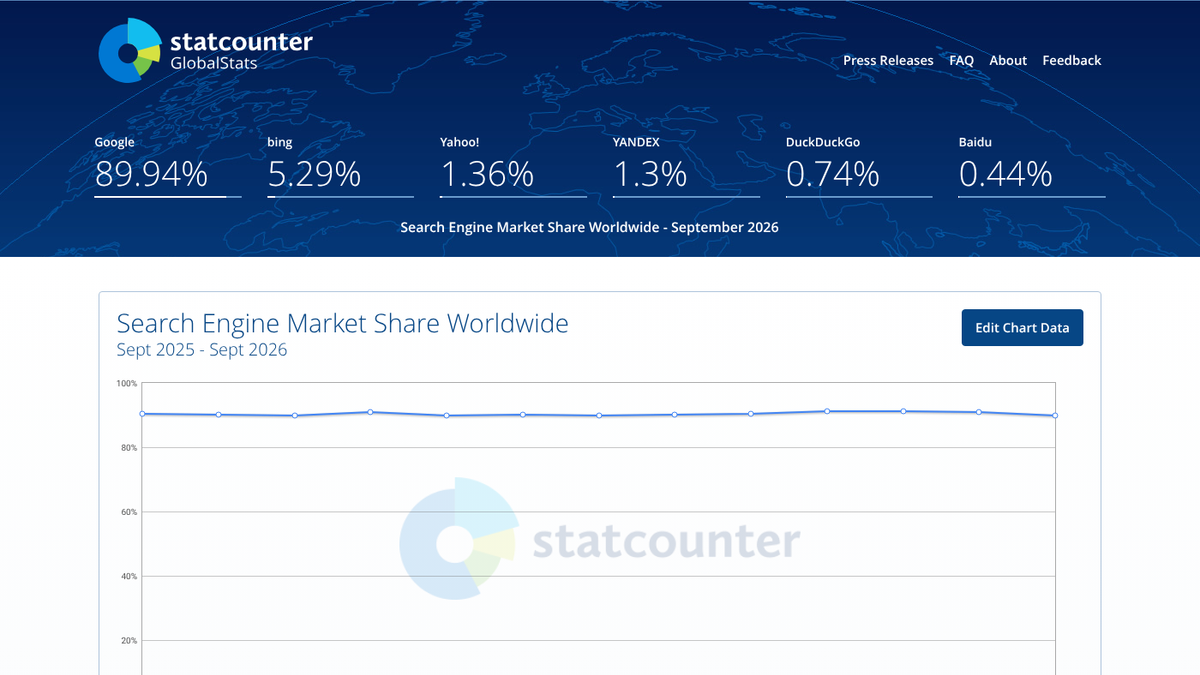
Statcounter builds this from the network of sites running its tracking code, so it's measuring referrals across that network rather than counting every query typed anywhere. It's still the number most of the industry reaches for, and it's free to check yourself.
I pulled Statcounter's monthly figures for the 24 months from September 2024 to September 2026 to see whether AI chatbots had actually dented Google's share.
| Month | Bing | |
|---|---|---|
| September 2024 | 90.00% | 3.96% |
| September 2025 | 90.38% | 4.10% |
| July 2026 | 91.32% | 4.46% |
| September 2026 | 89.94% | 5.29% |
Across those two full years, Google's monthly share never fell below 89.34% or climbed past 91.32%. Its best months landed in mid-2026, the exact stretch when AI chatbot use kept growing elsewhere. The steadier mover was Bing, which crept from 3.96% up to 5.29% over the same window.
None of this says AI search isn't growing. It says that among search engines specifically, Google's slice is holding firm; Statcounter's search chart counts search engines, not chatbots. Our AI search adoption statistics cover the chatbot side of the ledger, and our post on whether ChatGPT search uses Bing explains why Bing's small worldwide number matters more than it first appears to.
Most searches happen on phones
Phones, not desktops, carry most search traffic now. Statcounter's search-only platform data (as opposed to its general device data, which mixes in all web use) put September 2026 at 59.03% mobile, 39.18% desktop and 1.75% tablet.
Keep that distinction in mind next time a roundup quotes a device split; a lot of them blend all internet activity with search specifically, which pushes the numbers around. For SEO, the search-only figure is the one that matters, and it says plainly that a page which reads badly on a phone is failing the majority of the people who actually find it.
Many searches are new to Google
Google's own How Search Works page still says this plainly: "fifteen percent of searches are ones we haven't seen before, so we use automated systems to get you the most relevant and reliable information we can find."
The page carries no date, and Google has quoted this same figure for years running. So treat it as a long-standing claim rather than a fresh 2026 measurement. The underlying point still holds, though. A large share of searches are long, specific phrasings nobody has typed quite that way before, which is part of why a page that answers a narrow question clearly can still pull traffic on a topic the big sites already seem to own.
How long a new page takes to rank
This is the number everyone wants, and the honest answer is longer than you're hoping for.
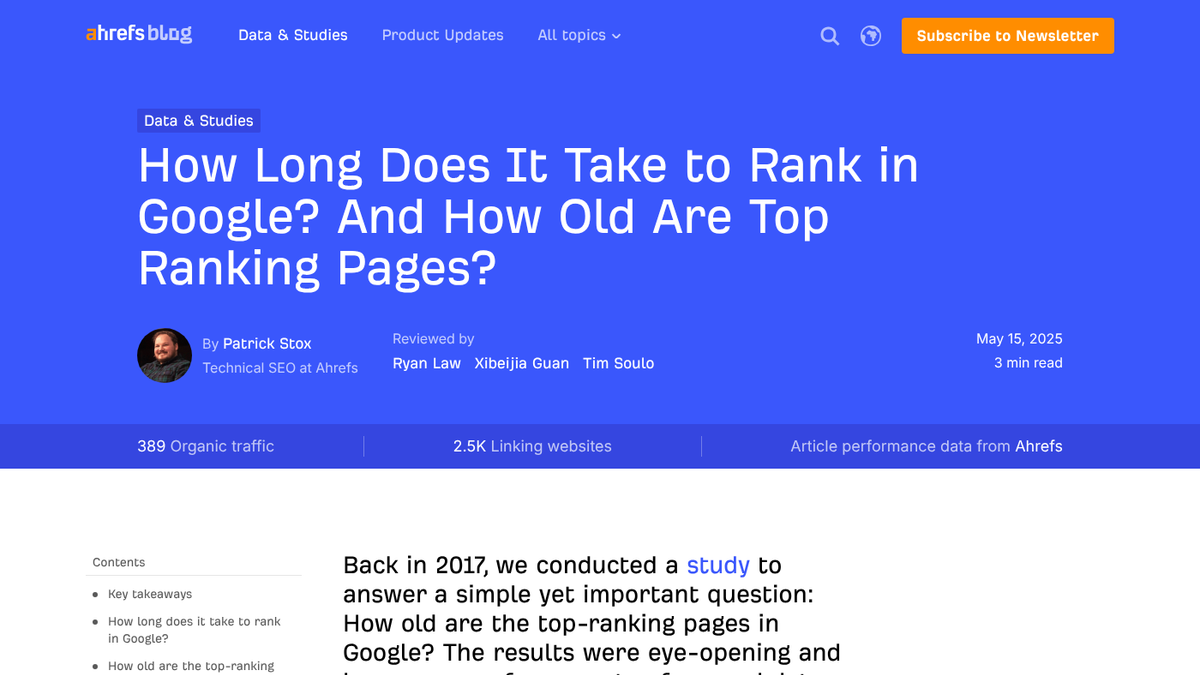
Patrick Stox at Ahrefs ran the study behind it. "We took 1M random URLs seen by our crawler in September 2023 and looked if any of them made it to the top 10 within a year," he wrote. The result: "Only 1.74% of them did. 98.26% of them did not. That's way down from 5.7% in 2017."
A lot of pages in that million were never going to rank anyway: thin pages, duplicates, pages in other languages. Stox re-ran the numbers on a cleaner sample, filtered to English pages with real content, and got a more usable figure. "6.11% of them made it to the top 10 within 1 year," he wrote. "This might be a more fair number to use."
Here's the part worth holding onto. Of the pages that did reach the top 10, "40.82% of pages that ranked in the top 10 did so within 1 month." Pages that are going to rank tend to show it early. A page that's gone nowhere after several months is usually asking for more work, not more patience.
A thread on r/SEO from September 2026 captured the gap between those numbers and what managers expect. A new SEO intern said their boss wanted results on one page within 30 days. The top reply put it bluntly: SEO is slow by nature, and if a 30-day deadline is fixed, that's a case for buying ads instead.
Boss wants SEO results in 30 days. Am I being unreasonable for feeling stressed?
I recently joined as an SEO intern and I'm not sure if what I'm experiencing is normal or if I'm just new to the industry. My manager assigned me a page to work on and expects to see results within a month. I'm doing keyword research, conte...
Another reply in that thread suggested a fairer test altogether: write down the starting point, log the changes made, and track what moves. Early movement counts as a result, even before a page ever touches the top ten.
Top pages are old
The same Ahrefs study looked at the age of pages already sitting in the top spots, checking when its crawler first saw each of the top 10 URLs across 1.3 million random US keywords.
| Page age finding | 2017 | Updated 2026 study |
|---|---|---|
| Top-10 pages more than three years old | 59% | 72.9% |
| Average age of the #1 page | 2 years | 5 years |
Pages that rank tend to keep ranking, and the pages sitting at the top keep getting older. If you're running a new site, that's a reason to aim at specific questions the old guard answers badly instead of taking on the broad terms they've held for years. Our analysis of the share of sites that never get cited turns up a similar pile-up on the AI side of things.
I'd call this the incumbent premium. Age, links and history stack up on pages that have ranked for years, so a new page going head-to-head with one of them pays a cost a new page on an open question simply doesn't.
We'll show you exactly where your brand stands in AI search.
No commitment. $0 due today, cancel anytime. See how ChatGPT, Perplexity, Claude, Gemini, Grok, Google AI Mode, and Google AI Overviews talk about your brand today.

Backlinks still line up with rankings
Backlinko, owned by Semrush since 2022, analyzed 11.8 million Google results for this one. First published in 2016 and last updated April 14, 2025, it's older than most figures on this page, which is worth knowing before you lean on it too hard.
Its finding on links: "Pages with lots of backlinks rank above pages that don't have as many backlinks. In fact, the #1 result in Google has an average of 3.8x more backlinks than positions #2-#10." A separate line from the same study is almost as striking: "95% of all pages have zero backlinks." Most of the web has no inbound links at all, which is a big part of why so few new pages break through.
Two caveats are worth holding onto here. This is correlation, and the #1 page may attract links because it ranks just as much as it ranks because it has links. The study also used Ahrefs' own link metrics to measure authority, so one vendor's tool is effectively measuring the effect of what that same tool measures.
A practitioner on r/SEO asked how long links actually take to show up, for a client project they were running. The top reply said the effect usually shows within a few weeks, with the full lift arriving once the linking pages themselves get indexed and start ranking.
How Long Does it Take for Backlinks to Impact Rankings & Traffic?
Earlier this year I was hired to fix a website whose SEO had been destroyed by an agency redesign. They made it pretty but killed onpage SEO, site structure, core vitals, created short/generic content, etc. Since fixing the site about 4 mon...
For the current debate on this, see our post on whether backlinks are still important in 2026, and our own 20-site test of backlinks and AI citations.
Length and speed don't line up with rank
Two popular beliefs didn't survive contact with Backlinko's data.
Content length is the first one. "We discovered that word count was evenly distributed among the top 10 results. The average Google first page result contains 1,447 words." That average gets quoted as a target constantly, but the study's actual point cuts the other way. Word count never separated the #1 page from the #10 page.
Site speed is the second. "The average Google first page result loads in 1.65 seconds. However, we found no correlation between site speed and Google rankings." Neither finding means length or speed are irrelevant on their own terms; a page still needs enough words to answer the question, and a slow page still loses visitors who get tired of waiting. What they mean is that neither one is a lever you can pull by itself to climb the rankings.
What SEO costs
Ahrefs polled SEO providers directly for its pricing survey, first published in December 2023 and updated August 12, 2026. "We polled 439 SEO service providers for the data in this post," the study says. "We even reviewed all their websites manually to make sure they really did offer SEO services."
| Pricing model | Share of providers using it |
|---|---|
| Monthly retainer | 78.2% |
| Per project | 48.9% |
| Hourly | 34.8% |
Providers could pick more than one model, which is why those shares add up past 100%.
| Most common rate | Figure | Share charging it |
|---|---|---|
| Monthly retainer | $501 to $1,000 | 20.4% |
| Hourly | $75 to $100 | 24% |
One small oddity I noticed while reading: the same Ahrefs page cites 439 providers in its title and body text, but "350 SEO professionals" in its meta description. I've used 439 throughout, since that's the figure stated in the body.
Our post on SEO ROI covers how to judge whether a given spend is paying off, and our comparison of RankControl and an SEO agency breaks down the cost gap between a tool and a retainer.
Our check: the numbers Google's own AI repeats
When I pulled the "seo statistics" results on October 19, 2026, an AI Overview sat right at the top of the page. It claimed Google handles "over 8.5 billion to 14 billion searches per day," a range wide enough to span 65% either way, and cited two SEO blogs, neither one a primary source.
I opened one of them. Its sentence reads: "As of 2026, Google accounts for almost 90% of the global search engine market, equating to nearly 14 billion searches a day." There was no citation anywhere near it. The 90% figure roughly matches Statcounter. The 14 billion figure traces back to nothing I could actually find.
The same AI Overview gave an SEO hourly rate of "$100 to $150 per hour," also sourced from aggregator blogs. Ahrefs' named survey of 439 providers, by contrast, found $75 to $100 the most common rate.
| Claim | AI Overview | Primary source |
|---|---|---|
| Daily Google searches | 8.5 billion to 14 billion | No primary source found |
| Google's search share | About 90% | 89.94%, Statcounter |
| Common SEO hourly rate | $100 to $150 | $75 to $100, Ahrefs survey |
A roundup can be wrong. Other roundups repeat it. An AI answer then repeats all of them, and sounds confident doing it. I left every other figure that AI Overview offered out of this post, since none of them had a source I could actually check.
What about AI search?
This post stays on classic organic search, but the two now share the same results page. For the numbers on where they overlap, see our click-through rate by position data for how much the top results still get clicked, our ChatGPT statistics for how many people use the biggest AI chatbot and what they ask it, and our post on which statistics posts AI engines cite for why sourced data pages tend to get quoted back.
Put simply, Google's share of search engines is steady while more of the actual answering happens right there on the results page. Ranking still matters, since the pages AI answers lean on are so often the pages that already rank.
How to check an SEO statistic before you use it
Before a number goes into a deck or a client report, run it through five questions.
- Who measured it? A named company or study, or a vague "studies show"?
- When? Look for a publish or update date on the original page, never the roundup quoting it.
- On what sample? A million URLs, 439 providers, or one agency's own client list?
- Is it a correlation? Most ranking studies are. Say so when you use one.
- Who benefits? Link tool vendors publish link studies. That doesn't make the finding wrong, but it's worth a line in your notes.
If you can't answer the first two questions, leave the number out entirely.
Common mistakes with these numbers
- Treating the 1,447-word average as a target. The study behind it found no link between length and rank at all.
- Quoting 1.74% without context. The cleaner sample put the real figure at 6.11%, and pages that do rank often get there within a month.
- Reading correlation as cause. Top pages carry more links. That doesn't prove the links are what put them there.
- Using the general device split for search. Search-specific data puts mobile at 59.03%, which isn't the same thing as all web use.
- Copying a roundup's year. Check the date on the original study, not the title someone slapped on a summary of it.
Doing it yourself or handing it off
Add it all up and the numbers say ranking is slow, links still matter, and new pages do best on specific questions the incumbents answer badly. That's months of steady research and writing, published on a schedule.
RankControl does that work on your behalf. We find the questions your buyers are searching, plan titles around them and write each article against the pages already ranking for it. We publish to your site as native posts and draft link outreach from your own mailbox, with nothing sent until you approve it. Our AI visibility tracking then checks up to 50 buyer questions every week across seven AI engines. Expect traffic from Google first, with AI citations following more slowly as links and mentions build up.
Know exactly what AI says about your competitors.
RankControl's Recon Agent monitors competitor citations across ChatGPT, Perplexity, Claude, Gemini, Grok, Google AI Mode, and Google AI Overviews. See where they show up and you don't.