
You've decided you don't want to do AI search optimization yourself. You want it done for you. That leaves two paths: hire an SEO or GEO agency on a retainer, or use software that does the work.
The prices make the choice look obvious, but the price isn't the hard part. The hard part is knowing what each one actually hands you at the end of the month, and what happens if it isn't working.
This post compares the two on that basis. It covers what agencies charge in 2026, what each retainer tier buys, the contract terms we couldn't find in any pricing guide and what RankControl produces for $400 a month. Every agency price below comes from published sources we checked on October 19, 2026.
RankControl vs an agency at a glance
| SEO or GEO agency | RankControl | |
|---|---|---|
| Price | About $1,500 to $50,000+ a month, by tier | $400/mo, or $4,000/yr |
| Contract | Often not stated publicly | Month to month or yearly |
| Content | Varies by tier, often unspecified | Up to 100 pages a month |
| Publishing | Depends on the agency | Native posts on your CMS |
| Link outreach | Digital PR on higher tiers | Drafted from your mailbox for each article |
| AI tracking | Usually a monthly report | 50 questions weekly across seven AI engines |
| Senior strategy | Often part of the retainer | Dedicated Strategist add-on, $1,500/mo |
| Trial | Not usually published | 7 days |
If you're still deciding between hiring at all and using software, our guide to AI SEO agencies vs AEO software covers that choice first.
What agencies charge
For general SEO, the most-cited benchmark is Ahrefs' survey of 439 SEO providers, updated August 15, 2024. It found that "SEO costs $2,917 per month on average," with agencies averaging $3,209 a month. Ahrefs sells SEO tools, so it has an interest in how agency costs look, but the survey is still the broadest public sample.
For AI search work, often sold as GEO or AEO, we checked the published pricing guides of five agencies: WebFX, First Page Sage, PageTraffic, Tenpoint Labs and IceCube Digital. Each sells these services, so treat their numbers as ranges, not an audit. But they line up closely.
| Tier | Typical monthly range |
|---|---|
| Small business or entry | About $1,500 to $3,000 |
| Mid-market | About $3,000 to $10,000 |
| Advanced or full service | About $8,000 to $15,000 |
| Enterprise | $15,000 to $50,000+, quoted |
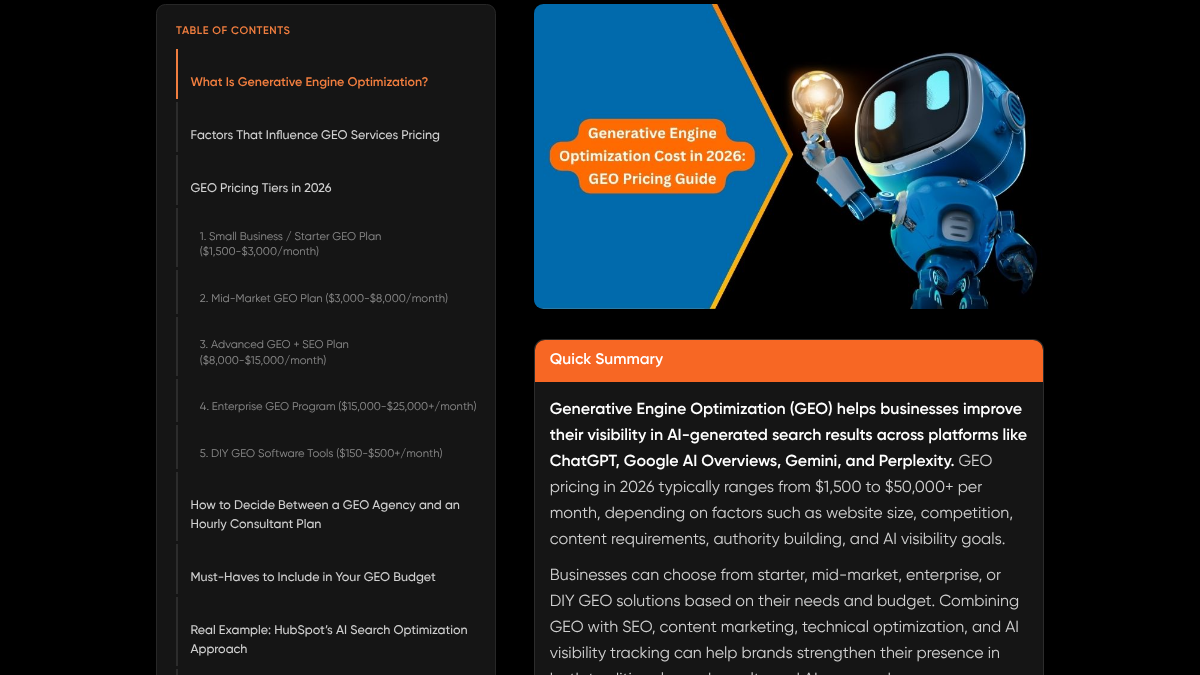
IceCube Digital's own summary puts it in one line: "GEO pricing in 2026 typically ranges from $1,500 to $50,000+ per month."

Built by the team that got cited in 48 hours.
Content generation, backlink building, AI visibility tracking, and Google rankings. One platform, zero guesswork.
What each tier buys
The agencies' guides describe what changes as you pay more. First Page Sage, for example, describes its $4,000 to $7,000 tier as "placement monitoring plus initial content creation," and its $8,000 to $12,000 tier as "comprehensive services including ongoing content, reputation management, and PR."
Across the five guides, the pattern is similar.
| Tier | What's usually included |
|---|---|
| Entry | Strategy, monitoring, a few placements |
| Mid-market | Monitoring plus some content |
| Advanced | Ongoing content, digital PR, reputation work |
| Enterprise | All of the above, custom scope |
What the guides rarely say is how much. How many articles a month? How many pitches? How many links? The tiers describe categories of work, not quantities.
Buyers notice. A post on r/seogrowth asked what a GEO agency actually does every month. The poster had looked at many agencies, found their service descriptions all sounded alike and wanted to know what they change or execute between the monthly reports.
What does a GEO agency actually do for you every month?
Genuine question because I'm trying to understand what people are actually paying for here. I've looked at quite a few GEO/AEO agencies, and the service descriptions tend to sound pretty similar: improve AI visibility, increase citations, b...
Agency owners in the replies described monthly checklists of prompt tracking, content rewrites, PR pitching and competitor analysis. That's real work. But the buyer's question shows how hard it is to know in advance what you'll get.
The contract terms nobody publishes
Here's what we found when we went looking for the other half of the deal. On October 19, 2026, we checked all five of those GEO pricing guides for contract length, minimum term and cancellation terms.
None of the five mentioned any of them. Each one published detailed price ranges by business size. Not one said whether the price was month to month or required a six- or twelve-month commitment, or what happens if you want to leave early.
We call this the retainer fog. You can see the monthly price, but not what the month produces or how to get out if it doesn't work. Agencies may well explain all of it on a sales call. The point is that you can't compare it before you get on one.
Before signing, ask directly:
- How long is the minimum term?
- What's the notice period to cancel?
- How many articles, pitches and links do we get each month?
- Who does the work, a senior strategist or a junior team?
- What do we own if we leave, including content and accounts?
See your first AI citation report in under 5 minutes.
No setup calls. No onboarding meetings. Connect your domain and see where AI mentions your brand right now.

What RankControl produces in the same month
RankControl replaces the retainer with a pipeline you can see. Here's what one month of the $400 plan covers.
| Work | What happens |
|---|---|
| Planning | Finds the questions your buyers search and plans titles around them |
| Writing | Up to 100 pages a month, each written against the pages already ranking for its keyword |
| Optimization | Each article scored for how easily AI engines can quote it, with a list of fixes |
| Publishing | Native posts on your site through WordPress, Webflow, Shopify, Ghost, Notion, Wix and others |
| Outreach | Link prospects found for each article, emails drafted from your own mailbox |
| Tracking | 50 buyer questions checked every week across ChatGPT, Perplexity, Claude, Gemini, Grok, Google AI Mode and Google AI Overviews, plus Google and Bing rankings |
Auto-publish is off by default, and nothing sends without your approval. A new citation sends you a notification.
An agency does offer one thing the core software doesn't: a senior person who knows your business and can make judgment calls, push back on a plan or handle a PR relationship. RankControl's answer is the Dedicated Strategist add-on, at $1,500 a month on top of the plan.
RankControl doesn't promise citations, and neither should an agency. The articles earn traffic from Google and AI search first. Citations tend to follow more slowly, mostly as other sites link to and mention you.
The tension buyers are weighing
Plenty of teams are working through this exact choice. A post on r/DigitalMarketing from someone whose company would normally sign another $10,000 to $15,000 a month agency retainer said that paying for junior strategists and an account manager now felt like the wrong move, given how much AI can do. They also said AI still lacks the brand intuition needed for the big judgment calls, and asked how to balance automation with senior talent.
Change my mind: marketing agencies are basically obsolete. Or at least the retainer model is…
At my company, we’ve reached the point where we’d normally sign another $10-15K per month agency retainer to scale content and handle channel research. But I’m seeing how quickly agentic AI can do a lot of this work, so paying massive agenc...
The top reply made the case for keeping senior expertise, pointing to a site whose traffic fell after it rebuilt its content with AI. That's fair. Badly used automation can do damage, and so can a badly run retainer.
Some teams have been burned by agencies too. Luke Whiting, who works on go-to-market at Convex, wrote on X that the company hired an expensive AEO agency that tried to talk them into pointing a "slop cannon" at the website. When they looked at the data, it wasn't working.
I joined Convex in February to figure out how to Get That Money. Since then we've sponsored newsletters, paid creators to make videos shilling us, poured thousands into Google and Reddit ads, and hired an expensive AEO agency that tried to convince us to hook a slop cannon to
 Luke Whiting@thelukewhitingAug 26, 2026
Red flags in any AI search proposal
Whether it's an agency or a tool, a few promises should make you careful.
Guaranteed rankings or citations. Google's guide to hiring an SEO, updated June 5, 2026, is plain about it: "No one can guarantee a #1 ranking on Google." The same goes for AI answers. Nobody controls what ChatGPT or Google's AI Mode says from week to week.
Special relationships. Google's guide also warns against SEOs who claim special access to Google. No agency has a back door into an AI engine either.
Volume with no quality bar. Publishing more pages helps only if each one answers a real question well. A plan to flood your site with thin pages can hurt you.
A score with nothing behind it. A single "AI visibility score" on a dashboard means little unless you can see which questions, which engines and which answers it comes from.
Google's guide also suggests questions worth asking anyone you hire. Can they show previous work? Do they follow Google Search Essentials? What results do they expect, in what timeframe, and how will they measure success? Will they share every change they make, with their reasoning? Those work just as well for judging software.
What you keep if you leave
This question gets asked least and matters most. When an agency engagement ends, what stays with you?
With an agency, the answer depends on the contract. Ask who owns the content, the reports, the tracking setup and any accounts created in your name, like a publishing login or a tracking tool. Some agencies hand everything over. Others keep the tools and the history, so you start again from zero.
With RankControl, the articles are native posts on your own site, published through your own CMS. If you cancel, they stay where they are, ranking and earning traffic, because they were yours from the day they went live. The outreach emails were sent from your own mailbox, so those conversations stay with you too.
That's worth weighing alongside the monthly price. The work you've paid for should keep working after the bill stops.
What it costs over a year
Monthly prices hide how far apart the two paths are. Here's a year at a few common levels.
| Option | Monthly | Over 12 months |
|---|---|---|
| Entry GEO retainer | About $2,000 | About $24,000 |
| Mid-market GEO retainer | About $5,000 | About $60,000 |
| Advanced retainer | About $10,000 | About $120,000 |
| RankControl, yearly | About $333 | $4,000 |
| RankControl plus Dedicated Strategist | $1,900 | About $22,800 |
Even with the strategist add-on, a year of RankControl costs less than a year of an entry retainer, and you know how many pages the month produces. For how to judge whether either is paying off, our guide to measuring SEO ROI covers the math.
How to compare them fairly
Whichever you choose, judge it on the same things.
- Output. What was published, pitched and earned this month, in numbers.
- Movement. Rankings, impressions and AI mentions for the questions that matter, tracked weekly.
- Traffic and leads. What came from search and AI referrals.
- Exit. What you keep if you stop.
If an agency can show you those every month, it's worth talking to. If it can only show a visibility score on a dashboard, be careful. Our post on how many sites never get an AI citation covers why any single score needs context.
RankControl vs an agency: which one?
For most teams that want AI search optimization done for them, the comparison comes down to what the month produces and what it costs to find out.
An agency retainer runs from about $1,500 to well past $10,000 a month, often with contract terms you only learn on a call and output that varies by tier. RankControl is $400 a month, plans and writes up to 100 pages, publishes them to your site, drafts the outreach and tracks the results every week, with no long contract and a 7-day trial. For teams that want the work done after tracking, RankControl is the pick.
You can also run all of this by hand, from the weekly checks to the outreach emails. Our comparison of doing it in a spreadsheet shows how many hours that takes.
Your competitors are building backlinks while you read this.
Organic outreach, social mentions, and citations from Editorial Circle member sites, with managed backlinks available as an add-on. Grow your domain authority without running the campaign yourself.