
Nightwatch's homepage makes a clear argument about AI search: "AI doesn't browse the web. It reads a search index." From there it argues that a position you lose is a citation you're about to lose. If you believe that, a rank tracker belongs at the center of your AI visibility work, and Nightwatch has built its newest features around exactly that idea.
The data has been moving the other way, though. Ahrefs first measured this in July 2025. Back then, 76% of pages cited in Google's AI Overviews ranked in the top 10 for the same query. Its follow-up study covered 863,000 keywords and 4 million cited URLs. In that one, the share was down to 38%.
Rankings still matter, but they explain less of who gets cited than they did a year ago, and that's the heart of the RankControl vs Nightwatch choice. Below you'll find the engines each one covers, who publishes the page, what it costs and a verdict. I checked Nightwatch's pricing page, product pages and help docs on September 26, 2026.
RankControl vs Nightwatch: the short answer
Nightwatch is a rank tracker first. It follows keyword positions daily across Google, Bing, YouTube and more. On top of that tracking it has added LLM Tracking for AI answers and a Content Studio that drafts articles, and there's an SEO agent too. You read the data, decide what to write, and publish it yourself.
RankControl is a pipeline instead. It plans titles from the questions your buyers ask, then writes the articles and publishes them as native posts on your site, drafts outreach for each one, and checks 50 queries every week across six AI engines. It costs a flat $400 a month.
So for AI search visibility, the deciding question is who ships the pages the engines cite. With Nightwatch, your team does. With RankControl, the pipeline publishes them and then checks whether they got cited.
Side by side
Here's how the two compare on paper:
| RankControl | Nightwatch | |
|---|---|---|
| What it is | Publishing pipeline with AI tracking | Rank tracker with AI tracking and drafting |
| Price | $400/mo or $4,000/yr | €79, €159 or €399/mo on the pricing page we saw |
| Free trial | 7 days | 14 days, no card |
| AI engines | 6, weekly: ChatGPT, Perplexity, Claude, Gemini, Grok, Google AI Mode | 6 on the pricing page, daily; no Grok |
| AI prompts | 50 queries | 50, 150 or 500 by plan |
| Keyword rank tracking | Google and Bing positions for pages it publishes | 500 to 7,500 keywords daily, 107,000+ locations |
| Articles | Written and published to your CMS, up to 100 pages a month | Content Studio drafts you copy or export |
| Backlink outreach | Drafted from your own mailbox; Managed Backlinks optional | None listed |
| Reddit and X | Social agent finds threads and drafts replies | None listed |
| MCP server | Included, 80+ tools | Included on every plan |
| Seats | 5 | Unlimited |

You're getting AI traffic. But do you know where it comes from?
RankControl credits every visit to the assistant that sent it: ChatGPT, Perplexity, Claude, Gemini, Copilot, or Grok. Full source attribution, next to your Google traffic.
What Nightwatch is in 2026
Nightwatch has been a rank tracker for more than a decade, and its site says 10,000+ SEO teams use it. Its daily position tracking covers Google, Bing and YouTube. Yahoo, DuckDuckGo and Google Maps are in there too, across 107,000+ locations. Every check stores the raw HTML of the results page, so a reported position links back to the page Google actually served, and every plan includes unlimited seats.
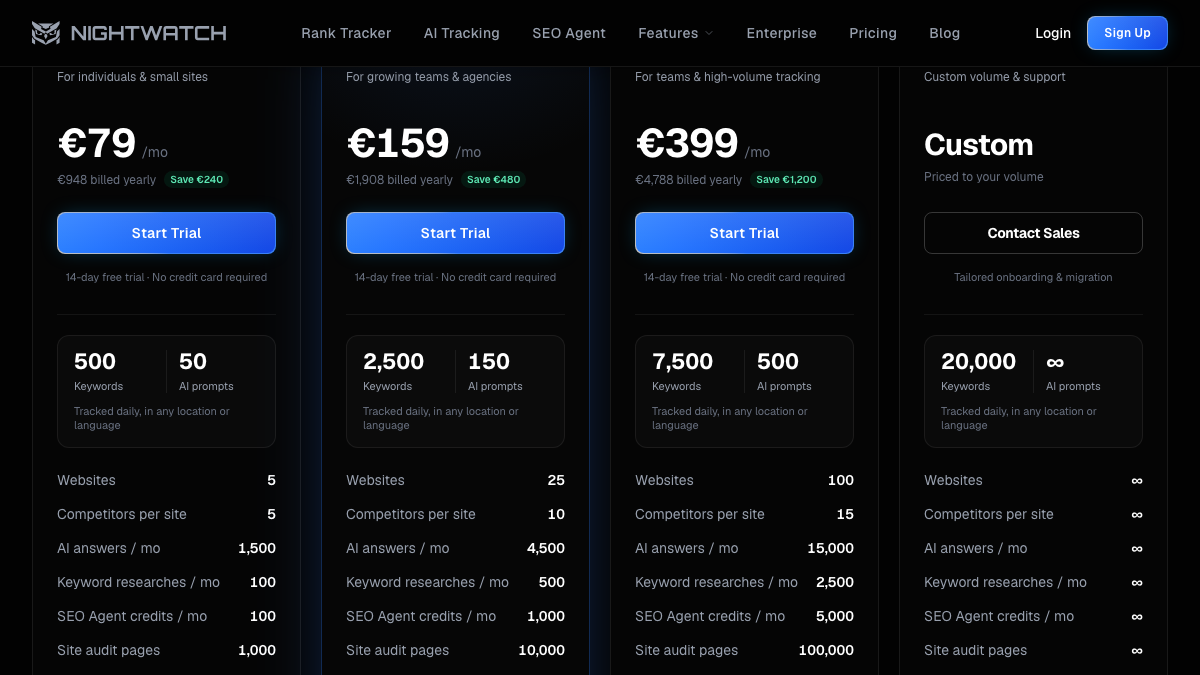
The newer tools sit on top of that. LLM Tracking runs your prompts through AI platforms every day and shows you mentions, positions, citations and sentiment, while Citation Intelligence links those AI mentions to the rankings behind them. Content Studio researches a keyword, writes a brief and then a draft, and scores the draft against the top results. NightOwl, the SEO agent, runs audits and research tasks on credits, and an MCP server lets Claude or Cursor read the data.
Nightwatch is the stronger rank tracker, and RankControl isn't trying to be one. RankControl tracks Google and Bing positions only for the pages it publishes, while Nightwatch tracks thousands of keywords across locations and devices and keeps a stored copy of every results page.
Does ranking still decide who gets cited?
Nightwatch says yes, and its Citation Intelligence feature is built on that link. The Ahrefs numbers say the link has loosened. Here's how the AI Overview citations in Ahrefs' newer study split by where the cited page ranked:
| Where the cited page ranked | Share of AI Overview citations |
|---|---|
| Top 10 | 38% |
| Positions 11 to 100 | A little over 30% |
| Beyond the top 100 | A similar share |
Practitioners are seeing the same split. In r/GrowthHacking this month, a marketer described pages that moved up in their AI Overviews report while classic rankings for the same URLs barely budged. One reply said their team had stopped treating AI Overview presence as a ranking proxy months ago.
our ai overviews visibility moved but rankings didnt.. how are you separating the two
pulled our ai overviews visibility report this morning and half the pages moved up. classic rankings for those same urls barely budged. clicks still flat. i keep two tabs open now and they refuse to agree. tried blaming a title rewrite from...
Both signals are worth your attention. RankControl tracks Google and Bing positions for every page it publishes and checks the AI answers separately, so you can see when a page gets cited without ranking, or ranks without getting cited.
Tracking AI answers: daily prompts against weekly checks
Nightwatch checks prompts daily. Each plan's monthly AI answer allowance is its prompt count times 30, which covers one check per prompt per day, so tracking the same prompts on several platforms spends it faster.
On engines, the pricing page lists ChatGPT, Claude, Gemini and Perplexity. Google's AI Mode and AI Overview are there too, but the help doc adds a catch: Gemini needs a plan with 300 or more prompts. Grok isn't on either list.
RankControl's AI visibility tracking checks 50 queries every week on all six of its engines (the table above lists them), and Grok and Claude are both among them. AI answers change from run to run, so a weekly check on a fixed question set shows you the trend without the daily noise. A new citation sends a notification, and a lost one shows up in the citation history for each engine.
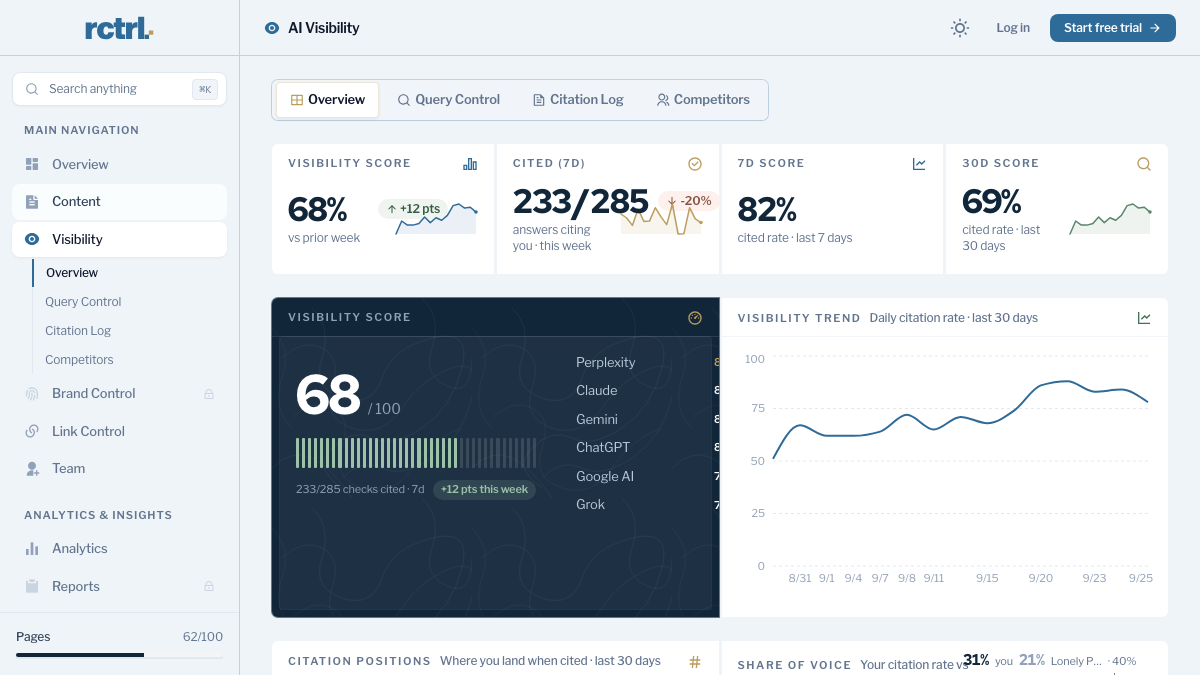
What you track matters more than how often. Nightwatch's Prompt Research suggests prompts from preset templates, while RankControl's Radar agent mines the questions buyers ask in your market and turns them into both the tracked query list and the title calendar. That way, the questions you track are the ones you publish pages for.
We'll show you exactly where your brand stands in AI search.
No commitment. $0 due today, cancel anytime. See how ChatGPT, Perplexity, Claude, Gemini, Grok, and Google AI Mode talk about your brand today.
Who publishes the page?
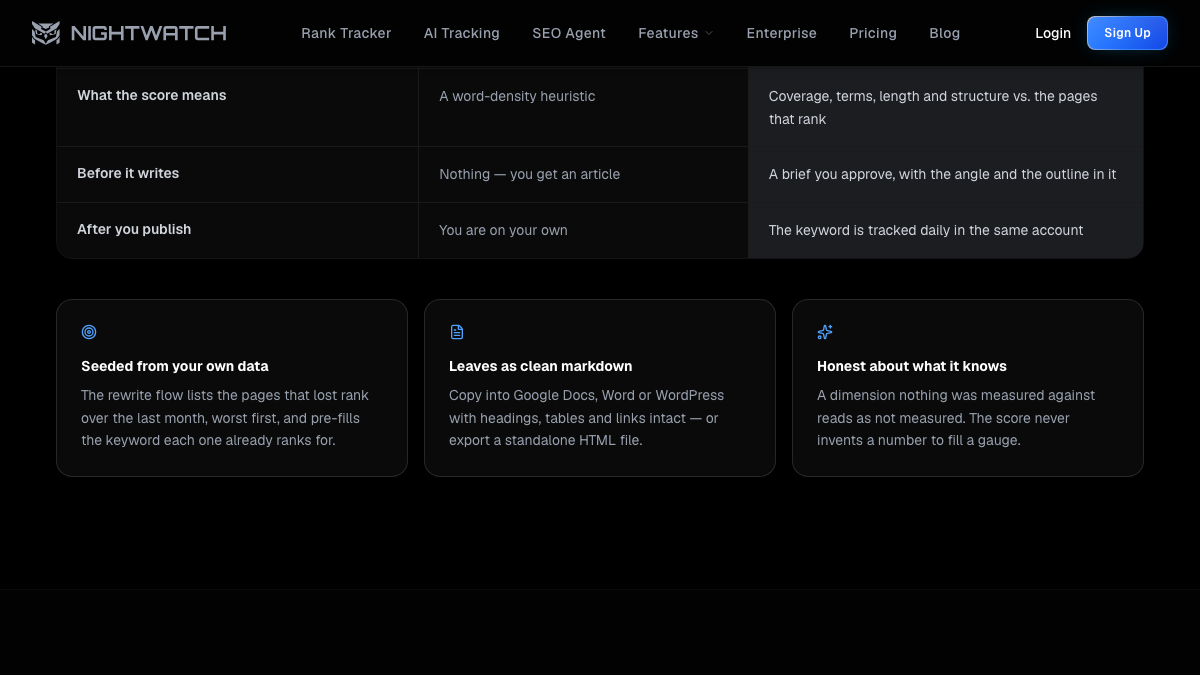
This is where the two differ most. Content Studio reads the pages ranking on page one, builds a brief for you to approve, writes the draft and scores it against those same results. Then the draft leaves Nightwatch as markdown, and you copy it into Google Docs, Word or WordPress, or export an HTML file. Publishing it is up to you.
RankControl's content engine plans the titles from the questions your buyers ask and writes each article against the pages already ranking. It scores every article for how easily AI engines can quote it, then publishes it as a native post through the CMS you connect, whether that's WordPress, Webflow, Shopify or a headless site. Auto-publish is off by default, so you approve each article until you trust the output.
The work after publishing is covered too. Link Control drafts outreach for each article from your own mailbox, and the Social agent finds Reddit and X threads where an article answers the question and drafts a reply. Nightwatch's plan lists no outreach or community tools.
A month of work, priced both ways
Say your team wants 20 articles a month, and you want to know whether ChatGPT and Perplexity start citing them.
| Job | With Nightwatch | With RankControl |
|---|---|---|
| Rank and AI tracking | Included, from €79/mo | Included |
| Drafting 20 articles | Content Studio | Included |
| Formatting, images and publishing | 20 to 40 hours of your team's time | Included, native posts |
| Backlink outreach | Separate tool or by hand | Drafted from your mailbox |
| Monthly total | €79 to €399 plus the publishing hours | $400 |
The hours are rough estimates, based on an hour or two per article to paste it in and format it, add images and links, and publish. Nightwatch is cheaper in cash at every tier. RankControl costs more and takes those hours off your team.
RankControl vs Nightwatch pricing
The pricing page we saw listed Nightwatch in euros, across three plans:
| Nightwatch plan | Price | Keywords | AI prompts | Also included |
|---|---|---|---|---|
| Starter | €79/mo | 500 | 50 | 1,500 AI answers |
| Professional | €159/mo | 2,500 | 150 | White-label reports and API access |
| Agency | €399/mo | 7,500 | 500 |
Annual billing takes off 20%, and every plan has a 14-day free trial with no card. Refunds are a different story, since Nightwatch's terms say it isn't obligated to provide them.
RankControl is one plan, at $400 a month or $4,000 a year. Its free trial runs 7 days. The plan covers 100 pages a month and 50 queries tracked weekly across six AI engines. Publishing to your CMS is included, and so are outreach drafting and the MCP server. Managed Backlinks at $350 a month and a Dedicated Strategist at $1,500 a month are optional add-ons.
Using each from Claude or Cursor
Both products ship an MCP server, and they use it for different jobs. Nightwatch's lets Claude, Cursor or ChatGPT query live rankings across Google, Bing and YouTube, run audits, and pull AI visibility data for AI Overviews, ChatGPT and Perplexity. It's a reporting layer on the data you already track.
RankControl's server has 80+ tools that act as well as read. From a chat, Claude can check your visibility score and recent citations, then propose article titles, approve them onto the calendar and publish an article. Anything with a visible side effect, like publishing, is a dry run until you confirm it. It's included in the plan, like Nightwatch's.
Getting started on each
Nightwatch starts with a 14-day trial and no card. You add your domain and load your keywords, then pick AI prompts, either by hand or from the Prompt Research templates. Rankings show up after the first daily check, and the dashboard fills in from there.
RankControl starts with a 7-day trial. You connect your CMS, let it build a brand profile from your site, name up to 10 competitors and choose the 50 questions to track. Titles then land on a calendar for your review, and the first weekly AI check shows where you stand before any article goes live.
What practitioners say
Recent threads split the two jobs the same way these products do. In r/SEO_Experts this month, a marketer asked for help making the case for AI tracking to a skeptical boss. One reply suggested tracking rankings and AI mentions separately, starting with 20 to 30 important queries checked once a week and tying the numbers to traffic or leads. Another said the way AI engines describe a brand tends to shift about once a week, so daily checks add little.
Nightwatch's own site cites a 4.8 rating on G2. It also says more than 10,000 SEO teams use it. The open question for you as a buyer is whether a tracker plus a drafting tool is enough, or whether your team needs the pages published and the outreach drafted as well.
Which wins AI search visibility?
For AI search visibility, RankControl wins for teams that want the work done. It writes and publishes the articles, drafts outreach and Reddit replies, and checks six engines every week, Grok and Claude included, all for one flat price.
If you're already on Nightwatch and moving over, our guide to switching from Nightwatch without losing data covers the CSV exports and how to capture your AI prompt data.
You can keep tracking rankings and prompts and publishing the drafts yourself. Or RankControl's agents can run the month for you while your team approves the pages.
Know exactly what AI says about your competitors.
RankControl's Recon Agent monitors competitor citations across ChatGPT, Perplexity, Claude, Gemini, Grok, and Google AI Mode. See where they show up and you don't.