
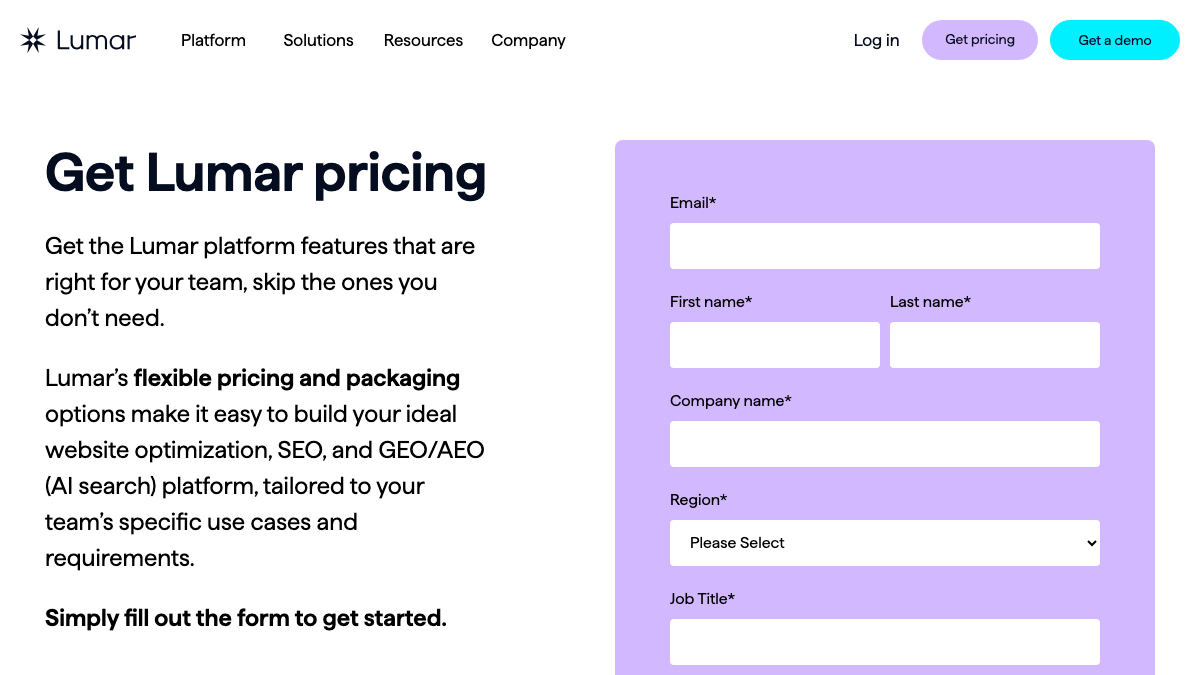
Lumar's pricing page has no prices on it. It has a form that asks for your job title and a phone number, next to a promise that you'll get "the Lumar platform features that are right for your team" and can "skip the ones you don't need." That page tells you who Lumar is built for: enterprise teams buying a platform module by module, through a sales call.
RankControl sells one plan at $400 a month and spends most of it on publishing: articles written and posted to your site, with the AI answers tracked every week afterwards. This comparison covers what each product does for AI search, what each costs, who writes the page, and how each works from Claude. Lumar's site, FAQ and API docs were checked on September 26, 2026.
RankControl vs Lumar: the short answer
Lumar is a diagnostics platform. It crawls your site and tracks your brand in six AI platforms, and its findings reach your team as reports and tickets.
RankControl is a publishing pipeline. It plans articles from the questions your buyers ask, then writes and publishes them on your site. After that it drafts the backlink outreach and checks every week whether AI engines start citing you. For AI search visibility the deciding question is who produces the pages that get cited, and with RankControl that's the product rather than a queue of tasks for your team.
Side by side
| RankControl | Lumar | |
|---|---|---|
| What it is | Publishing pipeline with AI tracking | Enterprise crawl, site health and GEO platform |
| Price | $400/mo or $4,000/yr, published | Custom proposal through a form |
| Getting started | 7-day trial | Demo, then a tailored proposal |
| AI engines | 6, weekly: ChatGPT, Perplexity, Claude, Gemini, Grok, Google AI Mode | 6, at a cadence you choose: ChatGPT, Gemini, Perplexity, Google AI Overviews, Google AI Mode, Claude |
| AI history | Citation history per engine from your first check | Up to two years of stored AI Visibility data |
| Content | Articles written and published to your CMS, up to 100 pages a month | GEO Content Evaluator scores pages and suggests fixes |
| Technical checks | AI crawler log, AI crawler access check, health score per published page | Hundreds of crawl reports, custom extraction, speed and accessibility testing |
| Backlink outreach | Drafted from your own mailbox; Managed Backlinks optional | None listed |
| MCP server | Included, 80+ tools | MCP Server subscription add-on |
How often does ChatGPT mention your brand?
Most founders have no idea. The answer might surprise you.

What Lumar is in 2026
Lumar is the platform that was called Deepcrawl until its rebrand, and its FAQ notes the crawler still identifies itself with "deepcrawl" or "lumar" in the user agent. It's sold in modules. According to the same FAQ, each account gets a set number of active projects and a set number of URLs it can crawl per billing period, both agreed in the proposal.
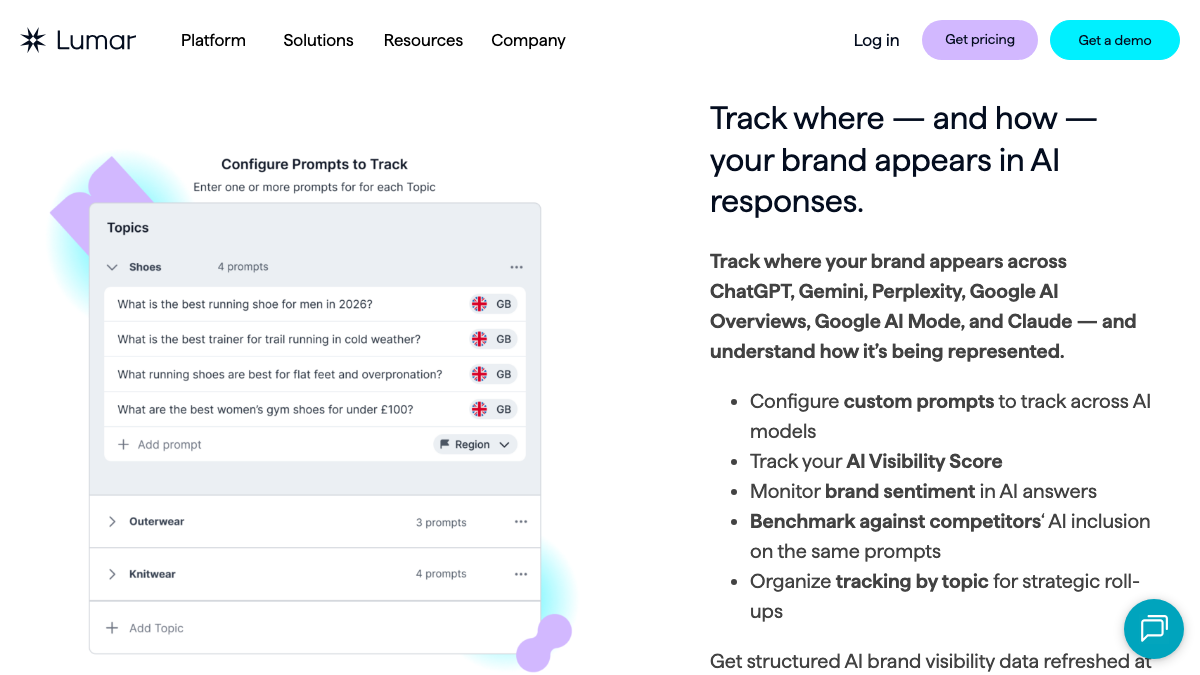
Over the past year Lumar has added a GEO toolkit on top of the crawler. Its GEO reports check whether AI bots can reach and render your pages. The GEO Content Evaluator scores pages with what Lumar calls "the same LLM-as-a-Judge frameworks used in AI research," and it maps your real Search Console queries to the prompts people type into AI tools. AI Visibility tracks prompts grouped into topics, with sentiment and competitor share of voice, plus the exact URLs cited at each position and how often.
Lumar also does a job RankControl doesn't touch. It crawls sites with millions of URLs and tests accessibility against WCAG 2.2 and Core Web Vitals at that scale, and RankControl has no crawler built for an audit of that size.
What each one costs
RankControl's price sits on its homepage: $400 a month, or $4,000 a year, with a 7-day trial. Lumar's FAQ answers the pricing question in one sentence, "We price our solutions based on your individual needs," and the pricing page leads to a form rather than a table. The MCP server costs extra on top of whatever the proposal covers.
Third-party estimates fill some of the gap. Vendr's buyer guide puts a 200-person company at $14,500 to just under $29,000 a year, and a 1,000-person company at roughly $26,000 to $52,000.
The same Vendr page lists a median contract of $58,175, which looks precise until you notice it rests on one tracked purchase. Treat it as a single data point. The ranges above are the better guide, and even the low end of them buys about three years of RankControl.
Diagnosis stops at the ticket
Every tool in Lumar's GEO toolkit ends in the same place, a recommendation. The content evaluator gives "a prioritized list of GEO content optimization suggestions." The AI dev ticket writer turns crawl issues into tasks, and the MCP server can file them straight into Jira. Each of those outputs then waits in someone's queue for an engineer or a writer.
Call it the ticket gap: the weeks between a tool naming a problem and a person shipping the fix. On a large site that gap is mostly engineering time. In AI search it's mostly writing time, because the usual fix for a prompt where a competitor gets cited is a page that answers the question better than the one being cited.
A marketer in r/growthmarketing put the frustration plainly last month. They wrote that they'd rather receive a shorter audit that explains impact and order than a huge export where every issue sits at the same level, and the top reply called exports without context noise.
What makes an SEO audit useful after the crawl is finished?
For me, it is the judgment around the findings. A technically valid warning can still be low priority, while one issue affecting a small set of important pages may deserve immediate attention. I would rather receive a shorter audit that exp...
Lumar does order its issues. Its FAQ explains that each report carries a weight, and the issue list is sorted by the number of affected items multiplied by that weight. That settles which task comes first, while the task itself still lands on your team.
Who writes the page?
This is where the two products split. RankControl's content engine picks titles from the questions your buyers ask and writes each article against the pages already ranking for its keyword. It scores every article it writes for how easily AI engines can quote it, with a fix list, and then publishes it through the CMS you connect as a native post on your own domain. WordPress, Webflow and Shopify are among the options, up to 100 pages a month are included, and auto-publish stays off until you turn it on.

Lumar's evaluator can score those pages once they exist. Its product pages describe scoring and suggestions, and nothing on them mentions writing articles or publishing to a CMS.
Links follow the same pattern. Mentions on other sites matter to AI answers too, and RankControl's Link Control finds prospects for each article it publishes and drafts the outreach from your own mailbox. If you'd rather not send it yourself, the Managed Backlinks add-on places five links a month from DR 25+ sites for $350. We found no outreach feature on Lumar's pages.
15 hours a week manually. Or 15 minutes with RankControl.
Track citations, monitor competitors, and fix content gaps across every AI search engine. Automatically.

Tracking AI answers on both
Both products track six AI platforms. Lumar has Google AI Overviews where RankControl has Grok, and the other five match. Lumar lets you pick the refresh cadence and stores up to two years of history. RankControl's AI visibility tracking checks 50 of your buyer questions every week and keeps the citation history for each engine, with share of voice against up to 10 competitors.
What matters more is what happens after a check. A founder in r/aiToolForBusiness described the problem both tools exist to solve this month. Their company shows up in ChatGPT and Perplexity sometimes, but not for the queries that matter to the business, and they asked whether on-site content or third-party citations moves the needle more. The most useful replies were practical: run the commercial questions through each engine, note which sources get cited, and build content that answers them.
Struggling to get AI search visibility, need real world advice
Struggling to get visibility for my company in AI search results (ChatGPT, Perplexity, Google AI Overviews). We show up sometimes, but not consistently, and not for the queries that actually matter to our business. My theory: on site conten...
Lumar runs the first two steps of that loop. RankControl runs all three, because each tracked question can become an article it plans, writes and publishes, and the next weekly check shows whether the new page got cited.
On the technical side of AI search, RankControl logs AI crawler visits in analytics and checks daily whether AI crawlers can reach your site at all. That covers the access question for most sites without a full crawl.
Working from Claude or ChatGPT
Both products now have an MCP server, so you can ask questions of your data from Claude, ChatGPT or Cursor. Lumar launched its server on July 23, 2026, and SEO consultants noticed quickly. One posted the same day that Lumar users could now connect their enterprise crawls to Claude and ChatGPT.
Awesome, @lumarhq (formerly DeepCrawl) just added an MCP connector. If you are using Lumar for enterprise crawls, you can now connect to those crawls via Claude, ChatGPT, etc. https://t.co/rTfPhkyldN https://t.co/QpkwUEXfkU
 Glenn Gabe@glenngabeJul 23, 2026
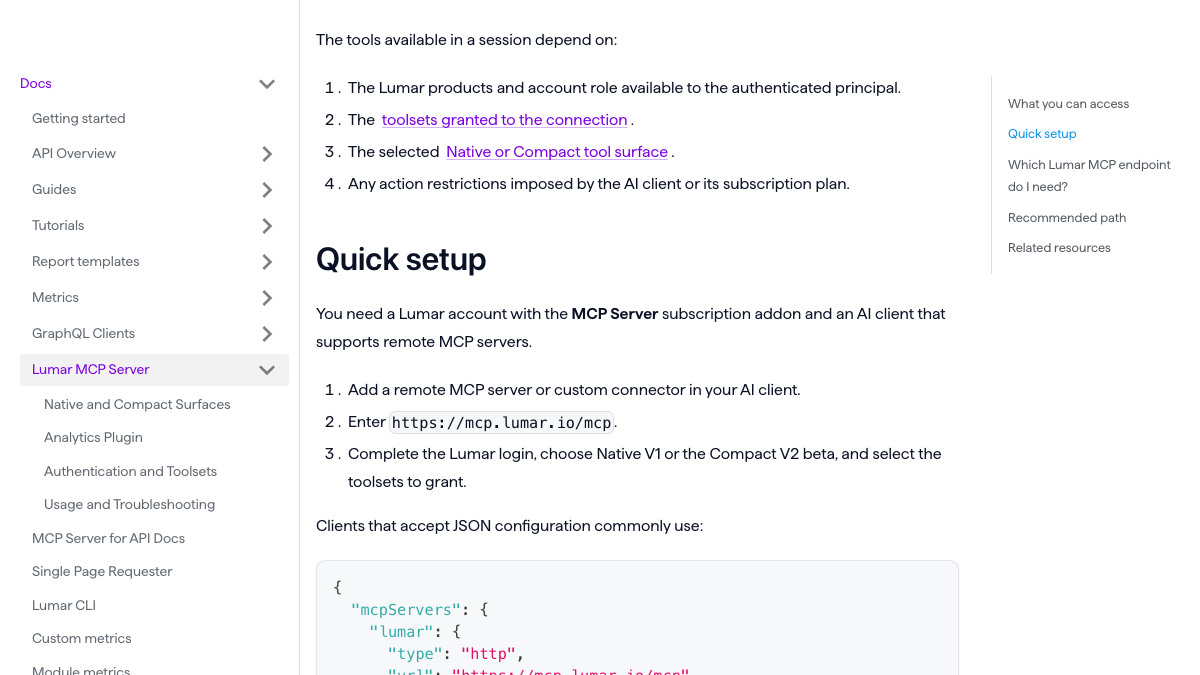
Lumar's server covers Analyze and AI Visibility, and some of its tools make changes, such as triggering crawls and creating tasks. Its launch post also warns that your crawl data passes through whichever AI assistant you connect. The API docs add a condition before any of that works:
RankControl's MCP server comes with the plan and has 80+ tools. From Claude or Cursor it can check your visibility, plan titles, write articles and publish them, and publishing stays a dry run until you confirm it.
Reporting AI search to leadership
Lumar's AI Visibility Score is a single weighted number that combines how often your brand gets mentioned with the quality of the citations, and Lumar pitches it as "reliable enough for leadership reporting." Its MCP launch post goes a step further and suggests asking Claude to blend crawl health with AI Visibility scores into a one-page update for the CMO.
RankControl reports on outcomes. A CMO asking what changed this month usually wants to see which pages earned citations rather than a score movement, and the Reports screen puts citations, rankings and Search Console data side by side. A weekly email lists the new citations and ranking gains from the past seven days.
A month of AI search work, priced both ways
Put the same month of AI search work through both products and the hours land in different places.
| Job | With Lumar | With RankControl |
|---|---|---|
| Tracking AI answers | Part of a custom contract | 50 questions weekly on six engines, included |
| Scoring content for AI | GEO Content Evaluator | A citability score and fix list on every article it writes |
| Writing 20 articles | Your team, 40 to 60 hours | Included |
| Publishing to your CMS | Your team | Included, as native posts |
| Backlink outreach | Your team or another tool | Drafted from your mailbox |
| MCP access | Paid add-on | Included |
| Yearly cost | Custom; Vendr's range starts near $14,500 | $4,000 to $4,800 |
The hour figures are rough estimates. Researching, writing, linking and publishing a solid article takes two to three hours even with good tools, and checking 50 questions by hand on six engines takes about five hours a week. A contract that tracks and diagnoses leaves both of those jobs with your staff.
If you already run Lumar
Some teams will keep Lumar for technical work and move their AI search program elsewhere, and others will leave entirely. Either way, Lumar's FAQ says your data stays available until the account expires, so plan exports before the end of the term.
Our guide to switching from Lumar covers pulling crawl reports through the API, capturing your AI Visibility prompts and cited URLs, and timing the non-renewal notice. Your Lumar prompt list is also the best starting point for choosing RankControl's 50 weekly questions.
Which wins AI search visibility?
For AI search visibility the deciding question is who produces the pages that get cited. Lumar measures and diagnoses in detail, and every finding still needs a writer and someone with CMS access before anything changes in an AI answer.
RankControl does that production every month. Buyer questions become titles, titles become published articles, and the weekly checks show whether the six engines start citing you. For marketing teams that want AI citations without adding headcount, RankControl wins, at $400 a month with a 7-day trial and no sales call.
You can run the loop yourself, with Lumar's reports as the map and your team writing the pages. Or RankControl's agents can run it every month while your team approves what goes live.
AI search traffic grew 835% this year. Is your content ready?
RankControl generates 26 content formats optimized for ChatGPT, Claude, and Perplexity. Published on your domain, matched to your brand.