
Every AI citation study is about the winners. Which domains get cited most, how much Reddit takes, how often Wikipedia shows up. The question most site owners actually have is the opposite one. How many websites never get cited at all, and is mine one of them?
Here's the honest answer first. No public study measures it. Nobody has counted every website on the internet and checked which ones AI engines have ever cited. Every study we found measures against something smaller: the pages an engine retrieved, the domains that were already cited once or a list of top domains.
But those studies, put together, tell a fairly clear story. This post goes through the closest data we could find, what each source measured and where they disagree. Then it covers what predicts whether a site gets cited at all, and how to check where you stand.
The short answer, by source
| Source | Date | What it measured | Finding |
|---|---|---|---|
| Semrush clickstream | April 2026 | How often ChatGPT searches the web | 34.5% of queries, down from 46% in late 2024 |
| Ahrefs | April 2026 | 1.4 million ChatGPT prompts | About 33 URLs retrieved per prompt, 49.98% cited |
| AirOps, via Alm Corp | March 2026 | 548,534 retrieved pages | 15% cited, 85% dropped |
| 5W citation index | 2026 | 680 million citations | Top 15 domains took about 68% of consolidated share |
| Profound | 2026 | About 730,000 ChatGPT conversations | Top 10 domains took 12% of citations |
| Somantra, audited by Digital Applied | August 2026 | Cited domains in one industry | 57.2% not cited again in the window |
Each of these counts something different, which is why they don't line up neatly. The rest of this post explains what each one means for the "never cited" question.
Most AI answers don't cite anyone
Start with the biggest filter. An AI engine can only cite a website when it searches the web. Often, it doesn't.
Semrush analyzed more than a billion lines of US clickstream data from its panel, from October 2024 to February 2026. It found that "ChatGPT enables its search feature on just 34.5% of queries as of February 2026," down from 46% in late 2024.
Flip that around. On roughly two of every three ChatGPT queries, the model answers from what it already knows, without looking anything up. On those queries, no website gets cited, however good it is.
That doesn't mean AI traffic is shrinking. The same study found outbound referral traffic from ChatGPT to the rest of the web grew 206% in 2025. ChatGPT is used so much more that a smaller share of searching still sends more visits overall. But it does mean the chances of any single query citing any single site are low before anything else happens.
200+ SaaS teams already track their AI citations.
They know exactly when ChatGPT mentions their brand, and when it stops. Do you?

Being found isn't being cited
When ChatGPT does search, it pulls a set of pages, reads them and cites some of them. The rest are dropped.
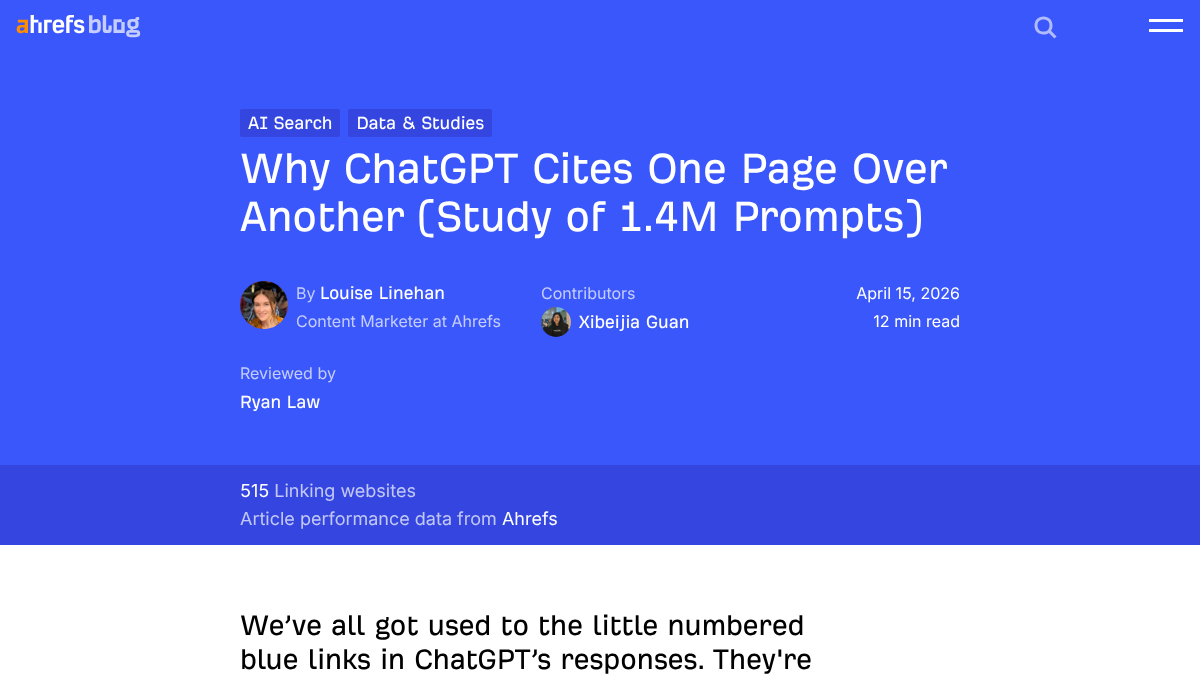
Ahrefs studied 1.4 million ChatGPT prompts, in a study by Louise Linehan published April 15, 2026. It found that "on average, ChatGPT pulls ~16.57 cited URLs and ~16.58 non-cited URLs per prompt." That's about 33 pages retrieved, and an almost even split: 49.98% cited and 50.02% not.
The pages that got dropped weren't random. Reddit made up 67.8% of the non-cited URLs. ChatGPT retrieved Reddit constantly, and cited it just 1.93% of the time it did.
An AirOps study, reported by Alm Corp in March 2026, found a much lower citation rate. Across 548,534 pages retrieved for 15,000 prompts, "only 15% of retrieved pages were ultimately cited." In its words, "85% were found, evaluated, and discarded." We couldn't find AirOps' own write-up of the study, but two separate sources reported the same figure.
We call this the retrieval gap: being found by an AI engine and being cited by it are two different events, and most of the drop-off happens between them.
Why the two studies disagree
Fifty percent and fifteen percent are far apart. The difference is mostly in what each study counted as "retrieved."
| Ahrefs | AirOps | |
|---|---|---|
| Sample | 1.4 million prompts | 15,000 prompts |
| What counted as retrieved | URLs ChatGPT pulled for the answer | Every page returned across fan-out searches |
| Fan-out | Not the focus | 89.6% of prompts triggered 2 or more searches |
| Citation rate | 49.98% | 15% |
AirOps counted every page ChatGPT saw across all the extra searches it ran behind the scenes, 43,233 searches in total. That's a much bigger pool, so a smaller share of it gets cited. Ahrefs measured a narrower set closer to the final answer. Both are probably right about what they measured.
For a site owner, the lesson is the same either way. Being retrieved is only the first step. Somewhere between half and most of what an engine looks at never shows up in the answer.
How concentrated citations are
Next question: of the citations that do happen, how many sites share them?
Here the studies disagree even more. The 5W AI Platform Citation Source Index, built from 680 million citations across ChatGPT, AI Overviews, Perplexity, Gemini and Claude, found the top 15 domains took about 68% of consolidated citation share. Profound, which sells AI visibility tracking, studied about 730,000 ChatGPT conversations and found the top ten domains took just 12% of all citations.
| Source | Top domains | Share of citations |
|---|---|---|
| 5W index | Top 15 | About 68% of consolidated share |
| Profound | Top 10 | 12% |
Those can't both describe the same thing. The likely explanation is what each one counted. A "consolidated share" across a set of tracked categories can concentrate heavily on big platforms like Reddit, Wikipedia and YouTube. A count across hundreds of thousands of ordinary conversations, on every kind of topic, spreads citations across a long tail. 5W is a PR agency, and Profound sells tracking, so each has its own reasons to frame the numbers the way it does.
What both suggest is that citations follow a long-tail pattern. A small group of huge domains takes a big share, and everyone else splits the rest. The question is how long the tail is. Our breakdown of AI citation data by engine covers who wins on each platform, and our roundup of AI search statistics has the wider numbers.
How often does ChatGPT mention your brand?
Most founders have no idea. The answer might surprise you.

Cited once, then gone
There's one more way a site ends up with no citations: it had some and lost them.
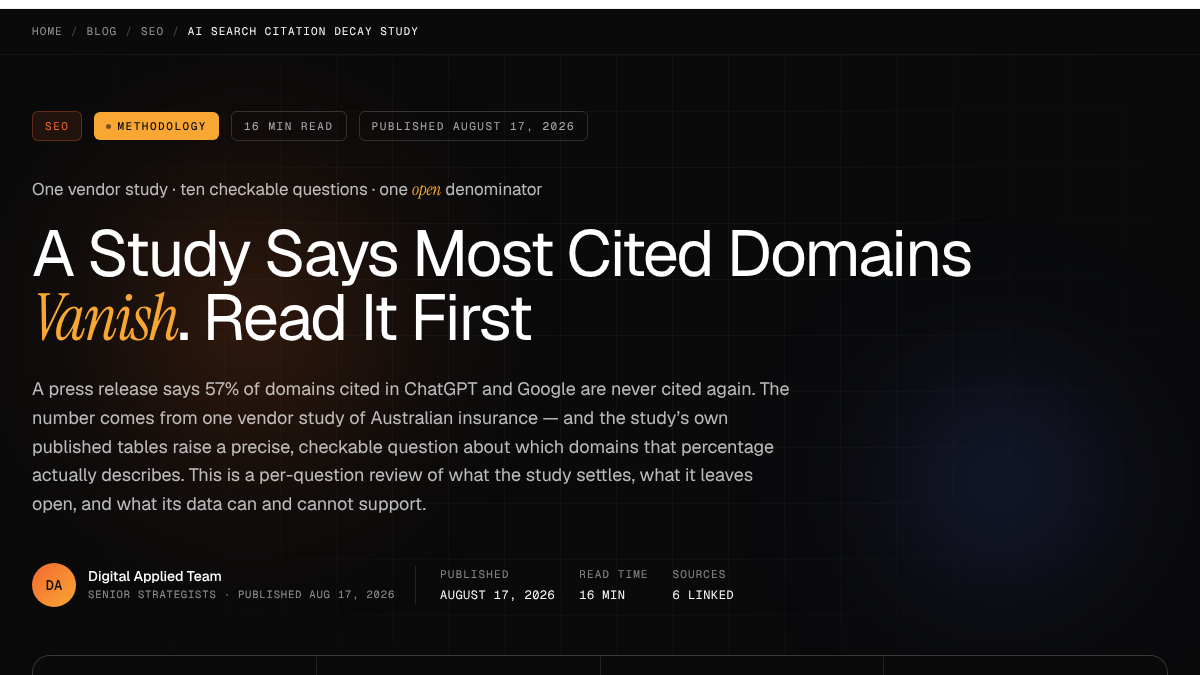
A study by Somantra AI, which sells AI visibility tracking, looked at Australian insurance sites from November 2025 to July 2026. The headline that traveled was "57% of domains cited in ChatGPT and Google are never cited again." The precise figure was 57.2%, across 2,437,107 citation records.
Digital Applied audited the study in August 2026 and raised real problems. It noted that "the survival table sums to only 10,446 domains, not the 28,725 claimed in headlines," so "it is an open question which denominator the 57.2% describes." The study also skipped two months, April and June. And it measured domains not seen again within a gapped seven-month window, not domains gone for good.
So treat 57.2% as a sign that citations churn, not a precise rate. It's also a churn number, not a "never cited" number. Every domain in it was cited at least once.
Why nobody publishes the real number
It's worth saying why the headline number doesn't exist. To measure the share of websites that never get an AI citation, you'd need three things nobody has.
- A list of every website. Estimates of how many sites exist vary wildly, and most are inactive.
- Every question people ask. AI companies don't publish their prompt logs, so trackers only see the prompts they choose to run.
- Every answer, over time. Answers change from run to run and week to week, so a site cited once might not show up the next day.
Every study above solves a smaller version of the problem. Ahrefs and AirOps measure what happens to pages after retrieval. 5W and Profound measure who shares the citations that happened. Somantra measures churn among sites already cited. None of them can see the sites that were never in the pool at all, which is where most of the web probably sits. Our post on whether you can trust AI volume data covers the same blind spot from the demand side.
A rough funnel
Put the studies together and you get a rough picture of what has to go right for one site to be cited for one question in ChatGPT.
| Step | What has to happen | What the data suggests |
|---|---|---|
| 1 | ChatGPT decides to search the web | About a third of queries, per Semrush |
| 2 | Your page is among the pages it retrieves | About 33 pages per prompt, per Ahrefs, out of the whole web |
| 3 | Your page is cited rather than dropped | Half or fewer of retrieved pages, per Ahrefs and AirOps |
| 4 | It keeps getting cited | Not guaranteed, per the Somantra churn data |
Each step is a filter, and the filters multiply. That's why so many sites see nothing. It isn't that AI engines dislike them. It's that the funnel is narrow, and step two is where most sites fall out.
Google's AI Overviews work a little differently but face the same narrowing. Google says a page must be "indexed and eligible to be shown in Google Search with a snippet" to appear as a supporting link, and each overview links to only a handful of sources. Our post on what changed from SGE to AI Overviews covers how they're chosen.
What one search looks like
To make this concrete, we looked at one everyday search on October 19, 2026: "how to remove wine stains from carpet," in Google's US results.
| Domains | |
|---|---|
| Cited in the AI Overview | bissell.com, homedepot.com, jaipurrugs.com, reddit.com, runrug.com, youtube.com |
| On page one of the organic results | sharkninja.co.nz, carpetbright.uk.com, justanswer.com, youtube.com, gopuff.com, reddit.com |
| In both | youtube.com, reddit.com |
Only 2 of the 6 domains overlapped. Four sites ranked on page one and got no citation in the AI Overview. Four sites were cited without appearing in those organic results.
That's one search, so it proves nothing on its own. But it shows how the retrieval gap plays out in practice. Ranking on page one didn't guarantee a citation, and being cited didn't require ranking on the visible page.
What the people doing this notice
Practitioners see the same patterns. A post on r/ArtificialInteligence asked why AI cites Reddit constantly but barely touches polished brand sites. The poster guessed AI prefers messy, opinionated comparison threads over pages that only say why a company is the best.
why does AI cite Reddit constantly but barely touch polished brand sites?
been digging into what AI actually cites (ChatGPT, Perplexity, AI Overviews) and Reddit keeps topping the list, often above wikipedia and youtube. meanwhile corporate blogs and brand sites barely show up. kind of makes sense when you think...
That fits the retrieval data in one way and not another. Reddit is retrieved constantly, but in the Ahrefs data it's cited at a very low rate. So it's everywhere in the pool and much rarer in the final answer.
Another post, on r/WebsiteSEO, made a related point. The poster found their top-ranking Google pages often weren't the ones AI tools cited, while lower-ranked pages sometimes were. Their read was that clarity, structure and outside credibility mattered more than rank alone.
Ranking #1 doesn't guarantee you show up in AI answers
Lately I’ve been paying attention to how content shows up in AI driven search, and the pattern isn't what I expected. High ranking pages are not usually the ones getting mentioned by AI tools. Some of the top results barely get referenced,...
What predicts being cited at all
If the never-cited bucket is large, what keeps a site out of it? The studies point to a few factors.
Ranking, still. In Kurt Fischman's preprint on schema and AI citation, Google rank was the strongest predictor. "Position-1 pages were cited in 43% of queries in which they appeared, declining to 5% at position 7." Ranking doesn't guarantee a citation, as the wine-stain search shows, but it's the biggest single lever in that data.
Descriptive URLs. CXL, drawing on the same Ahrefs dataset, reported a citation rate of 89.78% for pages with natural-language URL slugs, against 81.11% for non-descriptive ones.
Standard, indexed content. According to CXL, "88.46% of ChatGPT citations come from standard indexed content." Forums and social posts get retrieved heavily but credited far less often.
A clear answer. AI answers lift passages that answer the question. Our analysis of where AI engines pull citations from covers why the top of the page matters most.
What doesn't seem to help much on its own is markup. Our analysis of schema and AI citations found the controlled studies show little effect.
How to tell if you're in the zero bucket
You can't look yourself up in a global database, but you can check in an afternoon.
- Write down 20 questions your buyers ask, in their words.
- Ask each one in ChatGPT, Perplexity, Gemini and Google's AI Mode.
- Note two things for each answer. Were you named? Was your page linked?
- Check GA4 for visits from chatgpt.com, perplexity.ai and gemini.google.com.
- Repeat in a week. AI answers change from run to run, so one check is a sample.
If you're never named or linked, and GA4 shows no AI visits, you're probably in the never-cited bucket for now. That's common, not a verdict. Our comparison of tracking this in a spreadsheet versus a tool covers how much time the weekly check takes.
Getting out of the zero bucket
The data points to the same path for small and new sites. Rank for specific questions your buyers ask. Answer each one clearly near the top of the page. Earn links and mentions from other sites, so engines have reasons to trust you. Then keep checking, because citations come and go.
None of that is quick. Citations tend to follow traffic and links, not lead them.
Doing it yourself or handing it off
You can run the 20-question check by hand every week, and it will tell you where you stand. It takes a few hours, and the hard part is the work that follows it.
RankControl does both halves. Our AI visibility tracking checks up to 50 buyer questions every week across seven AI engines and sends a notification when a new citation appears, so you'll know the week you leave the zero bucket. We also write and publish articles that answer those questions, and find link prospects for each one. Expect traffic from Google first, with AI citations following more slowly as links and mentions build up.
15 hours a week manually. Or 15 minutes with RankControl.
Track citations, monitor competitors, and fix content gaps across every AI search engine. Automatically.