
AI prompt volume data is everywhere now. Tools show you how many people ask ChatGPT about your category each month. Studies claim AI already handles half of all search. Sales decks put a number on every prompt.
Almost none of those numbers come from the AI companies. OpenAI hasn't published volume for any topic, keyword or prompt. What it has shared are totals. Everything below the total level is an estimate built by someone else, with their own sample, their own model and usually their own product to sell.
That doesn't make the numbers useless. It makes them something to read carefully. This post separates what's been disclosed from what's been estimated, shows where two well-known studies disagree by 53 percentage points, and lays out what the vendors themselves say about their data. It ends with a checklist for reading any AI volume claim.
The short answer, by type of number
Not all AI volume numbers are the same kind of number. Here's how the main ones sort.
| Type | Example | Who it comes from | How much to trust it |
|---|---|---|---|
| Official total | 2.5 billion ChatGPT prompts a day | OpenAI, July 2025 | High, but only as a total |
| Official users | 800 million weekly ChatGPT users | Sam Altman, October 2025 | High, but only as a total |
| Third-party share estimate | AI at 56% of global search | Graphite.io, using Similarweb data | Depends on the definitions |
| Third-party share estimate | ChatGPT at 3% of desktop search | Rand Fishkin, using Datos data | Depends on the definitions |
| Vendor prompt database | 317 million prompts | Semrush's documentation | A database size, not demand |
| Per-prompt volume | "This prompt gets 4,000 asks a month" | Tool estimates | Directional at best |
The further down the table you go, the more the number depends on choices you can't see.
What OpenAI has actually disclosed
Start with what's solid. OpenAI has made a few on-the-record statements about how much ChatGPT is used.
In July 2025, TechCrunch reported that "ChatGPT receives 2.5 billion prompts from global users every day, OpenAI told Axios." About 330 million of those came from US users.
At OpenAI's Dev Day on October 6, 2025, Sam Altman said: "More than 800 million people use ChatGPT every week, and we process over 6 billion tokens per minute on the API."
Weekly users have grown fast, based on figures OpenAI shared with various outlets.
| Date | Weekly ChatGPT users | Reported by |
|---|---|---|
| August 2024 | 200 million | Axios |
| February 2025 | 400 million | Reuters |
| October 2025 | 800 million | Sam Altman at Dev Day |
| February 2026 | Over 900 million | Seeking Alpha |
These are real numbers, and they tell you the scale. What they don't tell you is how many of those prompts are about your category, your competitors or your product. OpenAI hasn't published anything at that level.
One more OpenAI figure matters for volume estimates. An OpenAI study of about a million de-identified messages, covering May 2024 to June 2025, classed 51.6% of ChatGPT prompts as "Asking," the kind of prompt closest to a search. Graphite's study, below, uses that share to separate search-like use from everything else people do in ChatGPT, like writing and coding.
AI search traffic grew 835% this year. Is your content ready?
RankControl generates 26 content formats optimized for ChatGPT, Claude, and Perplexity. Published on your domain, matched to your brand.

The estimates: 56% or 3%?
Here's where it gets interesting. Two of the most-discussed estimates of AI's share of search came out within days of each other in March 2026, and they're 53 points apart.
Graphite.io's estimate. In a study published March 5, 2026, Graphite.io's CEO Ethan Smith reported that AI tools generate "45 billion monthly sessions worldwide," which Search Engine Land summarized as "about 56% of search engine volume." In the US, the figure was 34%. Narrowing to search-like "Asking" prompts brought it down to 28% worldwide and 17% in the US.
The study used Similarweb data, combining web visits and mobile app sessions for the top five AI apps, compared with the top six search engines. Graphite checked the data against Google Search Console clicks on 8 websites and reported a median correlation of 0.86.
Rand Fishkin's rebuttal. SparkToro's co-founder disputed the methodology publicly. According to Search Engine Land, Fishkin posted a rebuttal with Datos data under the headline "Datos: ChatGPT is 3% of desktop web search."
Both can be roughly right, because they measure different things.
| Choice | Graphite.io (56%) | Fishkin, Datos (3%) |
|---|---|---|
| Which AI tools | Top 5 AI apps | ChatGPT |
| Devices | Web and mobile apps | Desktop web only |
| What counts | All AI sessions | Visits to ChatGPT |
| Compared with | Top 6 search engines | Desktop web search |
| Data source | Similarweb | Datos clickstream panel |
Graphite's own data showed 83% of global AI usage happens inside mobile apps. A desktop-only measure leaves most of that out. Counting all sessions, including writing and coding, pushes the number up. Counting only one product on one device pushes it down.
There's a simple sanity check you can run with only the disclosed numbers. Google said in early 2025 that it handles more than 5 trillion searches a year. OpenAI's 2.5 billion prompts a day works out to roughly 900 billion a year. That's about 18% of Google's count. Keep only the 51.6% of prompts that are "Asking," and it falls to about 9%.
That math is rough. The two totals come from different months, and not every "Asking" prompt replaces a Google search. But it lands well between 3% and 56%, using only figures the two companies published themselves.
We call this the denominator problem. Every "AI is X% of search" figure hides at least three choices: which AI tools count, which devices count and what counts as a search. Change any one and the headline moves by tens of points. Most headlines don't say which choices were made.
Both sides also have a stake. Graphite sells SEO and content services, and a bigger AI number makes the work look more urgent. SparkToro sells audience research built on clickstream data. That's no reason to dismiss either study, but it's a reason to read the method before the headline.
What vendors say about their own data
AI visibility tools often show volume estimates for prompts. On October 19, 2026, we checked what three of them say about their own data, using each vendor's own documentation or blog.
| Vendor | Stated database size | Stated source | Update cadence | Own accuracy caveat |
|---|---|---|---|---|
| Semrush AI Visibility Toolkit | 317 million prompts | AI search clickstream data plus Google keyword data | Daily, rolling | "No exact numbers on visibility"; aims for "reliable directional signals" |
| Profound | 500 million+ prompts, per its own blog | Not stated on the pages we checked | Not stated | None found |
| Otterly.AI | Not stated | Its own estimation method | Not stated | Platforms "do not share any information or metrics related to Search Volume"; its feature is "still in its early stages" |
Semrush's documentation describes "a collection of over 317 million prompts and responses on ChatGPT, Gemini, Google AI Overviews, and AI Mode," built from "billions of real prompts from AI search clickstream data and Google's keyword dataset." It says the data covers 117 regional databases and updates daily.
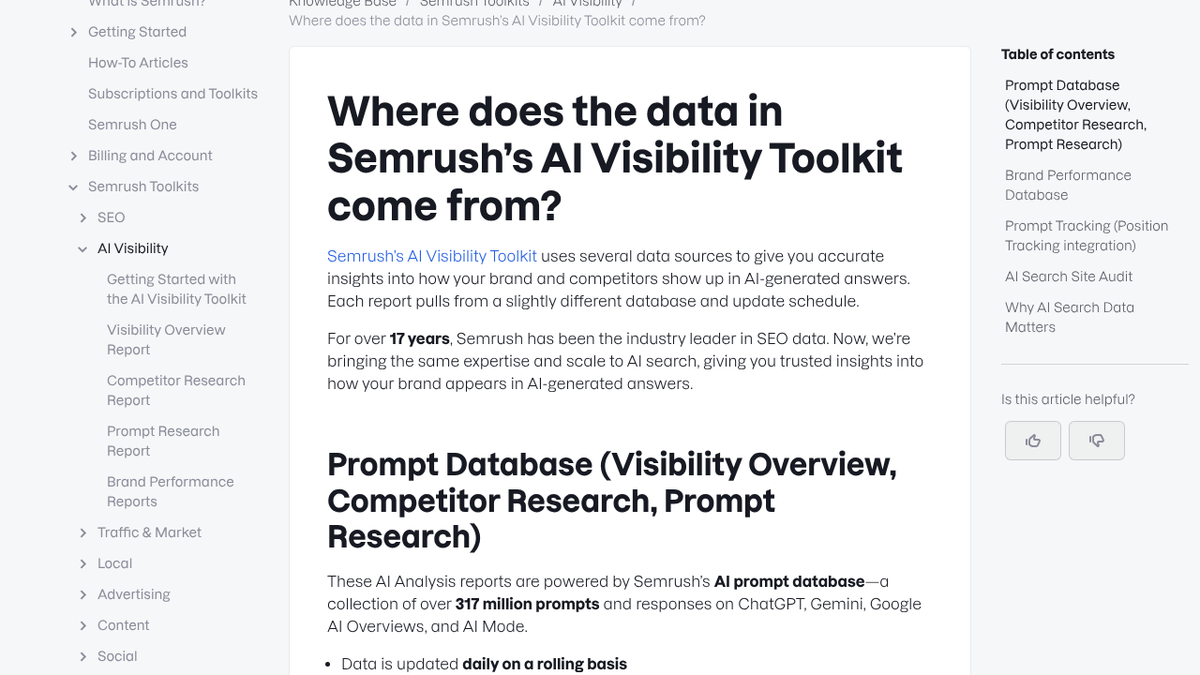
It's also candid about the limits. The same page says AI search provides no exact numbers on visibility, and that the toolkit aims for reliable directional signals instead.
Otterly.AI is blunter still. In a post last updated August 4, 2026, it says "platforms like OpenAI/ChatGPT and Perplexity currently do not share any information or metrics related to Search Volume." Of its own estimation feature, it writes: "Although still in its early stages, this innovation holds significant promise."
The pattern we noticed is an uncomfortable one. The vendor that admitted the most, Otterly, gave the fewest numbers. The biggest number, Profound's 500 million prompts, came from a blog post comparing Profound with a rival, not from a methodology page. We couldn't find a methodology page for it.

Built by the team that got cited in 48 hours.
Content generation, backlink building, AI visibility tracking, and Google rankings. One platform, zero guesswork.
The numbers move, even for the same vendor
Vendor numbers also change fast, and different sources describe the same product differently.
In a review published November 18, 2025, Profound described Semrush's prompt database as "100 million, which sounds like a lot." It said Semrush covered "only six regional databases." Less than a year later, Semrush's own documentation says 317 million prompts and 117 regional databases.
Maybe Semrush tripled its prompt database and grew its regions nearly twentyfold in eleven months. These products are moving quickly, so that's plausible. Or maybe a competitor's review undersold a rival. Both companies have an obvious interest in how the comparison reads. We can't tell which, and that's the point. A database size means little without a date next to it.
It's also worth separating the database from what you track. Semrush's plans let a customer track between 25 and 200 prompts, depending on the tier. The 317 million is the pool the estimates come from, not what any one customer sees.
Real prompts don't look like tracked prompts
There's a second problem with prompt volume data, separate from sample size. The prompts tools track may not look like what people actually type.
Otterly.AI compared hundreds of real ChatGPT prompts with the estimated prompts tools often use, in a study last updated February 3, 2026.
| Measure | Real prompts | Estimated prompts |
|---|---|---|
| Average length | 15.1 words | 8.8 words |
| Looking for a tool | 78.9% | 62.5% |
| Problem-solving intent | 21.1% | 7.1% |
| Uses personal pronouns | 52.1% | 18.8% |
Real prompts were 71% longer. They were three times as likely to describe a problem and far more likely to say "I" or "my." People tell ChatGPT about their situation. Tracked prompts tend to read like short keywords with a question mark.
That matters for volume. If a tool estimates demand for "best CRM for agencies," it's measuring a phrase real users rarely type in that form. They're more likely to write "I run a 12-person agency and we keep losing track of client emails, what CRM should I use?"
There's a related finding on what ChatGPT does with those prompts. A study by the marketing agency Nectiv, reported by Search Engine Land in October 2025, found that "ChatGPT performs a search in nearly one-third of prompts and averages more than two searches per query, each about 5.5 words long." So a single long prompt can turn into several short searches behind the scenes. Volume for the prompt and volume for the searches are different things.
Why volume still matters
None of this means AI demand is small. The traffic is real, and for some businesses it's valuable.
Tanay Jaipuria shared a quote on X from Costco's CFO. The CFO said traffic to Costco's site from AI search had grown triple digits for the second straight quarter, and that it had the highest conversion rate of any traffic the company tracks.
Costco CFO on AI search volume and intent: "Traffic to our site from AI search grew triple digits for the second consecutive quarter and continues to show the highest conversion rate of all site traffic"
 Tanay Jaipuria@tanayjSep 29, 2026
That's referral traffic, not prompt volume, but it's why the volume question matters. If AI-referred visitors convert better, businesses want to know how many people are asking about their category. The demand for a number is real, even when the number isn't.
Even this topic has no search volume
One small irony. When we checked Google keyword data for this post's own topic, "ai prompt volume" showed no measurable monthly search volume in the US. "AI search volume" showed about 30 searches a month.
People are clearly interested in the subject. They just don't search for it in those words, or not often enough for keyword tools to register. That's the same blind spot, one level up. Our analysis of why AI search volume is invisible to keyword tools covers that gap in more depth.
How to read any AI volume claim
Next time a tool, study or sales deck shows you an AI volume number, ask these questions.
- Is it a disclosed total or an estimate? Only the AI companies can disclose totals. Anything about a topic, keyword or prompt is an estimate.
- What's the denominator? Which AI tools, which devices, which kinds of prompts, compared with what?
- Where does the data come from? A clickstream panel, prompts run through AI engines, Google keyword data or a mix?
- How big is the sample, and when was it taken? A number without a date is a number you can't compare.
- Does the vendor say what it can't measure? The honest ones do, in their own documentation.
- What does the vendor sell? Bigger numbers help sell AI services. Smaller ones help sell skepticism.
- Does the prompt look like something a person would type? Short keyword-style prompts may undercount the long, specific ones real users write.
If a claim can't answer at least the first four, treat it as a talking point, not data. For the AI usage side, our breakdown of AI chatbot market share collects the dated figures for which tools people use most.
What to measure alongside volume
Volume estimates help you size a market. They're less useful for deciding what to do on Monday. For that, presence is easier to measure honestly. Pick the questions your buyers ask, check whether AI engines mention or cite you for them and track the trend over time.
That's a number you can verify yourself, by asking the same questions in each engine. Our guide to share of voice in AI search covers how to track it, and our roundup of AI search statistics has more of the dated benchmarks.
Doing it yourself or handing it off
You can check presence by hand. Write down 20 questions your buyers ask, run each one in ChatGPT, Perplexity, Gemini and Google's AI Mode every week and log who gets named. It works, but it takes a few hours a week, and the answers change from run to run.
RankControl doesn't sell a prompt volume number. It tracks presence. Its AI visibility tracking checks up to 50 buyer questions every week across seven AI engines and records whether each answer mentions or cites you, and which competitors it names instead. A new citation sends a notification. It also writes and publishes articles that answer those questions on your site. Expect traffic from Google first, with AI citations following more slowly as links and mentions build up.
See your first AI citation report in under 5 minutes.
No setup calls. No onboarding meetings. Connect your domain and see where AI mentions your brand right now.