
When ChatGPT recommends a brand, it's doing one of two things. Either it's answering from what it learned during training, or it's searching the web right then and picking from what it finds. Which one it does changes everything about how a brand gets in.
The short answer from the data is that, for most people using the free version, ChatGPT answers from memory most of the time. Ahrefs found that only 14.4% of 66.6 million free ChatGPT responses ran a web search. But Semrush's data puts the figure at more than twice that. And small independent tests show the choice can flip on the same question.
This post sets out every public test we could find, with its sample and date. It explains why they disagree and what that means if you want ChatGPT to recommend you. We didn't run any ChatGPT tests of our own for this post. Everything here comes from published studies and a small check of public files.
The short answer, by source
Here are the main figures on how often ChatGPT searches, and what happens when it does.
| Source | Date | Sample | Finding |
|---|---|---|---|
| Ahrefs | Aug to Sep 2026 | 66.6M free, logged-out responses | 14.4% ran a web search |
| Semrush | Feb 2026 | US clickstream, 200M-user panel | Search on 34.5% of queries, down from 46% in late 2024 |
| Ahrefs | Feb 2025 data | 1.4M prompts | 49.98% of retrieved URLs cited |
| Suganthan Mohanadasan | July 2026 | 60 conversations | Brands in the search query reached the answer 68.9% of the time, vs 2.1% |
| OpenAI | Current | Help page | May search "when your question would benefit from current information" |
The top two rows are the headline disagreement, 14.4% against 34.5%. The rest explain what happens once a search runs.
What OpenAI says
OpenAI's own explanation is short. Its help page on ChatGPT search says that "ChatGPT may search the web automatically when your question would benefit from current information."
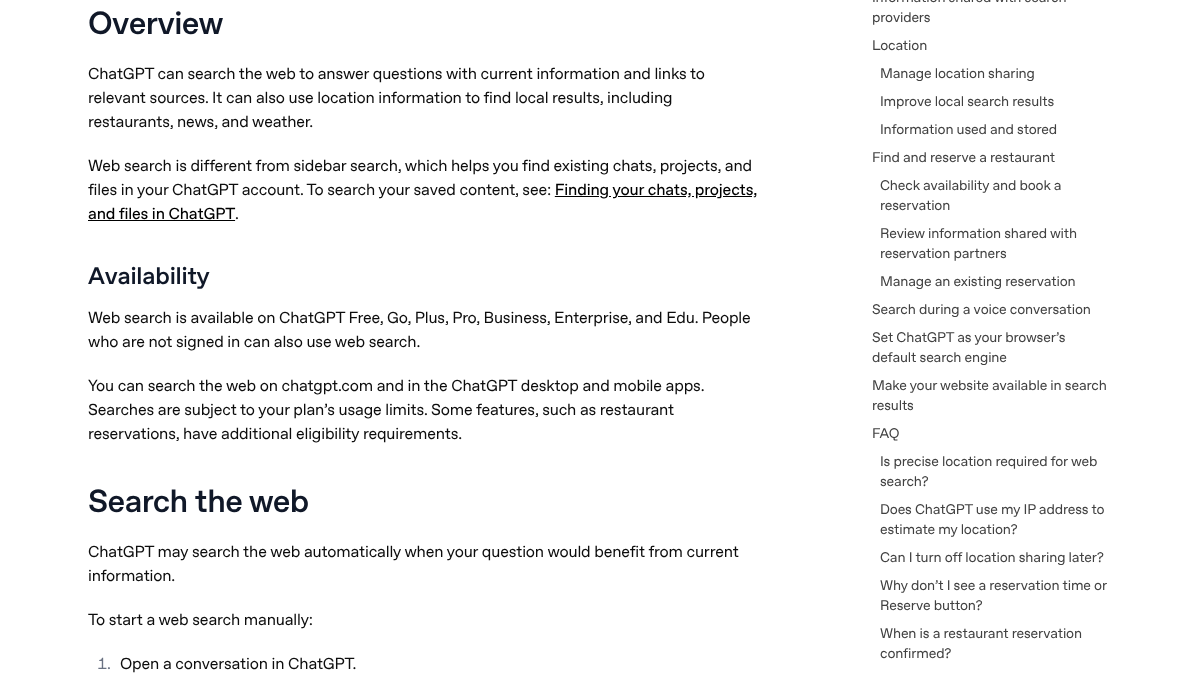
The same page says web search is available on every plan, from Free to Enterprise, and to people who aren't signed in. There's no published rule for when the search runs, and no percentage. So the only way to know how often it happens is to measure it from outside.
Ahrefs: 14.4% of free answers searched
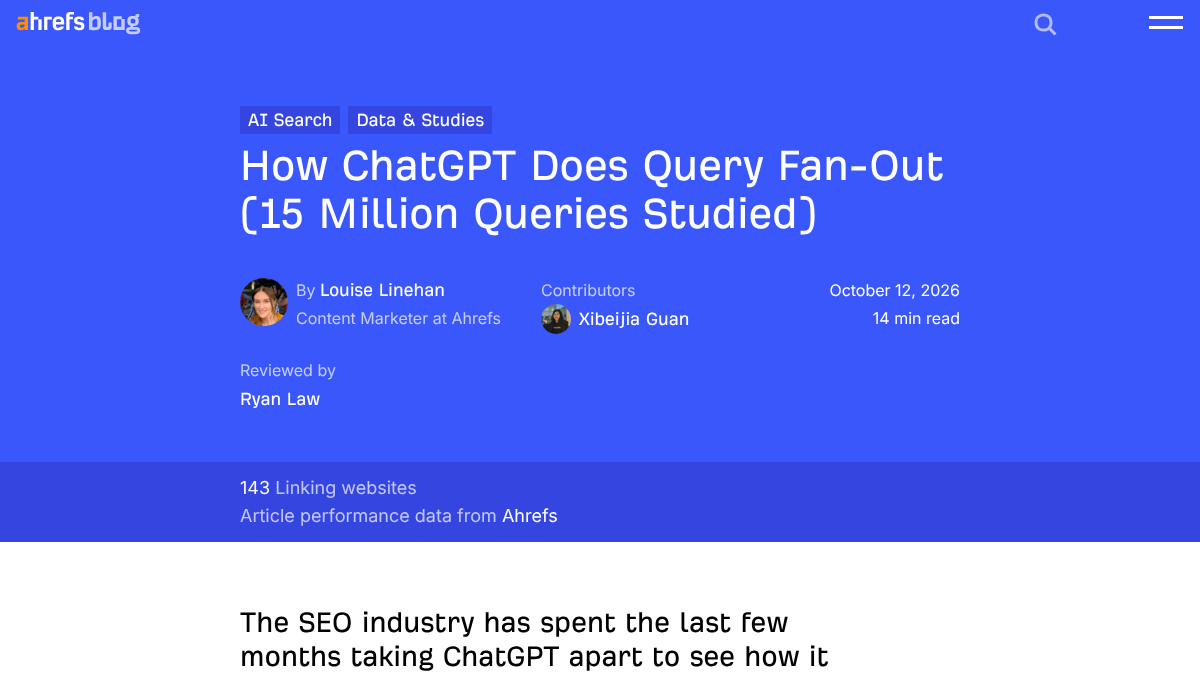
Ahrefs published the largest study on this on October 12, 2026, by Louise Linehan. It analyzed 66.6 million free, logged-out responses from ChatGPT's default model in August and September 2026.
"Only 14.4% of the 66.6 million ChatGPT responses we tracked triggered a web search," it found. When a search did run, ChatGPT ran about 1.6 searches on average.
That means about 85% of free, logged-out answers in the sample came from the model's training alone. For a brand, that's a sobering number. Most of the time, a free user asking ChatGPT for a recommendation gets an answer built from what the model already knew.
Ahrefs added its own caveat. Paid users and reasoning models search more than free, logged-out users do, so 14.4% describes default behavior, not every ChatGPT user. Ahrefs also sells AI visibility tracking, so it has an interest in this topic.
The same study found something useful about how ChatGPT searches. In 6.8% of its searches, ChatGPT used a site: operator to look inside one website, spread across about 116,000 domains. So when it does search, it sometimes goes straight to a brand's own site to check a fact.
Semrush: 34.5%, and falling
Semrush's study, published April 7, 2026, used a different method. It looked at more than a billion lines of US clickstream data from a panel of about 200 million users, across mobile and desktop, from October 2024 to February 2026.
"As of February 2026, ChatGPT enabled web search on 34.5% of queries, which is down from 46% in late 2024," Semrush reported. Over the study window, the share swung between 15% and 66.3%.
Two things stand out. The figure is more than twice Ahrefs' 14.4%. And the trend points down, toward less searching over time, not more.
Semrush sells an AI visibility toolkit too.
Know exactly what AI says about your competitors.
RankControl's Recon Agent monitors competitor citations across ChatGPT, Perplexity, Claude, Gemini, Grok, Google AI Mode, and Google AI Overviews. See where they show up and you don't.

Why 14.4% and 34.5% are both right
The two biggest studies look like they contradict each other. They mostly measure different things.
Different users. Ahrefs looked only at free, logged-out responses. Semrush's panel covers a wider mix of users and plans. Since paid and signed-in users tend to trigger more searches, Semrush's figure should be higher.
Different measures. Ahrefs counted responses that actually ran a search. Semrush counted queries where search was enabled. Those aren't quite the same event.
Different times. Ahrefs covers two months in late 2026. Semrush's 34.5% is one month inside a 17-month series that ranged from 15% to 66.3%. Any single month is a point on a moving line.
Different models. ChatGPT's default model changed in early August 2026, when GPT-5.6 rolled out. Ahrefs' sample sits entirely after that change, while Semrush's series ends in February. A new model can search more or less often, and cite different kinds of sources, so the two studies may be describing two different versions of ChatGPT. Our post on why Reddit citations dropped covers how that update changed what ChatGPT cites.
We call this the two-door problem. A brand can get into a ChatGPT answer through the memory door or the search door, and studies disagree on how often each door opens. The safe reading is that the memory door opens most of the time for free users, and the search door opens far more often than zero.
When it does search, who gets picked?
Searching isn't the same as recommending. Two studies show how much is lost between the two.
Ahrefs' April 2026 study of 1.4 million prompts found that ChatGPT retrieves dozens of URLs for a single query but cites only about half of them, 49.98% in its data. Pages from regular search results made up most of what was cited. Reddit, YouTube and academic sources made up a small share.
A smaller study goes further. Suganthan Mohanadasan, an independent search consultant, analyzed the network traffic of 60 real ChatGPT conversations in July 2026. The study looked at the search query ChatGPT itself wrote before it searched.
"Brands that appear in that string reached the final answer 68.9 percent of the time," it found. "Brands that were merely retrieved during the search reached it 2.1 percent of the time." That's about a 33-fold gap.
So ChatGPT often seems to decide which brands to consider before it searches, then uses the search to check them. A brand that only turns up in the retrieved pages, without being named in the query, rarely makes the answer. That's a small, hand-built sample, so treat it as a strong signal rather than a population figure.
Memory has an age
If most answers come from memory, the age of that memory matters.
A May 2026 paper on arXiv by Ben Moore and Liam Dunne of Discovered Labs analyzed about 2 million citations across four AI engines over roughly six months. It found ChatGPT's cited sources had a median age of 8.0 months, against 5.1 months for Claude. ChatGPT also cited brand-owned pages at about three times Gemini's rate, 39.3% against 13.8%.
Discovered Labs is an SEO and AEO agency, not a neutral lab, so read those figures with that in mind. But the direction makes sense. A model that leans on what it already knows will favor sources that have been around a while.
SE Ranking's November 2025 study points the same way from the other side. Across 129,000 domains and 100,000 prompts, content updated within the past three months averaged nearly double the citations, 6.0 against 3.6. So freshness helps when ChatGPT does search, even if older, established sources dominate memory. SE Ranking also sells AI visibility tracking.
26 content formats. Published on your domain. Matched to your brand.
Guides, comparisons, listicles, case studies, and more. RankControl generates content that gets cited by ChatGPT, Perplexity, Claude, Gemini, Grok, Google AI Mode, and Google AI Overviews.

The same question, two different answers
The hardest part of measuring this is that ChatGPT isn't consistent. The same prompt can be answered from memory once and with a search the next time.
GEO Lab, run by Artur Ferreira, ran a seven-month citation study from February to September 2026. Partway through, it changed its method for ChatGPT. Each prompt began with "search the web for," so ChatGPT retrieved sources instead of sometimes answering from memory. The study had to force search to get comparable results. Ferreira consults on GEO, so it's another source with a stake in the topic.
Different engines also cite very different sources for the same question. Backlinko, citing Kevin Indig's analysis of 3.7 million citations across 20,000 prompts, reported that 91% of cited URLs appeared in just one AI engine. Only 2.37% appeared in all three major ones for the same prompt. Backlinko is owned by Semrush.
Ethan Lazuk, an independent consultant, tracked 2,594 of ChatGPT's search queries over 30 days and was candid about the limits. The findings, Lazuk wrote, "aren't necessarily representative of fanouts at large." That's true of every small test here, including any you run yourself.
A check of our own: how sites treat the two doors
ChatGPT uses different crawlers for training and for live search. GPTBot collects training data. OAI-SearchBot and ChatGPT-User fetch pages for live answers. So a site's robots.txt shows whether it treats memory and search differently.
On October 19, 2026, we fetched the robots.txt files of 18 well-known software and consumer sites. Fifteen had no rule for any of these crawlers, which means all of them are allowed by default.
The other three had written rules, and all three treated training and live search differently. Figma blocked GPTBot from the whole site, while allowing ChatGPT-User and OAI-SearchBot to reach its homepages. Canva blocked GPTBot and several other training crawlers, with no separate rule for the search crawlers, so they fall back to allowed. Monday.com gave the search crawlers almost full access.
That's a small, hand-picked sample, not a statistic about the web. But it shows the split from the other side. The sites that think about it are saying no to training and yes to being fetched for live answers. Our robots.txt and AI crawler checklist covers how to set yours.
Where the studies disagree
Pulling it together, here's how solid each part of the picture is.
Fairly solid. Free, logged-out ChatGPT answers come from memory most of the time. When ChatGPT searches, it cites only some of what it retrieves. Different engines cite very different sources.
Mixed. The overall search rate, 14.4% or 34.5%, depends on which users and which measure. The trend over time may be downward, but the monthly swings are large.
Thin. The 33-fold gap between named and merely retrieved brands comes from 60 conversations. The memory-age figures come from an agency's study.
Left out. One dataset that circulated in AI-written summaries, said to cover 615 buying questions, couldn't be traced to any real source, so we didn't use it. A claim that 95% of ChatGPT citations come from content published in the last 10 months, attributed to SE Ranking, doesn't appear in SE Ranking's own article.
How to test it for your own brand
You can see the two doors for yourself in about an hour. You don't need any special tools.
- Pick five buyer questions. Use the questions a customer would really ask, like "best invoicing software for freelancers," not your brand name.
- Ask each one in a logged-out window. That matches the free, logged-out users in Ahrefs' study. Note whether the answer shows sources. If it does, ChatGPT searched. If it doesn't, it answered from memory.
- Ask each one again, starting with "search the web for." That forces a search, the same way GEO Lab did. Now compare the two answers.
- Note which brands appear in each. If you show up only in the forced-search answer, you're in the search door but not the memory door. If you show up only in the memory answer, you're known but your pages aren't being found.
- Repeat a few days later. Answers vary between runs, so one pass isn't enough.
This won't give you a statistic. It will show you which door you're missing, which is the useful part. Keep a simple sheet with the date, the question, the mode and the brands named, so you can compare runs over a month.
Numbers to use
If you need figures for a plan or a deck, here's what we'd use, with the source attached.
- How often free ChatGPT searches: 14.4% of responses (Ahrefs, 66.6 million responses, August to September 2026).
- A broader estimate: 34.5% of queries with search enabled (Semrush clickstream, February 2026).
- How much of a search gets cited: about half of retrieved URLs (Ahrefs, 1.4 million prompts).
- Named vs merely retrieved: 68.9% against 2.1% reaching the answer (Mohanadasan, 60 conversations).
Treat the first two as a range rather than a single number. And don't quote any search rate without saying which users it describes.
What this means for brands
If ChatGPT answers from memory most of the time, and picks from a shortlist when it searches, a brand needs to be in both places.
Get into memory. That means being written about widely and consistently, on sites that end up in training data, over months and years. Our guide to getting into LLM training data covers the Common Crawl side, and our post on how long it takes AI search to learn a brand covers the timeline.
Get into search. That means clear, current pages that rank for the questions buyers ask, with your brand's facts stated plainly on your own site. Our analysis of where AI engines pull citations from covers how to write them.
Get named as well as retrieved. Mohanadasan's data suggests ChatGPT's shortlist forms before it searches. Being mentioned alongside competitors on trusted third-party pages, like reviews, comparisons and trade press, is what puts a name on that shortlist. Our guide to how ChatGPT decides which websites to recommend explains the mechanism.
Doing it yourself or handing it off
Checking this yourself is slow, because the same question can give different answers on different runs. A fair check means running a fixed set of buyer questions through ChatGPT every week and logging what comes back. That's a few hours a week.
RankControl does that part. Its AI visibility tracking checks up to 50 buyer questions every week across seven AI engines, and records whether each answer mentioned you, cited you or both, with every source it used. It also writes and publishes articles aimed at those questions, which is the search door. Expect traffic from Google and AI search first, with citations following more slowly as other sites link to and mention you.

Your competitors are getting cited by AI. You're not.
Every day without citation tracking is a day your competitors pull ahead in ChatGPT, Perplexity, and Claude.