
A user posted in r/ChatGPT in September that ChatGPT Plus "feels like a completely different product." They'd assumed Plus was the free version with higher limits. Instead, they found the paid model gave wrong answers far less often than the free one.
ChatGPT Plus feels like a completely different product
My Google AI Pro subscription expired yesterday, so I decided to get ChatGPT Plus for a month and see what it’s like. I honestly didn’t expect the difference to be this big. I always thought Plus was basically free ChatGPT with higher limit...
Another reply made the point sharply. Half the "AI is overrated" takes come from people who've only used the free model.
Part of that gap is how often ChatGPT goes to the web before it answers. If you care about whether ChatGPT cites your site, that's the number that matters. So we pulled the public studies together and pooled 117 ChatGPT answers from our own October tests.
How often ChatGPT searches, at a glance
| Source | What it measured | Search rate |
|---|---|---|
| Nectiv, October 2025 | 8,500+ prompts across nine industries | 31% of prompts triggered a search |
| Nectiv, by industry | Local, credit card and fashion prompts | 59% local, 18% credit cards, 19% fashion |
| Our pooled tests, October 2026 | 117 prompts on ChatGPT's web app | 58% overall, 100% for facts and prices, 21% for how-to |
| Semrush and Kevin Indig, June 2026 | 100 prompts, Instant vs Thinking style | 245 vs 1,130 web searches, almost 5x more |
| Otterly, August 2026 | An estimate, not a measurement | 20% to 35% of all prompts |
The short version is that nobody outside OpenAI knows the true share. OpenAI doesn't publish how often its users trigger search. Every number above is a sample, and each sample's mix of questions decides most of the result.
There's one more way to size it. The UK agency SEO Works took the usage categories in OpenAI's own research on how people use ChatGPT and picked the ones that look like Google searches. Those were specific information, how-to advice, health and fitness tips, products to buy and recipes. Together they came to 35.5% of conversations.
That isn't a search rate, since a how-to question often gets answered from memory. But it gives a rough sense of how many chats a web page could even compete in. The rest is writing, coding, editing and chat, where no search is needed.
That's the most useful thing to know. The search rate isn't a property of ChatGPT. It's a property of the question.
What decides whether ChatGPT searches
OpenAI's help page on web search says ChatGPT may search on its own when your question would benefit from current information. You can also ask it to search.
In practice, that means it searches when the answer is a lookup and skips it when the answer is a method. We'd call this the lookup line. A price, a founding year, a list of products or a local business is a lookup. How to write a cold email or boil an egg is a method it already knows.
Nectiv's numbers fit the same pattern. Local questions, which need a current list of nearby places, triggered a search 59% of the time. Credit card and fashion prompts, where the model leans on what it already knows, searched less than a fifth of the time.
200+ SaaS teams already track their AI citations.
They know exactly when ChatGPT mentions their brand, and when it stops. Do you?
Our test: when ChatGPT searched, by question type
Over October 2026 we ran 117 prompts through ChatGPT's web app, via a data provider's live feed, for several studies on this blog. Each answer shows whether ChatGPT ran a web search and which sources it cited. We pooled them and sorted them by question type.
| Question type | Prompts | Searched | Share |
|---|---|---|---|
| Facts about a named company, like founding year | 26 | 26 | 100% |
| Current prices of a SaaS plan | 8 | 8 | 100% |
| Price and founder of obscure or made-up brands | 10 | 10 | 100% |
| Questions using a search operator, like site: | 4 | 4 | 100% |
| Shopping and buying questions | 8 | 7 | 88% |
| Everyday how-to and advice | 61 | 13 | 21% |
| All prompts | 117 | 68 | 58% |
The pattern held across studies. Every question about a company's facts or prices triggered a search. Every made-up brand did too, and ChatGPT then said it couldn't find the product, as our post on AI hallucination rates describes.
Everyday how-to questions mostly didn't. ChatGPT answered "how to calculate customer churn rate" and "how long to boil an egg" from memory. Among the 13 how-to questions that did trigger a search, the answer often depended on something current. Examples were payroll rules, SaaS pricing models and email open rate benchmarks.
Shopping questions sat in between and nearly always searched. "Best CRM for small business," "running shoes for flat feet" and "cheap flights to London" all went to the web.
The 58% overall figure means little on its own. If we'd asked mostly how-to questions, we'd have reported 21%. If we'd asked mostly about companies, we'd have reported 100%. That's why published search rates disagree.
Same question, different words
One of our studies asked 14 questions twice, worded two ways, like "how long to boil an egg" and "egg cooking time." That let us see whether wording alone changes the search decision.
Mostly it doesn't. In 12 of the 14 pairs, both versions searched or both skipped. The two that split are worth a look.
| First wording | Searched? | Second wording | Searched? |
|---|---|---|---|
| how to fix a dripping tap | No | leaky faucet repair | Yes |
| tool to monitor brand in ChatGPT answers | Yes | track AI mentions of my company | No |
| best CRM for small business | Yes | customer management software for small companies | Yes |
| how long to boil an egg | No | egg cooking time | No |
The faucet split didn't matter much, since the search that ran cited no sources. The brand one matters more. "Tool to monitor" reads like a request for a product list, so ChatGPT searched and cited five sources. "Track AI mentions of my company" read like a request for advice, so it answered from memory and cited nothing.
For a software company, that's the whole game in one pair. Buyers who ask for a tool get a live list that your page can join. Buyers who ask how to do the job get a stored answer, and only brands the model already knows can appear in it.
What happens inside a search
When ChatGPT does search, it rarely searches your exact words. Nectiv found ChatGPT ran an average of 2.17 searches per prompt, up to four, and the searches averaged 5.48 words. That's longer than most people type into Google.
In our tests, ChatGPT rewrote searches to add detail. "Inexpensive airfare to London" became a search for cheap flights to London from a specific city, with the season and year. Our guide to how ChatGPT searches the web walks through that rewriting step, and our explainer on semantic search shows how rare phrasings get mapped to common ones.
Searches also carried more weight for the pages they found. When ChatGPT searched for a company's facts, it cited about 2.7 sources per answer. For shopping and how-to questions that searched, it cited about 4 to 5.
The free vs paid gap
Free users can search. OpenAI's help center says web search is available on Free, Go, Plus, Pro, Business, Enterprise and Edu, and even to people who aren't signed in, subject to each plan's usage limits.
The gap is in the model doing the searching. OpenAI's Free tier FAQ says free users get GPT-5.6 Luna, with a Think option that's available on the mobile app and rolling out on the web. Plus, at $20 a month, adds advanced reasoning options and higher limits.
That matters because reasoning changes how much ChatGPT searches. In June 2026, Semrush and Kevin Indig of Growth Memo ran 100 buyer-journey prompts through GPT-5.2 twice, once with minimal reasoning and once with high reasoning. Semrush maps those to ChatGPT's Instant and Thinking modes.
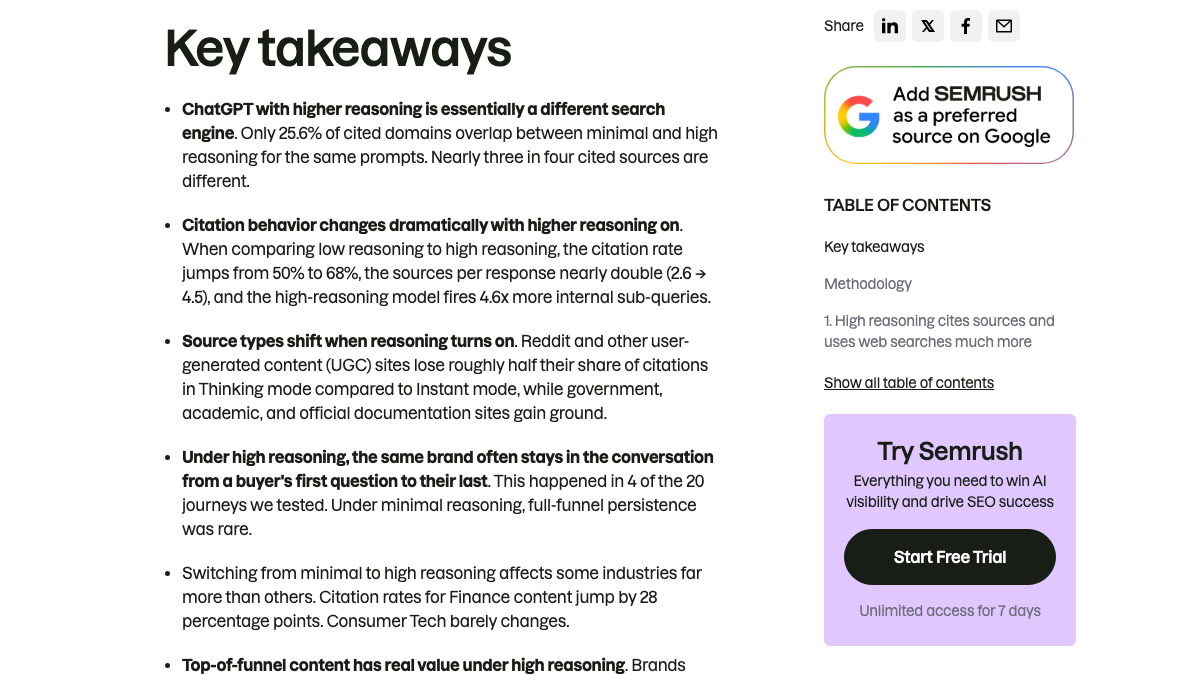
| Measure | Minimal reasoning (Instant) | High reasoning (Thinking) |
|---|---|---|
| Web searches across 100 prompts | 245 | 1,130 |
| Answers with citations | 50% | 68% |
| Sources cited per answer | 2.6 | 4.5 |
| Cited domains shared between modes | 25.6% overlap | 25.6% overlap |
High reasoning ran almost 5x more web searches and cited nearly twice as many sources. And only about a quarter of the cited domains were the same across the two modes, so the two modes mostly cited different sites for the same prompts.
The study found the sources changed in kind too. In Thinking mode, Reddit and other user-generated sites lost roughly half their share of citations, while government, academic and official documentation sites gained.
Where the plan gap is widest
The gap wasn't the same everywhere. Semrush split its 100 prompts into four categories and five buying stages, from spotting a problem to picking a product.
| Category | Rise in answers with citations, Instant to Thinking |
|---|---|
| Finance | +28 points |
| Health and lifestyle | +24 points |
| B2B SaaS | +16 points |
| Consumer tech | +4 points |
The stage mattered too. At the comparison stage, where a buyer weighs named options side by side, high reasoning ran 24 searches per prompt against 5.5 for minimal reasoning, and cited 9.8 sources against 5.8. At the very first stage, when a buyer is still naming the problem, the citation rate was 35 points higher in Thinking mode.
So the gap is widest where the stakes are highest, in money, health and side-by-side comparisons. If you sell in one of those, the answers your buyers see depend a lot on which mode they use.
We call this the plan gap. A buyer on the free default and a buyer on Plus with Thinking turned on can ask the same question and get answers built from different sources. Your brand can be cited in one and missing from the other.
How often does ChatGPT mention your brand?
Most founders have no idea. The answer might surprise you.
Why the plan gap matters for your brand
OpenAI doesn't publish how many users turn on Thinking, but the default fast mode is what everyone gets unless they switch. The users who pay, and who turn on Thinking for big decisions, are often the buyers who matter most for B2B and high-ticket purchases.
That has three practical effects.
- A brand that only shows up in Instant-style answers can miss the deeper research buyers do in Thinking mode, and the reverse.
- Reddit and forum mentions carry more weight in the fast mode, while official docs, studies and government sources carry more in Thinking mode.
- A tracking tool that checks only one mode sees only one version of the answer. Ask which mode your tool checks.
The Semrush study also found that under high reasoning, the same brand often stayed in the conversation from a buyer's first question to the last. That happened in 4 of its 20 buyer journeys, and it was rare under minimal reasoning.
Why some users think ChatGPT stopped searching
There's a separate confusion worth clearing up. In September 2026, a thread in r/ChatGPT asked why OpenAI got rid of web search. The most upvoted answer was simple. ChatGPT now searches on its own when a question calls for it, and another reply said typing "@web" still forces a search.
So "ChatGPT didn't search" usually means the question looked like a method, not a lookup. If you want a search, ask for current information, name a source or a date, or ask it to look it up. Our test of search operators found that naming one website in a ChatGPT question made it cite only that site.
How to tell whether ChatGPT searched
You don't have to guess. OpenAI's help page says answers that use web search may include citations, and you can select a citation to open its source. A Sources button, when it shows, lists the cited pages and other links.
If an answer has no citations and no Sources button, it most likely came from what the model already knew. To force a search, open the tools menu and pick Search, type / and choose Search, or use the retry control and pick "Search the web." Those steps are all in OpenAI's help page.
This matters when you check your own brand. An answer with no sources can't be changed by publishing a new page this week. An answer with sources can, because the next search may find you.
What this means for getting cited
If ChatGPT only searches for some questions, the questions you target decide whether your pages can be cited at all.
- Questions about your company, prices and products almost always trigger a search. Put those facts on your own site in plain text, so the search finds you first.
- Shopping and comparison questions nearly always search. These are the questions where good comparison and "best of" pages earn citations.
- Stable how-to questions often don't search, especially in the free default mode. Citations there come more from what the model learned in training, so they build slowly through being widely referenced.
- Thinking mode reaches for official and authoritative sources. Original data, documentation and named experts help you show up in the deeper answers.
Our breakdown of how AI engines choose which sources to cite covers what makes a page more likely to be picked once a search runs.
Limits of these numbers
Every figure here comes from a sample. Nectiv's prompts came from its own tracking across nine industries. The Semrush study used 100 buyer-journey prompts and ran them through a model with two reasoning settings, which Semrush maps to ChatGPT's modes.
Our own 117 prompts came from several studies with different goals, so the mix isn't random, and we ran each prompt once from the US. ChatGPT's answers vary from run to run, and OpenAI changes default models and search behavior often. Treat the pattern as solid and the exact shares as a snapshot.
What tracking this takes by hand
Here's a rough monthly budget for checking how ChatGPT answers your buyers' questions across modes, by our estimate.
| Task | Hours a month |
|---|---|
| Running key questions in the default mode | 2 to 3 |
| Running the same questions in Thinking mode | 2 to 3 |
| Comparing cited sources between modes | 2 to 4 |
| Checking whether each answer searched the web | 1 to 2 |
| Updating facts on your site that answers rely on | 2 to 4 |
| Total | 9 to 16 |
Doing it by hand or with help
You can run these checks yourself, mode by mode. Or RankControl can take on the steady part. We check 50 of your buyer questions every week on ChatGPT, Perplexity, Claude, Gemini, Grok, Google AI Mode and Google AI Overviews, and our AI visibility tracking shows which sources each engine cites, so you can see which pages are shaping the answers.
15 hours a week manually. Or 15 minutes with RankControl.
Track citations, monitor competitors, and fix content gaps across every AI search engine. Automatically.