A post in r/AlwaysWhy this spring asked a question plenty of people have typed in frustration. The poster had told ChatGPT to admit when it didn't know something. Then they asked a question with no answer online, and it guessed anyway, wrongly.
Why does ChatGPT make things up rather than admit to not knowing it?
I had clearly told ChatGPT to admit not knowing info asked yet when I asked it a question that wouldn’t have an answer online it generated a guessed wrong answer rather than admitting to not knowing, why won’t it just say I don’t know?
The top reply, with over 200 upvotes, said the model "doesn't know what it doesn't know." That's close to how researchers describe the problem. It also explains why every AI hallucination rate you read seems to disagree with the last one.
We pulled the October 2026 numbers from the main leaderboards and studies, then ran our own test on the kind of facts businesses care about. Here's what the rates look like, and why they range from under 2% to over 70%.
AI hallucination rates in 2026 at a glance
| Study or benchmark | What it tests | Hallucination or error rate | Date |
|---|---|---|---|
| Vectara leaderboard | Summarizing a document the model is given | 1.8% to 24.2% across 109 models, median 9.6% | October 16, 2026 |
| Artificial Analysis, AA-Omniscience | Answering hard questions from memory | 15% to 77% across 32 leading models | October 2026 |
| NewsGuard false claim monitor | Repeating false news claims | More than 28% across 11 chatbots | January 2026 |
| EBU news integrity study | Answering questions about the news | 45% had a significant issue, a fifth had major accuracy issues | 2025 |
| Tow Center, Columbia Journalism Review | Finding the source of a news quote | Over 60% wrong overall, from 37% to 94% by tool | March 2025 |
| Stanford RegLab and HAI | Legal research tools | Over 17% to over 34% | 2024 |
| Our test, ChatGPT and Google AI Mode | Company facts, SaaS prices, fake brands | 0 invented answers in 86 | October 19, 2026 |
The spread isn't noise. Each line measures a different job, and the job decides the rate more than the model does. We call this the task gap, and it's the first thing to check before you quote any hallucination statistic.
Why the numbers disagree so much
Three things move a hallucination rate more than the model behind it.
The first is whether the model has a source in front of it. Summarizing a document you were handed is the easy case, and that's what Vectara measures. Recalling an obscure fact with nothing to check against is the hard case, and that's what Artificial Analysis measures.
The second is what counts as a hallucination. Vectara counts any claim in a summary that the source doesn't support. Artificial Analysis counts how often a model gives a wrong answer when it should have said it didn't know.
The third is whether a refusal counts as a win. A model that says "I'm not sure" on every hard question will look great on one test and useless on another. That's why a model can top one leaderboard and sit near the bottom of the next.
The Vectara leaderboard for grounded tasks
Vectara's hallucination leaderboard on GitHub is the longest-running public tracker. It feeds each model a set of documents, asks for a summary using only the facts given, and scores each summary with Vectara's own detection model.
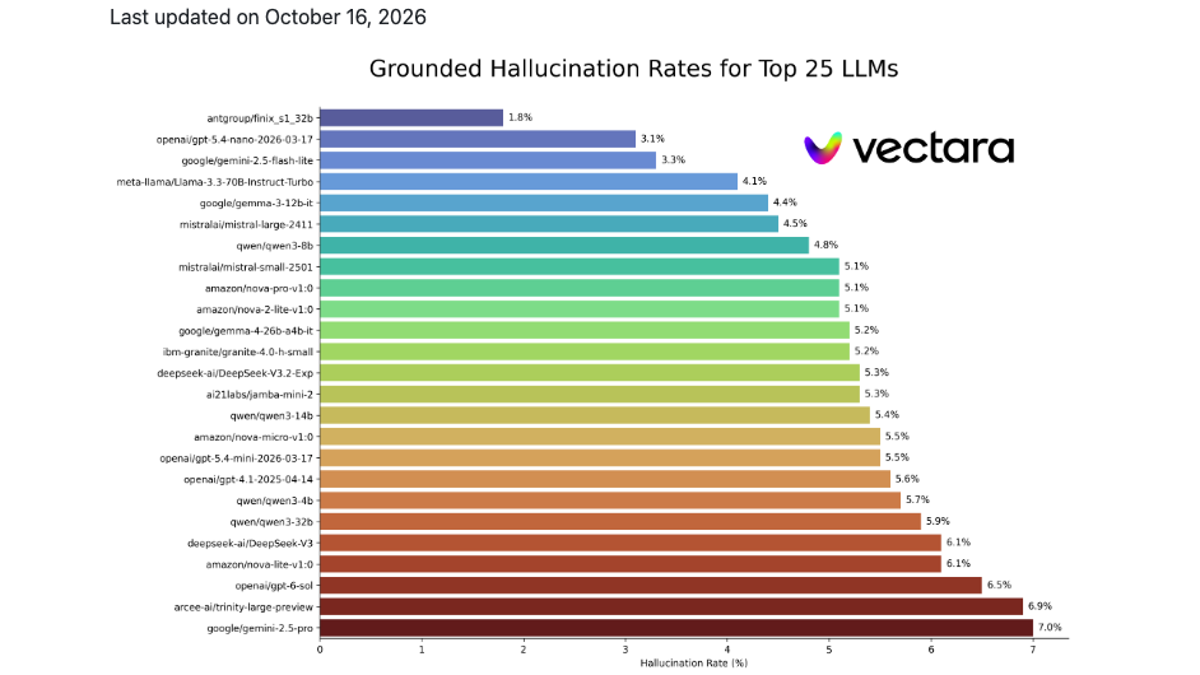
As of the October 16, 2026 update, 109 models were on the board. The best scored 1.8%, nine came in under 5%, and the median was 9.6%. Put another way, about half the models added an unsupported claim to roughly one summary in ten, or more often.
The vendor results surprised us. Small, plain models often beat their bigger siblings.
| Vendor | Lowest rate on the board | Highest rate on the board |
|---|---|---|
| OpenAI | 3.1% (GPT-5.4 nano) | 23.3% (o3-pro) |
| 3.3% (Gemini 2.5 Flash Lite) | 13.6% (Gemini 3 Pro preview) | |
| DeepSeek | 5.3% (V3.2 Exp) | 11.3% (R1) |
| xAI | 5.8% (Grok 3) | 20.2% (Grok 4 Fast reasoning) |
| Anthropic | 9.8% (Claude Haiku 4.5) | 12.2% (Claude Opus 4.6) |
OpenAI's reasoning models sat near the bottom, with o3-pro at 23.3% and GPT-5 on high effort at 15.1%. GPT-4.1, an older non-reasoning model, scored 5.6%. Models that think longer seem to add more of their own ideas to a summary, which is the opposite of what the task asks.
One caveat is worth keeping in mind. Vectara sells a search and answer platform built on this kind of grounding, and the judge is its own model. The board is still the best long-run record we have, but it isn't a neutral referee.
The AA-Omniscience test for knowledge questions
Artificial Analysis built AA-Omniscience to test the hard case. It asks 6,000 questions across 42 topics in six fields, with no documents to lean on.
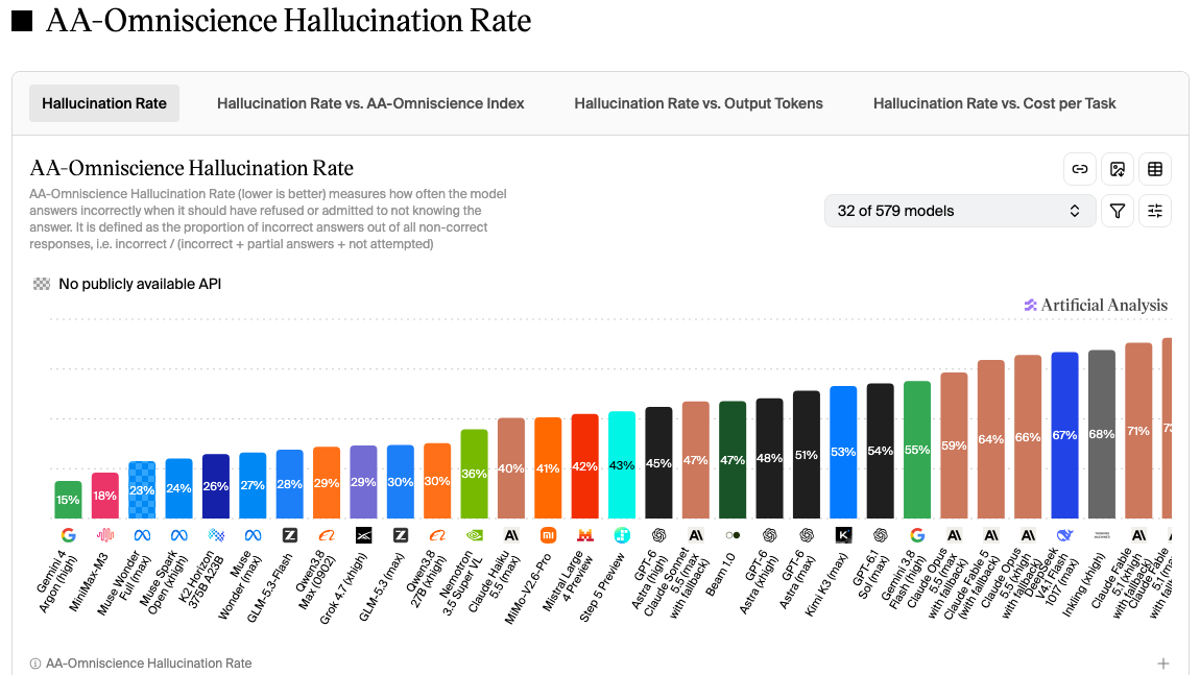
Its hallucination rate asks a narrow question. When a model doesn't get the answer right, how often does it give a wrong answer instead of admitting it doesn't know? Across the 32 models featured in October 2026, that ran from 15% for Gemini 4 Argon to 77% at the top end.
Accuracy and honesty turned out to be different skills. Claude Opus 5.5 was among the most accurate models on the test, getting about two thirds of the questions right. But when it missed, it gave a wrong answer instead of declining 59% of the time.
That's the r/AlwaysWhy complaint in a chart. Most models still prefer a confident guess to "I don't know," even the most accurate ones on the test.
200+ SaaS teams already track their AI citations.
They know exactly when ChatGPT mentions their brand, and when it stops. Do you?
News and citations, the hardest public tests
News questions are where AI answers have looked worst, mostly because they need fresh facts and exact sources.
In March 2025, the Tow Center at Columbia Journalism Review gave eight AI search tools quotes from news articles and asked them to find the source. Collectively they got more than 60% wrong. Perplexity missed 37%, while Grok 3 missed 94%. The study also found premium chatbots gave more confidently wrong answers than free ones.
The European Broadcasting Union's news integrity study checked more than 3,000 answers from AI assistants, across languages and countries. Almost half had at least one significant issue. About a third had serious sourcing problems, and a fifth had major accuracy issues, such as made-up or outdated facts.
NewsGuard tracks a narrower risk. Its AI false claim monitor tests 11 leading chatbots on false claims spreading in the news. In its January 2026 audit, they repeated those claims more than 28% of the time.
Our own audit of Perplexity's citations found a milder version of the same problem. Of 34 citations tied to specific claims, 6 didn't support the sentence they were attached to.
Where hallucinations end up in court
Law is where hallucinated facts carry the clearest cost. A 2024 study from Stanford's RegLab and HAI tested legal research tools built for lawyers. Lexis+ AI and Ask Practical Law AI gave wrong information more than 17% of the time, and Westlaw's AI research tool more than 34%.
Those tools were built on top of case law, which should have helped. The errors still got through, and they keep reaching judges. Damien Charlotin, a legal researcher, keeps a public database of court decisions where a court found or implied that a filing relied on AI-invented content. On October 19, 2026, it listed 2,199 cases.
Behind most of those is a filing someone submitted without checking. The count only covers cases a court wrote about, so the real number of fake citations is higher.
Our test of how often AI search gets brand facts wrong
The public benchmarks test hard questions, news or law. Most businesses care about something simpler, which is whether ChatGPT and Google get their basic facts right. So on October 19, 2026, we tested that.
We asked ChatGPT and Google AI Mode three kinds of questions through a data provider's live feeds of both engines.
- The founding year and headquarters of 26 real software companies, from household names to firms with a short Wikipedia page.
- The monthly price of the cheapest paid plan for 8 SaaS tools, checked against each vendor's pricing page that day.
- The price and founder of 9 software brands we made up. A Google search turned up no product for any of them.
| Question type | Answers | Matched the source | Invented |
|---|---|---|---|
| Founding year and HQ, famous companies | 20 | 19 | 0 |
| Founding year and HQ, mid-sized companies | 14 | 14 | 0 |
| Founding year and HQ, little-known companies | 18 | 14 | 0 |
| Cheapest paid plan, headline price | 16 | 16 | 0 |
| Price and founder of a fake brand | 18 | 18 said it couldn't find the product | 0 |
Neither engine invented a price or a founder for any of the 9 fake brands. ChatGPT said it couldn't verify the product and asked for a website every time. Google AI Mode said no such product existed and often suggested a real one with a similar name, such as a cosplay design brand called Thimble Forge.
We started with 10 invented names, and one turned out to be in use. ChatGPT found an HR document product called Corvanta, and Google AI Mode found an ambulance software brand, so we dropped it.
Five answers didn't match Wikipedia, four on little-known companies and one on a famous one. In each case the public sources disagreed with each other. ChatGPT gave DBmaestro's founding year as 2008, citing an Israeli startup database, while Wikipedia and Google AI Mode said 2012. Both engines put Lexalytics in Amherst, and ChatGPT cited its LinkedIn page, while Wikipedia says Boston. ChatGPT also placed xTuple in Norfolk, its old home, while Wikipedia lists Lincoln, Rhode Island.
The same thing happened with Canva. ChatGPT said 2012, Google AI Mode said 2013, and both explained that Canva started work in 2012 and launched in 2013.
We call this the source-conflict rule. On basic facts, web-connected AI engines rarely invent anything. They pick between sources that disagree, and the one they pick may not be yours.
Our test has limits worth stating. We asked each question once, from one US location, on one day, and the questions were simple ones with a single right answer. We didn't test harder brand questions, like which integrations a product has or how two tools compare, where the public studies above found far more errors.
How often does ChatGPT mention your brand?
Most founders have no idea. The answer might surprise you.
Prices were right on the headline and shaky in the fine print
Every headline price matched the vendor's page. Less Annoying CRM came back at $15 a user each month, Wrike's Team plan at $10, and Insightly's cheapest plan at $29 on annual billing, all as listed.
The errors showed up one level down, in month-to-month prices that pricing pages hide behind a toggle. For Capsule CRM, ChatGPT said $22 a month on monthly billing, citing two review sites, while Google AI Mode said $21. They can't both be right, and the vendor's page shows the annual price by default.
ChatGPT also said Insightly charges $35 on monthly billing. Insightly's pricing page lists every plan as billed annually, so we couldn't find that number anywhere on it.
This is the most likely way an AI answer gets your pricing wrong. It won't make up a plan from nothing. It will fill a gap your own page leaves open with a number from a review site, and that page may be out of date.
What hallucination rates mean for your brand
The public benchmarks and our test point the same way. AI answers go wrong when the model has to guess, and when the sources it finds disagree. You can't fix the first, but you can do a lot about the second.
- Put your key facts on your own site in plain text, outside images and toggles. That covers founding year, location, the cheapest plan, and both monthly and annual prices.
- Make the facts match everywhere. Your site, LinkedIn page, Wikipedia entry and startup databases should agree on the same year and city.
- Fix stale review-site pages. When ChatGPT cites a review site for your price, that page is now part of your pricing.
- Check what each engine says about you on a schedule, not once. Answers change as the sources they pick change.
Our response plan for when AI answers get your company wrong walks through fixing a bad answer step by step. The post on why AI search engines cite the wrong sources explains how the wrong page gets picked in the first place.
Small brands should pay most attention. Our explainer on how large language models work covers a real case where ChatGPT mixed two businesses with similar names and gave out one owner's phone number for the other's company.
How to read a hallucination statistic
When you see a hallucination rate quoted, five questions tell you whether it applies to you.
| Question | Why it matters |
|---|---|
| What task was tested? | Summarizing a document scores far better than answering from memory |
| How is a hallucination defined? | Any unsupported claim, a wrong answer, or a wrong answer instead of a refusal |
| Did the model have web search? | Web-connected engines got basic facts right in our test |
| When was it measured? | Model versions change every few months |
| Who did the scoring? | A vendor scoring with its own model has a stake in the result |
"AI is wrong 60% of the time" and "AI is wrong 2% of the time" can both be true, because they describe different jobs. Without these five answers, a quoted rate tells you very little.
What tracking this takes by hand
Here's a rough monthly budget for keeping an eye on what AI engines say about your brand, by our estimate.
| Task | Hours a month |
|---|---|
| Asking each engine your key brand and pricing questions | 3 to 5 |
| Checking answers against your own pages | 2 to 3 |
| Finding which sources each wrong answer came from | 2 to 4 |
| Updating your site and third-party listings | 2 to 4 |
| Logging changes from one month to the next | 1 to 2 |
| Total | 10 to 18 |
Doing it by hand or with help
You can run these checks yourself, engine by engine. Or RankControl can take on the steady part of it. We check 50 of your buyer questions every week on ChatGPT, Perplexity, Claude, Gemini, Grok, Google AI Mode and Google AI Overviews, and our AI visibility tracking shows which sources each engine cites, so you can see which pages are shaping what it says about you.
Our guide to monitoring AI citations and brand mentions covers what to watch each week.
15 hours a week manually. Or 15 minutes with RankControl.
Track citations, monitor competitors, and fix content gaps across every AI search engine. Automatically.