Here's the short answer. The best data so far suggests that being recommended in an AI answer does lift branded search, and by more than most people expect. Similarweb found that 55.9% of the visits that followed a ChatGPT recommendation came through branded Google search, not a click on the AI's link.
The longer answer is messier. That finding comes from one panel study. Several other widely shared studies measure the opposite question, whether brands that people already search for get cited more. Real accounts from marketers point both ways. And the thing everyone wants to measure, cause and effect in your own data, is the hardest part to see.
This post sets out what the studies actually found, with dates, samples and each publisher's commercial interest. Then it covers why they disagree and what you can check in your own numbers.
The short answer, by source
Here are the key data points, grouped by what they measure.
| Finding | Figure | Source and date |
|---|---|---|
| More likely to visit a brand after an AI recommendation | 2.5x | Similarweb, US desktop, Jul to Dec 2025 |
| Share of those visits through branded Google search | 55.9% | Similarweb, same study |
| Pages viewed by AI-influenced visitors | About 12 vs 6.5 | Similarweb, same study |
| AI citations where the brand isn't named | 62% | Semrush ghost citations study, June 2026 |
| Correlation of branded search with AI Overview visibility | 0.392 | Ahrefs, 75,000 brands, May 2025 |
| Topic leaders with higher branded search | 55.7% of pairs | Semrush, 50,000+ brands, July 2026 |
| Branded searches showing an AI Overview | 82.91% | Ahrefs, Sept 29, 2026 |
The first three rows measure what happens after an AI recommendation. The next three measure something else, which is the main reason this topic causes so much confusion.
The best evidence: Similarweb's downstream study
Similarweb published "The Downstream Impact of AI Visibility" on June 21, 2026. It's the closest thing yet to a direct test of the question in this post's title.
The method was straightforward. Similarweb's panel tracked US desktop users in three industries, finance, travel and beauty, from July to December 2025. It found people who asked ChatGPT an industry question and got a brand recommendation. It left out anyone who'd already visited that brand's site, then watched what they did over the next seven days.
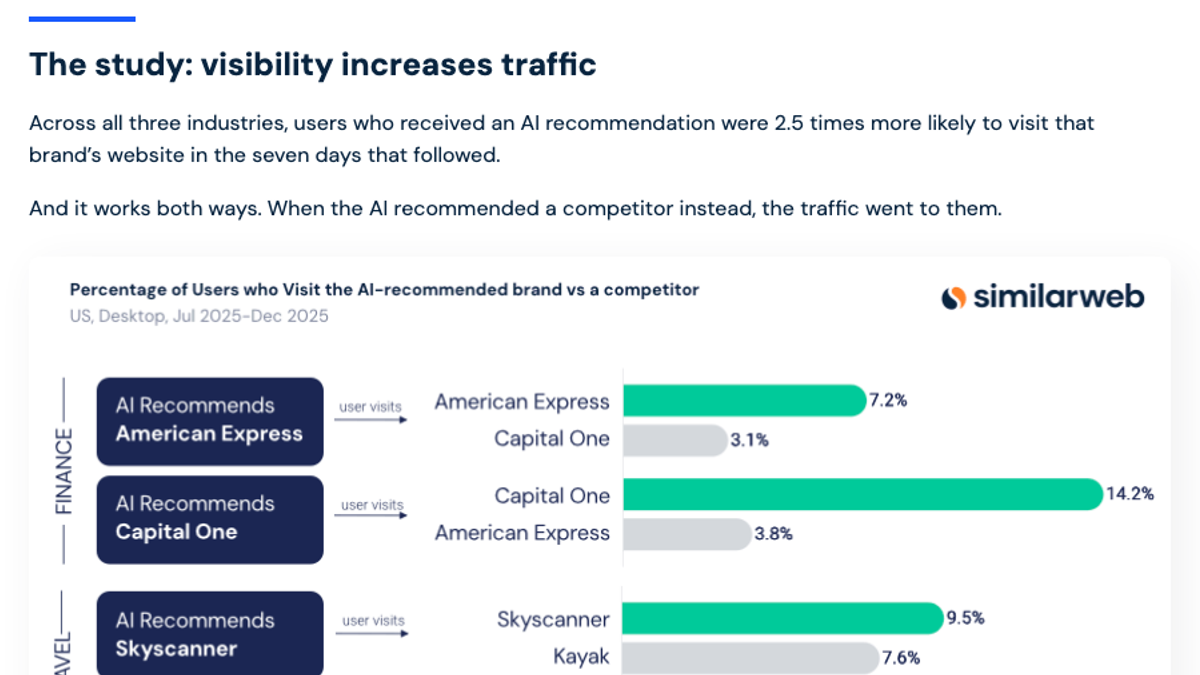
"Being recommended in AI makes users 2.5x more likely to visit your site in the next seven days," Similarweb found. The chart shows how sharp that can be. When ChatGPT recommended Capital One, 14.2% of those users visited Capital One, against 3.8% who visited American Express. When it recommended American Express instead, the order flipped.
The number that matters most for this post is how those visits arrived. According to Search Engine Journal's coverage of the study, 55.9% came through branded Google search. The rest arrived by other routes, including direct visits and clicks from the AI answer itself.
Similarweb's own summary put it plainly. "AI is essentially priming people to search for brands by name."
Those visitors were also more engaged. They viewed about 12 pages and stayed about 11.8 minutes, against 6.5 pages and 5.6 minutes for other visitors.
Two caveats are worth keeping. Similarweb sells web analytics and AI visibility products, so it benefits from brands believing AI visibility matters. And the panel covers US desktop users in three industries over six months. Mobile behavior, B2B software and other countries could look different.
Even so, it's a clean design. It compares people who got a recommendation with the same kind of people who didn't, and it rules out existing visitors. That's stronger evidence than the correlation studies below.
Why an AI mention turns into a Google search
The pattern makes sense once you think about how people use AI answers. Someone asks ChatGPT which travel card to get. It names two or three. The person then opens Google, types one brand name, and reads the brand's own site or its reviews.
We call this the second-tab search. The AI answer is where the idea starts, but the visit happens in another tab, through Google. In your analytics, that visit looks like ordinary branded search, and the AI engine gets no credit for it.
That's also why AI referral traffic looks small in most reports. Our breakdown of AI referral traffic by engine shows ChatGPT sending most AI visits, but those visits are only the people who clicked through directly. The second-tab searches sit in your Google numbers.
200+ SaaS teams already track their AI citations.
They know exactly when ChatGPT mentions their brand, and when it stops. Do you?
The ceiling: when the AI doesn't say your name
There's a limit to all this. A person can only search for a brand they've seen named. And many AI citations never name the brand at all.
Semrush's ghost citations study, published June 9, 2026 with Kevin Indig, looked at 3,981 brand appearances across 115 prompts, 14 countries and four AI engines. Its headline finding was that "62% of AI citations are ghost citations. Your site gets a source link, but the AI never says your name in the answer."
So being cited and being recommended are different things. A citation links to your page as a source. A recommendation names your brand in the answer. Only the second one gives a reader something to type into Google.
This changes what to aim for. If your page is cited but your name isn't in the answer, you're helping the AI without getting the second-tab search. Our analysis of where in an article AI engines pull citations from covers how to make your name part of the passage that gets lifted.
Semrush sells an AI visibility toolkit, so it has an interest in this topic too.
The arrow that points the other way
Here's where most coverage goes wrong. Two well-known studies are often quoted as if they show AI mentions lifting branded search. They actually measure the reverse.
Ahrefs, May 2025. Ahrefs studied 75,000 brands and measured which signals correlated with how often each brand appeared in Google's AI Overviews. Branded web mentions came out at 0.664. Branded search volume came in at 0.392. Ahrefs itself warned that correlation isn't causation.
Semrush, July 2026. Semrush studied more than 50,000 brands across 1,094 US categories, comparing brands that "own" a topic in ChatGPT with those that don't. "Only branded search volume was a statistically significant differentiator, and even then, the edge was modest," it found. Topic owners had higher branded search in 55.7% of pairs.
Both studies ask whether brands that people already search for are more likely to show up in AI answers. That's the opposite direction from this post's question. A brand can be searched a lot because it's well known, and also cited a lot for the same reason. Neither study can tell which came first.
They also disagree on strength. Ahrefs found a moderate correlation. Semrush found an edge only slightly better than a coin flip. The samples were different, the definition of "winning" was different, and they cover different years. Our post on brand mentions vs backlinks goes deeper into the Ahrefs study.
Ahrefs and Semrush both sell AI visibility tracking, so both benefit from brand signals mattering.
How often does ChatGPT mention your brand?
Most founders have no idea. The answer might surprise you.
What happens when someone searches your brand now
There's a twist in the second-tab search. When someone types your brand name into Google, they may get another AI answer before they reach your site.
Ahrefs published a study on October 2, 2026, by Ryan Law, of 232.8 million US desktop Google results from July to September 2026. It found AI Overviews on 73.3% of branded searches in July, rising to 82.91% by September 29. In the same piece, Ahrefs reported that Chris Long found AI Overviews on 93 of 100 enterprise brand names in an informal test.
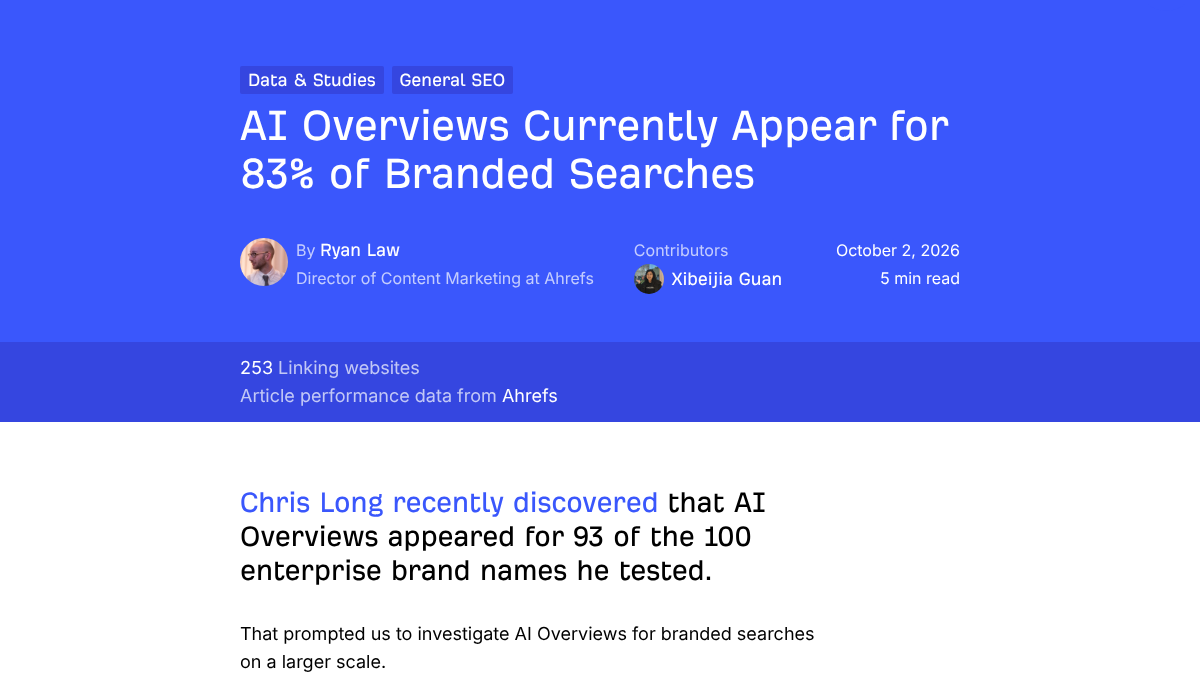
Ann Smarty noted the same pattern in September, after checking a few brand searches to verify it.
THIS IS BAD NEWS FOR JUST ABOUT ANY BUSINESS According to @chris_nectiv, (and I did a few searches to verify the observation), Google appears to show AI Overviews in about 90% of cases when you search for a brand name... This is not exactly great news for companies because they https://t.co/WFd3CpUyXf
 Ann Smarty@seosmartySep 30, 2026
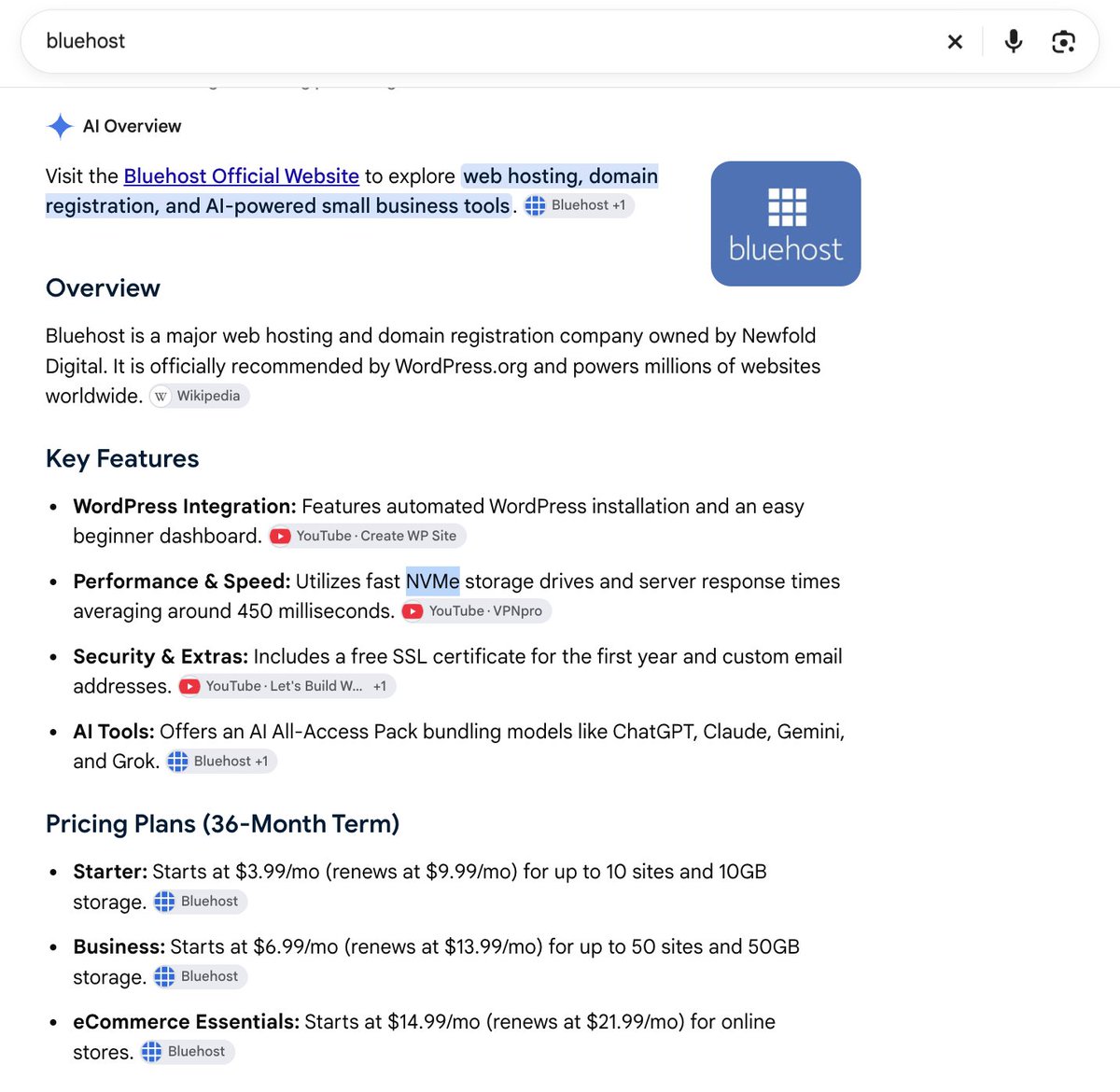
We ran a small check of our own on October 18, 2026. We searched three brand names, including our own, and all three brought up an AI Overview. That's a tiny sample, but it fits Ahrefs' figure.
This matters for measurement. A branded search might now end with an AI summary of your brand and no click at all. So branded impressions in Search Console may rise while branded clicks stay flat. Both are still signs of interest, but they tell different stories.
Real accounts point both ways
Studies average out a lot of variety. Individual marketers report very different things.
A thread on r/PPC asked whether others were seeing branded search drop while ChatGPT referrals crept up. The poster ran paid search for a B2B software client. Branded impressions were down about 18% over four months, while a small but growing trickle of visits came from ChatGPT and Perplexity. Sales reps were hearing "ChatGPT recommended you" on demo calls.
Anyone else seeing branded search volume drop while ChatGPT referrals creep up?
Running paid for a B2B SaaS client (around 15k/month on Google Ads, mostly branded + competitor terms). Last 4 months something weird is happening and I want to know if others are seeing it. Branded search impressions down roughly 18% YoY....
In the same thread, a marketer for a home-services marketplace reported the opposite. Branded search impressions were up sharply year over year, which they put down to strong visibility in AI answers. Another reply pointed out that both could be coincidence, given how small direct AI traffic still is.
That spread is useful in itself. It suggests the effect depends a lot on the category, on whether AI answers name the brand, and on what else is changing at the same time.
Why it's so hard to measure
Even with good data, three things get in the way of seeing a clean lift in your own numbers.
Most searches don't end in a click. Bain and Dynata surveyed 1,117 consumers in December 2024. They reported that about 80% of consumers rely on zero-click results in at least 40% of their searches. They also estimated that about 60% of searches end without a visit to another site. That's self-reported survey data, not clickstream, but it points the same way as earlier SparkToro research from 2024.
Search Console doesn't record why someone searched. You can see branded clicks and impressions. You can't see that a person searched your name because ChatGPT mentioned you an hour earlier.
Most marketers say they can't measure AI visibility. Semrush's 2026 AI Visibility Index, based on 126 million prompts, reported that 45% of marketing leaders can't accurately measure their brand's visibility in AI answers. Only 9% said they have tools to track every relevant metric. That's a survey of marketers, so treat it as a sign of the gap rather than hard data.
The result is what you'd expect. Most brands that see branded search rise can't say for sure whether AI answers caused it.
Where the studies disagree
Pulling it together, here's how solid each part of the story is.
Fairly solid. In Similarweb's panel, an AI recommendation raised the chance of a visit 2.5 times, and most of those visits came through branded Google search. Branded searches now usually show an AI Overview.
Mixed. Brands with more branded search are somewhat more likely to be cited, but Ahrefs and Semrush disagree on how much, and neither shows which way the arrow points.
Thin. Individual accounts go both ways. Survey figures on zero-click behavior and measurement gaps are self-reported.
Left out. One figure circulates widely, claiming global branded search volume fell from about 1.1 billion a month to 713 million. We couldn't trace it to any primary source, so we haven't used it. A "74% of users chose the top-mentioned brand" figure attributed to Growth Memo sits behind a paywall, and the visible text doesn't match how it's usually quoted.
How to check your own numbers
You can't prove cause in your own data. But you can look for the pattern Similarweb found, which is enough to make a decision.
- Pull branded queries from Search Console. Filter the Performance report for queries containing your brand name, and export clicks and impressions by week for the past year.
- Watch Google Trends for your brand name. It's rough, but it shows whether interest is rising outside your own site.
- Log when AI answers start naming you. Run the same 20 to 50 buyer questions through the main AI engines each week, and note the first week your brand is named in the answer, rather than only cited as a source.
- Compare the timing. If branded impressions climb a few weeks after AI answers start naming you, with nothing else changing, that's a reasonable signal.
- Ask new customers. A free-text "How did you hear about us?" field on sign-up or demo forms catches the second-tab search that analytics misses.
Our guide to Search Console's AI performance report covers the Search Console side, and our GA4 guide to AI referral tracking covers the direct clicks.
What this means for your content
If the second-tab search is real, two kinds of page matter more than they used to.
The first is the page an AI answer is built from. If ChatGPT names you when someone asks for the best option in your category, it's usually because pages it trusts say so, including your own. Clear comparison pages, plain pricing and specific use cases give it something to quote with your name attached.
The second is the page people land on after they search your name. That's often your homepage, a pricing page or a review site. If it doesn't quickly confirm what the AI answer said, you lose the person you just earned. Check that your top branded landing pages answer the obvious next questions, like what it costs, who it's for and how it compares.
Neither needs a new strategy. It's the same work as good search content, aimed at the moment after the AI answer.
Numbers to use
If you need one line for a deck, here's what we'd say, with the source attached. Similarweb found people recommended a brand in ChatGPT were 2.5 times more likely to visit it within a week, and 55.9% of those visits came through branded Google search. That's US desktop data from three industries, from late 2025.
And we'd retire any claim that AI mentions "cause" branded search based on the Ahrefs or Semrush correlations. Those studies measure the other direction.
Doing it yourself or handing it off
Tracking this by hand means a weekly run of the same questions through several AI engines, a log of when your name appears, and a monthly look at branded queries in Search Console. Allow two to three hours a week once it's set up.
RankControl handles the AI side of that. Its AI visibility tracking checks up to 50 buyer questions every week across seven AI engines, including Google AI Mode and Google AI Overviews, and marks whether each answer mentioned you, cited you or both. That makes it easy to spot the week your name starts appearing, then compare it with your branded search. It also writes and publishes articles aimed at those questions. Expect traffic from Google and AI search first, with citations following more slowly as other sites link to and mention you.
15 hours a week manually. Or 15 minutes with RankControl.
Track citations, monitor competitors, and fix content gaps across every AI search engine. Automatically.