
If you want an AI engine to quote you, put the answer near the top. That's the short version of every study we could find on where in an article AI engines pull citations from. CXL found 55% of cited passages in Google AI Overviews came from the first 30% of the page.
The longer version is more useful. The bottom of a page still gets cited, mostly from blocks that stand on their own. Structure seems to matter as much as position. Length barely matters at all. And two studies from the same company disagree by more than half on whether ranking decides which pages get pulled from.
This post sets out the data, dated and sourced, with each publisher's commercial interest noted. It also adds a check of our own on the pages that rank for this question.
The short answer
Here are the main numbers on where citations come from in a page, and what shapes them.
| Finding | Figure | Source and date |
|---|---|---|
| Cited passages from the first 30% of a page | 55% | CXL, 100 AI Overview citations, March 2026 |
| Cited passages from the middle, 30% to 60% | 24% | CXL, same study |
| Cited passages from the bottom 40% | 21% | CXL, same study |
| ChatGPT citations from the first 30% of a page | 44.2% | Kevin Indig, 18,012 citations, as reported by CXL |
| Cited pages with lists | 63% | Previsible, 5,000 AI responses, January 2026 |
| Cited pages with FAQ-type sections | 47% | Previsible, same study |
| Correlation between word count and citation | 0.04 | Ahrefs, 174,048 pages, December 2025 |
| Visibility lift from adding quotations | 41% | Princeton GEO paper, 2024 |
The pattern is consistent. AI engines lean hard on the opening of a page, and they favor passages that are easy to lift out cleanly.
The top third does most of the work
CXL's study, by Tarek Reslan, mapped exactly where in each source page 100 Google AI Overview citations came from. It was published on March 6, 2026 and updated on September 17.
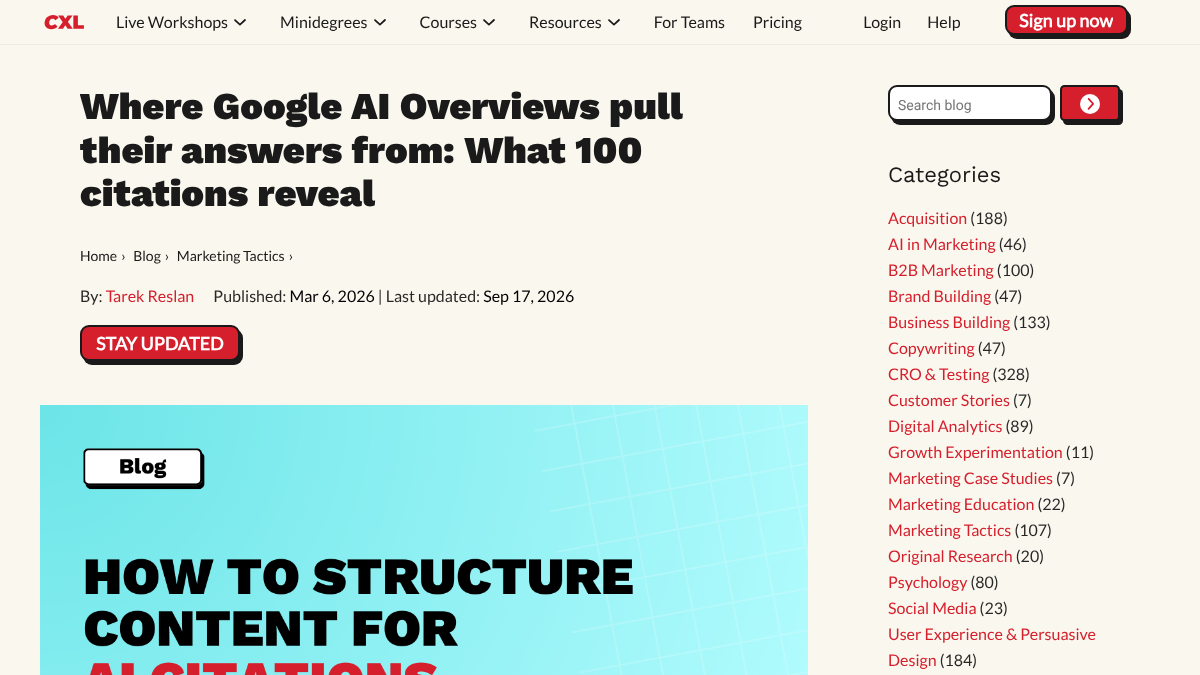
In its words, "55% of cited passages came from the first 30% of a page." A further 24% came from the middle section, and the bottom 40% accounted for 21%. So more than half the citations came from less than a third of the page.
ChatGPT shows the same shape. CXL also reported Kevin Indig's analysis of 1.2 million search results and 18,012 verified ChatGPT citations, which found that 44.2% came from the first 30% of a document. CXL described it as a ski ramp, with a steep drop after the first third and a long, slow tail to the bottom. We couldn't open Indig's original post, so treat that figure as reported by CXL rather than checked by us.
Two independent datasets, two different engines, one pattern. That's about as strong as this kind of evidence gets.
The sample sizes are worth keeping in mind, though. CXL's 100 citations were mapped by hand, which makes them precise but few. Indig's set is much larger, and it was matched by software, which makes it broad but less exact.
Why the top of the page wins
There's a likely reason in how language models handle long text. A 2023 paper by Liu and colleagues, titled "Lost in the Middle", tested how models use information placed at different points in a long input. They found performance "can degrade significantly when changing the position of relevant information."
Models did best when the answer sat at the start or the end of the input. Accuracy dropped as the answer moved toward the middle, even for models built for long inputs.
That paper tested a lab setup, not live AI search, so it doesn't prove why AI Overviews cite the top third. But it fits the shape CXL and Indig found, with the opening strongest, the middle weakest and a small rise for self-contained blocks near the end.
There's a simpler reason too. The top of most pages is where the topic gets defined. An intro that says plainly what something is, who it's for and what it costs is exactly the sentence an AI answer needs. Pages that warm up for 300 words before saying anything give the engine nothing to lift.
You're getting AI traffic. But do you know where it comes from?
RankControl credits every visit to the assistant that sent it: ChatGPT, Perplexity, Claude, Gemini, Copilot, or Grok. Full source attribution, next to your Google traffic.
The exception: blocks that stand on their own
The bottom 40% still produced 21% of CXL's citations, and the study noticed where they came from. "Several citations from the bottom of pages came from FAQ blocks addressing specific, discrete questions," it said.
CXL's explanation is that each question and answer is "structurally self-contained." That may make the passage easier to find and quote, even late on the page. CXL is careful to add that this is "not proof Google gives FAQ sections preferential treatment."
We call this the cold-open paragraph. It's a passage that makes complete sense to someone who arrives at it cold, with no context from the paragraphs above. Most intros are cold-open paragraphs by nature. Good FAQ answers are too. A paragraph that starts "As mentioned above" is not.
Our guide to FAQ pages for AEO covers FAQ placement and schema in more detail.
What kind of block gets cited
Position is one question. The type of block is another, and here the best data comes from Previsible, which studied 5,000 AI responses across four kinds of prompts. It published the results on January 26, 2026.
Previsible is an AI discovery agency that sells this kind of work, so read its figures as a vendor's own analysis. With that said, the numbers are specific.
- Lists appeared on 63% of cited pages, the most common element in the study.
- FAQ-type sections appeared on 47% of cited pages.
- Tables appeared on 39% overall, and more often for comparison and buying questions.
- Question headings, like "What is" or "How does it work," appeared on 58% of cited pages.
For prompts about a named brand, 71% of cited pages kept paragraphs under four lines, and 82% named things explicitly rather than saying "it" or "the tool."
These are descriptions of cited pages, not proof that the format caused the citation. Pages with lists and tables also tend to be well-organized in other ways. Still, every one of those elements makes a passage easier to lift out, which fits the cold-open idea.
Headings every 100 to 200 words
Previsible's most practical finding is about heading cadence. Cited pages had "one header every 100 to 200 words." Rarely cited pages had one header every 400 words or more.
We checked this against the pages that rank for this exact question. On October 18, 2026 we pulled Google's top results for "where do ai engines pull citations from" and measured the heading structure of two posts from SEO software companies in the top ten. One had 12 H2 sections, about one every 130 words. The other had 11, about one every 290 words.
That's a sample of two, so it's color, not proof. But both sit far closer to Previsible's cited-page cadence than to its rarely cited one.
Something else stood out. None of the top ten titles asked where within a page citations come from. They all asked which sites get cited. CXL's study was the only top-ten page that covered position, and it ranked for the phrase almost by accident.
Length barely matters
A common belief is that longer content gets cited more. The best data says no.
Ahrefs studied 174,048 pages drawn from 560,346 AI Overviews and published the results on December 3, 2025. Its Despina Gavoyannis reported that the correlation between word count and citation position was 0.04, which she called "essentially zero." More than half of all citations, 53.4%, went to pages under 1,000 words.
Ahrefs sells SEO software, including AI visibility tracking, so it has an interest in this topic too. But a near-zero correlation isn't a result anyone would invent to sell something.
So length isn't the lever. What matters is whether the right passage exists, sits near the top and reads cleanly on its own. A 900-word page that answers the question in its first paragraph can beat a 4,000-word guide that answers it in section seven.
We'll show you exactly where your brand stands in AI search.
No commitment. $0 due today, cancel anytime. See how ChatGPT, Perplexity, Claude, Gemini, Grok, Google AI Mode, and Google AI Overviews talk about your brand today.

What you add to a passage matters
The one study that tested changes, rather than counting what already exists, is academic. The GEO paper from Princeton, the Allen Institute for AI and IIT Delhi was accepted at the ACM SIGKDD conference in 2024. Its authors built a test set of about 10,000 queries and measured how much of a source's text showed up in a generated answer.
They then edited the sources and measured again. Here's what each change did to visibility, against an unedited baseline.
| Change to the source | Visibility lift |
|---|---|
| Adding quotations | 41% |
| Adding statistics | 34% |
| Improving fluency | 30% |
| Citing sources | 28% |
The most striking result was about smaller sites. When several sites in the same results optimized at once, citing sources raised visibility by 115.1% for the site ranked fifth. In other words, the change helped lower-ranked pages catch up rather than making the leader stronger.
The caveat is that the paper used a test search engine built for the study, not live ChatGPT or AI Overviews. The direction is useful. The exact percentages may not carry over.
Does ranking decide which pages get pulled from?
Here the studies disagree sharply, and both come from Ahrefs.
In July 2025, Ahrefs reported that 76.10% of pages cited in AI Overviews ranked in Google's top 10. The median cited page ranked third. That study covered 1.9 million citations, focusing on the top three most visible citations in each answer.
In March 2026, a larger Ahrefs study of 4 million AI Overview URLs found only 37.1% ranked in the top 10. Another 26.2% ranked from 11 to 100, and 36.7% ranked beyond the top 100.
That's a drop by more than half in seven months. Part of it is method. The first study looked at the top three citations per answer, and the second appears to count every cited URL. Part of it is probably real, as AI Overviews pull from a wider set of pages than they used to. Neither article refers to the other, so we can't say how much is which.
For this post's question, the takeaway is modest. Ranking well still helps you get into the pool. Once you're in it, where your answer sits on the page and how cleanly it reads decides which passage gets used.
Where the studies disagree
Pulling it together, here's where the evidence is solid and where it's thin.
Solid. The top third of a page gets cited most, in two independent datasets on two engines. Length doesn't predict citation. Cited pages are heavily structured.
Mixed. How much Google ranking matters depends on which Ahrefs study you read and how citations are counted. The FAQ effect is real in CXL's sample, but CXL itself won't call it a preference.
Thin. The exact lifts from the GEO paper come from a test engine. Previsible's format figures come from a vendor. The "ideal 40 to 60 word passage" figure that circulates on SEO blogs didn't trace back to any named study we could find, so we've left it out.
A different question: which citation gets clicked
You'll also see a stat that the first citation in an AI Overview gets 47% of clicks, the second 23% and the third 14%. That's about the order of citations in the answer, not about where the passage sat on your page.
Mintec, which reported it on October 11, 2026, was candid that it couldn't find the primary table behind those numbers. It also noted Pew's finding that people clicked a cited source on just 1% of visits to pages with an AI Overview. So even the top slot is a large share of a very small pool. We'd treat the 47% figure as unconfirmed.
Fixing a post you've already published
Most sites have more old posts than new ones, so the quickest wins are usually edits. Start with posts that already get Google impressions for a question, since those are already in the pool AI engines pull from.
Read the first 150 words of each one. If the answer to the post's main question isn't there, move it up. Often it's sitting in a conclusion or a section halfway down, and it only needs a light rewrite so it reads cold.
Then check the headings. A post with one H2 every 500 words can usually be split into smaller sections without new writing. Finally, look for paragraphs that lean on the one before, like "This is why" or "As we saw," and rewrite their first sentence so each one stands alone.
That's which passage gets used. Which sites get into the pool in the first place is a separate question, covered in our guide to how AI engines choose sources to cite.
How to write for this
Here's how we'd apply the research to a page you're writing now.
- Answer in the first paragraph. Say what the thing is, who it's for and the key number, before any background.
- Make that paragraph a cold-open one. It should make sense if it's the only thing someone reads.
- Put a heading every 100 to 200 words, and phrase some of them as the questions people ask.
- Use a list or table where you're comparing things, especially on buying and comparison pages.
- Add a short FAQ near the end, with each answer complete on its own.
- Add a quote, a number or a cited source to key passages. Those were the strongest changes in the GEO paper.
- Don't pad for length. A shorter page that answers early can beat a long one.
A thread on r/GenerativeSEOstrategy asked what actually helps sites get cited in AI search. The top reply made the same point in plain words. The model isn't scrolling, so being clear about who you help and what problem you solve has to happen at the very top.
What’s actually helping websites get cited in AI search?
I’ve been looking into AI search visibility lately, especially Google AI Overviews, ChatGPT and Perplexity, and I’m finding it harder to understand what actually makes one website get mentioned over another. With traditional SEO, we can loo...
For engine-specific structure, our guide to structuring content for ChatGPT goes further. Our post on how to optimize a website for AI search covers the site-wide side.
Doing it yourself or handing it off
You can restructure pages by hand. For an existing article, moving the answer up, adding headings and writing a short FAQ takes about an hour. For a new one, building it this way from the start adds little time once it's a habit.
The harder part is doing it on every page, every week. RankControl writes each article against the pages already ranking for its keyword and scores it for how easily AI engines can quote it, with a list of fixes. Its AI visibility tracking then checks up to 50 buyer questions every week across seven AI engines. Expect traffic from Google and AI search first. Citations tend to follow more slowly, as other sites link to and mention your pages.
Know exactly what AI says about your competitors.
RankControl's Recon Agent monitors competitor citations across ChatGPT, Perplexity, Claude, Gemini, Grok, Google AI Mode, and Google AI Overviews. See where they show up and you don't.