
We asked the API behind ChatGPT, with web search on, for the best project management software for small agencies. It ran six searches and cited six pages. All six were vendor pricing pages: Asana, Basecamp, ClickUp, monday.com, Productive and Teamwork. Not one blog post or review made it into the answer.
That result says a lot about GEO for ChatGPT (GEO is short for generative engine optimization). ChatGPT's search pulls a handful of pages, lifts passages from them and cites where they came from. Your job is to be one of those pages, with passages worth lifting. This guide covers how to structure content for that, using OpenAI's own documentation, the research that exists, and a small test we ran on September 26, 2026.
ChatGPT doesn't search for every question
Structure only matters when ChatGPT goes looking. Of the six questions in our test, two got no web search at all: "how to reduce churn in B2B SaaS" and "how often should I update old blog posts." The model answered both from what it already knew and cited nothing. A second test we ran the same day, on recruiting questions, went the same way for both of its general advice questions.
The questions that did set off searches named something specific, like a category, a team size or a type of buyer. "Best accounting software for freelancers" led to three searches. "A good CRM for a 10 person sales team" led to four.
So choose the questions you write for with that in mind. Specific, current and comparative questions are the ones ChatGPT fetches pages for. Broad how-to topics can still earn Google traffic, but in ChatGPT they're up against the model's memory, and a page you publish this week won't change that answer. Our explainer on how ChatGPT decides which websites to recommend goes deeper on the split.
You're getting AI traffic. But do you know where it comes from?
RankControl credits every visit to the assistant that sent it: ChatGPT, Perplexity, Claude, Gemini, Copilot, or Grok. Full source attribution, next to your Google traffic.
Answer first, under a heading people would type
When ChatGPT's search does pull your page, the top of each section does most of the work. Kevin Indig's Growth Memo looked at 18,012 verified citations earlier this year and found 44.2% came from the first 30% of a page. Cited passages were also about twice as likely to contain a question mark, mostly because they sat right under a question heading.
Here's the difference on a typical SaaS page:
| Heading | First sentence | |
|---|---|---|
| Before | Our approach to onboarding | At Acme, we believe great onboarding starts with listening. |
| After | How long does onboarding take? | Most teams are live in five working days, and larger teams with SSO take about two weeks. |
The second version works on its own. A buyer asking ChatGPT how long onboarding takes gets a number, and so does ChatGPT.
A heading can be a plain phrase, too, as long as it matches how people word the thing. An AirOps study of 16,851 queries found pages whose headings closely matched the query got cited 41% of the time, against about 30% for weak matches. "Pricing for teams of 10 to 50" does the job as well as a question would. We wrote more on this in why titles should match the questions AI answers.
Run the lift test on every section
Here's a check worth running on every page, which we call the lift test. Copy one section out on its own, as if ChatGPT had lifted it into an answer. Does it still say what it's about, and does it carry its own fact?
Most sections fail on small things. "It" points to a product named two sections up, or the number sits in a chart image, or the answer depends on a table three scrolls away. Name the subject again, write the number in the text, and keep the answer inside the section.
One small-business owner on r/smallbusinessUS asked how to get cited in ChatGPT and Gemini after customers said they'd started asking AI for recommendations. The most useful replies in the 65-comment thread said the same thing in plainer words: make the headers questions, answer them, and keep your business facts in plain text instead of images.
How do I get my business cited in ChatGPT and Google Gemini answers?
Hi all- sorry if this question has been asked again but I am seeing more and more of my customers are telling they use ChatGPT and whatnot to find answers and get recommended. This got me thinking because we have been focused mostly just on...
The lift test matters more than it looks, because ChatGPT often splits one prompt into several searches. A question about CRMs for a small sales team might also go out as separate searches on pricing and integrations. Each section that stands on its own is one more chance to match one of them.
Give ChatGPT something to quote
The best evidence on what to put in a page comes from a peer-reviewed paper, GEO: Generative Engine Optimization, presented at KDD 2024. The authors tested nine ways of rewriting a source across 10,000 queries. Adding quotations lifted a source's visibility in the generated answers by about 41%, adding statistics by 31% and citing sources by 28%. Keyword stuffing cut visibility by 8%.
The detail most people skip is who gains. Sources ranked fifth gained up to 115% from citing sources, while the top-ranked source lost ground with the same edits. Well, lost ground on that one measure, at least. These edits help most when you're not already the page everyone quotes, which is most of us.
So add the number, name where it came from, and quote the person who said it. A claim like "most teams see results quickly" gives ChatGPT nothing to lift.
None of this needs more words. An Ahrefs study of AI Overview citations found almost no link between a page's word count and whether it got cited, and more than half the cited pages ran under 1,000 words. A section that answers the question with two sourced numbers has done its job, so there's no reason to pad it toward a target length.
Treat your pricing page as content
Back to the test. ChatGPT's API cited five pages for "best accounting software for freelancers." All five came from the vendors themselves: QuickBooks, FreshBooks, Wave, Xero and Zoho. Across our three software questions it sent out 16 citations, and only one went to an independent review site.
We fetched four of the cited pricing pages to see what they shared. Three had FAQ blocks, and FreshBooks alone had 11 tables. None showed an author or an updated date. What they all had was plain facts: plan names, prices, limits and what each plan includes.
For "best X for Y" questions, then, your pricing page may be the one that gets cited. Keep plans, prices and limits in text rather than in images, add an FAQ with the questions buyers ask before they pay, and say who each plan fits. Our guide to FAQ pages has the structure.
We'll show you exactly where your brand stands in AI search.
No commitment. $0 due today, cancel anytime. See how ChatGPT, Perplexity, Claude, Gemini, Grok, Google AI Mode, and Google AI Overviews talk about your brand today.
Keep pages fresh, for real
An Ahrefs study of roughly 17 million cited URLs found that pages cited by AI assistants were about 26% fresher than pages in Google's organic results. The same team warned against bumping the "last updated" date without changing the page.
New pages can get picked up fast. Last year the writer Tiago Forte found ChatGPT describing him as a "productivity historian," citing a blog post he'd published only a few weeks before.
I'm being cited by ChatGPT as a "productivity historian" 🤣 The funniest part is I only published this blog post a few weeks ago, and it was itself generated by AI... The internet is so screwed 😭 https://t.co/jZKS05rpGj
 Tiago Forte@fortelabsSep 29, 2025

Put a visible updated date on the pages you revise. Then revise the ones that answer changing questions, like pricing, comparisons and anything with a year in the title.
Let OAI-SearchBot in
None of this counts if ChatGPT's crawler can't reach the page. OpenAI's crawler documentation says sites that opt out of OAI-SearchBot "will not be shown in ChatGPT search answers."
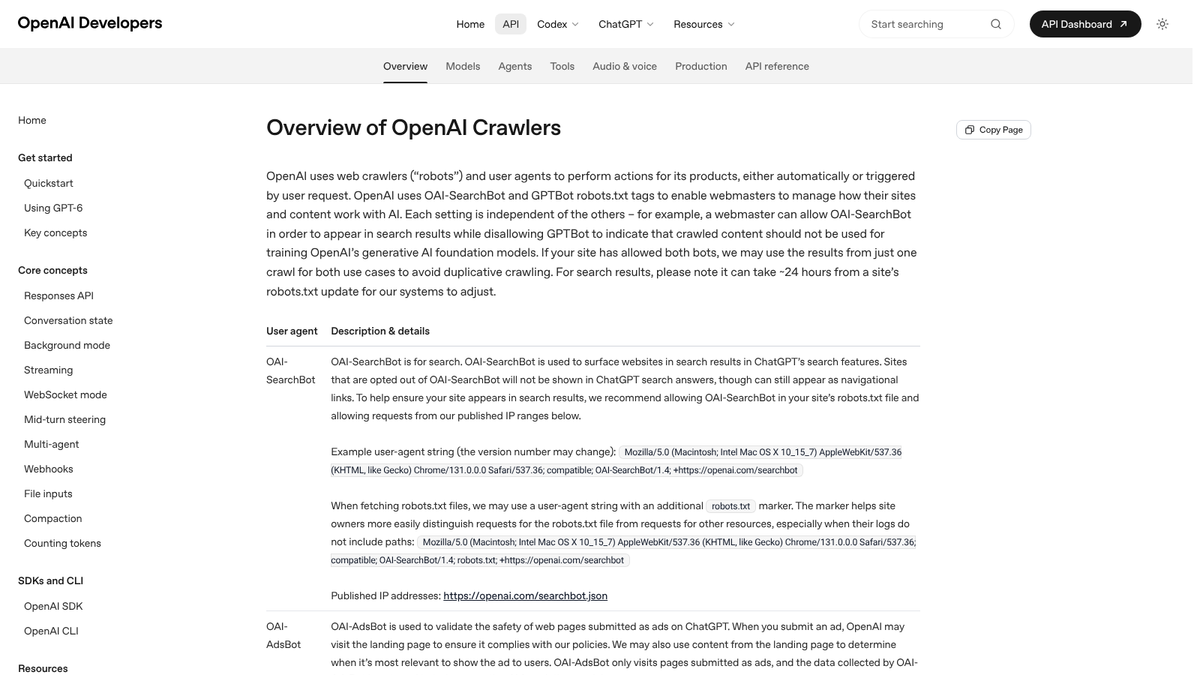
A few details on that page trip people up. OAI-SearchBot is separate from GPTBot, OpenAI's training crawler, so you can block training and still appear in search. A robots.txt change takes about 24 hours to register. OpenAI also asks sites to allow its published IP addresses, which means a firewall or bot-protection setting can shut ChatGPT out even when robots.txt lets it in. Our AI crawler list covers the other engines.
Once it can crawl, ChatGPT adds utm_source=chatgpt.com to the links people click in its answers, according to OpenAI's publisher FAQ. Those visits show up under that source in your analytics, with the landing page telling you what got cited.
Check whether it's working
Pick 10 to 20 questions your buyers ask, the specific kind that sets off a search. Ask them in ChatGPT every week or two, note whether you're cited and which page got the citation, and watch utm_source=chatgpt.com in your analytics. Once the list is set, that's an hour or two a week.
When a competitor gets cited in your place, open their page and run the lift test on it. Check whether the cited section answers in its first line and carries a number. If it does and yours doesn't, start there.
You can run all of it by hand: restructure the pages, fix the crawler settings and check the answers yourself. Or RankControl can take most of it. The content engine writes articles structured this way from the start, and each article it writes gets a citability score with a list of fixes. AI visibility tracking checks up to 50 questions every week on ChatGPT and five other engines, and shows which pages got cited instead of yours.
Covering more engines than ChatGPT? Our guide to optimizing SaaS content for six AI engines covers where they differ. Or start with a free check of your brand in AI answers.
Know exactly what AI says about your competitors.
RankControl's Recon Agent monitors competitor citations across ChatGPT, Perplexity, Claude, Gemini, Grok, Google AI Mode, and Google AI Overviews. See where they show up and you don't.