On September 26 we took the 133 pages that OpenAI's API and Perplexity's API cited across 12 B2B software questions and checked when each one was last published or updated. Of the 87 pages with a readable date, 78 carried a 2026 date. Half carried a date from mid-July or later.
The pages Google ranked in its top 10 for the same questions, but that neither engine cited, were older. Only 56% of them carried a 2026 date, and their median date was February 26, against July 14 for the cited pages.
Freshness is one lever among several, and it's the kind of evidence that should decide where your time goes. This guide ranks the levers that move AI search visibility in 2026 by the strength of the evidence behind them, and names the popular tactics that don't earn their time. Sources were checked on September 26, 2026.
Start with the evidence
The most useful summary of the evidence came from Cyrus Shepard in May. He gathered more than 50 published AI citation experiments, studies and patents, then scored each factor on how consistently it repeated across studies and how strong the evidence was.
New: AI Citation Ranking Factors Everyone talks about AI Citations as a way to boost visibility + traffic, but what works? To find out, I gathered every study/experiment from the past 2 years, and scored the biggest wins 22 Ranking Factors associated with earning AI citations https://t.co/lPhO42NFbv
 Cyrus SEO@CyrusShepardMay 7, 2026
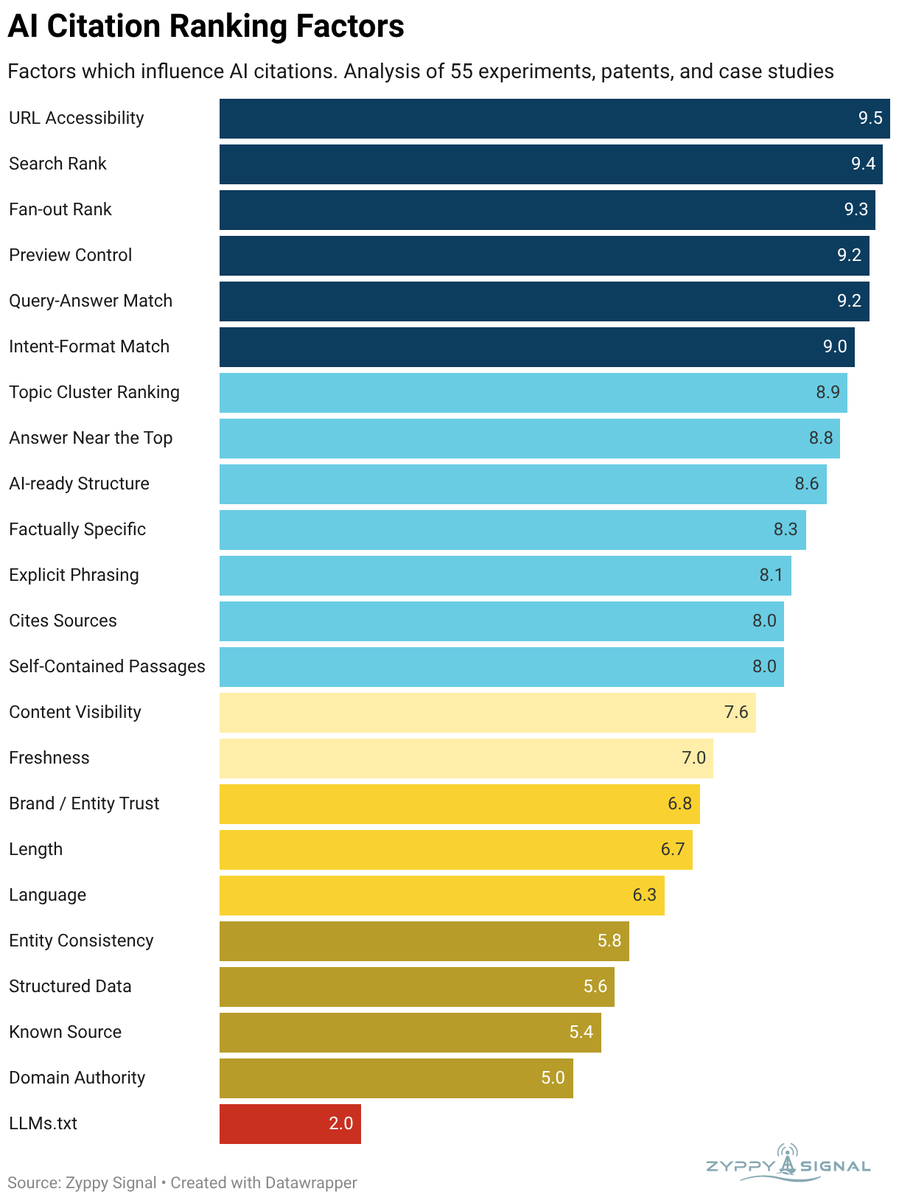
The top of his ranking reads like an SEO checklist:
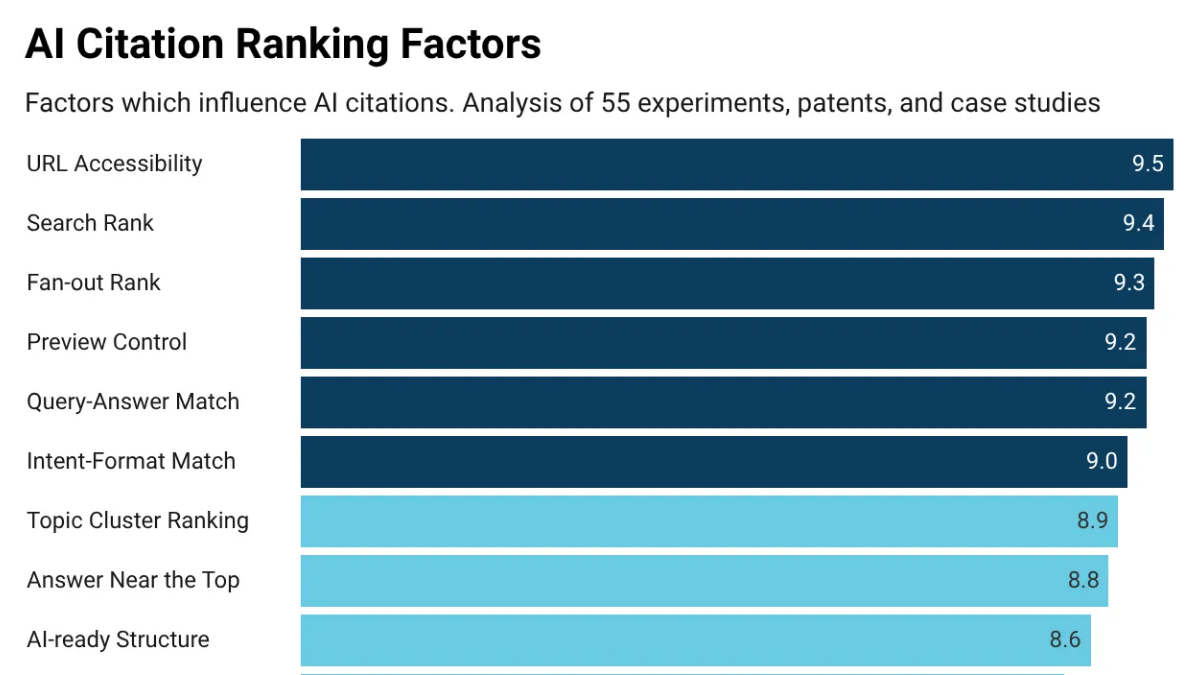
His own summary was that most of the critical factors align with traditional SEO: win SEO, win AI citations, most of the time with extra steps. The five levers below follow that order, with our own data where we have it.
Lever 1: Let the engines in
A page an engine can't fetch can't be cited, which is why URL accessibility scored highest. The common failures are quiet ones. A robots.txt rule meant for training crawlers can also block the search crawlers, such as OAI-SearchBot, PerplexityBot and Claude-SearchBot, that fetch pages for live answers. Since July 2025, Cloudflare has blocked AI crawlers by default for new domains unless the owner allows them, so a setting picked quickly at sign-up can quietly shut engines out.
Two smaller checks belong here too. Preview controls such as nosnippet limit what Google can show from a page, including in its AI features. And pages whose main content only appears after JavaScript runs can look empty to crawlers that don't render it.
This is the cheapest lever on the list. An afternoon checking your robots.txt and CDN settings will tell you whether it's a problem.
Lever 2: Rank in the index each engine searches
Search rank scored 9.4, but "rank" means different things per engine. When we compared citations with Google rankings for the same 12 questions, 40% of the pages cited in Google's AI Overviews ranked in Google's top 10, against 20% for Perplexity's API. None of the pages OpenAI's API cited ranked in Google's top 20.
Each engine searches its own index. Google's AI features draw on Google's, Claude uses Brave Search, ChatGPT runs its own index alongside Bing, and Perplexity has its own. Our check of AI citations against Google rankings maps which index feeds which engine, and why good Google rankings alone leave gaps.
A quick first step is to check your most important pages in Bing Webmaster Tools and with a site search on Brave. A page missing from those indexes is missing from several engines at once, however well it ranks on Google.
26 content formats. Published on your domain. Matched to your brand.
Guides, comparisons, listicles, case studies, and more. RankControl generates content that gets cited by ChatGPT, Perplexity, Claude, Gemini, Grok, Google AI Mode, and Google AI Overviews.

Lever 3: Cover the questions around the question
AI engines split a question into several searches before answering, a process Google calls query fan-out. Fan-out rank scored 9.3 and topic cluster ranking 8.9 in Shepard's review, and a December 2025 study of 173,000 URLs found pages ranking for the fan-out sub-queries were 161% more likely to be cited in Google's AI answers.
The practical version is one clear page for each distinct question buyers ask about a topic, linked together under a hub. When we ran six related SOC 2 questions through two AI engines, a site devoted to SOC 2 audits was cited in 6 of 12 answers, more than any large security brand. Our guide to topical authority for AI search covers how to build that kind of coverage.
Answer near the top, which scored 8.8, belongs with this lever. Each page should answer its question in the first few lines, because some engines read only a short snippet. A July 2026 study of 1,249 ChatGPT answers found the free tier often worked from about 200 characters of a page.
Lever 4: Keep pages current
Freshness scored 7 in Shepard's review, and he noted that it varies by query. Our own check suggests it counts for more in B2B software questions than that score implies. We call the difference the freshness gap: how much more recent the cited pages are than the ranking pages the engines skipped.
| Pages for 12 B2B questions | With a readable date | Dated 2026 | Median date |
|---|---|---|---|
| Cited by OpenAI's or Perplexity's API | 87 | 78 (90%) | July 14, 2026 |
| Google top 10 but not cited | 59 | 33 (56%) | February 26, 2026 |
All 14 dated pages that OpenAI's API cited carried a 2026 date. Two cautions apply. Some sites update their modified date automatically, so a recent date doesn't always mean recent content. And this is a correlation from one set of questions, so the engines may be favoring the kinds of pages that tend to be updated, such as vendor comparisons, and the date itself may matter less.
Citations also churn quickly. An analysis of 3.5 million citation events found half of ChatGPT's citations in a given week were gone within about 3.4 weeks. A page that isn't maintained tends to fall out of that rotation. If you can't refresh everything, start with the pages that already rank or get cited for your core questions, since those are the ones with the most to lose. Our guide to setting a publishing cadence shows how often to review each type of page.
What counts as a real update? New information, such as current prices or a changed recommendation. Google has warned against changing dates without substantial changes, and AI engines quote the page content, which a new date leaves untouched.
Lever 5: Get mentioned where engines look
Engines lean on what other sites say about you, especially when a question asks for recommendations. An Ahrefs study of 75,000 brands found branded web mentions correlated with AI visibility at 0.664, against 0.218 for backlinks. Our comparison of brand mentions and backlinks goes through that study.
Engines are also getting pickier about which sites they search. Lily Ray pointed out in July that newer ChatGPT models run more searches per answer and increasingly use site: queries to limit them to a handful of trusted sources.
I'm surprised more people aren't talking about the newish ways ChatGPT is structuring its fan-out queries to limit its searches down to a handful of trusted results. From the research I'm doing, I see a few trends: ⭐ the better models tend to do more searches and include more
 Lily Ray 😏@lilyraynycJul 31, 2026
That makes the sites your buyers already trust the ones worth being on: independent reviews, industry publications, comparison articles and the communities where your category gets discussed. Google has also warned against manufacturing mentions, so the durable route is earning them through original data and customers who talk about you.
Your competitors are getting cited by AI. You're not.
Every day without citation tracking is a day your competitors pull ahead in ChatGPT, Perplexity, and Claude.
What doesn't move it
The bottom of Shepard's ranking is just as useful, because it lists where teams spend time for little return.
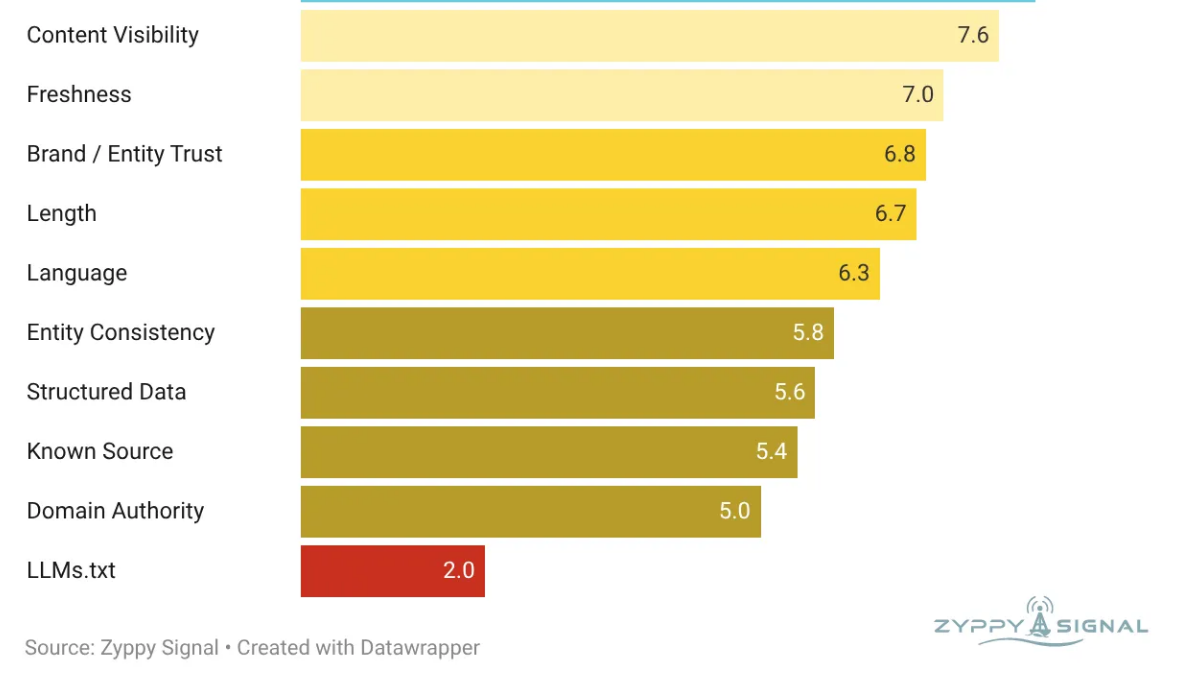
An llms.txt file scored 2 out of 10, because no credible experiment showed it improving citations. Our guide on writing an llms.txt file explains where it does help, which is mostly developer documentation.
Structured data scored 5.6. It can help engines understand a page, but markup alone doesn't earn citations, and Google stopped showing FAQ rich results in May 2026. Domain authority scored 5, a weak relationship in most studies.
The last trap is impatience. In late September a B2B services company posted in r/DigitalMarketing that two months of schema markup and three articles a week, among other work, had left citations basically flat. The replies put typical timelines for niche B2B at three to six months and pointed to third-party mentions as what moved results. One also warned that week-to-week changes often sit inside the noise of answers that vary between runs.
2 months into AI visibility work (schema, directories, 3 articles/week) and citations barely moved. What was your actual timeline?
B2B services company, niche industry. About 2 months ago we went all in on AI visibility. Here's what we've done so far: Article schema on every post, plus Organization schema sitewide Publishing 3 well-sourced articles a week Directory lis...
Putting the levers in order
Which lever should come first? Access, because it's cheap and blocks everything else. Then rankings in the indexes your buyers' engines use, then coverage of the questions around your core topics. Freshness and mentions are ongoing work that pays off over months.
Measure against a fixed set of questions run on a schedule, so you can tell a real change from noise. Our guide on how to check your AI visibility sets up that baseline.
Done by hand, publishing eight solid articles a month takes 16 to 24 hours, and checking 50 questions on seven engines takes about six hours a week. Those are rough estimates.
RankControl covers the repeatable levers. The Radar agent finds the questions your buyers actually search, checks them against real search data and plans titles onto your content calendar. The content engine writes each article against the pages already ranking for its keyword and publishes it on your own domain, and AI visibility tracking runs your 50 questions every week on seven engines and marks each one as mentioned, cited or both.
You can work through these levers yourself with a spreadsheet and a few afternoons. Or RankControl's agents can keep the content and tracking running every week while your team earns the mentions.
200+ SaaS teams already track their AI citations.
They know exactly when ChatGPT mentions their brand, and when it stops. Do you?