
A headline went around r/technology last month saying the price of AI is crashing faster than Moore's Law, and it collected more than 2,000 upvotes. Over in r/BetterOffline, a thread set out to debunk the same claim. Its sharpest reply said old models getting cheaper is like saying iPhones are getting cheaper because an iPhone 14 now costs less than it did at launch.
Both threads were arguing without much data. So on October 19 we pulled the full public catalog from OpenRouter, a service that routes developer traffic to hundreds of models, and counted. This page collects the LLM statistics that came out of it, along with the best published numbers on who uses these models and what for.
Our other stats posts cover the consumer side in more depth, including ChatGPT's user numbers and AI chatbot market share. This one is about the models themselves.
The numbers at a glance
| Measure | Figure | Source |
|---|---|---|
| Models in OpenRouter's catalog | 465 | OpenRouter, October 19, 2026 |
| Companies that made them | 66 | OpenRouter |
| Released in 2026 | 272 | OpenRouter |
| Median price per million input tokens | $0.50 | OpenRouter |
| Median price per million output tokens | $2.00 | OpenRouter |
| Models with a context window of 1 million tokens or more | 191 | OpenRouter |
| Open-weight models | 180 | OpenRouter |
| Top model author by developer requests | DeepSeek, 24.5% | OpenRouter rankings, week of October 5 |
| ChatGPT weekly users | More than 1 billion | OpenAI, August 2026 |
The catalog counts every version and variant as its own model. OpenAI alone has 104 entries, many of them dated snapshots or "pro" versions of the same family, so the number of truly distinct models is lower than 465.
How many LLMs there are
Three companies account for more than a third of the catalog. OpenAI had 104 entries, Google 44 and Alibaba's Qwen 43, followed by Anthropic at 30 and Mistral at 26.
The pace is the more striking number. Of the 465 models, 272 were released in 2026, 145 in 2025 and only 48 before that. Nearly six in ten models a developer can call today are less than a year old.
That churn matters if you build anything on top of these models. A model you test in January may be replaced, renamed or priced differently by summer, and several entries in the catalog already carry expiry dates.
What LLMs cost
Prices spread across a huge range. The cheapest paid model in the catalog charged about half a cent per million input tokens. The most expensive, OpenAI's o1-pro, charged $150 per million input tokens and $600 per million output tokens.
The middle is cheaper than most people expect. The median model cost $0.50 per million input tokens and $2.00 per million output tokens. For a sense of scale, a million tokens is roughly 750,000 words.
| Model | Released | Input price per million tokens | Output price per million tokens | Context window |
|---|---|---|---|---|
| GPT-4 | 2023 | $30.00 | $60.00 | 8,191 |
| GPT-4o | 2024 | $2.50 | $10.00 | 128,000 |
| Claude Opus 5.5 | September 2026 | $4.00 | $20.00 | 1,000,000 |
| GPT-6 Sol | September 2026 | $2.00 | $10.00 | 1,050,000 |
| Claude Haiku 5.5 | October 2026 | $0.10 | $0.50 | 1,000,000 |
| DeepSeek V4.1 Flash | September 2026 | $0.061 | $0.144 | 1,048,576 |
GPT-4 launched at $30 per million input tokens with an 8,000-token window. DeepSeek V4.1 Flash, the most used model on OpenRouter in mid-October, costs about six cents with a window more than 100 times bigger. That's roughly 490 times cheaper on input.
You're getting AI traffic. But do you know where it comes from?
RankControl credits every visit to the assistant that sent it: ChatGPT, Perplexity, Claude, Gemini, Copilot, or Grok. Full source attribution, next to your Google traffic.
Prices by model maker
The makers price very differently, and the split follows open and closed lines. These are the median prices across each maker's models in the catalog.
| Maker | Models listed | Open-weight models | Median input price | Median output price |
|---|---|---|---|---|
| Anthropic | 30 | 0 | $2.50 | $12.50 |
| OpenAI | 104 | 5 | $1.25 | $6.00 |
| xAI | 8 | 0 | $1.25 | $2.50 |
| 44 | 8 | $0.44 | $2.50 | |
| Z.ai | 18 | 14 | $0.52 | $1.99 |
| Qwen | 43 | 29 | $0.23 | $1.00 |
| Mistral | 26 | 13 | $0.23 | $0.68 |
| DeepSeek | 16 | 16 | $0.26 | $0.62 |
Anthropic had the highest median output price, about 20 times DeepSeek's. Every DeepSeek model in the catalog was open-weight, while Anthropic and xAI listed none. Eighteen models were free to call outright. Meta's eight Llama models, all open, had the lowest median of the big names at $0.10 per million input tokens and $0.31 per million output tokens.
So is AI getting cheaper?
Here's where the skeptics have a point. When we grouped models by release year, the median price of new models went up.
| Released in | Models | Median input price | Median output price |
|---|---|---|---|
| 2024 | 40 | $0.65 | $0.73 |
| 2025 | 145 | $0.30 | $1.50 |
| 2026 | 272 | $0.60 | $2.50 |
Models released in 2026 cost twice as much per input token as 2025 releases at the median, and two-thirds more per output token. Part of that likely comes from bigger reasoning models, which also use more tokens per task because they think before they answer.
So both Reddit threads were half right. A given level of capability gets cheaper very fast. The newest, most capable models don't, and output prices in particular have barely fallen at the top end. One reply in the skeptics' thread made the same point by comparing GPT-4's old $60 output price with today's frontier models at around $50.
We'd call this the iPhone 14 effect. Last year's capability gets cheap quickly, and the price of the newest model holds, sometimes climbing.
Context windows got huge
Context windows grew faster than prices fell. The median model in the catalog could take 262,144 tokens in one request, about 200,000 words. In all, 191 models, or 41%, accepted a million tokens or more, and the largest took two million.
GPT-4's original window was 8,191 tokens, roughly a 6,000-word document. A typical model today can read a long book in one go.
Size isn't the same as use, though. A bigger window lets a tool read a whole report, a codebase or a long web page at once, but most everyday questions still fit in a few thousand tokens.
How old a model's knowledge is
Every model stops learning at a training cutoff, and that date is often far behind its release. OpenRouter lists a knowledge cutoff for 172 of the 465 models. The most common cutoff year was 2024 with 65 models, then 2025 with 54 and 2023 with 32. Only 15 had a cutoff in 2026.
For the 29 models released in 2026 that list a cutoff, the median gap between cutoff and release was 144 days, almost five months. Then the model stays in use for months or years after that.
That gap is why AI answers lean so heavily on live web search for anything current. A model can't know a price you changed last month or a product you launched last week unless it finds your page. For marketers, it's the strongest argument for keeping key pages current and easy to crawl.
Open models are cheaper, and Chinese labs lead them
Of the 465 models, 180 had open weights, meaning anyone can download and run them. That's 39% of the catalog. Qwen led with 29 open models, followed by DeepSeek with 16 and Z.ai with 14. Open models also kept pace with the release rush, making up 93 of the 272 models released in 2026, about a third.
Open models were far cheaper to call. Their median price was $0.20 per million input tokens and $0.60 per million output tokens. Closed models had a median of $1.00 and $4.40, so closed output cost about seven times as much.
The gap in quality has narrowed too. A chart posted to r/dataisbeautiful this month argued that China's open-weight models now trail the best US closed models by about seven months, and it drew more than 900 upvotes. The most upvoted reply suggested they may never fully catch up, but could end up a few weeks behind at a lower price.
The AI race: China's open-weight models trail US closed models by just 7 months [OC]
Which LLMs developers actually use
OpenRouter also publishes weekly usage, and it looks nothing like the consumer charts. The OpenRouter rankings count tokens processed through its API, with data through October 17, 2026.
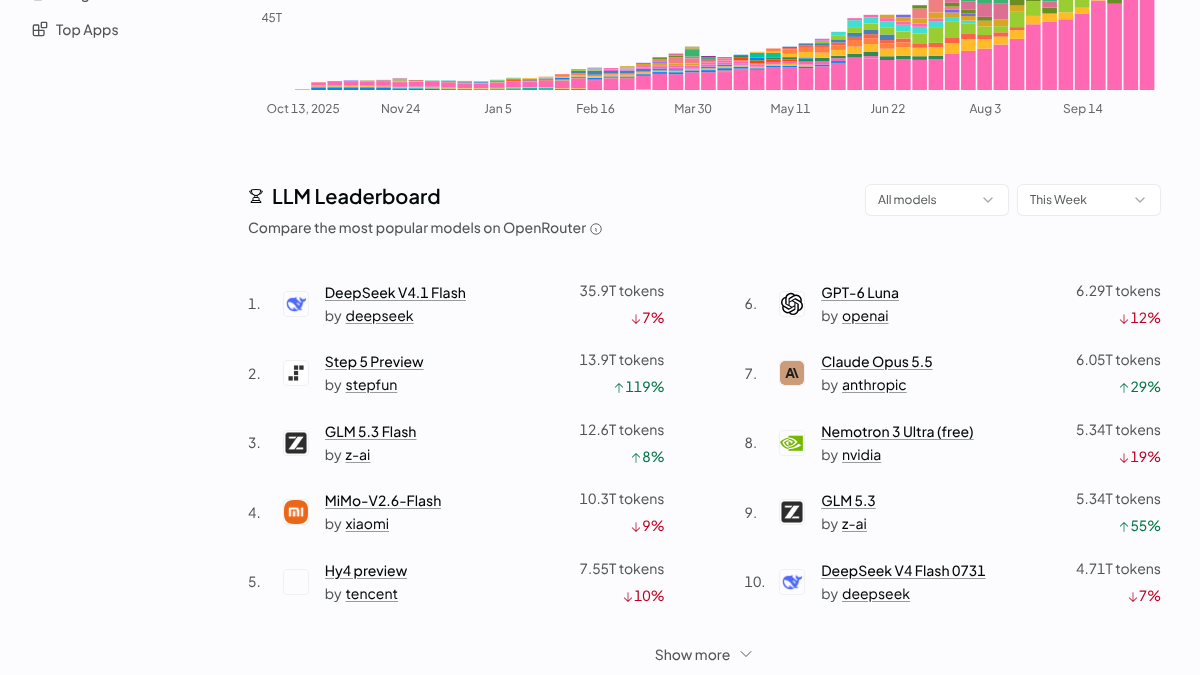
The top five models by tokens all came from Chinese labs. DeepSeek V4.1 Flash led with 35.9 trillion tokens in a week, more than the next two combined. GPT-6 Luna was sixth and Claude Opus 5.5 seventh.
By share of requests, the picture is a little more balanced.
| Model author | Share of text requests | Change on prior week |
|---|---|---|
| DeepSeek | 24.5% | +14% |
| OpenAI | 18.6% | +3% |
| 17.8% | -16% | |
| Z.ai | 13.4% | +107% |
| Qwen | 5.4% | -12% |
| Anthropic | 3.9% | +59% |
| All other authors | 16.3% | Mixed |
Week-to-week swings are large. Z.ai's requests more than doubled, Anthropic's rose 59% and Google's fell 16%, all in one week, while StepFun's Step 5 Preview more than doubled its tokens. A single week is a snapshot, so we'd watch a month of these charts before reading much into any one move.
Our ranking of the most popular AI tools shows which apps sit on top of these models. OpenRouter is careful about what this shows, and so should you be. Its own notes say the rankings count traffic routed through OpenRouter, and none of them measure users or spend. Big companies mostly call OpenAI, Anthropic and Google directly, so their usage barely appears here. What the chart does show is where cost-sensitive developers and apps send their tokens, and they send a lot of them to cheap open models.
We'll show you exactly where your brand stands in AI search.
No commitment. $0 due today, cancel anytime. See how ChatGPT, Perplexity, Claude, Gemini, Grok, and Google AI Mode talk about your brand today.

How many people use LLMs
The consumer side is dominated by a few apps rather than hundreds of models. ChatGPT passed 1 billion weekly users in August 2026, according to OpenAI. Alphabet reported 950 million monthly users for the Gemini app in July.
Measured across whole populations, the reach is narrower than those totals suggest. Microsoft's AI Economy Institute estimated that 18.8% of the world's working-age population used AI in June 2026, and 33% in the United States. Pew Research Center found 49% of US adults had used an AI chatbot by February. Our generative AI statistics break down use at work and at home.
So a billion weekly users and under one in five working-age people worldwide are both true at once. Our AI statistics roundup covers how those measures differ.
What people use LLMs for
Two large studies looked at real conversations rather than surveys.
The OpenAI and NBER study of 1.5 million ChatGPT conversations sorted messages into three kinds. Asking for information or advice made up 49%, doing a task like writing or coding made up 40%, and personal expression made up 11%. About 30% of consumer use was for work.
Anthropic's Economic Index, published in January 2026 and based on November 2025 conversations, found Claude used very differently. Coding-related tasks made up about a third of Claude.ai conversations and nearly half of business API traffic. Help with coursework and teaching had grown to 15% of Claude.ai conversations, up from 9% at the start of 2025.
| Study | Main finding | Data from |
|---|---|---|
| OpenAI and NBER | 49% asking, 40% doing, 11% expressing | ChatGPT conversations |
| Anthropic Economic Index | About a third of Claude.ai use is coding-related | November 2025 |
| Anthropic Economic Index | Top 10 tasks were 24% of Claude.ai conversations | November 2025 |
| Anthropic Economic Index | Office and admin tasks rose to 13% of API traffic | November 2025 |
Anthropic also found people working with Claude more than handing tasks off. Conversations where the user learns, iterates or gets feedback made up just over half of Claude.ai use, after briefly falling behind fully delegated tasks in mid-2025.
What the models can do now
Feature support has become standard across the catalog. Of the 465 models, 396 supported tool calling, which lets a model use outside functions such as search or a database. And 337 accepted a reasoning setting that controls how much the model thinks before answering.
Text-only models are now the minority. Only 146 accepted text alone, while the rest also took images, files, audio or video.
What this means if you market anything
Here's the useful takeaway for marketers. There are hundreds of models, but your buyers meet only a handful of them, inside ChatGPT, Gemini, Claude, Perplexity, Grok and Google's AI Mode. Those apps decide what gets read, quoted and cited.
The cheap models matter in a different way. Developers build agents, browser tools and research apps on top of them, and those tools read websites too. Pages that are crawlable, clear and specific get read by both the big consumer apps and the long tail of tools built on cheap models. Our guide on how to rank on ChatGPT covers the crawler side.
Tracking it by hand is slow, because each engine answers differently and changes week to week. RankControl's AI visibility tracking checks 50 buyer questions across those six engines every week.
How we gathered these numbers
We pulled OpenRouter's public model list through its API on October 19, 2026, and removed its own routing entries, leaving 465 models. Release years come from the date each model was added. Open-weight models are those with a published Hugging Face ID. Prices are OpenRouter's listed prices, which can differ slightly from each maker's direct price.
Usage figures come from OpenRouter's rankings page, which is published under a CC BY 4.0 license, with data through October 17. The consumer and study figures come from OpenAI, Alphabet, Microsoft, Pew and Anthropic as cited above.
What this costs to track yourself
Pulling a catalog like this takes an hour with a little code, and reading the rankings another hour. Keeping a stats page current takes a couple of hours a month, since prices and leaders change that often.
You can do all of that by hand. Or RankControl's agents can do the content side for you every month, writing and publishing articles built on current data and checking how six AI engines answer your buyers each week, while you focus on your product.
Know exactly what AI says about your competitors.
RankControl's Recon Agent monitors competitor citations across ChatGPT, Perplexity, Claude, Gemini, Grok, and Google AI Mode. See where they show up and you don't.