Search interest in Microsoft Copilot runs about twice as high on weekdays as on weekends. Netflix runs the other way, 22% lower on weekdays. ChatGPT, Claude and Gemini sit almost exactly between those two, at about one and a half times their weekend level.
That's from 90 days of US Google Trends data we pulled on October 19, 2026, and it says something the big surveys only hint at. Generative AI is now a work tool and a home tool at once, and each of the major apps leans a different way.
This roundup pulls the newest numbers from the Census Bureau, the St. Louis Fed, Gallup and Pew, all published in 2026, and splits them into work and home. Our AI statistics roundup covers the broader market, and our LLM statistics cover the models themselves.
Generative AI statistics at a glance
| Measure | Figure | Source |
|---|---|---|
| US adults 18 to 64 using generative AI, Q2 2026 | 61.8% | St. Louis Fed, Real-Time Population Survey |
| US adults who have used an AI chatbot, Feb 2026 | 49% | Pew Research Center |
| US employees using AI at work a few times a year or more, May 2026 | 52% | Gallup |
| US employees using AI at work daily, May 2026 | 15% | Gallup |
| Employed adults who used it for work in the past week, Q2 2026 | 39.2% | St. Louis Fed via FRED |
| Workers who've used AI for at least one of 11 job tasks, March 2026 | 56% | Census Bureau, HTOPS |
| US businesses using AI, May 2026 | 19.8% | Census Bureau, BTOS |
| Share of work hours saved by AI, Q2 2026 | 2.2% | St. Louis Fed via FRED |
The numbers don't all agree, and they aren't meant to. "Used AI" can mean once ever, once a year or every day, for any purpose or only at work. Each section below says which one it means.
How many people use generative AI
The broadest US measure comes from the St. Louis Fed's Real-Time Population Survey, which asks adults aged 18 to 64 whether they use generative AI at work, outside work or both. Its quarterly series on FRED put adoption at 61.8% in the second quarter of 2026, up from 51.9% a year earlier.
| Quarter | US adults 18 to 64 using generative AI |
|---|---|
| Q2 2025 | 51.9% |
| Q3 2025 | 54.5% |
| Q4 2025 | 55.9% |
| Q1 2026 | 57.9% |
| Q2 2026 | 61.8% |
That's about ten points in a year, with the biggest jump in the latest quarter. Pew's narrower question gets a lower number. In February 2026, Pew found 49% of all US adults had ever used an AI chatbot like ChatGPT, Gemini or Copilot.
The gap between 62% and 49% is mostly age. The Fed's survey stops at 64, and Pew's includes older adults, where use drops sharply.
| Age group | Have used an AI chatbot (Pew, Feb 2026) |
|---|---|
| 18 to 29 | 66% |
| 30 to 49 | 61% |
| 50 to 64 | 42% |
| 65 and older | 23% |
Pew also found 36% of Americans say they interact with AI at least several times a day. That question covers any contact with AI, including features built into other apps, so it measures exposure as much as choice.
Worldwide, adoption is much lower. Microsoft's AI Economy Institute put the share of working-age people who used AI at 18.8% in June 2026, against 33% in the US. Our AI statistics roundup breaks that down by country.
You're getting AI traffic. But do you know where it comes from?
RankControl credits every visit to the assistant that sent it: ChatGPT, Perplexity, Claude, Gemini, Copilot, or Grok. Full source attribution, next to your Google traffic.
How many people use AI at work
Gallup tracks this every quarter with a large employee panel. As of May 2026, 52% of US employees used AI in their role at least a few times a year, 30% used it a few times a week or more and 15% used it daily, according to Gallup's AI indicator.
The St. Louis Fed measures a tighter window, use for work in the past week. That share grew from 28.2% of employed adults in the third quarter of 2024 to 39.2% in the second quarter of 2026. So roughly four in ten American workers used generative AI on the job in any given recent week.
The Census Bureau asked a different way, about 11 specific tasks. In its March 2026 Household Trends and Outlook Pulse Survey, 56% of workers said they'd used AI for at least one of them.
Industry matters a lot. Gallup found daily AI use at 42% in technology, 27% in finance and 22% in professional services, while the other seven industries it tracks ranged from 9% to 15%.
The St. Louis Fed's September analysis went further, by occupation. Computer and information research scientists led at 87.3%, followed by information security analysts at 85.4%. Animal caretakers were lowest at 5.3%, with receptionists at 7.6%.
The same analysis found adoption is wide but shallow. In more than 80% of occupations, at least one in five workers uses AI on the job. But fewer than 3% of individual work tasks have adoption above 50%, and none passes 70%.
What people use AI for at work
Two surveys asked about tasks, and they line up well. The Census Bureau's survey ranked the top five ways workers have used AI.
| Task | Share of workers |
|---|---|
| Search for information or technical help | 37% |
| Write communications, documentation or instructions | 32% |
| Generate ideas | 32% |
| Interpret, translate or summarize information | 31% |
| Do administrative tasks | 27% |
Gallup, asking only AI users, found writing and editing first at 51%, then search or research at 49% and general problem-solving at 39%. Coding assistance and automation were each cited by 16% of users.
Education changes the mix. The Census found 46% of workers with a bachelor's degree used AI to interpret or summarize information, against 15% of those with a high school diploma or less.
There's a gender gap at work too, even though Pew found men and women now equally likely to have used a chatbot at all. Among Census respondents who used AI at work, 30% of men used it every day in the past week, against 17% of women.
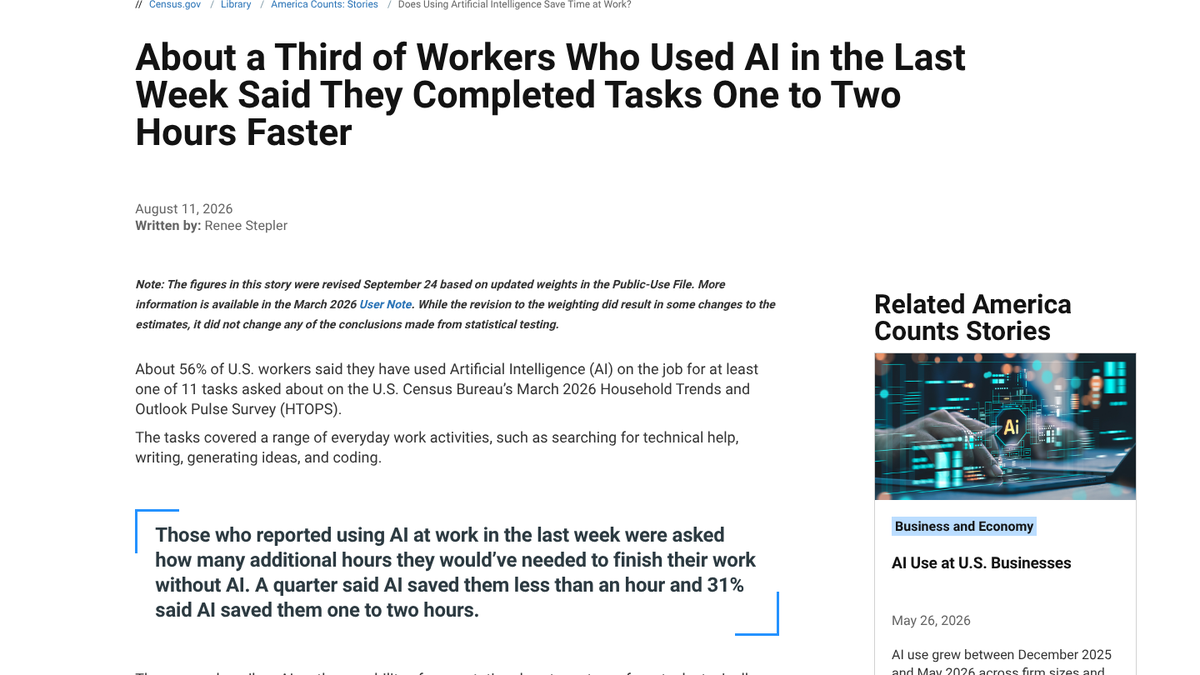
Does AI save time at work?
The Census asked people who used AI at work in the past week how many more hours they'd have needed without it. The answers spread widely.
| Time saved in the past week | Share of AI users at work |
|---|---|
| None | 10% |
| Less than an hour | 25% |
| One to two hours | 31% |
| Three to four hours | 15% |
| More than four hours | 15% |
| AI added time | 4% |
So about a third saved three hours or more, and one in seven saved nothing or lost time. The FRED data puts it in economy-wide terms. The share of all work hours saved thanks to AI rose from 1.6% to 2.2% over roughly two years, while the share of work hours AI assisted with rose from 4.1% to 6.3%.
That's a useful reality check. Individual workers report real savings, but across the whole labor force, AI still touches a small slice of the hours worked.
Gallup found the same split in attitudes. Among employees at organizations using AI, 65% said it had improved their productivity, but only 14% strongly agreed it had changed how work gets done. Productivity also climbed with breadth of use, from 45% positive among those using AI for one or two purposes to 90% among those using it for seven or more.
We'll show you exactly where your brand stands in AI search.
No commitment. $0 due today, cancel anytime. See how ChatGPT, Perplexity, Claude, Gemini, Grok, Google AI Mode, and Google AI Overviews talk about your brand today.
How many businesses use AI
The business picture is much lower than the worker one. The Census Bureau's Business Trends and Outlook Survey put AI use at 19.8% of US businesses as of May 2026, and between 17% and 20% over the prior six months, per its May analysis.
| Group | Businesses using AI (BTOS, May 2026) |
|---|---|
| All US businesses | 19.8% |
| Information sector | 39.7% |
| Finance and insurance | 33.9% |
| Firms with 250+ employees | 37% |
| Firms with 100 to 249 employees | 32% |
| Retail trade | About 14% |
The gap between 52% of workers and 20% of businesses isn't a contradiction. Most US businesses are small, and fewer than 20% of firms with four or fewer employees reported using AI. Bigger employers, where most people work, use it far more.
Gallup adds a view from inside companies. 47% of US employees said their organization had integrated AI tools as of May 2026, up from 41% a quarter earlier. But only 25% said their organization had a clear plan for it.
That gap between tools and plans shows up in what employees do on their own. In an October r/ChatGPT thread with 154 upvotes, someone asked whether their employer could see prompts from a personal ChatGPT account used on a work computer. The top reply, with 791 upvotes, was "Never use anything personal on a work computer."
How people use generative AI at home
Personal use is bigger than work use, even if surveys ask about it less. The OpenAI and NBER study of 1.5 million ChatGPT conversations found about 30% of consumer use was work-related, so roughly seven in ten conversations were personal.
The St. Louis Fed's survey asks about home use separately for that reason. Its overall adoption rate of 61.8% counts both, which is why it runs well above the 39.2% who used AI for work in the past week.
Reddit gives a sense of what the home side looks like. A September r/AskUK thread asking what people actually use AI for drew 948 comments. The top reply said it works best as a search engine when you're not sure what you're looking for. Others used it for meal plans for a family of five, checking a local auction's 500 listings for retro games and writing up meeting minutes.
What do you ACTUALLY use "AI" for that genuinely saves you time, in detail?
This comes up all the time on this sub but I've never ever seen anyone go into any actual detail about how they use Generative AI tools and why it saves time or is better over other methods. To make clear here, I'm talking about "AI" - the...
The second most upvoted reply, with 301 votes, said they consciously use AI for nothing, but can't avoid it in Google's results. That's a fair summary of the other half of the population.
Who still doesn't use it, and why
Pew asked the 51% of Americans who don't use chatbots why. Lack of interest led, with 60% calling it a major reason. Concern about how personal information would be used came next at 54%, and distrust of the answers' accuracy at 45%. Only 29% said not knowing how was a major reason.
Most of them don't plan to change. About seven in ten non-users said they're unlikely to use a chatbot in the next year, including 40% who said they're not at all likely. Only 5% said it was highly likely.
So the next stretch of adoption will be slower than the last one. The easy converts have mostly converted, and the rest have reasons that a better model won't fix on its own.
Our check: when people search for each AI tool
Surveys ask what people do. Search data shows when they do it. We pulled 90 days of daily US Google Trends interest, from July 19 to October 19, 2026, for the main AI tools and for three benchmarks. We then divided each term's average weekday interest by its average weekend interest.
| Search term | Weekday interest vs weekend |
|---|---|
| Excel (work benchmark) | 2.78x |
| Outlook (work benchmark) | 2.47x |
| Microsoft Copilot | 1.99x |
| Claude | 1.52x |
| ChatGPT | 1.50x |
| Gemini | 1.48x |
| Perplexity | 1.33x |
| Grok | 1.12x |
| Netflix (home benchmark) | 0.78x |
We'd call this the weekday ratio. A score near 2.5 behaves like office software, and one below 1 behaves like home entertainment. Copilot sits closest to the office tools, which fits a product built into Microsoft 365. Our Microsoft Copilot statistics cover its paid seats. Grok sits closest to home, which fits a chatbot built into a social app.
ChatGPT, Claude and Gemini cluster together at about 1.5. They're used at work more than at home, but far less exclusively than Excel. That matches the surveys, which find heavy work use alongside even more personal use.
Two caveats matter. A search for a tool's name is often just someone opening it, so this measures when people go looking, not how long they use it. And the window covers the start of the school year, when students add weekday searches of their own.
What this means if you sell to these people
For B2B marketers, the work numbers are the ones to watch. Four in ten US workers used AI on the job in a recent week, and the most common use was searching for information. A buyer researching software on a Tuesday afternoon is now fairly likely to ask a chatbot as well as Google. Our study of B2B buyers and AI search covers how that changes software research.
The weekday ratio also suggests timing. If your buyers are at work, they reach AI tools most on weekdays. Content that answers their work questions, with clear facts an AI can quote, is the content those sessions will find.
For consumer brands, the home numbers matter more. Seven in ten ChatGPT conversations aren't about work, and they include product questions, meal plans and travel. Our ChatGPT statistics cover what people ask it.
How we gathered these numbers
Every statistic here comes from a primary source published in 2026, checked on October 18 and 19. The survey figures come from the St. Louis Fed's Real-Time Population Survey via FRED, Gallup's quarterly employee panel, the Census Bureau's HTOPS and BTOS surveys, and Pew's February 2026 survey published in June. The Google Trends figures come from our own pull, with each term measured on its own 0 to 100 scale so small terms aren't rounded away.
We skipped secondhand statistics we couldn't trace to a primary source.
Tracking how AI talks about you
Knowing how many people use AI is the easy part. Knowing what it says when they ask about your category is harder, and it changes week to week.
You can check that by hand, asking each AI tool your buyers' questions every week and noting who gets named. Or RankControl can do it for you, checking 50 of your buyers' questions across ChatGPT, Perplexity, Claude, Gemini, Grok, Google AI Mode and Google AI Overviews every week, and writing the articles that answer the questions where you're missing, while you focus on your product.
Know exactly what AI says about your competitors.
RankControl's Recon Agent monitors competitor citations across ChatGPT, Perplexity, Claude, Gemini, Grok, Google AI Mode, and Google AI Overviews. See where they show up and you don't.