
If you ask Google what Microsoft 365 Copilot Business costs, the answer can be wrong. We searched on October 19, 2026. The AI Overview said the plan costs $21 a user a month, "previously $18 until June." Microsoft's own pricing page says the reverse. The plan now starts at $18, and it used to be $21.
That mix-up is easy to make, because "Copilot" isn't one product. Microsoft 365 Copilot is the work version, and the Copilot app is the free one. Developers use GitHub Copilot. Then there's Copilot inside Bing and Edge. Microsoft reports on some of these every quarter and stays quiet about the others.
So in this roundup of Microsoft Copilot statistics, I've kept only figures that have a source and a date. Most of them come from Microsoft's earnings calls. The rest are from Statcounter, Similarweb and Google search volume estimates, which we pulled on October 19. Microsoft reports its next quarter on October 28, 2026, so expect some of these to move soon.
Microsoft Copilot statistics at a glance
| Statistic | Figure | Source |
|---|---|---|
| Paid Microsoft 365 Copilot seats | Over 30 million | Microsoft earnings call, July 29, 2026 |
| GitHub Copilot users | 50 million | Microsoft earnings call, July 29, 2026 |
| Bing monthly active users | 1 billion | Microsoft earnings call, April 29, 2026 |
| Copilot app daily users | Nearly 3x in a year | Microsoft earnings call, January 28, 2026 |
| Copilot's share of AI referrals, worldwide | 1.78% | Statcounter, September 2026 |
| Copilot's share of AI referrals, US | 6.69% | Statcounter, September 2026 |
| Copilot's share of AI site visits | 1.5% | Similarweb, September 2026 |
| Bing's share of searches, US | 9.91% | Statcounter, September 2026 |
| Bing's share of US desktop searches | 18.83% | Statcounter, September 2026 |
| Microsoft 365 Copilot Business price | From $18 a user a month, yearly | Microsoft pricing page |
Microsoft 365 Copilot paid seats
Microsoft is most careful with this number, since it's the one investors watch. It has grown fast this year.
| Earnings call | Paid Microsoft 365 Copilot seats | What else Microsoft said |
|---|---|---|
| January 28, 2026 | 15 million | Seat adds up over 160% year over year; daily users up 10x |
| April 29, 2026 | Over 20 million | Seat adds up 250% year over year; Accenture at 740,000 seats |
| July 29, 2026 | Over 30 million | Net seat adds more than doubled from the quarter before |
The calls added color, too. In April, Satya Nadella said Copilot queries per user were up nearly 20% on the quarter before. He also said weekly use had caught up with Outlook. In July he said the number of enterprise customers rolling Copilot out to most of their information workers grew nearly 75% in one quarter.
Thirty million sounds big. Set against Microsoft's base, it's small. In February, The Register reported Microsoft figures showing that only 3.3% of Microsoft 365 users who touch the free Copilot Chat pay for Copilot. Digital Applied ran its own analysis in July. It put paid seats at roughly 6.5% of an estimated 464 million commercial Microsoft 365 seats.
AI search traffic grew 835% this year. Is your content ready?
RankControl generates 26 content formats optimized for ChatGPT, Claude, and Perplexity. Published on your domain, matched to your brand.

Ask IT teams how it's going and you'll hear mixed reports. In October, a thread in r/Office365 asked whether Copilot had changed how people work once it was rolled out.
Has Copilot actually changed how your users work yet?
We keep hearing about Copilot adoption, but I’m curious what it looks like after the initial rollout. Are users actually saving time with it, or is it mostly a tool people try once and forget about? Also curious whether the bigger challenge...
The top reply said people ran everything through Copilot and never proofread it. Another said lots of users tried Copilot and then moved to ChatGPT and Claude on their own. One person just said Copilot in Excel is quite good. That's one thread, I know. Still, it lines up with the gap analysts keep pointing to between seats sold and seats used.
The consumer Copilot app
On the free Copilot app, Microsoft says far less. The last firm figure we found came in January. Microsoft said daily users of the Copilot app had grown nearly three times in a year, and it didn't give a total.
Reddit is split on it too. An October post in r/CopilotMicrosoft was titled "Copilot Isn't Nearly as Bad as Reddit Makes It Sound", and it drew 93 upvotes. People who use it every day seem to like it more than its reputation suggests.
Guesses fill the gap. The stats pages we checked put consumer Copilot anywhere from 33 million to 145 million monthly users, and most don't say who measured it. I'd treat those as estimates at best.
Outside data hints that the consumer side is growing more slowly than the work side.
| Consumer signal | Earlier | September 2026 |
|---|---|---|
| Copilot's share of visits to generative AI websites (Similarweb) | 2.0% in October 2025 | 1.5% |
| US Google searches a month for "microsoft copilot" | About 823,000 in September 2025 | 550,000 |
| US Google searches a month for "bing chat" | 22,200 | 6,600 |
The search counts are Google search volume estimates, and "bing chat" is the old name Copilot used to go by.
GitHub Copilot
For public numbers, the developer product is the clearest. In January, Microsoft said it had over 4.7 million paid Copilot subscribers, up 75% in a year. In July, Nadella said GitHub Copilot now has 50 million users.
Don't read those two as growth. One counts paid subscribers and the other counts all users. What they do show is that developers are one of Copilot's biggest audiences.
Copilot in Windows and Edge
Where Copilot lives is its biggest edge. It's built into Windows, the Edge browser and Office, so people run into it without going looking for it.
In April, Nadella said monthly active Windows devices had passed 1.6 billion. He said Edge had also taken share from other browsers for 20 quarters in a row. Both are Microsoft's own counts.
Statcounter counts page views across its network, and its line is bumpier. It had Edge at 13.78% of desktop browser use worldwide in September 2024. A year later Edge was down to 10.37%. This September it was back up at 14.64%. In the US, Edge went from 15.62% to 14.83% over the same two years.
So Edge keeps a steady slice of desktop use. The smooth climb the earnings calls describe just doesn't show up in outside data.
What does that mean for you? Plenty of office workers search from Edge on Windows, with Bing and Copilot one click away. If your buyers work at desks, Copilot can reach them, even if few of them picked it.
Copilot's share of AI referral traffic
If you run a website, the Copilot number that matters most is how often it sends you visitors. Statcounter tracks the visits AI chatbots send to sites across its network, and we exported its monthly data on October 19.
| Month | Copilot, worldwide | Copilot, US |
|---|---|---|
| April 2025 | 0.23% | 0.61% |
| May 2025 | 5.18% | 12.44% |
| October 2025 | 3.47% | 8.74% |
| January 2026 | 3.50% | 7.98% |
| April 2026 | 3.76% | 12.65% |
| July 2026 | 3.07% | 8.98% |
| September 2026 | 1.78% | 6.69% |
In the US, Copilot is a much bigger referrer than it is worldwide. This September it sent more AI referrals than Perplexity did in the US. Worldwide it came fourth, behind ChatGPT, Gemini and Perplexity. Our Perplexity statistics go into that matchup in more detail.
It's a desktop product, too. Worldwide in September, Copilot had 2.00% of AI referrals on desktop and just 0.33% on mobile. You'd expect that from a tool that ships inside Windows, Edge and Office.
Copilot by country
Copilot's share of AI referrals swings a lot from one country to the next. Here's Statcounter's September 2026 data for a few big markets.
| Market | Copilot's share of AI referrals |
|---|---|
| United States | 6.69% |
| United Kingdom | 5.68% |
| Germany | 3.06% |
| Worldwide | 1.78% |
| India | 1.70% |
In the UK that month, Copilot sent about twice as many AI referrals as Perplexity. In India it trailed Gemini and Perplexity, though it still beat Claude. If most of your buyers are English-speaking businesses, Copilot deserves more of your attention than the worldwide figure implies.
How Copilot compares with other AI assistants
Set the two outside measures next to each other and Copilot looks a bit different from its rivals.
| Assistant | Share of AI site visits (Similarweb, Sept 2026) | Share of AI referrals (Statcounter, Sept 2026) |
|---|---|---|
| ChatGPT | 56.4% | 80.47% |
| Gemini | 25.0% | 10.94% |
| Claude | 9.6% | 0.95% |
| Copilot | 1.5% | 1.78% |
| Perplexity | 0.9% | 5.84% |
Copilot's two numbers sit close together. That suggests its users click through to websites at about an average rate. They click more than Claude's users do and less than Perplexity's. Our AI chatbot market share analysis explains why the two measures differ.
Mind what's missing, though. Similarweb counts website visits, so Copilot use inside Windows, Office and the apps never shows up there. Statcounter counts clicks to the sites in its network. Neither one picks up the work use that Microsoft's seat numbers describe.
Bing's reach
Copilot reaches search users through Bing. In April, Nadella said Bing had passed 1 billion monthly active users for the first time. He said Edge had taken browser share for 20 straight quarters. In July he said Bing and Edge had both taken share for five straight years.
Statcounter's search data shows that growth, but slowly.
| Month | Bing, worldwide | Bing, US |
|---|---|---|
| September 2024 | 3.96% | 7.03% |
| September 2025 | 4.10% | 8.50% |
| February 2026 | 4.98% | 10.48% |
| September 2026 | 5.29% | 9.91% |
The number to watch is US desktop. This September, Bing had 18.83% of US desktop searches and only 2.15% on mobile. Our search engine market share roundup has the full split by country and device.
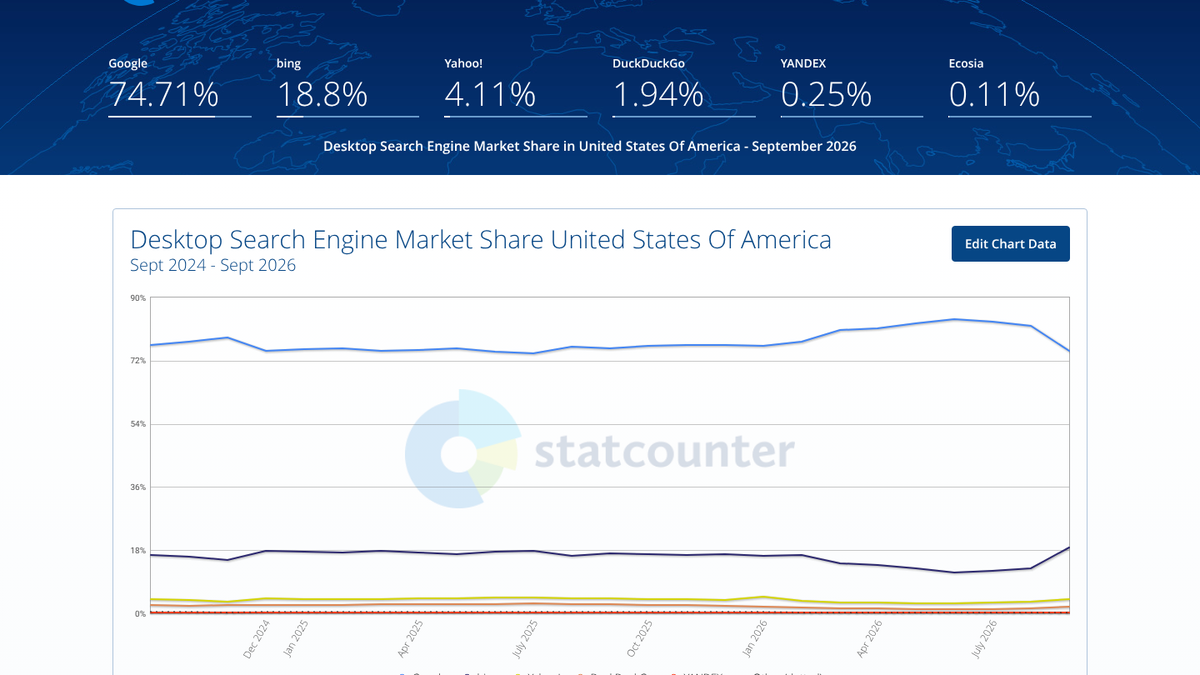
That desktop line jumps around. Bing's US desktop share fell from 16.66% in February to 11.65% in June. By September it had shot up to 18.83%. I wouldn't lean on any single month.
Some sites get far more Bing traffic than they'd guess. In August, a founder posted in r/SaaS that Bing sent 33 times more clicks than Google over 30 days. That was 5,000 clicks against 150, because Bing ranked their pages much higher.
Bing sends me 33x more traffic than Google. Never saw that coming
Solo founder here, been shipping SaaS for years. My first product was an (NSFW) AI companion platform. Did the normal SEO stuff. Sitemap, Search Console, content, backlinks, wait. Last week I finally put my Google numbers next to my Bing We...
One reply pointed out that Bing's numbers include results from DuckDuckGo, Yahoo and Ecosia, which draw on Bing's index. Keep that in mind when you compare engines in your own reports.
Search ads tell the same story
Microsoft also reports search and news ad revenue, which follows how much people use Bing and Edge. Leaving out what it pays partners, that revenue grew 10% in the quarter it reported in January. April's call put growth at 12%, and July's at 10% again. In April, Microsoft said the growth came from more searches and more revenue per search across Edge and Bing.
In July it said growth was held back by third-party partnerships, without naming them. Bing's index powers other search engines too. So a change in one of those deals can move Bing's numbers for reasons that have little to do with Copilot.
Prices for Copilot at work
If your team is weighing Copilot, here's what Microsoft's pricing page listed on October 19. Microsoft 365 Copilot Business started at $18 a user a month, paid yearly, down from $21. Microsoft also sells Microsoft 365 Business Standard with Copilot included, at $23.50 a user a month. Our comparison of AI content creation tools for SEO teams sets that next to ChatGPT Business and Claude Team.

Built by the team that got cited in 48 hours.
Content generation, backlink building, AI visibility tracking, and Google rankings. One platform, zero guesswork.
What these numbers mean for your website
Worldwide, Copilot is a small AI referrer. In the US it's a real one, most of all for business buyers on desktop. That leads to four things I'd do.
Start by checking how Bing sees your site. Copilot's web answers draw on Bing, so a page Bing can't find can't be cited. Our guide to submitting a sitemap to Google and Bing covers the setup.
Then open the AI Performance report in Bing Webmaster Tools. Bing added it in early 2026. It shows how often Copilot and Bing's partners cited your pages, by day and by page. Google's Search Console has a similar report for AI Overviews and AI Mode, so with both you can see most AI search citations for free. Our guide to tracking Bing rankings alongside Google and Copilot puts the two reports in one sheet.
Keep an eye on copilot.microsoft.com in your analytics referrals as well. If your buyers work at companies on Microsoft 365, that line may matter more than its worldwide share suggests.
And don't plan around consumer user counts. The work side and the Bing side have real numbers behind them, and the consumer app doesn't. For what to change on your pages, see our Bing and Copilot optimization playbook.
What to watch on October 28
Microsoft's next earnings call is on October 28, 2026, four days after this post goes live. Here's what I'll be checking when it lands.
The big one is paid Microsoft 365 Copilot seats. Over the last three calls the count went from 15 million to over 20 million. Then it passed 30 million. What I want to know is whether the jump keeps getting bigger.
A total for the Copilot app would be news, since Microsoft hasn't given one this year. Bing users and search ad growth will show whether Copilot is pulling more people into Microsoft's search. For GitHub Copilot, July's 50 million users is the base to compare against.
Price matters too. A cut or a new bundle for Copilot at work would say a lot about how hard the seats are to sell.
If the new figures change the picture, check them against the outside data above before you quote them. A big number on an earnings call is a claim about one product, and it doesn't cover all of Copilot.
How to read Copilot statistics without getting fooled
The first thing to ask is which Copilot a number is about. Microsoft 365 Copilot, the Copilot app, GitHub Copilot and Copilot in Bing are separate products, each with its own numbers. Then see whether a figure counts paid users or everyone. GitHub's 4.7 million paid subscribers and its 50 million users are two different counts, and together they don't tell a growth story.
Dates matter as well, since Microsoft reports every quarter and the next update lands on October 28, 2026.
Be careful, too, with headline figures that nobody said on the call. Digital Applied found that a widely shared "$37 billion Copilot AI revenue" figure came from April's call, not July's. Our AI statistics roundup covers the same problem across the wider market.
How much this takes to track by hand
Keeping these numbers current takes about two hours a quarter. You read Microsoft's earnings transcript the day it's posted. You export Statcounter's AI chatbot and search engine data for your main countries, and you note Similarweb's monthly post. Then each month you check Bing Webmaster Tools and your own analytics, which takes about an hour each time.
That tells you how Copilot is doing in general. It won't tell you whether AI engines cite you for your buyers' questions. Checking that by hand across engines takes two to four hours a month for 20 questions.
You can do all of this by hand. Or RankControl can do much of it for you, checking seven AI engines every week for the questions your buyers ask and writing the pages that answer them, while you focus on your product. The seven are ChatGPT, Perplexity and Claude, Gemini and Grok, and Google AI Mode and Google AI Overviews.
See your first AI citation report in under 5 minutes.
No setup calls. No onboarding meetings. Connect your domain and see where AI mentions your brand right now.