
We searched "ai statistics" on Google this week to see what a marketer gets back. The AI Overview opened with "72% of businesses have integrated AI into at least one function", a line lifted from a Forbes Advisor list first published in April 2023. Then it switched topics and printed Allen Iverson's career NBA averages, since he's also known as "AI". Iverson scored 26.7 points a game, if you were wondering.
Below that sat an Adobe blog post from 2017 and five pages with 2023, 2024 or 2025 in their titles. About 2,400 people a month in the US search for AI statistics, according to Google search volume estimates, and a lot of them are pasting these numbers into decks and posts.
So this page does two jobs. It gives the 2026 numbers that matter for marketing decisions, each checked against its source. And it lists the old numbers that keep coming back, so you can stop quoting them.
What Google ranks for "ai statistics" right now
We pulled Google's first 20 positions for the search on October 19, which held 19 regular results, and read every page that was a list of AI statistics. That came to 15 pages. The other four went to a statistics conference, a tool list, a YouTube video and Our World in Data.
| What we checked | Pages |
|---|---|
| AI stats list pages in the results | 15 |
| Title year before 2026, or published in 2017 | 6 |
| 2026 in the title | 5 |
| Quote PwC's 2017 forecast of $15.7 trillion by 2030 (of 14 we could read) | 5 |
| Quote the World Economic Forum's 2020 jobs figures | 3 |
| Cite McKinsey somewhere | 7 |
The PwC number is the one to watch. It came from a 2017 report, before ChatGPT existed, and five of the 14 pages we could read still use it. One of them adds that $15.7 trillion is more than the combined GDP of China and India.
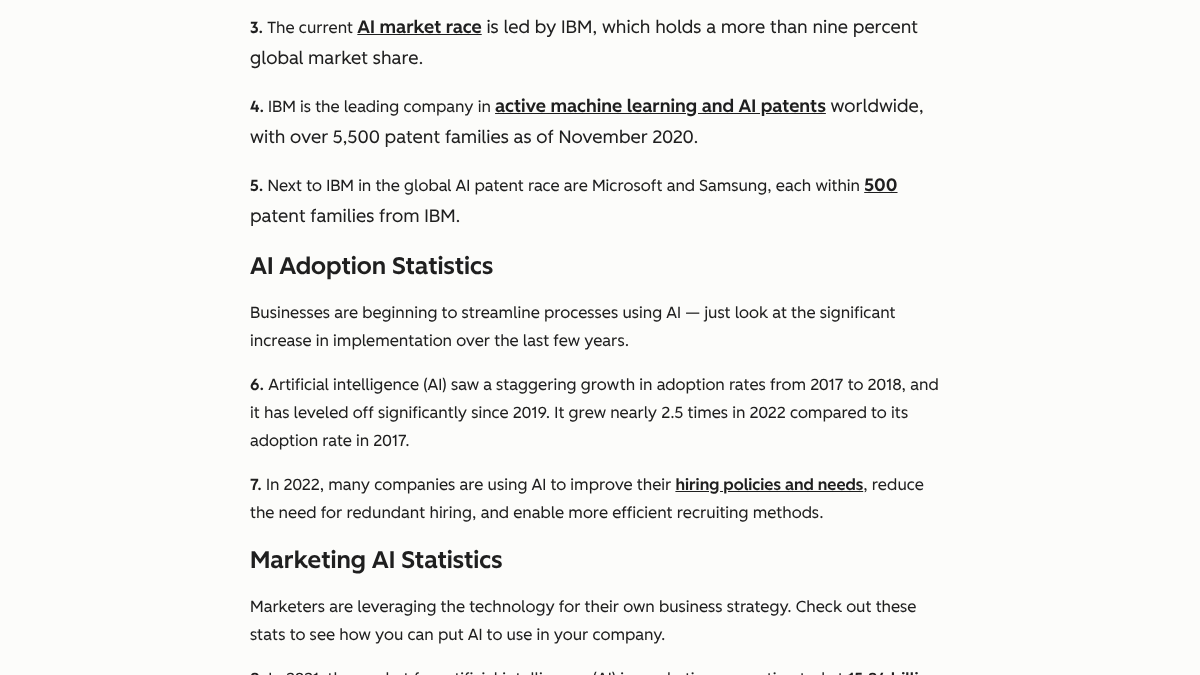
A new date on top doesn't mean new numbers below it. HubSpot's list of 20 AI statistics marketers need to know carries an update date of March 9, 2026 under the title. Its fourth item counts IBM's AI patents "as of November 2020", and its marketing section opens with a 2021 market size and an October 2022 survey.
None of this makes those writers careless. A stats page is cheap to retitle and slow to re-source, so the title moves and the body stays. Our post on statistics and data roundup posts covers why these pages get cited so often by AI engines, which is part of why the old numbers spread.
Zombie stats, and how to spot one
We've started calling these zombie stats. A zombie stat is a number that keeps getting quoted long after its source has been replaced, usually because each page copies the last page instead of the study.
You can catch most of them with four questions before a number goes into your deck.
- What year was the source published? Not the page you found it on, the actual study.
- Is it a forecast or a count? "Will add $15.7 trillion by 2030" is a guess made in 2017.
- Is it a survey or measured behavior? A survey tells you what people say. Traffic data tells you what they did.
- Has the same source published a newer number? McKinsey runs its AI survey every year, so a 2024 McKinsey figure is out of date by design.
That last one catches the AI Overview's opening line. The 72% figure matches what McKinsey reported in early 2024. McKinsey's newest survey, published in August 2026, puts it at nearly nine in ten.
200+ SaaS teams already track their AI citations.
They know exactly when ChatGPT mentions their brand, and when it stops. Do you?
How many people use AI in 2026
Here's where the numbers disagree most, because "use AI" means different things in each study. The honest answer depends on which people and which time window you pick.
| Measure | Figure | Source |
|---|---|---|
| Working-age people worldwide who used AI, June 2026 | 18.8% | Microsoft AI Economy Institute |
| Working-age people in the US, June 2026 | 33% | Microsoft AI Economy Institute |
| EU adults (16 to 74) who used generative AI in the past 3 months, 2025 | 33% | Eurostat |
| US adults who have used an AI chatbot, February 2026 | 49% | Pew Research Center |
| US adults who use a chatbot every day | 24% | Pew Research Center |
| ChatGPT weekly users, August 2026 | More than 1 billion | OpenAI |
The world figure surprises people. The AI Economy Institute at Microsoft found AI use rising in nearly every country in the second quarter, but the global rate was still under one in five working-age people. The UAE led at 73.3% and Singapore came next at 64.3%, while the US sat 21st.
A chart built on that data drew more than 1,700 upvotes on r/dataisbeautiful in September, showing that 80% of the world had still never used generative AI. The most upvoted reply pointed out that 26% of people don't have clean water.
[OC] Each dot is ~3.2 million people: 80% of the world has still never used generative AI (Sep 2026)
Age splits the picture more than anything else. Eurostat's survey found 64% of Europeans aged 16 to 24 had used generative AI, against 7% of those aged 65 to 74. Among people who hadn't used it, 64% said they simply didn't feel the need, which is a much bigger reason than privacy (7%).
For a marketer, the useful read is that your audience's age decides how much of this applies to you. A B2B buyer in their thirties is far more likely to ask a chatbot than the retiree buying garden furniture. Our generative AI statistics split US use between work and home. Our ChatGPT statistics post goes deeper on who uses ChatGPT and for what.
How many companies use AI, and what it pays
McKinsey's State of AI in 2026 surveyed 1,719 people in 97 countries in May and June. Nearly nine in ten said their organization uses AI regularly in at least one business function. 44% said AI is now scaling across the enterprise, up from 38% a year before.
The money hasn't followed. Just 37% said AI had added anything at all to their company's EBIT, the same share as in 2025. Only 6% qualified as what McKinsey calls high performers, meaning AI drives at least 5% of EBIT and the impact is significant.
That gap between personal and company gains is the number we'd show a CFO. Eight in ten respondents said AI made them personally more productive. An investor summed up the same split on X, with 80% feeling faster against 37% seeing any profit impact.
🤖The AI conversation is shifting from adoption to ROI. McKinsey & Company & QuantumBlack, AI by McKinsey’s new State of AI in 2026 report highlights a fascinating disconnect: ⚡ 80% of people say AI is making them more productive. 💰 But only 37% of companies report any https://t.co/O9ZUX7p3WC
 Constantin Kogan@constkoganSep 1, 2026

Two smaller findings matter for marketing budgets. When respondents linked AI to revenue gains, marketing and sales came up more than any other function. And about one in five said AI running costs, tokens included, were already limiting how much they use it.
The jobs story is softer than headlines suggest. In 2025, 32% of McKinsey's respondents expected AI to shrink their workforce over the next year. This year, only 14% said it actually did.
What marketers actually do with AI
Search for a 2026 figure on how many marketers use AI and you'll find five answers on the first page. We saw 77%, 78%, 84%, 87% and 95%. They aren't contradicting each other so much as counting different things, from "uses at least one AI tool" to "uses AI for first drafts".
The strongest of them comes from the Content Marketing Institute, which surveyed 1,015 B2B marketers with MarketingProfs for its 2026 report. 95% said their organization uses AI-powered applications. Of those, 89% use it for content creation and 41% for SEO tools.
CMI also asked what changed for marketers using AI for content, and the answers split sharply by what was measured.
| Outcome | Improved | Got worse |
|---|---|---|
| Productivity | 87% | 3% |
| Operational efficiency | 80% | 2% |
| Content quality | 58% | 12% |
| Content performance | 39% | 5% |
Speed is clearly up. Performance is the weak spot, with fewer than four in ten seeing better results and 22% either unsure or saying it's too soon to tell. CMI's own summary was that AI helps marketers type faster more than it helps them think better.
Budgets follow the speed story anyway. 45% of CMI's respondents named AI tools as a top area for more spending in 2026, the most of any category, while only 9% picked salaries and training.
We'd read that table as a warning about volume. If AI makes it four times easier to publish, every competitor publishes four times more, and the pages that win are the ones with something the others don't have. In our experience, that's usually original data or a clear point of view.
How often does ChatGPT mention your brand?
Most founders have no idea. The answer might surprise you.

Where AI meets search
This is the part of the AI statistics story that changes a marketing plan, because it decides where people find you. AI answers now reach billions of people, but Google still sends most of the clicks.
On reach, Google said in May that AI Overviews reach more than 2.5 billion people a month, and ChatGPT passed 1 billion weekly users in August. Pew found that half of US adults had used an AI chatbot by February, and 42% used one to look up information.
Clicks tell a different story. SparkToro, using Similarweb's US clickstream data, found 68.01% of Google searches ended without a click in early 2026. In a Pew Research Center study, people clicked a regular result 8% of the time when an AI summary appeared, against 15% without one.
AI tools don't make up the difference in visits yet. Statcounter's September data put ChatGPT at 0.39% of referrals when compared directly with Google, a share that's barely moved in 18 months. SE Ranking measured AI platforms at 0.32% of total site traffic in 2026.
| What it measures | Figure | Source |
|---|---|---|
| Monthly reach of AI Overviews | More than 2.5 billion people | Google, May 2026 |
| Google searches with no click | 68.01% | SparkToro, Jan to Apr 2026 |
| ChatGPT referrals vs Google, worldwide | 0.39% | Statcounter, Sep 2026 |
| AI platforms' share of site traffic | 0.32% | SE Ranking, 2026 |
So AI is where people form opinions, and Google is still where most of them click. That's why we'd plan for both instead of moving budget from one to the other. Our posts on zero-click search and on how AI traffic converts cover each half in detail.
Which AI tools people pick
ChatGPT still dominates, but by less than it used to, and how much depends on what you count. Statcounter put it at 80.48% of AI chatbot referrals to websites in September. In Similarweb's May data it had 52.7% of visits to AI chatbot sites, with Gemini up to 27.3%.
Business spending tells yet another story. Ramp's AI Index found 43.8% of US companies on its platform paid for Anthropic in August, ahead of OpenAI at 39.8%. That's a count of which companies pay, not how many people chat, which is why it can disagree with every consumer measure and still be right.
For a marketer, this means tracking more than one engine. A buyer researching software at work may be on Claude, while the same person shopping at home uses ChatGPT or Google's AI Mode. Our breakdown of AI chatbot market share compares all five measures side by side. Our LLM statistics page covers the models behind them, from prices per million tokens to which ones developers use.
The old numbers to stop quoting
Here's the swap list. Each of these still appears on pages that rank for AI statistics, and each has a newer figure from the same kind of source.
| Old number you'll see | Where it's from | Use this instead |
|---|---|---|
| AI will add $15.7 trillion by 2030 | PwC forecast, 2017 | McKinsey 2026: 37% of firms see any EBIT impact |
| 72% of businesses use AI | McKinsey survey, early 2024 | McKinsey 2026: nearly 9 in 10 |
| 85 million jobs displaced, 97 million created | World Economic Forum, 2020 | McKinsey 2026: 14% saw AI shrink their workforce |
| India leads AI adoption at 59% | Company survey, quoted since 2023 | Microsoft Q2 2026: UAE 73.3% of working-age people |
| 80% of marketers use AI | Varies, often undated | CMI 2026: 95% of B2B orgs, 89% for content |
Notice that the India figure and the Microsoft figure measure different things. The older one counted companies, while Microsoft counts people. Swapping them changes the claim, so say which one you mean.
A reply in r/DigitalMarketing this month put the skeptic's case plainly. A post built an argument on one survey line saying 92% of marketers use or plan to use AI-search optimization, and a commenter replied that such market surveys aren't worth the paper they're written on. That's too harsh for a survey with a clear method, like McKinsey's or CMI's, but fair for a number with no year and no sample size.
How to use these numbers in your own content
If you're writing about AI for your own audience, numbers like these are what make a page worth citing. Data roundups are one of the formats AI engines cite most often, and a page that's actually current has an edge over the 2017 ones still ranking.
- Link the original study, not the stats page you found it on.
- Put the year and the sample size next to every survey number.
- Say whether a figure is a forecast, a survey or measured behavior.
- Set a date to recheck. Most of the sources above update once a year.
- Add one number nobody else has, even a small one you collected yourself.
The rechecking is the part that slips. A stats page takes a day to build and an hour every quarter to keep honest, and most teams don't get to the second part.
What this costs in hours
Building a sourced statistics page like this one took us most of a day. That covered reading 14 ranking pages, tracing their numbers back to five primary sources and checking every figure against the original. Keeping it current takes about two hours a quarter, more when McKinsey, Pew or Eurostat publish.
You can do all of this by hand. Or RankControl's agents can do the content side for you every month, writing and publishing articles built on current sources to your own site and checking how ChatGPT, Perplexity, Claude, Gemini, Grok, Google AI Mode and Google AI Overviews answer your buyers' questions each week, while you focus on your product. Our AI visibility tracking shows which of those answers name you and which pages they cite.
15 hours a week manually. Or 15 minutes with RankControl.
Track citations, monitor competitors, and fix content gaps across every AI search engine. Automatically.