
On October 19, 2026, we searched "optimize for sge" in Google's US results. Google's own guidance on optimizing for its AI features came 19th. Most of the top 20 were agency and vendor guides from 2023 and 2024, still titled around SGE, a name Google retired in 2024.
SGE, short for Search Generative Experience, began as a Search Labs experiment on May 10, 2023. In May 2024 Google rolled it out to everyone in the US as AI Overviews. AI Mode followed later as a separate, conversational way to search. In 2023 and 2024 a lot of agencies published guides on optimizing for it. Most of those guides are still online, and many still rank.
So this post goes back through that advice tip by tip and checks it against what Google says now. How SGE became AI Overviews has its own write-up in our SGE to AI Overviews timeline. Here the subject is the advice.
What we checked
Five guides from the period made the sample, and all five are still live.
| Guide | Published |
|---|---|
| Seer Interactive, "A Marketer's Guide to Google's SGE" | August 10, 2023 |
| Workshop Digital, "SEO for Generative AI and SGE Search Results" | February 26, 2024 |
| Dignitas Digital, "5 Tips for Optimizing Your Content Strategy for Google SGE" | March 26, 2024 |
| Neil Patel, "What is SGE and How to Adapt Your SEO Strategy" | April 9, 2024 |
| Go Inflow, "8 SGE SEO Tips" | June 14, 2024 |
Each tip went up against Google's guide to optimizing for generative AI features, last updated July 10, 2026, and against its AI features documentation.
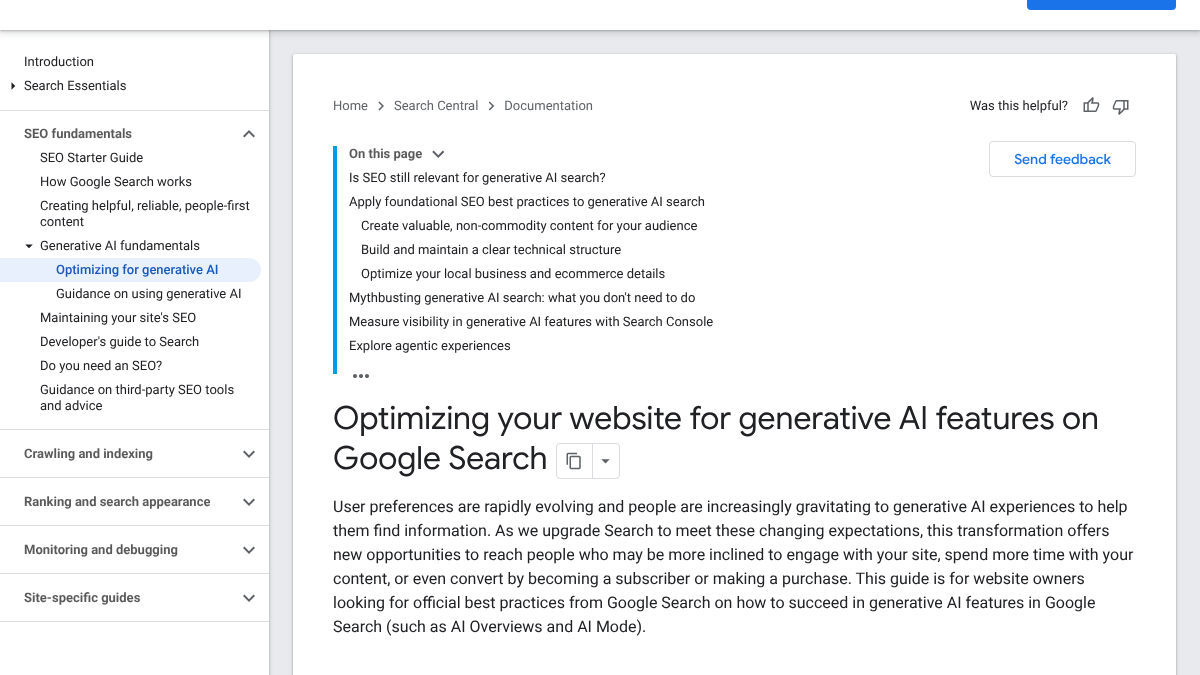
The yardstick is one we call the rename test. Swap "SGE" in the tip for "Google Search" and read it again. If the advice still makes sense, it was SEO all along and it probably held up. If it only makes sense for an AI feature, check it twice.
The verdicts at a glance
Five of the ten tips held up, two held up in part and three didn't.
| Tip | Verdict |
|---|---|
| Match search intent, not keywords | Held up |
| Write useful, original content with real expertise | Held up |
| Keep technical SEO in order | Held up |
| Keep your Business Profile and product data accurate | Held up |
| Target conversational, long-tail keywords | Partly |
| Optimize for featured snippets | Partly |
| Add schema to help SGE | Didn't |
| Restructure content for how AI models work | Didn't |
| Expect SGE on nearly every search | Didn't |
| Measure revenue as well as traffic | Held up |
How often does ChatGPT mention your brand?
Most founders have no idea. The answer might surprise you.

What held up
The oldest advice aged best. Workshop Digital told readers to create "strong, unique, trustworthy content that demonstrates E-E-A-T," and Neil Patel said to focus on search intent over keywords. Google's current guide says nearly the same thing. "Creating content that people find unique, compelling, and useful will likely influence your website's presence in generative AI search in the long run more than any of the other suggestions." Both tips pass the rename test easily. They were good SEO before SGE and they still are.
Technical SEO comes next. Several guides said the basics mattered, and Google's AI features page backs them up. "To be eligible to be shown as a supporting link in AI Overviews or AI Mode, a page must be indexed and eligible to be shown in Google Search with a snippet." Your page has to work in normal Search before it can do anything in an AI answer.
Seer Interactive advised keeping your site, Business Profile and Shopping data accurate, since SGE could draw on Google's own properties. That held up well for local and shopping searches. Go Inflow suggested moving SEO reporting toward revenue-based measures. With more answers showing on the results page itself, that one aged well too.
What partly held up
Should you write for every way a person might phrase a question? Seer said people would ask longer questions once they learned the tool, and Go Inflow favored middle- and bottom-of-funnel and long-tail queries. Answering longer, more specific questions still makes sense. Writing for every phrasing doesn't, and Google's guide says so. It says "you don't have to worry that you don't have enough 'long-tail' keywords or haven't captured every variation of how someone might seek content like yours."
Target the specific questions buyers ask, and skip the page for each variation.
Dignitas said "Google's SGE relies heavily on featured snippets," and told readers to optimize for them. A clear, direct answer near the top of a page does still help with both snippets and AI answers. The gap is that AI Overviews draw on more than the snippet page. Google says AI Overviews and AI Mode may run several related searches, which it calls query fan-out, to build one answer. Our guide to featured snippets covers the older answer box on its own.
15 hours a week manually. Or 15 minutes with RankControl.
Track citations, monitor competitors, and fix content gaps across every AI search engine. Automatically.

What didn't hold up
Schema took the hardest hit. Neil Patel's guide called structured data "more important than ever," and Dignitas recommended "highlighting key points with schema markup." Google now says it plainly. "Structured data isn't required for generative AI search, and there's no special schema.org markup you need to add." It still recommends structured data for normal SEO and rich results. Our post on schema and AI citations covers what the research found.
Reshaping pages for AI models fared no better. Workshop Digital suggested auditing content to make sure it's "structured in a way conducive to how AI models work." Google's guide takes that on directly. "There's no requirement to break your content into tiny pieces for AI to better understand it. Google systems are able to understand the nuance of multiple topics on a page." The same guide says you don't need new AI text files or special markup.
On r/SEO, a post sharing Google's list of things you don't need to do drew a top reply that sums up how many readers took it. So, keep doing what SEO has asked for since Panda and Penguin.
Google's Guide to Optimizing for Generative AI Features on Google Search
Google Have released the first, official AI SEO Guide and the ONLY guide for AI SEO, GEO, AEO of any of the LLM/AI Vendors. Critically important - as Google is the main search engine for RAG/QFO and Gemini is the 2nd biggest and fastest gro...
The biggest miss was how often SGE would show up. Fear of a takeover sat behind much of the advice, and BrightEdge's tracking shows why it felt real. SGE was still an opt-in Labs experiment in November 2023, and about 16% of tracked searches showed no SGE result. By February 2024 that had fallen to 14%. Turn it around and SGE appeared on roughly 84% to 86% of tracked queries.
When AI Overviews launched to everyone in May 2024, BrightEdge saw them on about 15% of queries.
| Period | Share of tracked queries with an AI result |
|---|---|
| SGE in Labs, November 2023 | About 84% |
| SGE in Labs, February 2024 | About 86% |
| AI Overviews at public launch, May 2024 | About 15% |
Coverage has risen since, and our timeline post covers the more recent figures. The advice written against the Labs numbers still assumed a near-total takeover, and that didn't happen at launch.
The zero-click fear
The biggest worry was never a tip. It was the idea that AI answers would stop clicks from reaching websites. When Google renamed SGE to AI Overviews in May 2024, the co-founder and chief strategy officer of Raptive, a company that runs ads for publishers, posted the fear on X. It was a boring name, the post said, for what could be the end of the open web.
It's official. SGE comes out of beta this week in the US (with other countries to follow). It's been renamed "AI Overviews" - a boring name for the potential end of the open web.
 Paul Bannister@pbannistMay 14, 2024
That fear was partly right. AI answers do take clicks from some searches, especially the simple informational ones. But the guides that responded by telling readers to give up on the top of the funnel went further than the data. Pages still get cited and clicked when they're the clearest answer. Google also still says its AI features are "rooted in our core Search ranking and quality systems."
What to do now
Google's own summary is short. "From Google Search's perspective, optimizing for generative AI search is optimizing for the search experience, and thus still SEO."
Here's the order I'd work in.
- Run the rename test on any AI advice you're handed. If it's SEO with a new label, it's probably fine, and if it's a special trick for the AI, be skeptical.
- Answer specific questions clearly, near the top of the page.
- Keep pages indexable and eligible for snippets.
- Keep your Google properties accurate, like your Business Profile and product data.
- If you published SGE guides yourself, check the old pages against Google's current guidance and update them.
For how Google's ranking and AI layers fit together, see our guide to how Google's search algorithm works. The names you'll see in older advice are sorted out in our explainer on LLM SEO, GEO, AEO and AIO.
Doing it yourself or handing it off
The advice that held up is also the advice that takes the most work. That means useful, original pages that answer specific questions, published steadily.
RankControl does that work. We find the questions your buyers search, write each article against the pages already ranking for it and publish it to your site. Our AI visibility tracking checks up to 50 buyer questions every week across seven AI engines, including Google AI Mode and Google AI Overviews. Expect traffic from Google first, with AI citations following more slowly as links and mentions build up.
AI search traffic grew 835% this year. Is your content ready?
RankControl generates 26 content formats optimized for ChatGPT, Claude, and Perplexity. Published on your domain, matched to your brand.