
A consultant in r/SEO said this month that they'd once served as an expert witness in a lawsuit. A company had sued its web designer over a drop in traffic after a redesign. But the site still ranked first, and its rankings had even gone up. It turned out Google's AI Overviews were answering the question above the link, and that's where the traffic went.
How do you explain to clients that traffic dropped because of AI Overviews? Do they actually get it? Have you lost a client over it?
Most of my clients are B2B and used to get a lot of their leads from informational articles and queries. Now I can see AI Overviews answering most of those queries directly, so people just don't click anymore. The problem is that clients do...
If you want the whole "is SEO dead" fight in a single case, that's it. The ranking held, and the click didn't. So we put the question to the AI engines themselves. Then we checked where their answers came from and set them against Google's own guidance and the latest click data.
The short answer
No, SEO isn't dead. Google says its AI answers sit on the same ranking systems as its normal results. What has changed is how many clicks a ranking brings you, and how many other places your pages need to show up.
The question itself isn't new. "Is SEO dead" gets about 590 US searches a month, according to a data provider's estimates, and over the past year it has stayed between 390 and 880.
The searches that grew are about what might come next. "Will ai replace seo" went from about 10 a month last winter to 170 in September. Over the same months, "answer engine optimization" more than doubled, from 1,900 to 4,400. The joke on X is older than both.
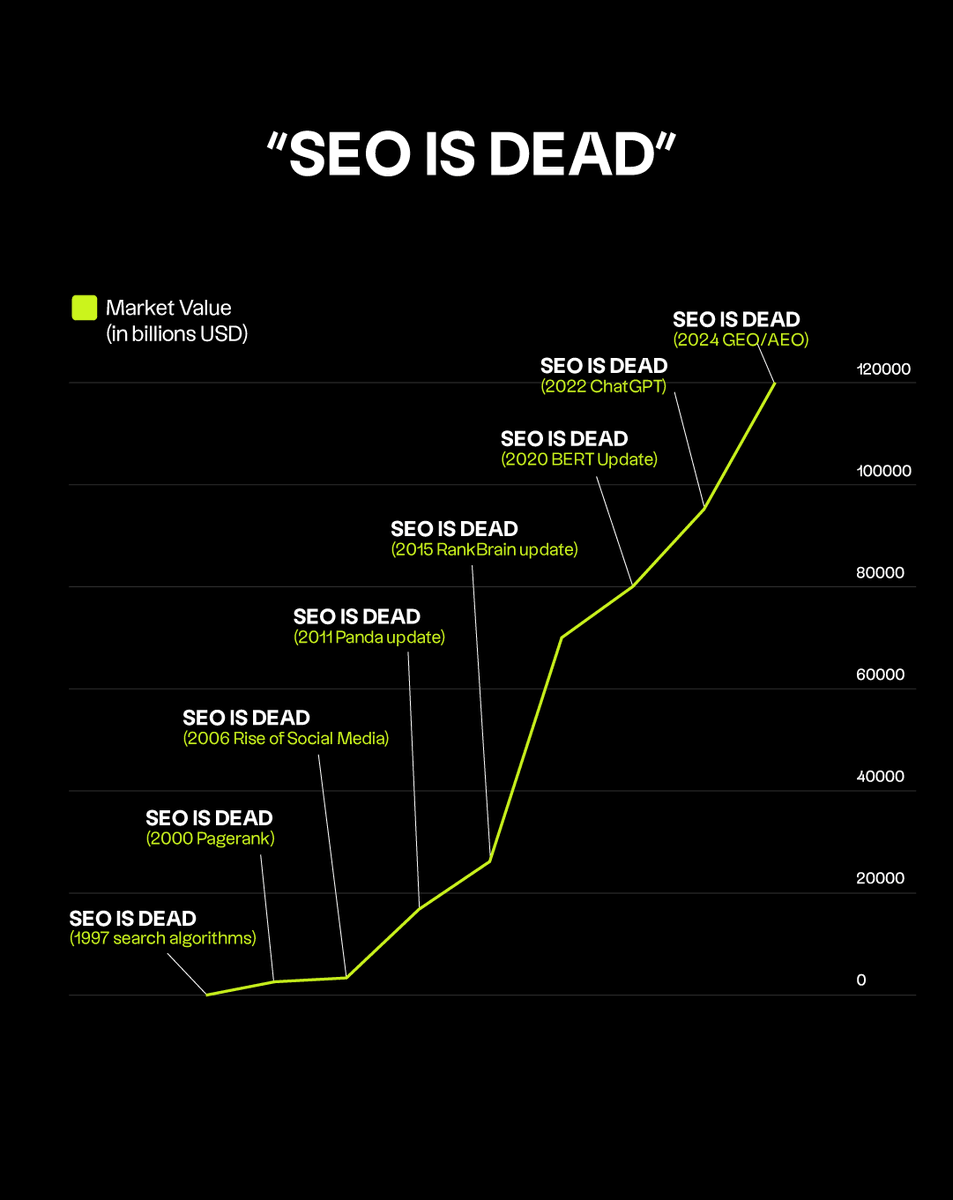
SEO has been dying since 1997. Google updates, voice assistants, Google Ads, zero-click searches, ChatGPT, AI Overviews… the list goes on. The reality is SEO will always evolve. It’s only dead for those who don’t adapt. https://t.co/X3BwbpsQ06
 Jake Ward@jakezwardAug 26, 2025
What did ChatGPT and AI Mode say?
On October 19, 2026, we asked ChatGPT and Google AI Mode 10 versions of the question. They ran from "is seo dead" to "will ai replace seo" and "is seo a dying career." We used a data provider's live US feed, and we also pulled Google's page one for each question.
| What we checked | ChatGPT | Google AI Mode |
|---|---|---|
| Answers saying SEO is dead | 0 of 10 | 0 of 10 |
| Links cited | 41 | 30 |
| Links to Google's own guidance | 20 | 0 |
| Cited sites also on Google's page one for that question | 0 | 10 |
| Most cited | Google's docs, Search Engine Land | Reddit (10), YouTube (5) |
Every one of the 20 answers drew the same line. SEO isn't dead, they said, but the old way of doing it is. Where they got that answer is the part worth your time.
ChatGPT ignored the pages that rank for "is seo dead." Those are mostly agency blog posts, and it didn't cite a single one.
In 7 of 10 answers, its own searches asked for Google Search Central. Half of its links went to Google's documentation, and six of those pointed at mirror copies of Google's pages on proxy sites. The rest went to studies, such as Seer Interactive's click data and a paper on AI Overviews and publisher traffic.
AI Mode did the opposite. A third of its links were Reddit threads, and five were YouTube videos. We saw the same gap in an earlier test of what ChatGPT cites compared with Bing and Google rankings. A page-one ranking explains only part of what an AI engine cites.
See your first AI citation report in under 5 minutes.
No setup calls. No onboarding meetings. Connect your domain and see where AI mentions your brand right now.

What does Google say?
Google has answered this in its own guide to its AI features. The guide asks whether SEO is still relevant for generative AI search, and the answer opens with "In short, yes!"
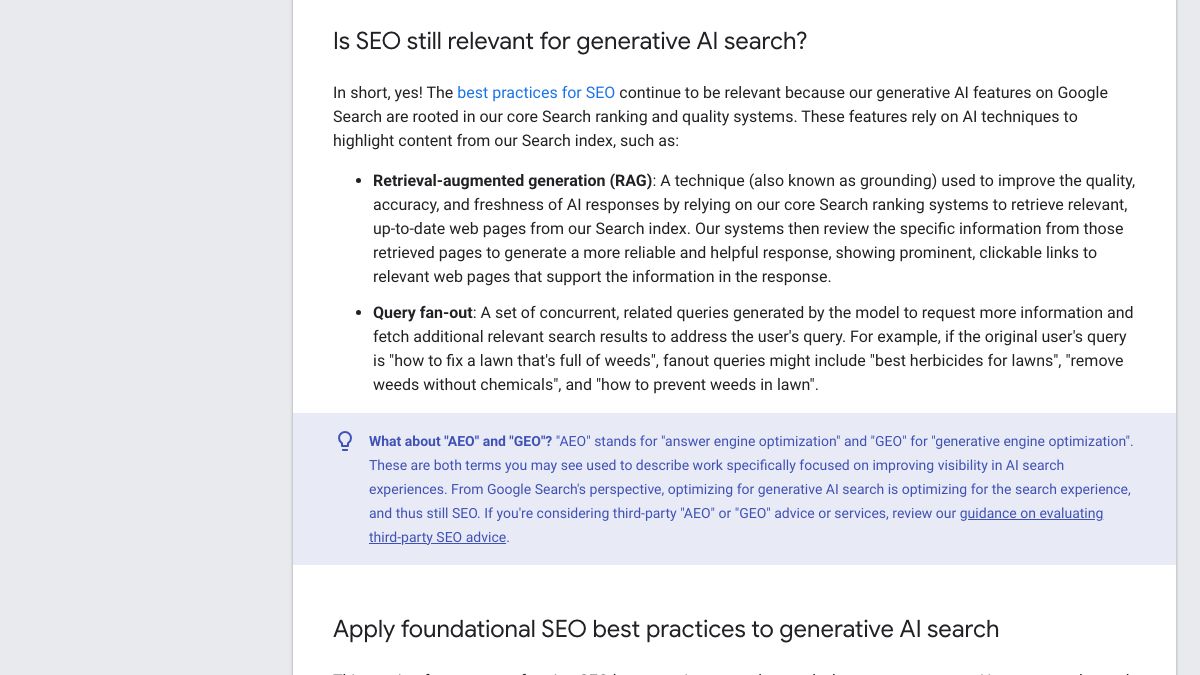
Here's Google's reasoning. AI Overviews and AI Mode pull pages from the search index through the normal ranking systems, and then they write an answer from those pages. The same guide says that, as far as Google is concerned, AEO and GEO are still SEO. It also says Google Search ignores llms.txt files. And you don't need to chunk your pages or rewrite them just for AI.
That's the strongest evidence against "SEO is dead." Google's AI answers can't cite a page Google hasn't indexed and ranked. Our explainer on SEO, GEO and AEO terms covers where the labels overlap.
If SEO isn't dead, why is my traffic down?
Because fewer searches end in a click. SparkToro's 2026 zero-click study used Similarweb data and found that 68% of US Google searches from January to April ended without one. Out of every 1,000 searches, 232 clicks reached the open web. In 2024, 41% of searches led to a click of any kind. By early 2026 that share was down to 32%.
AI Overviews account for a big part of that. Seer Interactive's 2026 CTR update looked at 53 brands and 5.47 million queries. Queries that showed an AI Overview had an organic click-through rate of 1.3% in December 2025. That climbed back to 2.4% by February 2026. Without an AI Overview, the rate was 3.8%.
So your rankings can hold while your traffic falls. One reply in that r/SEO thread offered a simple test. Split your informational queries into two groups, the ones that show an AI Overview and the ones that don't. If only the first group lost clicks, the AI answer took them. If both groups dropped, you've got a ranking problem.
Does SEO still matter for ChatGPT?
It does, but rankings explain less there. ChatGPT runs its own searches, and it rewrites your question before it does. It pulls from Bing, from Google results and from an index OpenAI builds itself. In our test it searched the web for all 10 questions. None of the sites it cited ranked on Google's page one for the question we asked.
That doesn't make SEO useless for ChatGPT. Its searches still need pages that are crawlable, clear and worth quoting, and that's SEO work. Our guide to how ChatGPT searches the web shows the rewriting step.
Is blogging dead for SEO?
Generic blogging is in trouble, yes. In September, someone in r/digital_marketing asked whether AI had killed SEO, and the top replies said the bar had gone up. One person pointed out that the same "SEO is dead" posts appeared after Google's Panda update, and again when featured snippets arrived.
Is SEO really dead because of AI? What are SEO experts doing differently now?
I’ve been hearing a lot recently that AI has basically killed SEO and that organic search is no longer as important as it used to be. But I’m not sure I agree. from what I understand, SEO is still important for improving a website’s organic...
Google's guide says much the same in its own words. It warns against commodity content, the "7 tips" kind of post anyone could write, and asks for a unique point of view instead. If your blog has original data or first-hand experience, it still has a job to do.
Is Google search dying?
Not if you go by Google's numbers. On Alphabet's July 2026 earnings call, CEO Sundar Pichai said search revenue grew 17%. He also said AI Mode had passed a billion monthly users, as Business Insider reported. And he said Google sends "billions of clicks to websites every week" through its AI features.
Both things are true at once. Google is getting more searches, and fewer of them send anyone to your site. Our look at whether SEO is still worth it runs the math for a business deciding where to spend.
Is SEO a dying career?
No, but the job is changing shape. Semrush published a study of 3,900 SEO job listings in March 2026. It found that 59% were Director, VP or Head-level roles. AI came up in 31% of the senior listings, and digital PR in about 13.5%.
The work is moving toward experiments, earned mentions and reporting across more than one search engine. Our guide to learning SEO with AI search covers which skills carry over.
What to do now
Based on Google's guidance and what we saw in the test, these five steps hold up.
- Split your Search Console queries by whether an AI Overview shows. Then you'll know which traffic loss is about AI and which is about rankings.
- Put something new in your pages, like first-hand data or a clear opinion. Google's guide warns against "commodity content" that repeats what's everywhere.
- Keep the basics working. A page has to be indexed and crawlable to appear in Google's AI answers at all.
- Get talked about where AI Mode reads. In our test, that meant Reddit and YouTube.
- Each week, ask the AI engines your buyers' questions and note who gets named.
Doing all this once is the easy part. Noticing when an AI engine stops naming you is harder. Search Console's new generative AI report covers Google's own AI features, but it won't tell you when ChatGPT or Perplexity drops you.
Your competitors are building backlinks while you read this.
Organic outreach, social mentions, and citations from Editorial Circle member sites, with managed backlinks available as an add-on. Grow your domain authority without running the campaign yourself.

Limits of our test
We asked each of the 10 questions once, on one day, from a US feed. AI answers change from one ask to the next. We also matched cited links to Google's page one by site, so a different article from a page-one site still counted as a match.
What this takes by hand
Here's a rough monthly budget, by our estimate, for keeping your SEO and AI visibility on track.
| Task | Hours a month |
|---|---|
| Splitting traffic by AI Overview and checking rankings | 2 to 3 |
| Writing four articles with original material | 16 to 24 |
| Asking AI engines your buyer questions and logging answers | 4 to 6 |
| Reddit, YouTube and outreach for mentions | 4 to 8 |
| Total | 26 to 41 |
Doing it by hand or with help
You can do all of this yourself. Or RankControl can take on the steady part every month while you focus on your product. Our AI visibility tracking checks 50 of your buyer questions every week, alongside your Google rankings. We cover ChatGPT, Perplexity, Claude and Gemini, plus Grok, Google AI Mode and Google AI Overviews. Our content engine writes the articles and, once you approve them, publishes them on your own site.
You're getting AI traffic. But do you know where it comes from?
RankControl credits every visit to the assistant that sent it: ChatGPT, Perplexity, Claude, Gemini, Copilot, or Grok. Full source attribution, next to your Google traffic.