When traffic drops, the first question is usually "was it the update?" The second is "how bad is this compared with everyone else?" Most answers to both are anecdotes: one site lost half its traffic, another doubled.
So this post puts the numbers in one place. Every Google core update from March 2023 to May 2026, from Google's own Search Status Dashboard, with how long each took, how far apart they come, how big the swings get and what Google says about recovery.
Every core update since 2023
We pulled the full ranking history from Google's Search Status Dashboard on October 19, 2026.
| Core update | Started | Rollout took |
|---|---|---|
| March 2023 | March 15, 2023 | 13 days, 7 hours |
| August 2023 | August 22, 2023 | 16 days, 3 hours |
| October 2023 | October 5, 2023 | 13 days, 23 hours |
| November 2023 | November 2, 2023 | 25 days, 21 hours |
| March 2024 | March 5, 2024 | 45 days |
| August 2024 | August 15, 2024 | 19 days, 4 hours |
| November 2024 | November 11, 2024 | 23 days, 13 hours |
| December 2024 | December 12, 2024 | 6 days, 4 hours |
| March 2025 | March 13, 2025 | 13 days, 21 hours |
| June 2025 | June 30, 2025 | 16 days, 18 hours |
| December 2025 | December 11, 2025 | 18 days, 2 hours |
| March 2026 | March 27, 2026 | 12 days, 4 hours |
| May 2026 | May 21, 2026 | 11 days, 21 hours |
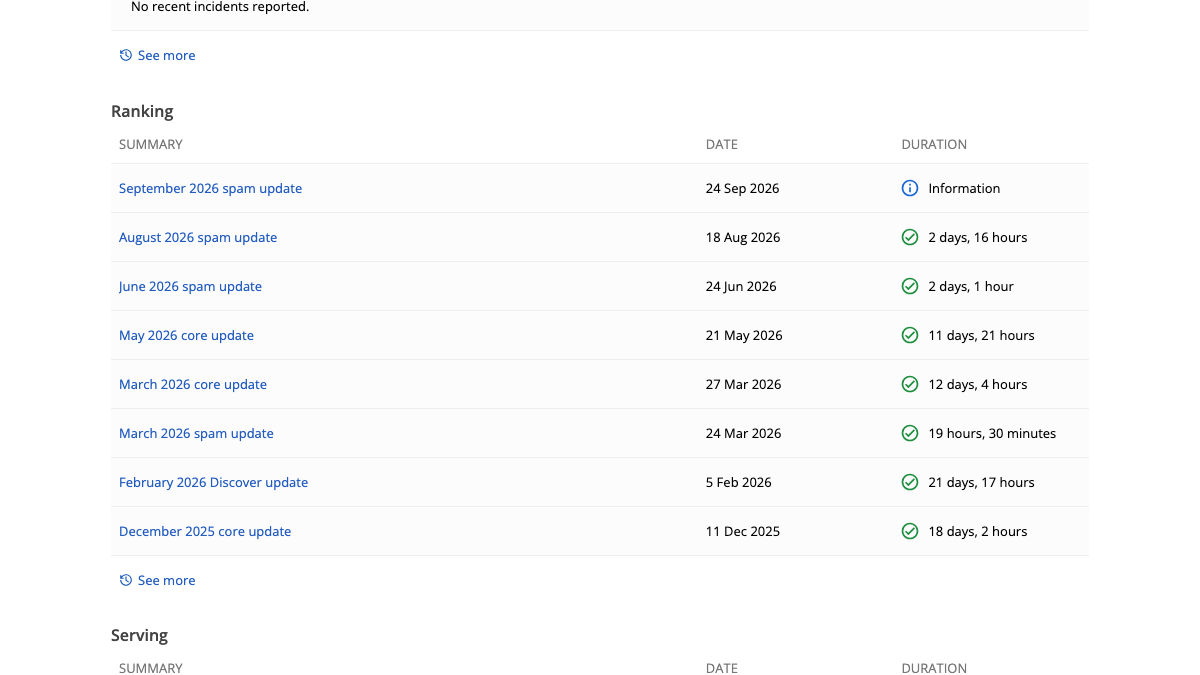
That's 13 confirmed core updates in a little over three years. The dashboard also lists spam updates, a helpful content update, reviews updates and a Discover update, which are separate systems. We've left them out of these numbers.
15 hours a week manually. Or 15 minutes with RankControl.
Track citations, monitor competitors, and fix content gaps across every AI search engine. Automatically.

The averages
We calculated these ourselves from the table above.
| Measure | Result |
|---|---|
| Core updates, March 2023 to May 2026 | 13 |
| Average rollout | 18.14 days |
| Median rollout | 16.12 days |
| Average rollout, leaving out March 2024 | 15.91 days |
| Average gap between start dates | 96.9 days |
| Median gap | 98.5 days |
| Shortest gap | 28 days, October to November 2023 |
| Longest gap | 164 days, June to December 2025 |
| Days since the May 2026 update, as of October 19 | 151 |
So a core update comes roughly every three months and takes about two to three weeks. The 151 days since May 2026 is longer than the average gap, close to the longest on record.
Our post on why traffic often recovers in steps quotes a median gap of 106 days since 2024. The difference is the window. Ours covers March 2023 onward.
Rollouts are getting shorter
Year by year, the average rollout has shrunk.
| Year | Core updates | Average rollout |
|---|---|---|
| 2023 | 4 | 17.3 days |
| 2024 | 4 | 23.5 days |
| 2025 | 3 | 16.2 days |
| 2026, to October | 2 | 12.0 days |
2024's average is pulled up by March 2024, which Google itself called unusual. "The March 2024 core update is a more complex update than our usual core updates, involving changes to multiple core systems," Google wrote at the time, warning "the rollout may take up to a month." It ended up taking 45 days.
Both 2026 updates finished in about 12 days. Two data points aren't a trend, but it's a change worth knowing: a drop that keeps sliding for a month is less likely to be a 2026 core update than it would have been in 2024.
We call the window from the start of a rollout to two weeks after it ends the settling window. Judging the effect of an update before it closes usually means judging a number that's still moving.
Which months they land in
Counting the 13 updates by the month they started shows a pattern.
| Month | Core updates since 2023 |
|---|---|
| March | 4 (2023, 2024, 2025, 2026) |
| December | 2 (2024, 2025) |
| November | 2 (2023, 2024) |
| August | 2 (2023, 2024) |
| May, June, October | 1 each |
Every year since 2023 has had a core update starting in March. Late in the year is common too, with five of the 13 starting in October, November or December. Google doesn't publish a schedule, so treat this as history, not a forecast. But if your business has a busy season in the spring or around the holidays, it's worth knowing that updates have often landed then.
The one percentage Google published
Google rarely puts a number on what a core update does. The exception was March 2024. At launch, Google said the update and earlier work would "collectively reduce low-quality, unoriginal content in search results by 40%." After the rollout, it reported: "You'll now see 45% less low-quality, unoriginal content in search results versus the 40% improvement we expected across this work."
That's a claim about the whole index, not about any one site's traffic. But it gives a sense of scale. When Google sets out to cut nearly half of a category of content from results, many sites in that category lose traffic at once.
How big the swings get
For the May 2026 core update, SISTRIX published its biggest winners and losers across the US and UK, measured by its visibility index.
| Biggest losers | Visibility change |
|---|---|
| zalesoutlet.com | -66.74% |
| freepik.com | -63.09% |
| onetonline.org | -60.07% |
| Biggest winners | Visibility change |
|---|---|
| freepeoplesearch.com | +267.24% |
| upstart.com | +224.56% |
| stinehome.com | +210.19% |
These are the extremes, drawn from SISTRIX's top 200 winners and losers. Most sites move far less. SISTRIX sells the visibility tool these numbers come from, and visibility isn't traffic, but it tracks closely enough to show the scale. Our May 2026 core update retrospective covers the update in more detail.
Search Engine Land's reporting on the May 2026 rollout described the volatility arriving in waves: felt "in a big way" two days after the announcement, more large movements the following weekend, and "even more volatility in the past 24-hours, right before Google marked this core update done."
AI search traffic grew 835% this year. Is your content ready?
RankControl generates 26 content formats optimized for ChatGPT, Claude, and Perplexity. Published on your domain, matched to your brand.

Core updates vs spam updates, year by year
The same dashboard lists Google's spam updates. Counting both kinds shows a shift in 2026.
| Year | Core updates | Spam updates |
|---|---|---|
| 2023 | 4 | 1 |
| 2024 | 4 | 3 |
| 2025 | 3 | 1 |
| 2026, to October | 2 | 4 |
So far in 2026, Google has run twice as many spam updates as core updates, three of them after the May core update, in June, August and September. That matters for diagnosis. A 2026 drop is more likely than in earlier years to come from a spam update, which targets specific practices rather than reassessing overall quality.
What kinds of sites tend to lose
The named examples only hint at a pattern, so read this loosely. Google's own stated target in March 2024 was "low-quality, unoriginal content." Google described its helpful content system, now part of core ranking, as aimed at content made primarily for search engines rather than for people. And the long wait many of the sites Gabe tracks went through shows how slowly that kind of judgment gets revised. SISTRIX's May 2026 losers included a retail outlet, a stock image site and a US government occupational data site, which is a reminder that no single type of site is safe, including large, well-known ones.
The common thread in Google's guidance is the same each time: pages made mainly to rank, rather than to help a reader, are the ones at risk.
A comparison: what a spam update does
Spam updates are a different system, but one recent study shows how a single update can reshuffle the top of the results. SE Ranking compared 100,000 keywords across 20 industries before and after Google's August 2026 spam update.
It found "16.71% of URLs that had ranked in Google's top 10 fell beyond position 100 for the same keyword, compared with 9.2% during a similar five-day period in July," an 82% increase. Every one of the 20 industries saw movement.
The lesson for diagnosis: a drop in late August or late September 2026 is more likely to be one of those spam updates than a core update, since no core update ran then. Our guide to the August 2026 spam update covers how to tell.
A post on r/SEO showed how sharp a spam-update hit can be. A small site owner described losing about 95% of Google search traffic in a single day, starting the same day as the September 2026 spam update began.
Sudden ~95% Google Search traffic loss in 1 day during the September 2026 spam update
Hi, I own an independent public agenda of classical music events in Madrid, Spain. I am trying to understand a sudden and unusually severe loss of Google Search visibility that started on September 27, 2026, shortly after the September 2026...
What Google says about recovery
Google's core updates documentation, last updated December 10, 2025, is cautious. "Some changes can take effect in a few days, but it could take several months for our systems to learn and confirm that the site as a whole is now producing helpful, reliable, people-first content in the long term."
And: "If it's been a few months and you still haven't seen any effect, that could mean waiting until the next core update. However, you don't necessarily have to wait for a major core update to see the effect of your improvements."
With a median of about 98 days between updates, "the next core update" usually means a three-month wait, and sometimes much longer. The current 151-day gap shows how long that can stretch. In practice, that means improvements made today may not show their full effect until well into next year, so it's worth starting them now rather than waiting for the next announcement.
Google also warns against the reflex fix: "Deleting content is a last resort, and only to be considered if you think the content can't be salvaged."
How often sites actually recover
The honest answer: many don't, at least not fully. The clearest long-run evidence comes from the sites hit by the helpful content update in 2023.
Glenn Gabe, who tracks a list of 400 sites hit hard by that update, reported after the June 2025 core update that some "finally started surging back," with "some full (or near-full) recoveries in the mix." But "not all HCU(X) sites surged back. Some actually dropped even more." Our analysis of HCU recovery data covers the full ledger, including nine straight months with no recoveries at all.
Gabe has also pointed out how often companies blame the wrong thing.
I hate when companies blame AIOs when they tanked from a core update or spam update. Easy to say that versus, "We have a quality problem". Reddit is doing that now... See Germany and Italy below for AI translations trending. This is a big reason Reddit is seeing less traffic from https://t.co/v17digitF3
 Glenn Gabe@glenngabeJul 31, 2026

Gabe's point, made on X in July 2026, was that companies blame AI Overviews when they actually fell in a core or spam update, because that's easier to say than admitting a quality problem.
Not every drop is an update
AI Overviews changed what a drop looks like. Pew Research found that users who saw an AI summary clicked a traditional search result in 8% of visits, against 15% for those who didn't. That was from 68,879 searches by 900 US adults in March 2025.
So a fall in clicks can come with steady rankings. The way to tell:
| What you see | Likely cause |
|---|---|
| Rankings fell, starting during a core update | Core update |
| Rankings fell sharply in one day, during a spam update | Spam update |
| Rankings steady, clicks down | AI Overviews or other results features |
| Rankings and clicks fell gradually, no update | Competitors, freshness or technical issues |
Our guide to telling a core update drop from an AI search drop walks through the checks in Search Console.
How to measure your own hit
The industry numbers only matter next to your own. Here's a simple way to measure an update's effect on your site in Search Console.
- Pick the window. Take the 28 days before the rollout started, and the 28 days starting two weeks after it ended. That skips the settling window.
- Compare clicks, impressions and average position for the site overall.
- Break it down by page. Most updates hit some pages and leave others alone. Sort by the biggest change in clicks.
- Check the same window last year. Seasonal drops can look like update losses.
- Look at the queries behind the biggest losers. If the same pages lost rankings across many queries, that points to the page or the site, not one keyword.
Write down the numbers. When the next update comes, roughly three months later on average, you'll have a baseline to compare against.
Common misreadings
- Blaming the update for a drop that started before it. Check the dashboard date against the first day of your decline.
- Judging mid-rollout. Search Engine Land's account of May 2026 shows the biggest moves can come at the end.
- Treating visibility scores as traffic. Third-party visibility indexes estimate rankings across a keyword set, not your actual visits.
- Assuming every update is a core update. Spam updates and other systems also move rankings, and they need different fixes.
- Expecting a quick bounce-back. Google's own guidance talks about months.
What to do with these numbers
- Match dates first. Put your drop next to the dashboard table. If it doesn't line up with a rollout, look elsewhere.
- Wait out the settling window. Don't make big changes until about two weeks after the rollout ends.
- Compare rankings as well as clicks. It separates update losses from AI Overview losses.
- Plan for months, not weeks. Google says recovery can take several months, and the median gap to the next update is about 98 days.
- Improve, don't delete. Google calls deletion a last resort.
For the update before this one, see our post on August and September 2026, when no core update ran.
Doing it yourself or handing it off
Recovering from a core update usually means the slow work Google describes: improving the pages that matter, adding helpful content and waiting for the systems to notice.
RankControl helps with the content side. We find the questions your buyers search, write each article against the pages already ranking for it and publish it to your site. We check your Google and Bing rankings, plus up to 50 buyer questions every week across seven AI engines, so you can see whether a drop is in rankings or in AI answers. Expect traffic from Google first, with AI citations following more slowly as links and mentions build up.

Built by the team that got cited in 48 hours.
Content generation, backlink building, AI visibility tracking, and Google rankings. One platform, zero guesswork.