In early September, a site owner posted in r/DoSEO that their Google traffic had dropped to almost nothing for about two months and was now suddenly coming back. They hadn't made any major changes, and they wanted to know why.
My website traffic dropped for almost 2 months, and now it's suddenly coming back
The replies told two different stories. One commenter had been hit by a spam update in late August, rebuilt their whole site, and saw Google traffic return that same week at about ten times the level of the low. Another reply made the point that matters most: when a site that changed nothing and a site that rebuilt everything recover on the same days, the thing that moved was Google itself.
That's the usual shape of a long drop and a sudden recovery. This guide explains why it happens, how Google's update calendar shapes it and how to tell an algorithm recovery from seasonality or a tracking problem. Sources were checked on September 26, 2026.
Recoveries come in steps
Google reassesses sites in batches. Core updates reevaluate how helpful and reliable a site's content is overall, and spam updates rerun the systems that detect spam. Between those updates, the assessment of a site tends to stay where it is, even after you fix things.
That's why the traffic chart rarely climbs gradually. A site that lost rankings in a core update often stays flat for months, then jumps on the day a later update rolls out. We call this the reassessment calendar: the dates when Google is most likely to change its mind about your site, in either direction.
Google describes the timing directly in its guidance on core updates:
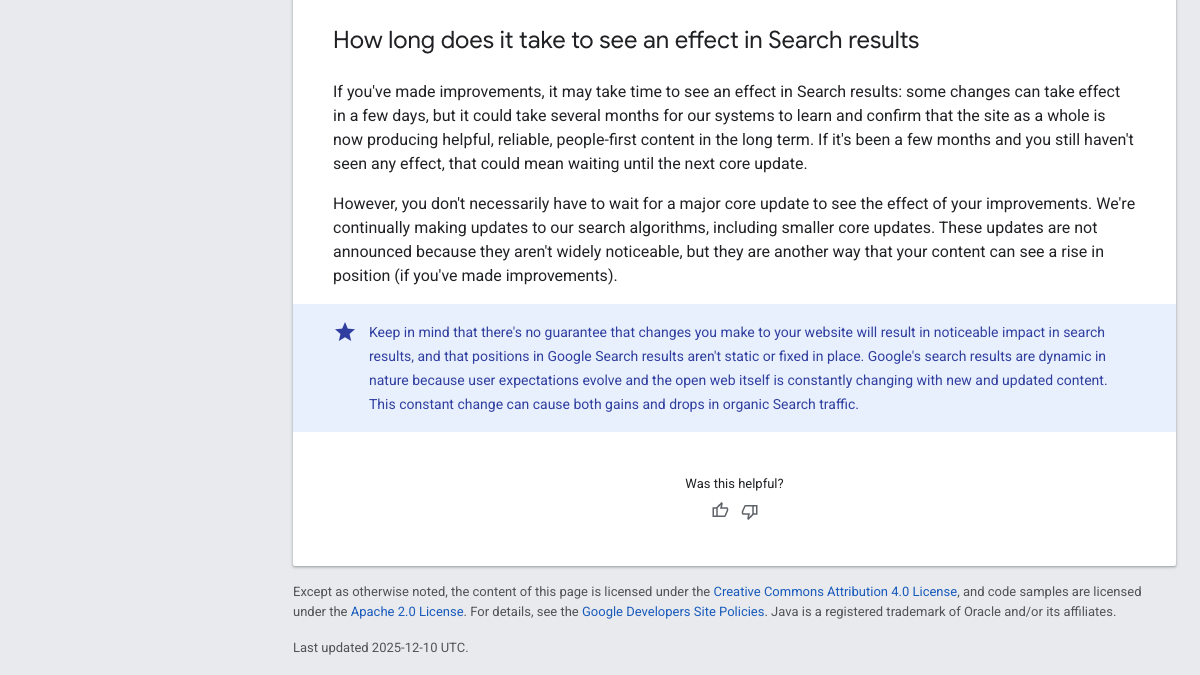
Two points in that section matter. It could take several months for Google's systems to confirm that a site as a whole has improved, which may mean waiting for the next core update. And Google also runs smaller core updates it doesn't announce, so a recovery can land on a date with no announcement at all.
You're getting AI traffic. But do you know where it comes from?
RankControl credits every visit to the assistant that sent it: ChatGPT, Perplexity, Claude, Gemini, Copilot, or Grok. Full source attribution, next to your Google traffic.
How long the gaps between updates are
So how long should you expect to wait? We pulled every confirmed core update since 2024 from Google's Search Status Dashboard:
| Core update | Started | Rollout | Days since previous core update |
|---|---|---|---|
| March 2024 | March 5, 2024 | 45 days | |
| August 2024 | August 15, 2024 | 19 days | 163 |
| November 2024 | November 11, 2024 | 24 days | 88 |
| December 2024 | December 12, 2024 | 6 days | 31 |
| March 2025 | March 13, 2025 | 14 days | 91 |
| June 2025 | June 30, 2025 | 17 days | 109 |
| December 2025 | December 11, 2025 | 18 days | 164 |
| March 2026 | March 27, 2026 | 12 days | 106 |
| May 2026 | May 21, 2026 | 12 days | 55 |
The median gap was 106 days, and two gaps ran past five months. As of September 26, 2026, it had been 128 days since the May core update started, with only spam updates in between, on June 24, August 18 and September 24.
So a site that lost rankings in the May update and fixed its problems in June could still be waiting, and nothing about that wait says the fixes failed. It's also why recoveries feel sudden: several months of improvements get credited on a single day.
Spam updates work the same way
Spam update recoveries follow the same step pattern, often on a shorter cycle. Google has run spam updates in March, June, August and September of 2026, so the gap between spam reassessments this year has been one to three months. In August, Glenn Gabe shared a site that dropped heavily with the June spam update and then spiked with the August one, two months later.
Good example of a spam update recovery. The site dropped heavily with the June spam update and spiked with the August spam update. I haven't analyzed the site, but you can see the screenshots below. Also, if they spiked on 8/18, then the spam update landed very quickly. I'm not
 Glenn Gabe@glenngabeAug 20, 2026
Not every recovery waits for a named update, though. In June, Lily Ray described a site hit by the December 2025 spam update that started recovering just outside a core update window, about five months after fixes began.
Excited to see this site that was hit by the December 2025 Spam Update is starting to recover... Interesting that the recovery happened just outside of a core update. It took about 5 months after beginning to make fixes to finally see the impact (as expected!) https://t.co/GyNFmcFXuc
 Lily Ray 😏@lilyraynycJun 24, 2026

Short recoveries can also reverse. A site owner posted in r/SEO in September that traffic started recovering in mid-August after a spam update hit, then fell back to the old low after August 28. The most useful reply described it as a reassessment window followed by the classifier settling back, which usually means the underlying problem wasn't solved yet.
Not every drop is the algorithm
Some drops that end in a sudden recovery have nothing to do with rankings. The two most common are demand and measurement.
Demand moves with the calendar in many B2B markets. According to Google Ads data, US searches for "1099 form" rose from 74,000 in September 2025 to 301,000 in January 2026, then fell to 60,500 a month from June through August. Searches for "project management software" dropped from 90,500 in September to 40,500 in December before climbing back to 90,500 by March. A site ranking in the same positions all year would see traffic fall for months and then recover, with no algorithm involved.
Measurement breaks too. In August, Google confirmed an issue with Search Console's performance reports that showed alarming drops in impressions and clicks, and in September it confirmed a short reporting bug in the "crawled - currently not indexed" data. A tracking tag removed during a site update, or a new consent banner, can do the same thing in analytics. When the fix goes live, traffic appears to recover instantly.
Technical problems sit in between. A noindex tag left on after a redesign, or a robots.txt rule that blocks a section, removes pages until someone fixes it. Recovery then follows Google's recrawl, which can take days for important pages and weeks for the rest. Our guide to diagnosing Googlebot crawl timeouts covers server errors and outages in more depth.
How to tell which one you had
Line the drop and the recovery up against a few dates before deciding what worked:
| If the drop and recovery... | The likely cause is... |
|---|---|
| Match confirmed Google update dates | An algorithm reassessment |
| Match the same months in previous years | Seasonal demand |
| Show up in one tool but not in others | A measurement or reporting problem |
| Follow a deploy or robots.txt change | A technical issue and its recrawl |
| Arrive on the same day unrelated sites recovered | A change on Google's side |
The last row is the trap the r/DoSEO reply pointed at. If you rebuilt your site and recovered on an update date, some of the credit may belong to the update. That matters for what you do next, because repeating a rebuild that didn't cause the recovery wastes months.
Average position is the fastest separator. If positions held while clicks fell, you're looking at demand or answers on the results page taking clicks, which our guide to separating SEO loss from AI search shifts covers. If positions fell and then returned on an update date, it was a reassessment.
We'll show you exactly where your brand stands in AI search.
No commitment. $0 due today, cancel anytime. See how ChatGPT, Perplexity, Claude, Gemini, Grok, Google AI Mode, and Google AI Overviews talk about your brand today.

What to do while you wait
Keep improving the pages that lost the most, and document what you changed and when, so you can match changes to results later. Our recovery guide sets out the fix and timeline for each kind of drop. Avoid large panicked changes, such as deleting whole sections or moving to a new domain, since they add new variables. Lily Ray shared a site in August that moved to a new domain after the January 2026 update, surged briefly and then fell lower than before.
Check Bing as well. The commenter in the r/DoSEO thread who was hit by a spam update in late August said their Bing traffic stayed strong and kept growing while Google traffic fell by 95%. When one engine holds steady and the other drops, the cause sits in that engine's assessment, and your site's technical health is probably fine.
Watch the reassessment calendar. Our retrospective on the May 2026 core update covers what recoveries from that update looked like, and our guide to telling thin content from an authority problem helps confirm you're fixing the right thing.
Track rankings for your important queries weekly alongside traffic, so the next step change shows up as a movement in positions you can date. Done by hand, checking 50 questions on seven engines takes about six hours a week, and publishing eight solid articles a month takes 16 to 24 hours more. Those are rough estimates.
RankControl handles that tracking. AI visibility tracking runs your 50 questions every week on seven engines and marks each one as mentioned, cited or both, alongside your Google and Bing rankings, so a sudden drop or recovery comes with dated position changes. The content engine writes each article against the pages already ranking for its keyword and publishes it on your own domain.
You can build this record yourself with Search Console and a change log. Or RankControl's agents can keep the tracking running every week while your team works on the pages that matter.
Know exactly what AI says about your competitors.
RankControl's Recon Agent monitors competitor citations across ChatGPT, Perplexity, Claude, Gemini, Grok, Google AI Mode, and Google AI Overviews. See where they show up and you don't.