
In September, a small business owner posted in r/SEO with a problem many site owners will recognize. All eight of their pages were indexed for five weeks. Then everything except the homepage and the privacy policy dropped out of Google's index. They rewrote one page with more words and a new Q&A section, and Google crawled it again without indexing it.
Thin Content or Authority issue?
Hi I run a small online business and for the first 5 Weeks, all of my 8 pages were indexed on Google. Then suddenly, only the main page and the privacy policy stayed up, all the others are no longer indexed. 5 days ago I updated one of the...
Their question was the title of the thread: thin content or authority issue? The top reply said it was mostly authority. Another said to check canonicals and internal links before assuming anything. Both were reasonable, which is why this question comes up so often.
Thin content and low authority produce the same symptom, a page that doesn't rank, but they leave different traces. This guide shows how to read them, using Search Console and one comparison we call the authority floor. Sources were checked on September 26, 2026.
What each problem actually means
"Thin content" gets used loosely. Google's own use of the term is narrow: its manual actions report lists thin content with little or no added value as a spam issue, with specific examples.
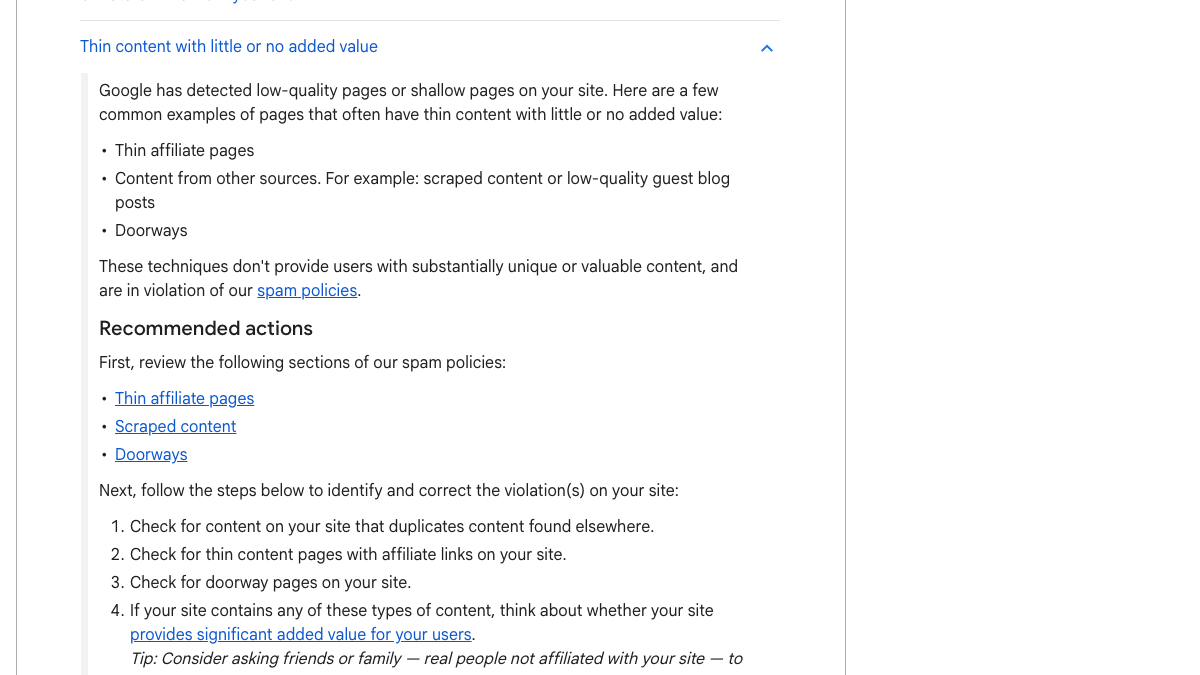
If you don't have that manual action, your problem isn't thin content in Google's sense. It's more likely that the page is less useful than the pages already ranking, which Google's ranking systems judge without any penalty.
Authority is the other side: how much the web, and therefore Google, trusts your site overall. Google doesn't publish an authority score. Third-party tools estimate it from links, such as the number of other websites linking to yours, usually called referring domains.
The two leave different patterns:
| What you see | What it usually points to |
|---|---|
| A thin content manual action in Search Console | Spam-level thin content |
| Many pages "crawled - currently not indexed" on an established site | Quality of those pages |
| Most pages not indexed on a new site | Authority, mostly |
| Ranking for long-tail variants but not the main search | Authority |
| Ranked well, then fell during a core update | Quality |
| Stuck at positions 20 to 50 while weaker sites rank above you | Content or intent |
Step 1: Check indexing before anything else
A page that isn't indexed can't rank, so start with Search Console's page indexing report. Google describes "crawled - currently not indexed" as a page it crawled but chose not to index, which may or may not be indexed later, with no need to resubmit it.
What causes that choice? In July, Google's John Mueller and Martin Splitt said on their podcast that quality issues, including low-quality AI-generated content, can lead to pages not being trusted and not being indexed.
Google's @johnmu and Martin Splitt on quality issues and some AI-generated content leading to page indexing issues such as crawled - currently not indexed https://t.co/vSWcAnpGKj
 Barry Schwartz@rustybrickJul 16, 2026
Context changes the reading. On an established site where most pages are indexed, a group of unindexed pages usually has a quality problem. On a new site, the r/SEO thread had the sharper observation: the homepage and privacy policy survived because Google needs the least convincing about them, and everything else has to earn index space on a domain Google doesn't know yet. Adding words to a page it already crawled rarely changes that.

Your competitors are getting cited by AI. You're not.
Every day without citation tracking is a day your competitors pull ahead in ChatGPT, Perplexity, and Claude.
Step 2: Find the authority floor
For indexed pages that don't rank, the most useful single check is what we call the authority floor: the referring-domain count of the weakest site that still ranks in the top 10 for your search. If sites weaker than yours rank and you don't, authority isn't what's stopping you.
We measured it for 12 common B2B software searches on September 26, pulling referring domains for every site in the top 10:
| Search | Weakest site in top 10 (referring domains) | Its position | Median site in top 10 |
|---|---|---|---|
| what is net revenue retention | 37 | 7 | 4,918 |
| cheap accounting software | 66 | 8 | 18,406 |
| asana alternatives | 305 | 3 | 8,458 |
| soc 2 compliance software | 314 | 5 | 2,485 |
| best crm for small business | 589 | 5 | 157,433 |
| best email marketing platform | 3,856 | 1 | 49,250 |
In 7 of the 12 searches, at least one top-10 page came from a site with fewer than 1,000 referring domains. The page ranking third for "asana alternatives" came from a site with 305 referring domains and had one link pointing at the page itself.
On other searches the floor sat much higher. For "best email marketing platform," even the weakest ranking site had 3,856 referring domains, and the median site had nearly 50,000. That weakest site also held first place, on a page with 131 referring domains of its own. A new site can't close that gap with a better article alone.
To use it, look up your own site's referring domains in the same tool and compare them with the floor for each search you target. Being well below the floor everywhere points to authority. Being above it on some searches marks those as the place to start.
Two cautions apply. Link counts vary between tools, so compare numbers from the same tool. And the floor is a snapshot, so check it again before committing months of work.
Step 3: Compare your page with what ranks
If your site sits above the floor and the page still doesn't rank, the gap is on the page. Open the top five results and compare them with yours on a few points.
Start with the type of page. If every result is a comparison list and yours is a product page, the intent doesn't match, and no amount of editing fixes that. Our guide to separating SEO loss from AI search shifts covers how intent can change under you.
Then check coverage and specifics. Note the questions the ranking pages answer that yours doesn't, and what first-hand material they include, such as prices or original data. Word count on its own is a weak guide; the missing sub-questions are usually the real gap.
Step 4: Read the pattern across your site
One page tells you little. The pattern across many pages tells you more.
If nothing on the site ranks, including easy long-tail searches, authority is the likely limit. If similar pages on searches of similar difficulty perform very differently, the weaker ones probably have a quality problem. If a group of pages starts ranking after you link them together properly, part of the problem was structure. And if pages that ranked for months fell together during a core update, look at quality before links.
A poster in r/SEOorganic in June described the other side of the coin. After building more than 400 backlinks with little movement, they switched to better content, intent matching and internal links, and pages that hadn't ranked at all moved into positions 70 to 90. A reply made the fair point that the top 100 isn't success yet, and that competitive searches still need real links to reach page one. Most sites need both, in the order the diagnosis suggests.
Fixing a thin content problem
Start with the pages that target real searches, and rewrite them to cover the sub-questions the ranking pages answer, with material only you have. Where two pages overlap, merge them into the stronger one and redirect the other. Pages with no search value or purpose can simply go.
Redirects don't hurt rankings, a point several replies made in an r/SEO thread about deleting thin articles. Noindexing weak pages just to hide them is rarely the best choice, since the page still exists for readers and still needs maintaining. Our list of underrated SEO techniques covers merging and refreshing in more detail.
200+ SaaS teams already track their AI citations.
They know exactly when ChatGPT mentions their brand, and when it stops. Do you?

Fixing an authority problem
Authority takes months, so point your effort where the floor is lowest. A search like "what is net revenue retention," where a site with 37 referring domains ranks, is a far better first target for a young site than "best crm for small business."
Build authority with links and mentions from relevant sites that real readers visit, earned through original data and expert commentary. Link your strongest pages to the ones you want to rank. Our look at whether backlinks still matter in 2026 covers which links move rankings now.
Done by hand, publishing eight solid articles a month takes 16 to 24 hours, and checking 50 questions on seven engines takes about six hours a week. Those are rough estimates.
RankControl handles the content side. The Radar agent finds the questions your buyers actually search, checks them against real search data and plans titles onto your content calendar. The content engine writes each article against the pages already ranking for its keyword and publishes it on your own domain, and AI visibility tracking follows your Google and Bing rankings alongside your AI citations.
You can run this diagnosis yourself with Search Console, a backlink tool and a spreadsheet. Or RankControl's agents can keep publishing and tracking every week while your team works on the authority side.
How often does ChatGPT mention your brand?
Most founders have no idea. The answer might surprise you.