
A site owner asked r/SEO in September what to do with years of old blog posts. Leave them, rewrite them, or delete them? The replies split three ways, which tells you how unclear this still is.
Old Blog Posts -- What do you do with them?
Hello, if you've been posting blogs pages on your website for the past 5+ years, you probably have hundreds of blog posts. What do you do about the old blog posts? A lot of them may be outdated or irrelevant. Do you just let them be, or do...
One reply stuck with us. A blogger said old posts still bring in business and new readers, because "what's old to you is new to someone else."
That's the whole idea of evergreen content. But how old can a page get and still rank, or still get quoted in an AI answer? We measured it.
What evergreen content is
Evergreen content answers a question whose answer doesn't change much. How to write a press release, how to calculate churn, how to set up a sales pipeline. People ask the same question every year, and a good answer from 2019 is still mostly a good answer.
The opposite is timely content, like news, launches and "best tools of 2026" lists. Those can bring a spike of traffic, then fade as the facts move on. Our guide to content freshness covers which searches reward new pages instead.
Most businesses need both. Evergreen pages are the ones that keep paying for themselves.
How old are the pages that win evergreen searches?
On October 19, 2026, we took the 40 everyday business questions from our business blog examples study. They included how to write an invoice, how to calculate net promoter score and how to hire your first employee. We collected every page in Google's top 10, every page cited in Google's AI Overview, and every page ChatGPT cited.
That gave us 635 pages. We read the publish and update dates each page declares in its code, and 260 non-video pages had a usable publish date.
| What we measured | Result |
|---|---|
| Median age of dated pages | 2.0 years |
| Published 3 or more years ago | 85 of 260, about a third |
| Of those, updated in the past 12 months | 42 |
| Of those, not updated in more than 3 years | 24 |
| Oldest page still in Google's top 10 | First published May 2005 |
| YouTube videos in results that were 3+ years old | 38 of 135 |
A third of the winners were at least three years old. The oldest, a small-business site's guide to writing a business proposal, was first published in 2005 and last updated in July 2026.
Old videos did well too. YouTube showed up constantly in these results, and more than a quarter of the videos were three or more years old. A video can't be edited, so those won purely on a lasting answer.
Your competitors are building backlinks while you read this.
Organic outreach, social mentions, and citations from Editorial Circle member sites, with managed backlinks available as an add-on. Grow your domain authority without running the campaign yourself.

Two ways old pages stay on top
The old winners split into two groups. We'd call them the tended pages and the timeless pages.
Tended pages are old URLs with fresh facts. Half of the 3+ year old pages had been updated in the past year. SurveyMonkey's Net Promoter Score guide was first published in 2019 and updated in September 2026. Pipedrive's sales pipeline guide dates from January 2020 and was updated in September 2026 too. Both still ranked in Google's top 10, and Pipedrive's was also cited in the AI Overview.
Timeless pages haven't been touched in years and still win. Harvard Business Review's guide to cold emailing from September 2016 ranked in Google's top 10 with no update date at all. A 2015 Pragmatic Institute article on SaaS pricing ranked and was cited in the AI Overview. GoCardless's April 2020 guide to cash flow forecasting carried the same publish and update date, and it still showed up in both places.
What do the timeless pages share? Most explain a method that hasn't changed, often from a name people trust. A cash flow forecast works the same way it did in 2020.
Which topics stay evergreen longest
Some questions rewarded old pages far more than others. Here's the median age of dated pages in Google's results and AI Overview sources, by question.
| Question | Median page age |
|---|---|
| How to calculate net promoter score | 7.0 years |
| How to create a brand style guide | 5.2 years |
| How to hire your first employee | 4.7 years |
| How to set OKRs for a team | 4.0 years |
| How to plan a product launch | 0.6 years |
| How to write an invoice | 0.4 years |
The pattern makes sense. Net Promoter Score has used the same formula since 2003, and the 2006 Wikipedia article on it is still an AI Overview source. Invoices and product launches attract a steady stream of new templates and tools, so newer pages crowd out older ones.
Before you write, check the ages of what already ranks. If the top results are years old, a well-built page can hold its spot for a long time. If they're all from this year, plan on updating yours often.
How AI answers treat old pages
Google's AI Overviews were happy to cite old pages. Of 137 dated pages they cited, 38 were three or more years old, including a Guardian guide to writing press releases dated 2015 and a 2016 Nielsen Norman Group article on customer journey maps.
ChatGPT leaned newer. Only 11 of the pages it cited had a date in their code, and none was more than three years old. The oldest was a Stripe guide to SaaS pricing from December 2023. That's a small sample, so we wouldn't read too much into it. Still, it matches a July 2025 Ahrefs study of nearly 17 million cited URLs, which found ChatGPT leaned hardest toward fresh pages while AI Overviews cited slightly older ones than Google's organic results.
Our post on how AI search engines re-index refreshed pages explains why engines pick up changes on different clocks.
How to write evergreen content that lasts
The old winners in our data had a few things in common.
- Answer one lasting question per page. Name it in the title the way people ask it.
- Lead with the method or formula. The NPS and churn pages that showed the math aged best.
- Keep time-bound facts in one place. Put prices, statistics and tool lists in a table or box you can update without rewriting the page.
- Avoid dates in the body where you can. "In 2019, most teams..." ages a page instantly.
- Show who wrote it and why they know. HBR, Nielsen Norman Group and Pragmatic Institute pages won partly on trusted names.
- Add something people keep coming back for, like a template, calculator or checklist.
Write the page so the next update is a small edit, not a rewrite.

You're getting AI traffic. But do you know where it comes from?
RankControl credits every visit to the assistant that sent it: ChatGPT, Perplexity, Claude, Gemini, Copilot, or Grok. Full source attribution, next to your Google traffic.
How to update evergreen content without breaking it
Updating is where many teams hurt good pages. A thread in r/seogrowth asked why pages sometimes lose rankings after an update, even when the new version is better. The useful replies pointed to removed sections that answered a common question, and to changes in what the page was about.
So update with care.
- Keep the same URL. An old URL carries its links and history.
- Change what's wrong or outdated, and leave what's working.
- Check Search Console for the queries the page ranks for before and after you edit.
- Change the date only when you've made a real update.
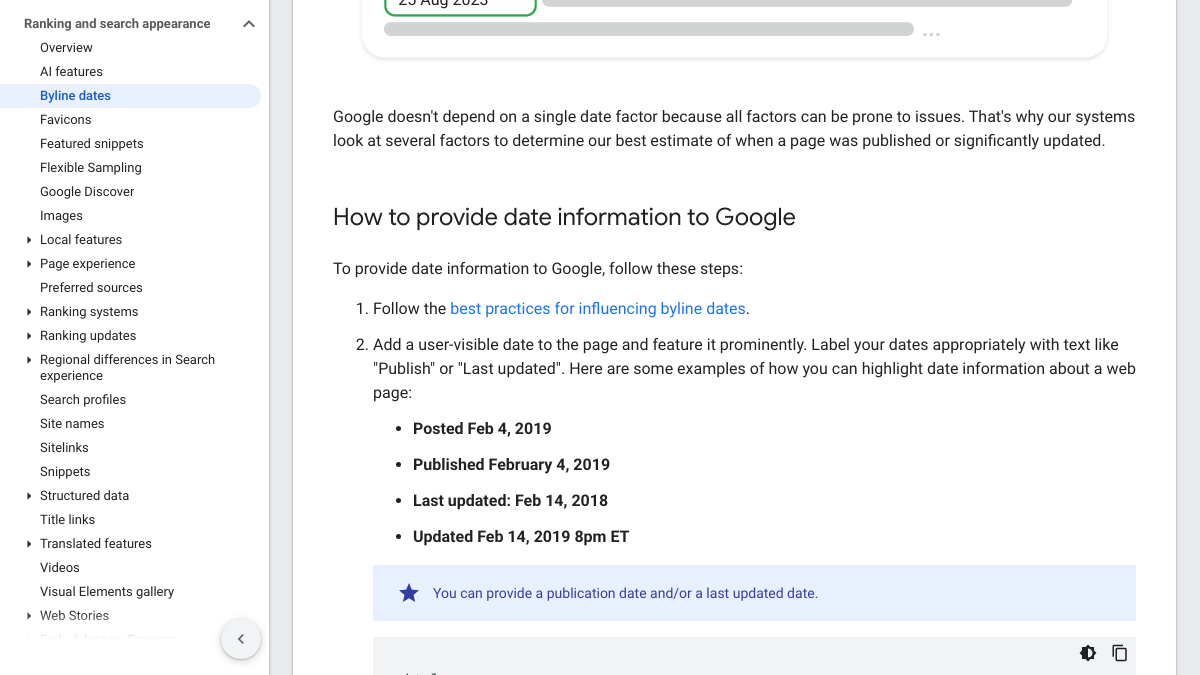
Google's documentation on byline dates says its systems look at several factors to estimate when a page was published or significantly updated. A new date on an unchanged page isn't one of them.
Our look at content refresh results shows what controlled tests found about updates, and our guide to content decay helps you find which pages need one.
Limits of our test
We checked 40 business questions on one day, from the US. Dates came from what each page declares in its code, which isn't always honest, since some sites bump their update date without changing much. Nearly a third of the pages we could fetch had no date at all, so we left them out.
The pattern still held across the questions. Old pages win evergreen searches often, especially for methods that don't change.
What it takes by hand
Here's a rough monthly budget for running an evergreen library of 50 pages, by our estimate.
| Task | Hours a month |
|---|---|
| Checking ages and rankings of what already ranks | 2 to 3 |
| Writing two new evergreen pages | 8 to 12 |
| Updating facts on 4 to 5 older pages | 4 to 8 |
| Checking Search Console before and after edits | 2 to 3 |
| Checking which pages AI answers cite | 2 to 3 |
| Total | 18 to 29 |
Doing it by hand or with help
You can build and tend an evergreen library yourself. Or RankControl can take on the steady part. It plans and writes articles around the lasting questions your buyers search, publishes them once you approve, and checks Google and Bing rankings plus 50 questions on ChatGPT, Perplexity, Claude, Gemini, Grok, Google AI Mode and Google AI Overviews every week, with AI visibility tracking that shows which pages each engine cites.
We'll show you exactly where your brand stands in AI search.
No commitment. $0 due today, cancel anytime. See how ChatGPT, Perplexity, Claude, Gemini, Grok, Google AI Mode, and Google AI Overviews talk about your brand today.