
A site owner posted in r/SEO last month with a confession. They'd published a batch of AI-written posts they now called slop, their Google rankings had fallen, and tweaking keywords hadn't helped. More than a hundred replies later, the advice mostly agreed on one point.
How can I recover my SEO after publishing a lot of AI-generated blog posts?
I messed up and published a bunch of AI-slop posts on my website. Now my Google rankings are awful.I’ve tried tweaking the SEO and keywords, but nothing has helped so far. Has anyone managed to bring a blog like this back? What actually wor...
The problem usually isn't that AI wrote the posts. It's that the posts didn't add anything. One reply put it simply. AI slop has no original input, so add real data, first-hand experience and specifics another site can't copy.
That's the whole game in AI content creation for 2026. Google updated its AI content guidance on October 1, its newer guide to generative AI search says much the same thing, and our own look at what AI Overviews cite points the same way. This guide pulls both together into a process.
What Google said this month
Google's guidance on using generative AI content, last updated October 1, now says it's "critical to manually factcheck and review all AI-generated content" before publishing. It explains why. Generative models don't retrieve facts, they predict likely words, so their output can contain errors.
The same page says using AI to generate many pages without adding value may break Google's scaled content abuse policy. It points to two sections of the Search Quality Rater Guidelines, one on scaled content abuse and one on content made with little effort, originality or added value.
Google's newer guide to optimizing for generative AI search goes further and names the problem.
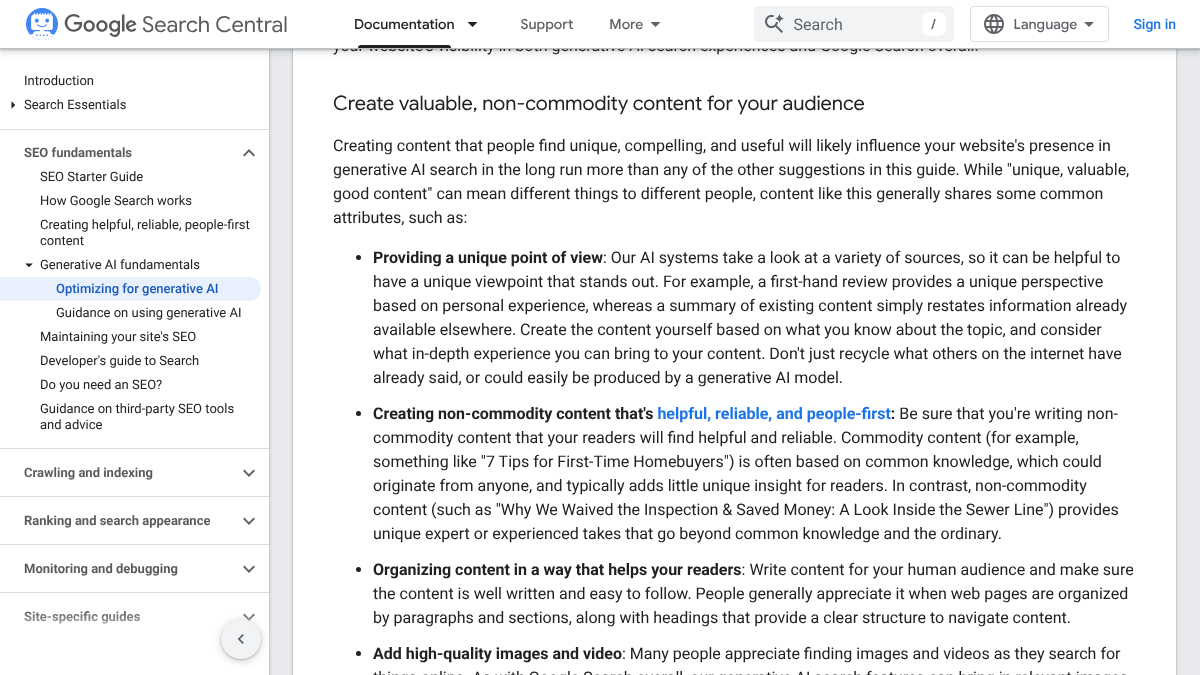
Its example of commodity content is "7 Tips for First-Time Homebuyers", common knowledge anyone could write. Its example of the opposite is a first-hand piece about waiving an inspection and looking inside the sewer line. That's the line to write on the right side of.
The commodity test
We use one question on every AI-assisted draft. Could anyone with the same AI model and the same keyword have written this page? If the answer is yes, it's commodity content, however well it reads.
A page passes when it contains something the model couldn't produce on its own. That might be a number you measured, a photo you took, a result from your own work, a local price, or a quote from a real conversation. Our post on why better AI content starts with context goes deeper on gathering that material.
AI search traffic grew 835% this year. Is your content ready?
RankControl generates 26 content formats optimized for ChatGPT, Claude, and Perplexity. Published on your domain, matched to your brand.

What AI Overviews actually cited
This month we pulled Google results for 41 searches that showed AI Overviews with sources. They covered dental care, real estate, online shopping, business software and AI tools, and gave us 171 citations to look at, 76 of them from the software searches. We compared each cited page with the regular results on the same search.
| What we checked | Cited by AI Overviews | Top 10 regular results |
|---|---|---|
| Page also ranked in the top 10 for that search | 25% | All of them |
| Reddit threads | 16% | 4% |
| YouTube videos | 7% | Not counted |
| "2026" in the title | 15% | 23% |
| An older year (2025 or before) in the title | None of 171 | 13 of 368 |
| Title phrased as a question | 24% | 25% |
Three things stand out.
Only a quarter of cited pages ranked in the top 10 for the exact search. Google's guide explains why. Its AI features run several related searches at once, which it calls query fan-out, and cite pages that answer those. A bigger Ahrefs study of 1.9 million citations found far more overlap, at 76%, so our small sample leans low. Either way, ranking for the head term isn't the only route in.
No cited page had an outdated year in its title. Thirteen regular results did, while no cited page did. Freshness signals seem to matter, but adding the current year didn't help on its own. Cited pages actually carried "2026" less often than the ranking pages did.
Question-style titles made no difference. Cited pages were phrased as questions about as often as the pages that only ranked.
One question, two kinds of page
The real estate searches in our set show the difference in practice. A commodity article on "how much does it cost to sell a house" would list national averages for agent fees, repairs and closing costs. A model can write that in a minute, and so can every competitor.
The AI Overview for "how much does it cost to sell a house in texas" cited something else. Next to NerdWallet, it cited four brokerage pages, each about one city. One covered Dallas, one Houston with a full breakdown, one closing costs in San Antonio, and one net proceeds in Austin. Each came from a brokerage that sells homes in that city and knows the local numbers.
Same question, same topic, but only one version has anything a model couldn't produce by itself. That's the version worth creating, and AI can still do most of the typing once you hand it the local figures.
Where AI helps and where it doesn't
AI is good at the slow, mechanical parts. It can turn a pile of notes into an outline, write a first draft from a fact sheet, summarize a call transcript into quotes, turn raw numbers into a table and tighten loose sentences. Our comparison of AI content creation tools for SEO teams covers which tools do this for a whole team.
It's bad at the parts that make a page worth citing. It can't measure anything, it doesn't know what happened last week, and it will state a wrong number with total confidence. Google's guidance makes the same point when it says models predict words rather than retrieve facts. Our post asking whether AI-written posts can rank in AI search shows what that looks like in a real draft.
A seven-step process for AI-assisted articles
Here's the order we'd work in. The AI does the parts it's good at, and a person does the parts that make the page worth citing.
- Pick a question where you have something to add. In our checks, the pages that got cited answered local or specific versions of common questions, like the cost to sell a house in one Texas city, or a dental practice's answer on whether implants hurt.
- Build a fact sheet before any drafting. Collect your numbers, sources, quotes, screenshots and examples in one place.
- Draft from the fact sheet. Give the model the facts and the outline, and ask it to write from them, not from memory.
- Check every claim against its source. This is the step Google now calls critical. Delete anything you can't verify.
- Add the part only you have. That could be a table of your own results, a photo or a short story from a real job.
- Answer the main question near the top, and date the page. Then update the numbers when they change instead of only changing the date.
- Check whether AI engines cite it. Search the question in ChatGPT and Google's AI Mode a few weeks later and note which pages they use.
Our AI content publishing workflow covers the review and launch steps in more detail. Agencies running this for clients can find staffing and pricing in our content marketing for agencies guide.

Built by the team that got cited in 48 hours.
Content generation, backlink building, AI visibility tracking, and Google rankings. One platform, zero guesswork.
What you can skip
Google's generative AI guide also lists things you don't need to do for Google Search. You don't need an llms.txt file or special AI markup, because Google Search ignores them. You don't need to break content into tiny chunks, and there's no ideal page length.
It also warns against two tempting shortcuts. Creating a separate page for every variation of a search, including the fan-out queries, mainly to influence rankings or AI answers counts as scaled content abuse. And seeking inauthentic mentions across the web isn't as helpful as it looks, since the ranking systems still look for quality.
That matches what we saw. Reddit showed up in AI Overviews four times as often as in the regular results, but the cited threads we looked at were ordinary community discussions, like a parents' forum comparing Austin neighborhoods.
If you've already published AI slop
The r/SEO replies gave a sensible recovery plan. Sort every AI post into three groups, keep, improve or remove. Noindex or delete the posts with no traffic and nothing useful in them, merge the near-duplicates, and rewrite the rest with real examples and sources.
Several replies also said to slow down. Publishing faster than you can check is how most sites ended up with slop in the first place. Our post on whether Google targets AI content or low quality covers what the spam updates actually hit.
What this costs in hours
A good AI-assisted article takes about three to five hours. Gathering facts takes one to two, the draft about thirty minutes, and checking claims and adding your own material another one to two. Then add a few minutes a week to see which AI engines cite it.
You can do all of this yourself. Or RankControl's agents can do it for you every month, writing each article from your brand facts and the pages already ranking, publishing it on your site after your approval, and checking six AI engines every week, while you focus on your product.
See your first AI citation report in under 5 minutes.
No setup calls. No onboarding meetings. Connect your domain and see where AI mentions your brand right now.