
Surfer changed what its Content Score means this month. Its help article, dated October 1, now splits the score into an SEO Score and a new AI Search Score. The pitch is one number for "content that performs across search engines and AI search platforms."
That raised a question we could actually test. Surfer builds its score by comparing your draft with the top 20 Google pages for your keyword. So do the pages AI engines cite look like the pages Google ranks? We had a set of real ChatGPT citations from an earlier test, so we checked.
This post compares Surfer SEO and RankControl on one job, writing content that AI engines cite. Our broader RankControl vs Surfer SEO comparison covers tracking, seats and integrations. The Surfer facts here come from its pricing page and help docs, read on October 19, 2026.
The short answer
For teams that want articles written, published and then checked against what AI engines say, the best pick is RankControl, because it does the whole loop every month.
| Surfer SEO | RankControl | |
|---|---|---|
| What it scores against | Top 20 Google pages for your keyword | Pages ranking for the keyword, plus how easily AI engines can quote the draft |
| Who writes the article | Your writer, or Surfer AI with your review | RankControl's agents, with your approval |
| Live score while typing | Yes | No, it scores finished drafts |
| Publishing | WordPress export, Google Docs and Contentful | Native posts on nine CMS destinations |
| Checks AI answers afterwards | AI Tracker, 25 to 100 prompts by plan | 50 queries weekly on six engines |
| Monthly price | $59 to $359 | $400, one plan |
| Trial | Free start on the pricing page | 7-day free trial |
What Surfer's Content Score measures now
Surfer's docs describe the AI Search Score as two parts. Facts Coverage rates how well your draft covers "the facts, entities, and concepts commonly included in AI-generated responses" for the topic. Upfront Intent Alignment rates how early the page answers the main question and says who it's for.
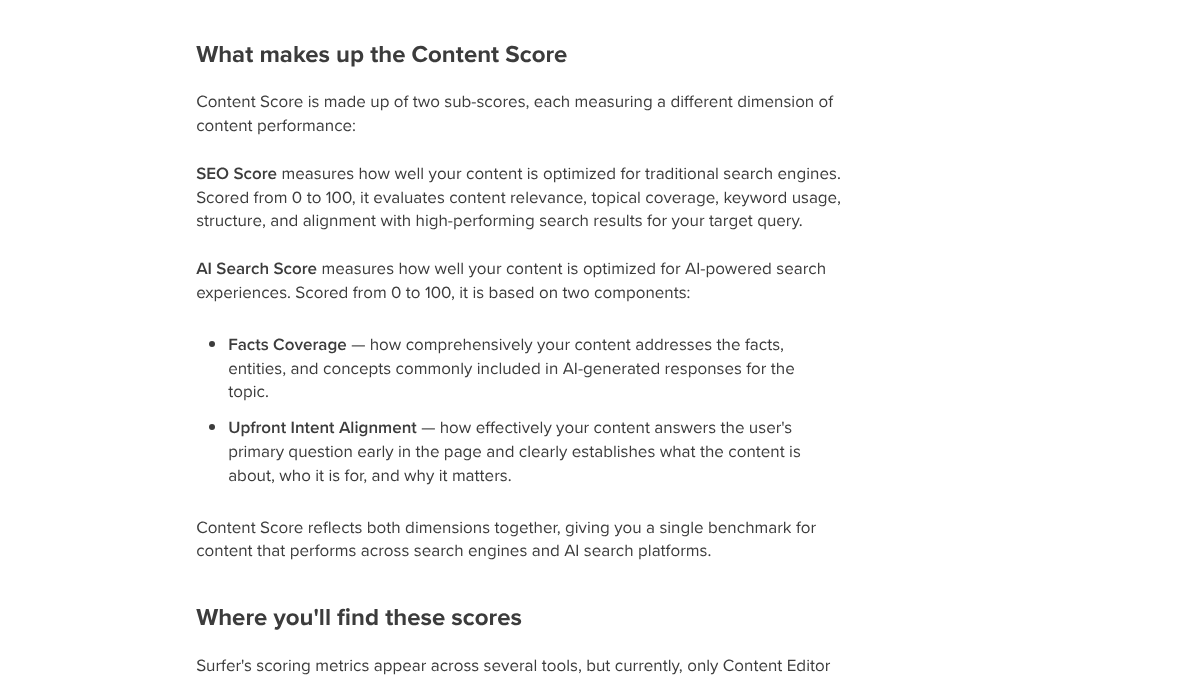
Both are sensible ideas. Answering early is good advice for any page, and covering the facts an answer needs makes a page easier to quote.
The SEO half works the way Surfer always has. The same docs say the score compares your draft with the top 20 pages ranking for your query, weighing keyword use, NLP terms, headings, images and content length against what those pages do. In the Content Editor, both halves roll into one number from 0 to 100, and 67 or more counts as optimized.
So the score still leans on one assumption. It assumes the pages worth copying are the ones Google ranks.
We checked the benchmark against ChatGPT's citations
Earlier this month, for our post on how online stores get cited by AI search, we ran eight everyday product questions through OpenAI's API with web search on. ChatGPT cited 29 pages across them. On October 19 we pulled Google's top 20 results for the closest matching search, like "office chair for back pain" or "pour over coffee grinder", and looked for each cited page.
| Product search | Pages ChatGPT cited | Same page in Google's top 20 | Same site in Google's top 20 |
|---|---|---|---|
| Stand mixer | 3 | 0 | 0 |
| Hiking backpack 50L | 3 | 0 | 2 |
| Dog food for sensitive stomach | 4 | 0 | 0 |
| Moisturizer for oily skin | 5 | 0 | 1 |
| Office chair for back pain | 4 | 0 | 0 |
| Pour over coffee grinder | 4 | 0 | 0 |
| Robot vacuum for pet hair | 1 | 0 | 0 |
| Noise cancelling headphones | 5 | 0 | 2 |
| Total | 29 | 0 | 5 |
None of the 29 cited pages ranked in Google's top 20 for its search. Only five even came from a site that appeared there, mostly REI and RTINGS with a different page.
There's a fair caveat here. Our ChatGPT questions were phrased like a shopper talking, such as "what's the best office chair for back pain?", while the Google searches were the short keyword. ChatGPT also rewrote the questions into its own searches. Even so, a benchmark built from Google's top 20 would have pointed a writer at pages ChatGPT didn't use.
Google's own AI answers are a different story. Ahrefs studied 1.9 million AI Overview citations and found 76% came from pages in Google's top 10. So the top-20 benchmark fits AI Overviews far better than it fits ChatGPT, and that split matters when you decide what to write.

Built by the team that got cited in 48 hours.
Content generation, backlink building, AI visibility tracking, and Google rankings. One platform, zero guesswork.
What the cited pages had instead
The pages ChatGPT picked weren't optimized versions of the ranking pages. They were mostly the makers' own pages. Steelcase's chair page, Fellow's grinder page, Sony's spec sheet, a Bose support article and a Purina label PDF all made the list.
The searches show why. In those eight runs, ChatGPT ran 43 web searches, and 19 of them targeted one brand's own site, often asking for official specs or a price. It used review sites to build a shortlist, then went to the source to check numbers.
Length didn't seem to matter much either. Ahrefs looked at about 174,000 pages cited in AI Overviews and found a correlation of 0.04 between word count and being cited, which is close to none. More than half the cited pages ran under 1,000 words.
That's a problem for any score that rewards matching the length of the ranking pages. A 600-word product page with the battery life in plain text did the job, where a 3,000-word guide padded to match a SERP average didn't come up at all.
Facts Coverage moves Surfer closer to this, since it rewards having the facts an answer needs. What it can't do is write your spec page, or put your price and test results where an AI engine will look for them.
Reading is not citing
One number from the same test changes how you should think about any score. Across the eight questions, ChatGPT pulled up 390 sources and cited 29 of them. That's about one page cited for every 13 it read.
Reddit made the gap plain. It supplied 73 of those 390 sources, more than any other site, and none of the 29 citations. A page can be read, used and still never shown to the shopper as a link.
Which questions get a citation at all varies too. A post in r/AI_SearchOptimization last month described a study of 480 questions in which ChatGPT cited a source in only 72 answers. The poster said 69 of those came from two kinds of question, finding a provider and asking what something costs. We can't check that study, but it fits our test, where all eight questions were buying questions and each one got at least one citation.
So the pages most worth writing for AI are the ones that answer "who sells this" and "what does it cost" with facts on your own site. A content score can tell you a draft covers a topic. It can't tell you whether the draft answers a question that gets citations.
How each tool handles the writing
Surfer gives your writer a workspace. The Content Editor shows live targets for terms, headings, length and images, Auto-Optimize can add missing terms and sections in one click, and Surfer AI can generate a full draft for you to review. Its Humanizer, per Surfer's own page, is meant to spot patterns that might get flagged as AI-written.
RankControl does the writing itself. It learns your products, buyers and voice through Brand Control, then writes each article against the pages already ranking for its keyword. Each finished draft also gets a score for how easily AI engines can quote it, with a list of fixes.
The bigger gap is what happens after the draft. With Surfer, a person still exports the article, formats it and publishes it. RankControl publishes approved articles as native posts on your own site through nine destinations, then checks ChatGPT, Perplexity, Claude, Gemini, Grok and Google AI Mode each week.
That weekly check is what tells you whether any of it worked. A score is a guess made before you publish. Seeing which engines name you a week later is the result.
Surfer's live editor is better for hands-on writers. The score moves as you type, Auto-Optimize fills gaps with one click, and nothing in RankControl gives a writer that kind of in-the-moment guide.
What people say about chasing the score
Writers who've used content scores for years are split on them. A long-time Surfer user asked r/WebsiteSEO whether to come back, saying they'd watched people optimize pages into "unreadable keyword soup." They wanted to know if rankings came from the score or from finally writing the page properly.
Is Surfer SEO worth it, or content score trap?
I’m torn on going back to Surfer, Neuronwriter etc. I get the value of a structured content brief, but I’ve also seen people “optimize” a page into unreadable keyword soup. I was an early user years ago when Mathew Woodward was pushing it h...
The replies leaned skeptical. One said the tool tends to stuff NLP terms without understanding what the searcher wants. In r/Agentic_SEO, a more balanced reply said the editor's live score works well as a checklist but can be gamed pretty easily.
Our read is that the score is a fair checklist for Google, and a weak predictor for ChatGPT. The pages ChatGPT cited in our test would have scored poorly against Google's top 20, since they weren't like those pages at all.
What each costs per article
Surfer's pricing page lists five plans on October 19, 2026. On monthly billing, Discovery is $59, AI Search Analytics (tracking only) is $95, Standard is $119, Pro is $219 and Peace of Mind is $359. Yearly billing drops those to $49, $82, $99, $182 and $299 a month.
Standard and Pro each include 360 documents a year, which works out to 30 a month. Peace of Mind is unlimited under a fair-use policy. Those documents are drafts and optimizations, so a person still edits, fact-checks and publishes each one.
| Surfer Pro | RankControl | |
|---|---|---|
| Monthly price | $219 | $400 |
| Articles a month | 30 documents to write or optimize | 100 pages written and published |
| Who publishes | Your team | RankControl, after your approval |
| AI engines checked | Five on Pro, 50 prompts daily | Six, 50 queries weekly |
Here's our rough math on the hours. Reviewing a generated draft, adding real facts and getting it live takes about two hours an article. At 20 articles a month, that's 40 hours on the Surfer side before anyone looks at whether AI engines cite the result.
See your first AI citation report in under 5 minutes.
No setup calls. No onboarding meetings. Connect your domain and see where AI mentions your brand right now.

What to write if you want AI to cite you
Whichever tool you use, our test points to the same few pages. These are worth more than any score.
- Put specs, prices and test numbers in plain text on your own product and service pages.
- Write buying guides with a year, an author and an update date.
- Keep support and spec pages public and crawlable.
- Answer the main question in the first two sentences, which is the part Surfer's new score gets right.
Our guide on how to rank on ChatGPT covers the crawler settings that decide whether ChatGPT can read those pages at all.
Which one gets your pages cited
Surfer gives a writer a scoring editor, and its new AI Search Score is a sensible addition to it. If you want the articles written, published on your site and checked against six AI engines every week, RankControl does that whole job for one price. Our Surfer SEO alternatives post lists the other options.
You can do all of this by hand with a score open in another tab. Or RankControl's agents can write and publish the pages every month, and track which AI engines cite them, while you focus on your product.
Your competitors are building backlinks while you read this.
Organic outreach, social mentions, and citations from Editorial Circle member sites, with managed backlinks available as an add-on. Grow your domain authority without running the campaign yourself.