
SEO.AI's onboarding agent is called Mark, and its first messages set expectations fast. Your content plan is ready in about five minutes and your first article in an hour. Backlinks from other users start within two weeks, and "you should start seeing more traffic from Google and ChatGPT within 6–8 weeks."
That last line is where RankControl vs SEO.AI splits. SEO.AI's Analytics help guide describes four metrics, all from Google Search Console: clicks, impressions, click-through rate and position. So the ChatGPT half of the promise isn't something the product reports on. We call that the half-measured promise, and it's the clearest difference between the two tools.
Everything about SEO.AI below comes from its own pricing, product and help pages and its terms. I checked them on September 26, 2026.
RankControl vs SEO.AI at a glance
| SEO.AI | RankControl | |
|---|---|---|
| What it is | Autopilot SEO agent: content, publishing, link exchange and Google Ads | Plans, writes, publishes and tracks articles for AI search, plus outreach |
| Price | $149/mo per site; Multi Site $299 to $749/mo | $400/mo, or $4,000/yr |
| What it measures | Google Search Console clicks, impressions, CTR and position | 50 queries weekly on seven AI engines, plus Google and Bing positions |
| AI engines tracked | None reported | ChatGPT, Perplexity, Claude, Gemini, Grok, Google AI Mode, Google AI Overviews |
| Publishing | Automatic, draft or review; WordPress and Shopify documented | 9 destinations, approval first, auto-publish optional |
| Links | Backlink Club exchange network, opt-in | Outreach drafted for each article, from your mailbox |
| Languages | "50+" | 23 |
| Ads | Builds and optimizes Google Ads | Not offered |
| Trial | 7 days | 7 days, card up front |
What SEO.AI is
SEO.AI is made by Ninety ApS, a company near Copenhagen, and its pricing page states the pitch plainly: "What an SEO agency charges $1,000 for, we deliver for $149." The Single Site plan covers one website in one language. Multi Site uses a slider, running $299 a month for up to three sites or languages, $449 for five and $749 for ten.
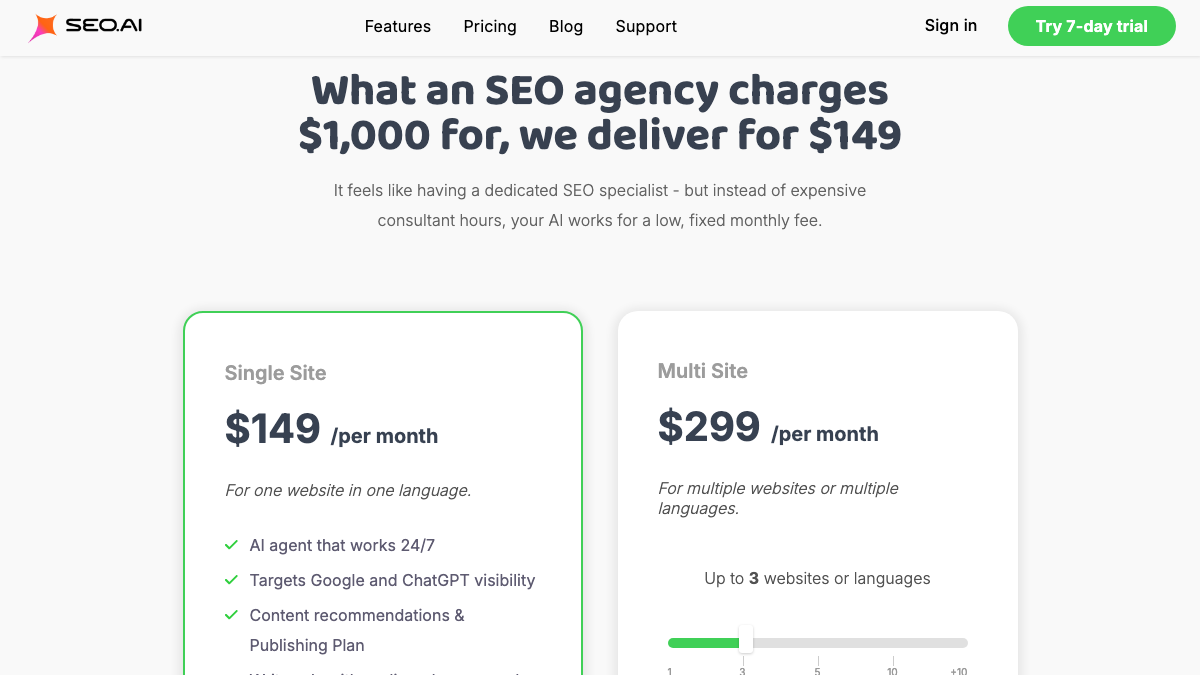
Both plans list the same features, from an "AI agent that works 24/7" and a publishing plan to backlinks and Google Ads management. Paying yearly takes 25% off, and all prices exclude VAT.
SEO.AI deserves credit on two things. At $149 a month for a single site, it costs well under half of RankControl. It also builds and optimizes Google Ads campaigns, which RankControl doesn't touch.
200+ SaaS teams already track their AI citations.
They know exactly when ChatGPT mentions their brand, and when it stops. Do you?

How SEO.AI runs day to day
Setup happens in a Connections panel. On one side sit the data sources: your sitemap, business details, Search Console, Google Ads and Ahrefs data. In the middle is the agent, and on the other side are the outputs, which are your CMS, Google Ads and the Backlink Club.
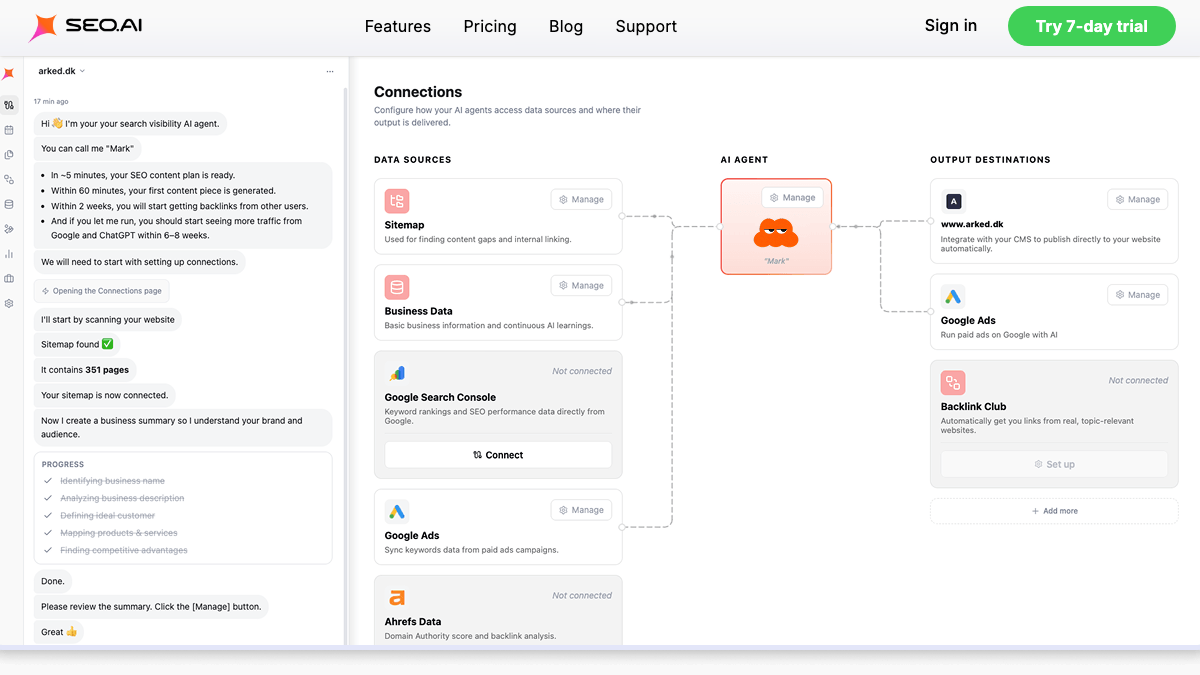
From there, SEO.AI writes on its own schedule. Its homepage says new articles "go live automatically," and its FAQ lists three modes: automatic publishing, saving as drafts, or reviewing in the platform, with an email preview before anything publishes.
RankControl works the same way at the start. We read your site, draft your brand profile for you to correct, and build a content plan. The difference is what feeds the plan. RankControl's content engine plans articles from the AI answers you're missing, so every article has a question it's meant to win.
The half-measured promise
SEO.AI's pricing card says it "Targets Google and ChatGPT visibility," and its homepage talks about getting mentioned by AI. What it measures is Google. Per SEO.AI's own help guide, the Analytics tab shows four Search Console numbers: clicks, impressions, click-through rate and position. I couldn't find a report anywhere that shows whether ChatGPT or any other AI engine cites you.
Search Console is a good report, and RankControl uses it too. It just can't see inside a ChatGPT answer. A page can rank well on Google while ChatGPT quotes a competitor for the same question, and nothing in a clicks-and-position chart will tell you.
Google has narrowed the gap on its own side. Since August 31, Search Console's Generative AI features report has shown every site its impressions inside AI Overviews and AI Mode. That covers Google's answers only, though, and it counts impressions rather than which source Google quoted. ChatGPT, Perplexity, Claude and Grok stay outside it.
RankControl's AI visibility tracking checks 50 of your queries every week on seven engines and keeps the cited pages for each answer. We track up to 10 competitors in your share of voice, so you can see who gets named instead of you. When a query shows a gap, that gap becomes an article on the calendar, and the next weekly check shows whether it worked.
Traffic gets the same treatment. RankControl's analytics separates visits referred by AI engines by source and logs AI crawler visits, next to Search Console clicks and impressions. That's how you see whether a citation in ChatGPT turned into people on your site.
If you're still on SEO.AI, you can measure your side of the promise yourself before deciding anything. Our free AI visibility check shows whether ChatGPT cites you on real buyer questions.
Content and publishing
SEO.AI writes a full article from a topic and a keyword, adds internal link suggestions and scores the draft against what it calls "5.7 million data points." Its content analysis flags missing keywords and benchmarks word count against the pages that rank.
For publishing, its FAQ promises support for "all major platforms," naming WordPress, Webflow, Wix and Squarespace, plus shops such as Shopify and Magento.
The help center is narrower. It has setup guides for WordPress and Shopify only. The WordPress guide, dated July 2025, describes opening a document and clicking "EXPORT," then choosing WordPress, which is a step more manual than "no manual uploads" suggests. Check that your CMS is really supported before you sign up.
RankControl publishes through nine documented destinations. They range from a WordPress plugin to Shopify and Webflow, with webhooks and a Content API for headless sites. Each article is written against the pages already ranking for its keyword and scored for how easily AI engines can quote it, with a fix list. Auto-publish is off by default, and you can switch it on once you trust the drafts.
How often does ChatGPT mention your brand?
Most founders have no idea. The answer might surprise you.

Backlink Club and outreach
SEO.AI's link model is an exchange. Its homepage describes matching you "with relevant sites in our link exchange network," and the in-app module is called the Backlink Club, set up from the Connections panel. It's opt-in there, showing "Not connected" until you set it up. SEO.AI doesn't have an outreach feature for pitching sites outside its network. What it adds is reporting on the result: its homepage promises you can track new links as they appear and follow your Domain Rating as it grows.
RankControl's Link Control takes the outreach route. For each article we publish, Link Control finds link prospects and their contacts, then drafts emails that go from your own mailbox after you approve them. Teams that don't want to run outreach at all can add Managed Backlinks for $350 a month, which delivers five links a month from DR 25+ sites.
What the first month looks like
Mark's timeline gives a clear picture of an SEO.AI month. The plan arrives in minutes and articles start within the hour. If you set up the Backlink Club, links from other members start arriving within two weeks. Six to eight weeks in, you'd look at Search Console for more clicks and impressions.
A RankControl month starts with a baseline instead. The first weekly check shows, engine by engine, which of your 50 queries cite you and which cite a competitor. The calendar fills from those gaps, drafts arrive for approval, and outreach drafts follow each published article. By the fourth weekly check you can see whether the new pages moved any answers, per engine.
Neither tool can promise a citation by a date. RankControl's weekly check records the first week an engine cites a new page, and SEO.AI's reports stop at Google.
Whichever autopilot you use
Automation is the point of both tools, and it works best with a person checking the early output. Read the first dozen articles closely for facts about your own product, since that's where any AI writer is most likely to be wrong. Check that the topics match the questions your buyers ask, rather than keywords picked for volume alone.
SEO.AI can email you a preview before each article publishes, and it can save drafts for review. RankControl holds every article for approval until you switch auto-publish on, which most teams do once the drafts need little editing.
Languages and markets
SEO.AI's homepage says it "works across 50+ languages" and names 35 of them. RankControl writes in 23 languages across 33 markets, so check that your languages are on the list.
For multilingual sites, pricing works differently too. On SEO.AI, each language counts like a site on the Multi Site slider, so three languages on one domain is the $299 tier. RankControl's multilingual publishing is part of the one plan.
Trials, refunds and cancelling
Both tools offer a 7-day trial. SEO.AI's terms say the trial "automatically converts to a paid plan unless canceled during the trial window." They also state that "all Subscriptions are final and there shall be no refunds" except as the terms or the law provide. Monthly plans have no binding period, and annual plans are binding for the paid year.
SEO.AI's help guides list a Refund Policy article, but the link led to a "page not found" when I checked. Cancelling is self-serve, under Account, then Subscription, where the last step asks you to confirm deleting your data.
RankControl's trial takes the card up front with nothing charged that day, and cancelling stops the plan at the end of the period you've paid for. If you're moving over, our guide to switching from SEO.AI covers what to export first.
Working from Claude
SEO.AI doesn't list an MCP server or a public API as customer features, so its agent lives inside its own app. RankControl's MCP server has more than 80 tools and comes with the plan. You can check citations, plan titles and publish from Claude, Cursor or Codex, and publishing stays a dry run until you confirm it.
Five questions to ask either tool
Before you pay for any SEO agent, these questions sort out most of the differences in a single demo:
- Which AI engines will I see numbers for, and how often are they checked?
- Is there a setup guide for my exact CMS, or only a line in the FAQ?
- Where do backlinks come from: an exchange among customers, paid placements or outreach to sites that choose to link?
- Can I approve each article before it publishes, and is that the default?
- What stays on my site if I cancel, and what data can I export first?
Both tools publish to your own site, so the articles stay yours either way. The other four answers are where they differ.
RankControl vs SEO.AI: which wins AI search visibility?
For AI search visibility, the question is whether you can see the result. SEO.AI publishes content on a schedule and reports how it does on Google, and the ChatGPT side of its promise stays a promise. RankControl measures seven engines every week, turns each gap into a published article and backs it with outreach, so you can tell which work moved which answer.
You can run that loop by hand: ask each engine your buyer questions every week, note who gets cited, brief an article for each gap, publish and pitch it. Or RankControl's agents can run it every month for $400, with a 7-day free trial, while you decide what goes live.
15 hours a week manually. Or 15 minutes with RankControl.
Track citations, monitor competitors, and fix content gaps across every AI search engine. Automatically.