
Okara and RankControl will show up in the same shortlists this year, both wearing the "AI does your marketing" label, and the label hides a genuinely useful fork. Okara is a breadth product: an AI CMO delegating to ten-plus channel agents at once. RankControl is a depth product: one growth loop, owned content and AI search visibility, run end to end and measured obsessively.
Neither shape is a gimmick, both are live products with real users, and which one wins depends almost entirely on a question about your company rather than about them. We build one of these, so the bias disclosure comes first, and every Okara claim below was pulled from their live pages this week, screenshots attached. The conclusion is stated plainly.
What Okara Is, Verified
Okara's homepage introduces it in five words: meet Okara, the AI CMO. The product is a roster of agents a business connects and delegates to: an SEO agent that finds keyword gaps and recommends fixes, a GEO agent that works on getting the brand cited in ChatGPT and Google AI Overviews, a Reddit agent that finds threads and drafts replies, X and LinkedIn agents for social drafts, an influencer agent for creator outreach, a UGC-video agent for clips, a writer agent for long-form articles on the Pro plan, and, distinctively, a coding agent that ships technical SEO and GEO fixes as reviewable GitHub pull requests.
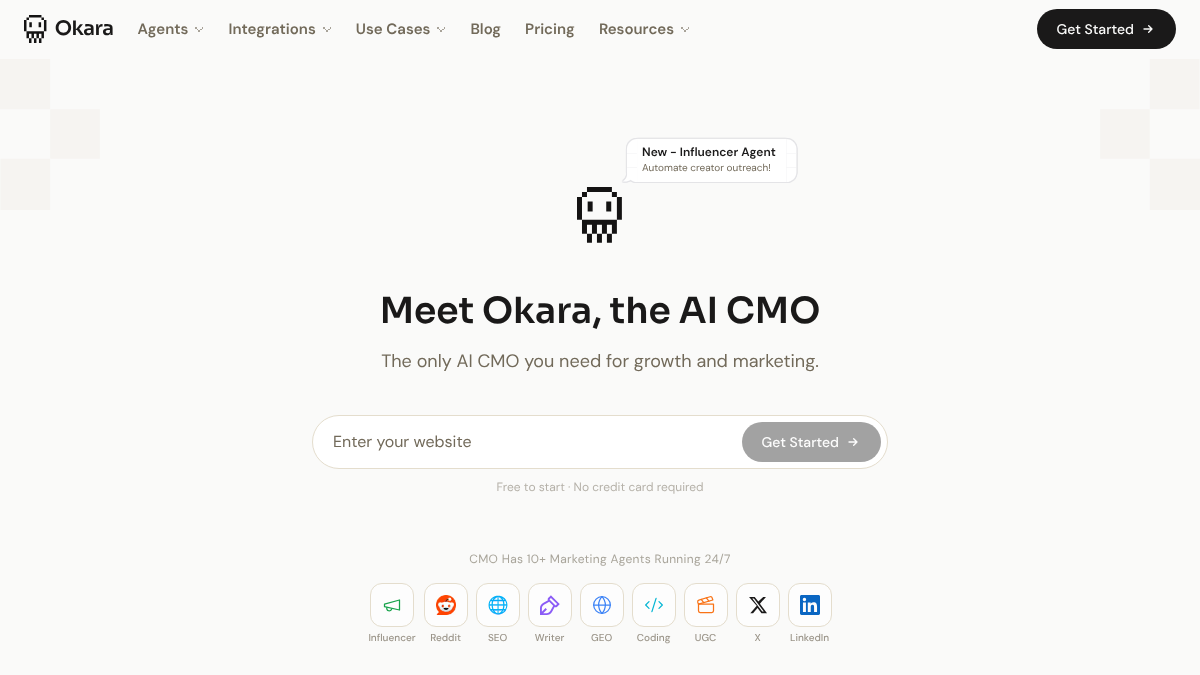
The commercial shape, from their pricing page: a genuinely free tier that runs website analysis and produces positioning, ICP messaging, and a 30-day strategy; AI CMO Lite at $129 a month ($108 equivalent billed annually) with the core channels; and AI CMO Pro at $249 ($208 annually) for the full agent suite. The article writer is Pro-only, with a minimum of 30 articles a month, so Lite users get SEO recommendations rather than drafts. The Lite plan's GEO agent tracks up to 15 AI search prompts with mentions, citation visibility, and competitor comparison. The site claims six figures of businesses on the free analysis funnel, and the surrounding content machine, free SEO tools, a viral-launch handbook, prompt libraries, is its own effective distribution play.
Fair summary: a wide, fast-moving generalist priced to be an easy yes.
What RankControl Is
RankControl is the narrow bet: that for B2B companies, owned content plus AI search visibility is the growth engine, and an engine deserves a whole machine rather than one agent among ten.
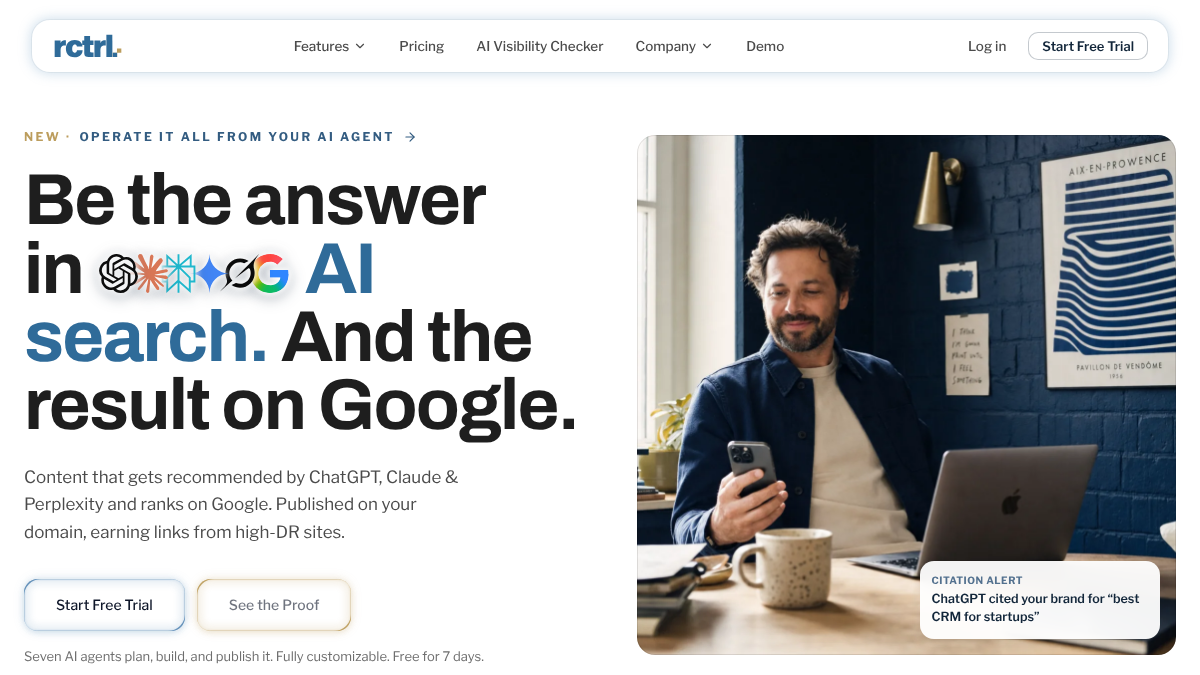
The loop: query discovery mines real buyer questions and plans titles onto a calendar; generation writes the articles; publishing lands them as native posts on your CMS, WordPress, Webflow, Shopify, Ghost, Notion, Wix, Framer, or the Content API, at up to 100 pages a month; outreach drafts backlink emails from your own mailbox, with an optional managed-links add-on; and measurement checks 50 tracked queries weekly across ChatGPT, Perplexity, Claude, Gemini, Grok, and Google AI Mode, alongside Google and Bing rankings, with per-engine history. Review modes by default, automation as the direction, $400 a month flat with a 7-day self-serve trial.
No Reddit agent, no video, no influencer outreach. The product's opinion is that depth in one compounding channel beats presence in eight, and everything about it follows from that opinion.

You're getting AI traffic. But do you know where it comes from?
RankControl credits every visit to the assistant that sent it: ChatGPT, Perplexity, Claude, Gemini, Copilot, or Grok. Full source attribution, next to your Google traffic.
Head To Head
| Okara | RankControl | |
|---|---|---|
| Shape | AI CMO: ten-plus channel agents | One deep loop: content + visibility |
| Price | Free tier; Lite $129/mo; Pro $249/mo | $400/mo flat, 7-day trial |
| Content | Article drafts on Pro ($249) | 100 pages/mo generated and published natively |
| AI visibility tracking | Up to 15 prompts, mentions + citations, competitors | 50 queries, weekly, six engines + Google/Bing, per-engine history |
| Links | Influencer/creator outreach focus | Backlink outreach from your mailbox; managed add-on |
| Social | X, LinkedIn, Reddit, UGC video agents | Repurposing drafts to your channels; engagement finding |
| Technical fixes | Coding agent ships GitHub PRs | Recommendations surfaced; fixes stay yours |
| Best for | Breadth across channels on a small budget | Owned content + AI search as the engine |
The Five Differences That Decide It
Breadth versus depth is the whole ballgame. Okara gives you a little of nine channels; RankControl gives you a lot of one. Neither is wrong, and your bottleneck picks: if nobody is doing anything across your channels, breadth is transformative at $129. If you've concluded, as the compounding math suggests, that owned content and answer-engine presence decide your category, a tenth of an AI CMO's attention is not what that conclusion deserves.
Where content comes from. On Okara, articles come from the Pro plan's writer agent, which can push them to WordPress, Webflow or Framer; on Lite, the SEO agent recommends topics and fixes rather than writing. RankControl writes and publishes in its one plan, at up to 100 pages a month, with each article planned from tracked queries and scored for how easily AI engines can quote it. The difference is less about the publish button than about what feeds it and how much volume the plan carries.
Measurement depth. Fifteen prompts versus fifty queries weekly across six engines with history is a real gap, and it compounds: citation sets churn between weeks, so shallow or occasional checks produce vibes rather than trends. If the AI-visibility number will be read in board decks, buy the instrument built for that weight, whatever tool it lives in.
The links philosophy. Okara's outreach energy goes to influencers and creators, a distribution play. RankControl's goes to editorial backlinks earned from your own mailbox, an authority play. Both are legitimate; they build different assets, and B2B search visibility runs on the second.
The coding agent. Okara ships technical fixes as reviewable pull requests, and that's the one place it's clearly ahead: RankControl surfaces technical issues and leaves the commits to you.
We'll show you exactly where your brand stands in AI search.
No commitment. $0 due today, cancel anytime. See how ChatGPT, Perplexity, Claude, Gemini, Grok, and Google AI Mode talk about your brand today.

The Month-Long Experiment, Specified
Because "try both" is advice only when it comes with a protocol, here's the clean version, runnable by one person in about an hour a week.
Pick the same ten buying queries for both products, the comparisons, alternatives, and constraint-heavy questions that precede your deals. On the Okara side, run the free analysis, take the Pro plan for one month, since article drafts start there, point its writer and GEO agents at those queries, and review the drafts it produces at whatever pace you'd realistically sustain. On the RankControl side, run the 7-day trial into a first month, load the same ten queries into tracking, and let the pipeline plan and publish against them. Keep a shared sheet with three columns per product: assets that actually went live, citations or mentions appearing for the ten queries, and hours you personally spent reviewing or unblocking.
Week four, read the sheet coldly. The published-assets column tells you which product's workflow survives contact with your real calendar. The citations column tells you which loop is moving the scoreboard you chose. And the hours column tells you the true price, because a $129 tool that needs six hours of your review beats a $400 tool that needs one only if your hours are cheap, and for most founders they are the most expensive line in the whole comparison.
Where Depth Shows
Depth starts inside each article. RankControl writes every article to beat what already ranks for its keyword, and gives each one a citability score with a fix list. The pages that need the most work sort to the top of one report, so an hour of review goes to the articles that need it most. In a ten-agent suite, content is one agent's job among ten; here it's the product.
Measurement goes deep the same way: 50 tracked queries checked every week across ChatGPT, Perplexity, Claude, Gemini, Grok, and Google AI Mode, with per-engine history and share of voice against named competitors. Okara's GEO agent on the Lite plan tracks up to 15 prompts. Fifteen prompts can tell you whether you appear; fifty checked weekly per engine can tell you why, and where to act next.
What Okara's customers might envy in the pipeline shape: volume with a destination. A hundred pages a month landing as native posts on your own domain, with links being earned to them and fifty queries grading the results weekly, is a compounding machine rather than a stream of activity, and compounding is the property that makes content cheap in year two. Breadth products struggle to offer that in any single channel, because breadth is precisely the promise not to go that deep.
Integration Reality, Briefly
One practical check before any decision: where each product touches your stack. RankControl's load-bearing integration is your CMS, WordPress via plugin, Webflow, Shopify, Ghost, Notion, Wix, Framer, or a content API for headless builds, because native publishing is the product's spine, plus your mailbox for outreach. Okara's load-bearing integrations are your social accounts, your GitHub for the coding agent, and, on Pro, the WordPress, Webflow or Framer site its writer publishes to. Neither is heavy to set up, but the difference tells you what each product believes: one is wired into where content lives, the other into where activity happens, and your stack will feel that difference every week you use them.
Pricing Math, Both Directions
The sticker comparison, $129-249 against $400, reads as an Okara win until you count what each price buys. RankControl's $400 includes the production volume (100 published pages), the six-engine measurement, and the outreach drafting that would otherwise be a content subscription plus a tracking subscription plus a VA. Okara's $249 Pro spreads the budget across channels, video and influencer work included. In other words, the prices aren't really comparable, because the products price different jobs; the honest question is which job you're hiring for this year.
One structural note a buyer should weigh: generalist suites iterate fast and wide, which is exciting and occasionally means depth arrives later in each channel. Specialists compound in one direction. Your risk tolerance for "the feature I need is on the roadmap" belongs in the decision.
The Skeptic's Corner
The genuine practitioner question about AI-CMO products shows up in founder communities as some variant of "has anyone actually tried this," and it deserves a straight answer rather than a scoff.
Anyone has tried out the AI CMO?
Saw the AI CMO (okara.ai) was released on Monday. Did a quick try and saw decent analysis of my product, and competitor analysis. It failed at SEO analysis and flagged immediately opportunities at Reddit, Hacker News but need to subscribe t...
The fair test for any agent suite, Okara included, is the same one we proposed for agency platforms: after a month, does last month's activity exist as published, measurable assets, posts that went live, PRs that merged, citations that appeared, or as drafts and dashboards? Okara's design, approval-gated drafts plus a coding agent, suggests the answer varies by how much reviewing you actually do, which is true of every approval-gated system, ours included when run in review mode. Buy whichever product you'll actually operate, because an unreviewed draft queue produces exactly as much growth in either tool: none.
The Verdict
B2B company that has decided owned content and AI search visibility are the engine: RankControl. Publishing at volume on your own domain, links earned to it, and fifty queries measured weekly across six engines is what taking that decision seriously looks like, and a tenth of a generalist's attention isn't.
Solo founder on a thin budget: decide which channel will carry the company first. If it's search and AI answers, one channel done deeply beats ten channels done a little, and $400 a month buys the whole loop for that channel. In B2B, the channel buyers use to build a shortlist is more and more often a question typed into an AI engine.
Team tempted by both: prove one loop first. Load your ten buyer queries into the 7-day trial and check three things before the week ends: a calendar of titles planned from those queries, the first articles with their citability scores and fix lists, and a per-engine baseline for every query. In the weeks after, published pages and citation rows show which shape your growth actually responds to, which is how this category's decisions should always end.
Already on Okara? Our guide to switching from Okara covers what to copy out before you cancel.
Know exactly what AI says about your competitors.
RankControl's Recon Agent monitors competitor citations across ChatGPT, Perplexity, Claude, Gemini, Grok, and Google AI Mode. See where they show up and you don't.