
You post on LinkedIn on a Tuesday. By Thursday it has 300 reactions, 40 comments and a DM from a prospect, and it feels like the week's marketing is done. Then someone asks ChatGPT for the best tool in your category, and your post isn't anywhere in the answer.
That gap is the RankControl vs Taplio question. Taplio is built to win the LinkedIn feed. RankControl is built to get your brand cited in the answers ChatGPT, Perplexity and Google's AI features write. The two jobs overlap less than they look, and a June 2026 analysis of 1.3 million AI citations of LinkedIn pages shows why: likes and comments had essentially no correlation with whether a post got cited. Taplio's plans and features below were checked on its site and help center on September 26, 2026.
RankControl vs Taplio: the short answer
Taplio is a LinkedIn operating tool. It writes posts with AI, schedules them and shows the analytics. It also helps you reply to comments, and on its top plan it adds a lead database and outreach automation. It works on LinkedIn only and says nothing about Google or AI search.
RankControl plans and writes articles from the questions your buyers search, then publishes them as native posts on your own domain. It checks 50 queries every week across six AI engines, drafts backlink outreach, and turns each article into draft posts for eight platforms, LinkedIn included, for $400 a month.
If the goal is AI search visibility, we'd pick RankControl, because the pages that earn citations are long, specific and findable, and a feed post is none of those.
Side by side
Here's how the two compare on what buyers usually ask about.
| Taplio | RankControl | |
|---|---|---|
| What it is | LinkedIn content, scheduling and growth tool | Pipeline for AI search visibility and Google rankings |
| Price | $39, $69 or $199/mo per seat | $400/mo or $4,000/yr, one plan |
| Seats | Per seat, with team discounts from 2 seats | 5 included |
| Platforms | LinkedIn only | Your website, plus drafts for 8 social platforms |
| AI writing | Growth plan and up | 100 pages/mo across 26 formats |
| Scheduling | Built-in LinkedIn calendar and queue | Drafts pushed to Buffer or Postiz, or copied out |
| Google and AI search | Not covered | 50 queries weekly on 6 AI engines, plus Google and Bing positions |
| Lead database | 3M+ profiles on Pro | Not offered |
| Backlink outreach | Not offered | Drafted from your own mailbox |
| Trial | 7 days, card required, full Pro access | 7 days, card required, $0 today |
What Taplio is good at
Taplio has belonged to lempire, the company behind lemlist, since 2024, when its founder sold it along with Tweet Hunter. The product is a complete LinkedIn workflow. You write in a composer with previews and an AI post generator that does hooks and carousels, and you borrow ideas from a library of more than five million viral posts. A calendar and queue handle scheduling, and analytics export to CSV. Growth adds engagement tools for replying to comments, and Pro adds a lead database with a push to lemlist.
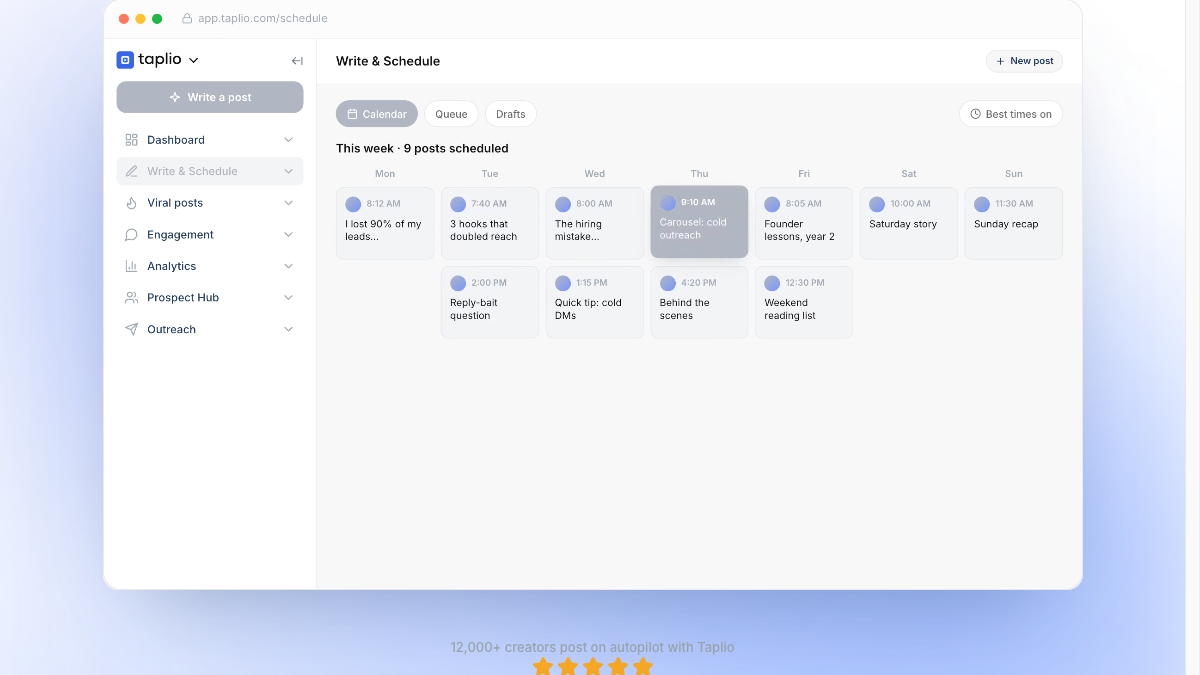
For running a LinkedIn presence day to day, Taplio goes much deeper than RankControl. It schedules natively, tracks your post analytics and helps you work the comments, while RankControl only drafts LinkedIn posts from your articles and hands them to a scheduler.
One caution on the Pro plan's automation. A developer who says they've worked on both lemlist and Taplio posted on r/gtmengineering this month that LinkedIn keeps an internal reputation score for accounts, and that bulk DMs and automated connection requests are the fastest way to damage it. Use those features carefully if your personal account is your main channel.
AI search traffic grew 835% this year. Is your content ready?
RankControl generates 26 content formats optimized for ChatGPT, Claude, and Perplexity. Published on your domain, matched to your brand.

Does LinkedIn content get cited in AI answers?
Yes, and more than most marketers expect. Semrush analyzed 325,000 prompts for a March 2026 study and found LinkedIn referenced in about 11% of AI responses: 14.3% in ChatGPT Search, 13.5% in Google AI Mode and 5.3% in Perplexity. That's a bigger share than most company blogs will ever get on their own.
Other data points the same way. Meltwater's May study of 9.5 million citations put LinkedIn second among all cited sources, behind only YouTube.
So LinkedIn belongs in an AI search plan. What gets cited there is the interesting part, and it isn't what a feed tool is built to produce.
In the June analysis of 1.3 million citations, long-form LinkedIn articles earned 72% of LinkedIn's citations and ordinary posts about 26%. Per URL, articles averaged 8.5 citations against 5.9 for posts. The typical cited post in Semrush's data had just 15 to 25 reactions and one comment or fewer.
We call this the applause gap: the distance between what earns reactions in the feed and what gets pulled into an answer. The r/aeo thread that walked through the same dataset put the numbers bluntly, with a correlation of -0.06 between likes and citations and -0.04 for comments.
Linkedin Articles at 66% citation rate
We did an internal research on 1,310,455 LinkedIn URLs that were cited by ChatGPT, Perplexity, Google AI Overviews, AI Mode, Copilot and Gemini between January and June 2026. I've been building LinkedIn content for a while and this one made...
That's the problem with judging LinkedIn work by Taplio's scoreboard. Its viral-post library, hook generator and engagement tools all push toward reactions, and the citation data says reactions are close to irrelevant. We covered what does work in our framework for LinkedIn posts that get cited by ChatGPT: original, specific, long enough to answer a question on its own.
What gets a LinkedIn post cited
If LinkedIn is part of your plan, the citation data gives a short list of habits that matter more than reach:
- Post original material. Reshares barely register in AI answers, so your own write-up of an idea beats a share of someone else's.
- Open with the question the post answers, in the words a buyer would type into ChatGPT.
- Keep it text-first. In the dataset behind that r/aeo thread, text-only posts averaged 6.48 citations per URL, a little ahead of posts with images at 5.91 and video at 5.69.
- Turn your strongest pieces into LinkedIn articles, which pull in far more citations per page than posts do.
- Link back to the full article on your site, so readers and any engine that follows the link can find the long version.
None of these depend on a big following. The same 1.3-million-citation dataset found follower count had little bearing on whether a URL got cited at all.
Where your own site fits
LinkedIn is one surface, and you don't control it. Your own site is the one you do control, and it's the one that ranks in Google's index, which is where AI Overviews and AI Mode look for sources.
RankControl's content engine plans titles from the questions your buyers search and writes each article in your brand's voice against the pages already ranking for the keyword. Each one gets a score for how easily AI engines can quote it, with a fix list, and goes out as a native post through the publishing destination you connect.
Then AI visibility tracking checks 50 queries every week across six AI engines, Claude and Grok included, and keeps a citation history per engine. You get a notification when a new citation lands, and a lost one shows up in that history on the dashboard.
Article first, then LinkedIn
The workflow the data points to uses both surfaces in order. Write the long, specific article on your own site first, then carry its sharpest ideas to LinkedIn.
RankControl's repurposing handles the second step. Every article it publishes can be turned into drafts for eight platforms, including a LinkedIn post built around the article's strongest point, written in your brand voice. You edit what you like, then copy it out or push it to Buffer or Postiz with an API key. RankControl never posts to your accounts on its own.
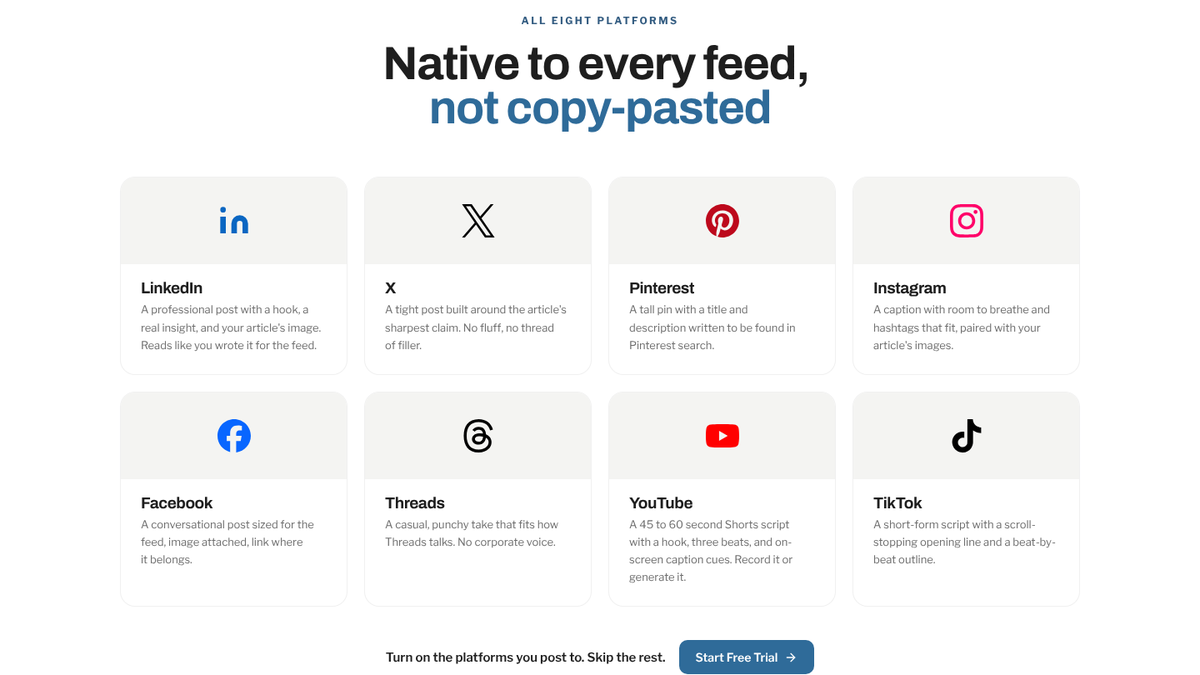
Given how often LinkedIn's long-form articles get cited, it's also worth republishing your best two or three pieces a month as LinkedIn articles by hand, with a link back to the original.
Here's what that loop costs when you run it yourself, per piece:
- Pick a question buyers ask and research what the current answers cite: 45 minutes.
- Write the article with sources and publish it on your site: four to five hours.
- Adapt it into a LinkedIn post and a LinkedIn article: about an hour.
- Check whether ChatGPT, Perplexity and Google's AI answers cite either one, every week: 20 minutes per query.
At eight pieces a month, that's 50 to 60 hours before the weekly checking. These are our estimates, but the article is the expensive step in every version of this workflow, and it's the step Taplio doesn't touch.

Built by the team that got cited in 48 hours.
Content generation, backlink building, AI visibility tracking, and Google rankings. One platform, zero guesswork.
RankControl vs Taplio on price
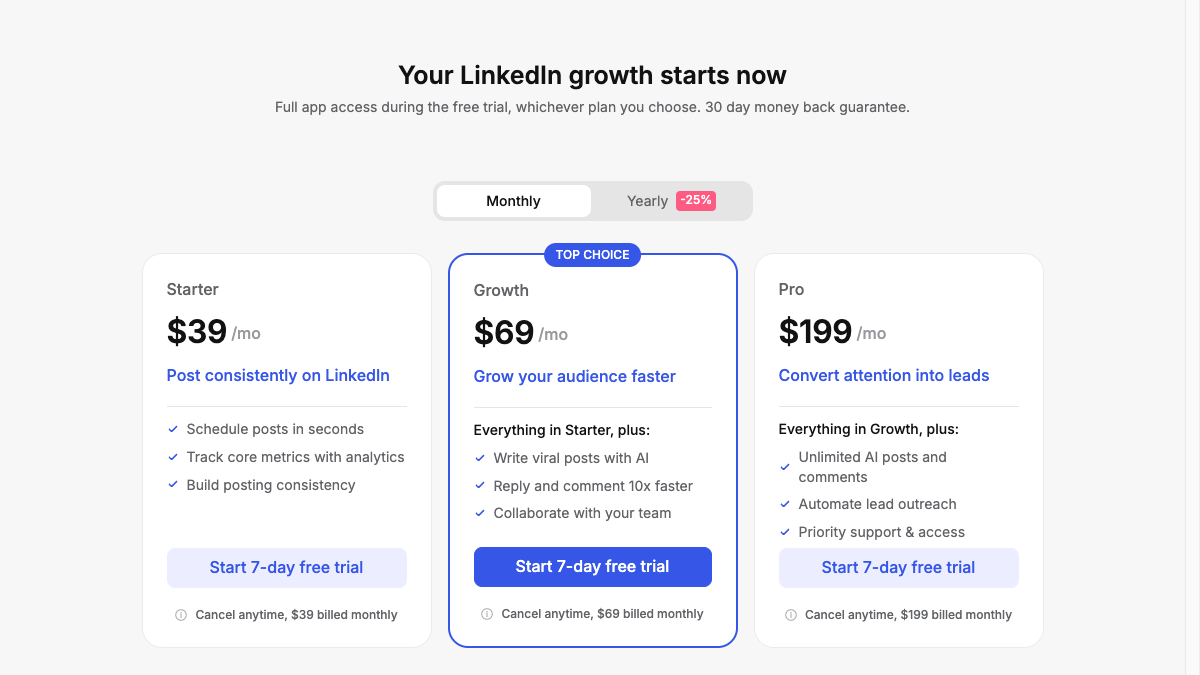
Taplio charges per seat. Starter costs $39 a month and covers scheduling and analytics without AI writing. Growth at $69 adds the AI post generator and engagement tools, and Pro at $199 adds the lead database and outreach automation. Yearly billing brings those down to roughly $32, $49 and $149 a month, and teams get 10% off from two seats.
For a five-person team on Growth, that's $345 a month billed monthly, or about $311 after the team discount. That covers one channel, LinkedIn, and none of the Google or AI search work.
| For a team of five | Taplio Growth | RankControl |
|---|---|---|
| Monthly cost | About $311 with the team discount | $400 |
| LinkedIn posts | Written, scheduled and analyzed | Drafted from articles, pushed to your scheduler |
| Articles on your site | Not offered | 100 pages/mo |
| AI citation tracking | Not offered | 50 queries weekly, 6 engines |
| Trial | 7 days, card up front, full Pro access | 7 days, card up front, $0 today |
| Refunds | 30-day money-back on the first payment | Cancel any time, access runs to period end |
Taplio's trial is generous on features, since you get full Pro access whichever plan you picked. It converts on day seven and charges the plan you chose, and if you picked yearly billing the whole year is charged then. Its help center says cancelling also deletes your account and data, so export first.
What the wider conversation says
The mood around AI-written LinkedIn content is not kind right now. A meme called "Welcome to LinkedIn Park" drew nearly 400 upvotes on r/ChatGPT in April, and the top replies were about AI-generated posts filling the feed.
That matters for tools like Taplio, whose Growth plan leans on AI hooks and rewrites. It matters for AI search too, in the opposite direction. The engines keep citing original, specific material from people with something to say, and the Semrush study found original posts made up about 95% of cited LinkedIn content, with reshares barely registering.
Which wins AI search visibility?
For AI search visibility, the verdict is RankControl.
Taplio does LinkedIn well, and that has real value for a founder building an audience. But it optimizes the feed metrics that the citation data says don't predict citations, and it does nothing for your website, Google or the six engines where buyers now ask their questions.
RankControl writes the articles those engines cite, publishes them on your domain, tracks the results every week, and still gives you a LinkedIn draft for every piece. In the first month you get a calendar of planned titles, articles going live on your schedule, social drafts for each one and four weekly readings of where you stand.
You can run all of this by hand: write the article, adapt it for LinkedIn, publish both, then check the answers every week. Or RankControl's agents can do it every month while you focus on your product. Already on Taplio? Our guide to switching from Taplio covers what to save first.
Not sure whether AI engines mention you at all yet? Start with a free check of your brand in AI answers.
See your first AI citation report in under 5 minutes.
No setup calls. No onboarding meetings. Connect your domain and see where AI mentions your brand right now.