
A Shopify store owner who sells ceramic pour-over sets asked ChatGPT for the best set under $80, phrased a few different ways, logged in and logged out. A rival store with nearly the same products and prices came up almost every time. Theirs never did, even though, by their own account, their product pages were the more detailed ones.
The replies in that r/shopify thread settled on one explanation. For a question shaped like that, ChatGPT leans on what other sites say about a brand: roundups, blog posts and forum threads. Nobody in the thread suggested posting more on Instagram.
That scene is the RankControl vs Predis question in small. Predis makes the ads and social posts a brand puts into feeds. RankControl makes the articles and earned mentions that AI engines read, publishes them on your own domain, and checks every week whether the engines cite you. Predis's features and prices below were checked on its own site in late September 2026.
RankControl vs Predis: the short answer
Predis is an AI ad platform built by EZML Technologies in Pune, India. It turns a text prompt, a product link or an image into ads and social posts, from UGC-style video to static carousels, and then schedules and auto-posts them. According to the company's own fact page, it began in 2020 as an idea for predicting how social posts would perform, and it now claims 6.4 million users.
RankControl is a pipeline for AI search visibility and Google rankings. It plans articles from the questions your buyers ask, writes them in your brand's voice, publishes them as native posts on your site, and drafts backlink outreach from your mailbox. Every week it checks 50 queries across six AI engines, ChatGPT and Grok among them, all on one plan at $400 a month.
So which wins AI search visibility? RankControl, for a plain reason: Predis doesn't compete for AI answers. Everything it makes and measures points at social feeds and ad accounts. The sections below cover why that matters for AI answers and what each tool costs once you add it up.
Side by side
Social output is the one row where both products do something similar, and even there one ships finished creative while the other drafts posts from articles.
| Predis | RankControl | |
|---|---|---|
| What it is | AI ad and social content generator with a scheduler | Pipeline for AI search visibility and Google rankings |
| What it makes | Video, UGC-style and image ads, carousels, reels, captions and hashtags | Articles in 26 formats, published on your site |
| Price | $32, $79 or $249 a month ($24, $55 or $212 billed yearly) | $400/mo or $4,000/yr, one plan |
| Billing unit | Credits, 1,300 to 10,000 a month by plan | 100 pages a month, everything included |
| AI search tracking | Not offered | 50 queries checked weekly on ChatGPT, Perplexity, Claude, Gemini, Grok and Google AI Mode |
| Competitor research | Facebook and Instagram pages, counted in runs | Up to 10 competitors, tracked for share of voice in AI answers |
| Where content goes | 10 to 60 social accounts; auto-posting from the Rise plan up | Native posts on WordPress, Webflow, Shopify, Ghost, Wix and more, or headless sites via API |
| Social output | Finished creatives, scheduled and posted | Editable drafts for 8 platforms from each article, pushed via Buffer or Postiz |
| Rankings | Not tracked | Google and Bing positions for every page it publishes |
| Backlinks | Not offered | Outreach drafted from your own mailbox |
| Team | Unlimited members | 5 seats |
| Languages | 18+ | 23 languages across 33 markets |
| Free trial | 3 days, card required, charged when day 3 ends | 7 days, card up front |

Your competitors are getting cited by AI. You're not.
Every day without citation tracking is a day your competitors pull ahead in ChatGPT, Perplexity, and Claude.
What Predis actually makes
Predis sits much closer to a creative studio than to anything in search. You type a prompt or paste a product URL, and it builds the visual and the copy together. Its Copilot mode returns four different hooks for each prompt, so a problem-and-solution angle can run against an educational one. For online stores, it reads the catalog straight from Shopify, Wix or WooCommerce and turns the product photos into ads and product videos sized for the Meta and TikTok ad managers.
Around the maker sits an operating layer. A content calendar and scheduler handle posting, with auto-posting from the $79 Rise plan up, while the $32 Core plan leaves the final click to you. Approval flows and brand kits keep a team's output on brand.
The competitor feature stays inside social. You connect your Facebook and Instagram accounts, enter a rival's handle, and see what they post and when, with each competitor you view counted as one run. Core includes 60 runs a month and Enterprise+ includes 600.
Predis is stronger at one job RankControl doesn't do at all: producing video and image ad creative at volume. RankControl writes short-video scripts and branded image cards from each article, but it renders no video and designs no ads.
Why feed content rarely shows up in AI answers
Predis keeps a page on its own site called LLM Info. It's a plain fact sheet listing the founders, a 25-person headcount, the services and the 6.4 million customer claim, written for AI models to read. When Predis wanted AI models to describe the company correctly, it published a page of plain text on its own domain.
The research backs that instinct. A September 2025 University of Toronto paper on generative engine optimization found that AI search engines show a "systematic and overwhelming bias" toward earned media, meaning third-party coverage, over brand-owned and social content. Classic Google results mixed those sources more evenly.
Call it the quote test. An AI engine builds an answer by lifting sentences from pages it can read and trust, so the useful question about any piece of content is whether it holds a sentence worth quoting. A 500-word article on the best pour-over set under $80 passes. A carousel with a 20-word caption and a row of hashtags mostly fails.
Social platforms do show up in AI citations when their content passes the quote test. On LinkedIn, a study of about two million citation records found long-form articles drew roughly 72% of the platform's AI citations, and feed posts about a quarter. We broke down what those cited LinkedIn posts look like in a separate guide. YouTube works the same way. Engines can't watch a video, so they read the title, description and captions around it.
Grok leans on social sites more than most engines do. Ahrefs looked at the domains cited across 1.9 million US queries in June 2026 and put YouTube at 15.1% of Grok's mention share and Facebook at 13.9%, with x.com down at 1.4%. So a Predis video posted to YouTube Shorts isn't invisible to every engine. What those studies leave open is how often a brand's own 30-second ad clip is the thing being cited, because they count domains rather than post types.
A long r/growthmarketing thread on getting into ChatGPT recommendations reached the same place from the practitioner side. The top-voted plan had two parts: make the brand worth mentioning on credible third-party sites, and publish pages that answer the exact prompts buyers type, such as FAQs, comparisons and implementation guides.
What's your strategy for appearing in ChatGPT recommendations?
As more customers are using ChatGPT instead of Google search, I'm wondering how other marketing teams are approaching this. Are you optimizing for AI visibility? How do you track if you're being recommended? Looking for insights from others...
What RankControl does for AI search visibility
RankControl runs the text side of that picture as a pipeline, with agents that share one workspace. Radar mines the questions your buyers ask and plans titles onto a calendar. Forge, the writer inside the content engine, drafts each article in the voice of your brand profile, against the pages already ranking for its keyword. Every article gets a score for how easily AI engines can quote it, with a fix list.
Then it goes out as a native post through the CMS you connect, whether that's WordPress, Webflow, Shopify or a headless site. Auto-publish is off by default, so each article waits for your approval until you trust the output.
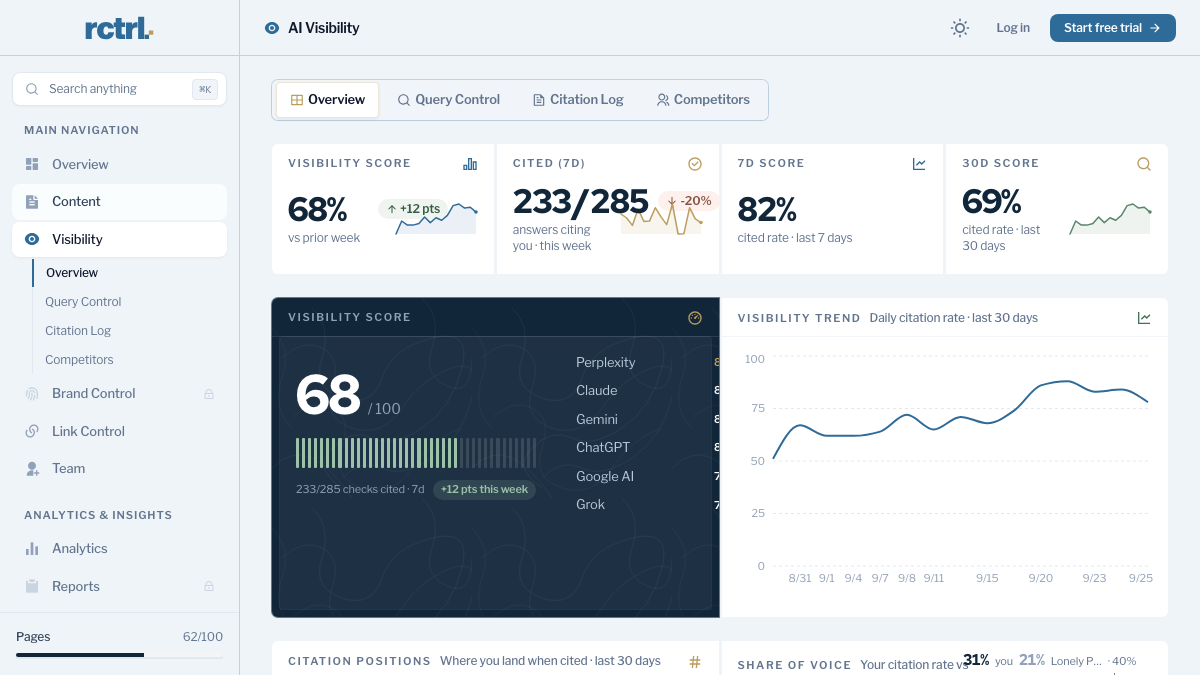
Publishing is the first half. The second half is knowing when an engine stops citing a page, because AI answers keep shifting. AI visibility tracking checks your 50 queries every week across six engines, keeps a citation history per engine, and tracks Google and Bing positions for every page RankControl publishes. A new citation sends you a notification, and a lost one shows up in the dashboard's history.
Mentions on other sites are the earned-media half that the Toronto paper points to. Link Control finds prospects and contacts for each published article, then drafts personalized outreach that goes out from your own mailbox, with follow-ups only when nobody replies. If you'd rather hand that off, Managed Backlinks is a $350 add-on that places five links a month from DR 25+ sites.
What does that loop cost by hand? Checking 50 prompts on six engines means reading 300 answers a week, about five hours at a minute per answer, or over 20 hours a month. A researched, linked and formatted article takes two to three hours after the first draft exists, so 20 articles add 40 to 60 hours. With 10 to 15 hours of outreach on top, the monthly total lands somewhere between 70 and 95 hours. Those are rough estimates for the AI search work alone, before any social posting.
200+ SaaS teams already track their AI citations.
They know exactly when ChatGPT mentions their brand, and when it stops. Do you?

RankControl vs Predis pricing: credits against one plan
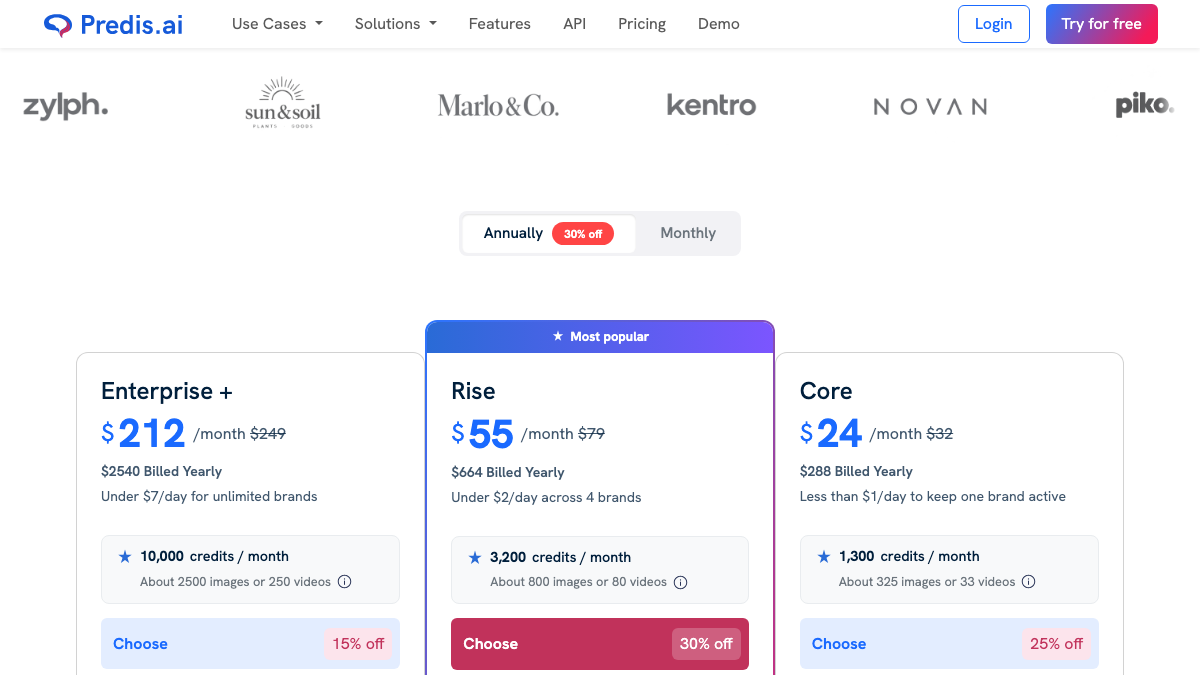
Predis prices by credits, and every generation spends some. The cost per item shifts with the content type and the AI model you pick, so the plan cards translate credits into rough output.
| Predis plan | Monthly | Billed yearly | Credits a month | Rough output | Brands | Auto-posting |
|---|---|---|---|---|---|---|
| Core | $32 | $24/mo ($288) | 1,300 | About 325 images or 33 videos | 1 | No |
| Rise | $79 | $55/mo ($664) | 3,200 | About 800 images or 80 videos | Up to 4 | Yes |
| Enterprise+ | $249 | $212/mo ($2,540) | 10,000 | About 2,500 images or 250 videos | Unlimited | Yes |
Extra credits cost $29 a month on any plan. The trial runs three days, and Predis takes a card at the start and charges it when day three ends. Its pricing FAQ says payments after the trial are non-refundable, though cancelling stops future charges.
RankControl is one plan at $400 a month, or $4,000 a year with two months free. That covers 100 pages a month and 50 tracked queries on six engines. Publishing and outreach drafting come with it, along with five seats and no credits to count. The trial lasts seven days with a card up front. Two add-ons exist for teams that want people on top of the software, a Dedicated Strategist at $1,500 a month and Managed Backlinks at $350, and each is a separate subscription.
Predis costs less, and it buys something different. At $79 a month, Rise buys around 800 images or 80 videos of feed creative. At $400, RankControl buys up to 100 published articles on your domain, plus the weekly check that shows which of them the engines picked up.
Where social fits once the pages exist
Social doesn't disappear when budget moves toward AI search. The order flips, so the article comes first and the posts come out of it. That's the case we made at length in owned content vs rented visibility, and it's how RankControl handles social.
Its repurposing feature turns every published article into drafts for eight platforms. LinkedIn and X get posts built from the article's own arguments. Instagram gets the article's images plus a branded card, and Pinterest gets a 2:3 pin. For YouTube Shorts and TikTok it writes scripts, 45 to 60 seconds and 30 to 45 seconds long, each with a hook, a payoff line and on-screen caption cues. Every draft is editable, and you push the ones worth posting through a connected Buffer or Postiz account or copy them out.
RankControl's Social agent works the conversation side as well. It looks for live Reddit and X threads where a published article answers the question being asked, checks the community's rules, and drafts a reply for you to post.
Predis has a feature that runs the same idea from the other direction. Its blog-to-video tool asks you to paste a blog URL, summarizes the post into a video script with scenes and text overlays, and hands you an editable video. The workflow starts from a blog post that already exists.

If you're moving over, our Predis migration guide covers what to export before you cancel and how to keep the feed running during the first month.
Which one wins AI search visibility?
RankControl wins AI search visibility. Predis is built for feeds and ad accounts, and at $32 to $249 a month it's priced for that job. Nothing it makes lands on your website, and its competitor view ends at the edge of Facebook and Instagram.
AI engines answer from text they can quote, mostly on sites they already trust, and the answers change often enough that a monthly glance misses most of it. RankControl covers that loop from the plan to the weekly check. It plans articles from buyer questions, publishes them on your domain, drafts the outreach that earns mentions elsewhere, and tracks the result across six engines.
You can run every step of this by hand: the prompt checks, the drafting, the CMS work and the outreach. Or RankControl's agents can run it every month while you focus on the product, and on the ads, if ads are part of your plan.
How often does ChatGPT mention your brand?
Most founders have no idea. The answer might surprise you.