
Look for ChatGPT on Anyword's website and you'll find it on the integrations page. It's listed as an AI co-pilot, a place where you can use Anyword's copy, next to Gemini. You won't find it anywhere as something Anyword measures.
That tells you most of what this comparison is about. Anyword answers one question: will this piece of copy perform before it goes out? RankControl answers a different one: after your page goes out, do the AI engines cite it? Both write content, and both care about brand voice, so they get compared. Every Anyword detail below comes from its site, pricing page and terms, checked on September 26, 2026.
RankControl vs Anyword: the short answer
Anyword is an AI copywriting platform built around performance prediction. It scores copy variations before you publish, keeps your brand voice, and writes blog posts through its Blog Wizard. It's built mostly for ads, email and landing pages, and it doesn't track AI answers or publish to common CMSs.
RankControl is a pipeline for AI search visibility. It plans titles from the questions your buyers search, writes and publishes the articles on your domain, and checks 50 queries every week on six AI engines. One plan, $400 a month.
For AI search visibility, it's RankControl. Anyword doesn't measure it.
Side by side
| Anyword | RankControl | |
|---|---|---|
| What it is | AI copywriting with performance prediction scores | AI search visibility pipeline |
| Price | $49/mo ($39 yearly) to custom | $400/mo or $4,000/yr, one plan |
| Seats | 1 on Starter, 3 on Data-Driven | 5 |
| AI citation tracking | Not offered | 6 engines, 50 queries, weekly |
| Content | Copy variations, Blog Wizard, templates | 100 pages/mo across 26 formats |
| Publishing | Enterprise CMS integrations such as Sitecore and Drupal | 9 destinations, native posts |
| Links and outreach | Not offered | Outreach from your own mailbox; Managed Backlinks at $350/mo |
| API and MCP | API on Enterprise; no MCP found | MCP server and CLI included |
| Trial | 7 days on Starter and Data-Driven | 7 days, card up front, $0 today |
What Anyword is
Anyword is the trading name of Keywee Inc., based in New York. It started as Keywee in 2013, and its last disclosed round was a $21 million Series B in November 2021, according to funding databases. Its homepage headline today is "Anyword makes AI content perform 76% better," and the pitch is that it "works with any AI and any agent, adding A/B tested data and brand context to every prompt."
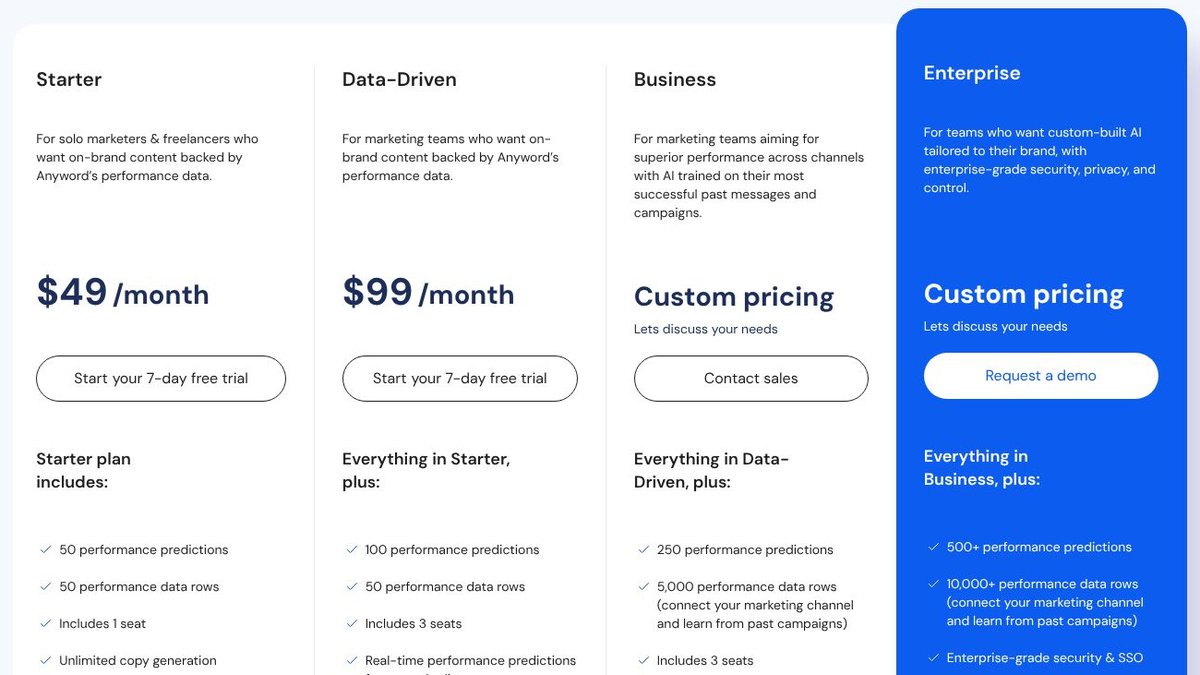
The center of the product is the performance prediction score. Anyword says its model picks the better-performing variation with 82% accuracy, against 52% for a generic model like GPT-5, which is its own figure. Around the score sit Brand Voice, a copy intelligence layer that reads what you've already published, a Blog Wizard with a plagiarism checker, and a Chrome extension that brings scoring into other apps.
Where Anyword goes further than RankControl is short-form copy for paid channels. Scoring ad and email variations before you spend budget testing them is a real job, and RankControl doesn't score ad variants at all.
200+ SaaS teams already track their AI citations.
They know exactly when ChatGPT mentions their brand, and when it stops. Do you?

Before you publish or after
The two tools sit on opposite sides of the publish button. Anyword's work ends when the copy is ready: it predicts how a variation will do and helps you pick the winner. What happens next, where the page ranks and whether an AI answer quotes it, is outside what it measures.
That gap matters more each year. Orbit Media's March 2026 survey of 1,110 people found that 55% now use AI chat as a primary or frequent research tool. When a buyer asks ChatGPT for a shortlist in your category, a well-scored landing page helps only if the engine chooses to cite it.
RankControl's work starts where Anyword's stops. The content engine plans titles from the questions your buyers search, writes each article in your brand's voice against the pages already ranking, and scores it for how easily AI engines can quote it, with a fix list. Then it publishes and keeps checking. RankControl's score is about being quoted by AI engines, where Anyword's is about beating another variation in an A/B test.
Brand voice in both
Both tools start from your brand, in different ways. Anyword's Brand Voice holds your messaging, tone and audience profiles, and every plan below Business includes one brand voice. Its copy intelligence layer can also read what you've already published and suggest what to improve.
RankControl's Brand Control reads your live site at setup and drafts your voice, products, buyers and competitors, and you correct what it got wrong. You can add guideline rules and up to three of your best articles as style references. Every article the pipeline writes draws on that profile, so the voice holds across 100 pages a month without anyone pasting a style guide into a prompt. If your team already wrote voice rules for Anyword, the same rules can go straight into Brand Control.
Tracking what the engines say
Anyword has no tracking of AI answers. There's no dashboard for any of the AI engines, and no share-of-voice view against competitors.
That's the core of RankControl. AI visibility tracking checks each of your 50 tracked queries on all six engines every week, which is 300 readings a week. You see which engines cited you, where competitors got named instead, and which sources the engines pulled from.
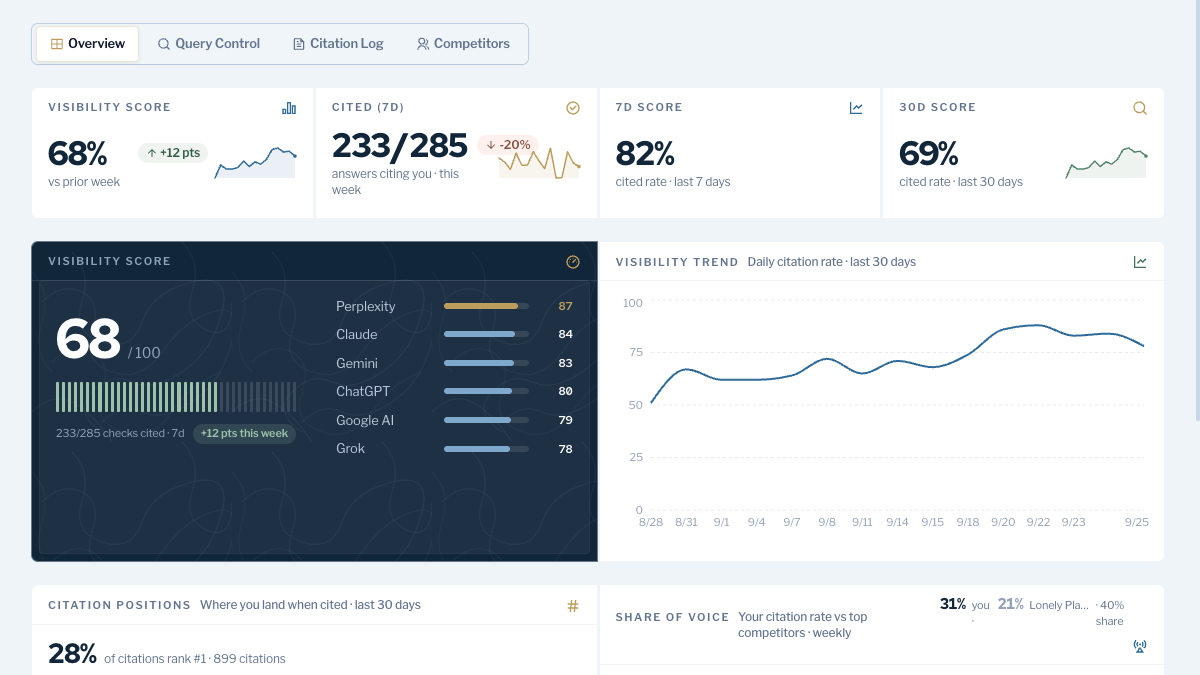
The weekly rankings check adds your Google and Bing positions, and whether an AI Overview appeared and cited your page. RankControl's analytics also count visits from AI crawlers and from people who clicked through from an AI answer. So you can tell whether a new citation sent anyone to your site.
Where the content ends up
Anyword's integrations page is built for large marketing stacks. It lists CRMs like Salesforce and HubSpot, email platforms like Marketo and Braze, and the major ad platforms. The content systems on it are enterprise ones, Sitecore and Drupal, along with product-information tools. WordPress, Webflow, Shopify, Ghost and Wix aren't on the list, so for most teams a finished blog post still gets copied into the CMS by hand.
RankControl publishes native posts through the destination you connect. There are nine, WordPress, Webflow and Shopify among them, plus a webhook and a Content API for custom stacks. Auto-publish stays off until you turn it on, so you can review every article first.
Links are the other half of being cited, and Anyword doesn't cover them. RankControl's Link Control finds prospects for each published article and drafts outreach from your own mailbox. If you'd rather hand it off, Managed Backlinks adds five links a month from DR 25+ sites for $350.
Social is the one place the two overlap. Anyword writes social posts from a prompt or a template. RankControl turns each article it publishes into drafts for eight social platforms through repurposing, so the posts point back to a page that can earn citations.
How often does ChatGPT mention your brand?
Most founders have no idea. The answer might surprise you.

One article, start to finish
The clearest way to see the gap is to follow one blog post through each tool.
| Step | With Anyword | With RankControl |
|---|---|---|
| Pick the topic | You choose it | Planned from your buyers' questions; you approve |
| Write the draft | Blog Wizard drafts it; you edit | Written against the pages already ranking |
| Check quality | Performance prediction and plagiarism check | Scored for how easily AI engines can quote it |
| Publish | Copy it into your CMS by hand | Published as a native post |
| Earn links | Not covered | Prospects found and outreach drafted |
| Measure | Search Console, plus manual checks of AI answers | Weekly checks on six engines |
With Anyword, a person carries the article through every step after the draft. With RankControl, the person's job is to approve the title and read the draft if auto-publish is off.
What each one costs
Anyword's self-serve plans start lower. Starter is $49 a month ($39 yearly) for one seat, 50 performance predictions and one brand voice. Data-Driven is $99 ($79 yearly) for three seats and 100 predictions, and you can add up to 10 more seats at $59 a month each. A five-person team on Data-Driven would pay $99 plus two extra seats, $217 a month, for copy scoring and drafting alone. Business and Enterprise are custom, and full API access sits on Enterprise.
Its terms are strict about money back. Fees are "non-cancellable and non-refundable," so use the 7-day trial, which covers Starter and Data-Driven, before you commit.
RankControl is one plan at $400 a month, or $4,000 a year. It includes five seats, 100 pages a month and 50 tracked queries on six engines, plus publishing and outreach drafts. Used in full, that's $4 a page with tracking included. The comparison isn't like for like, because the $400 covers work Anyword doesn't do.
| What you need | Anyword | RankControl |
|---|---|---|
| Score ad and email copy | From $49/mo | Not offered |
| Write and publish blog articles | Blog Wizard, then copy to your CMS | Included, native publishing |
| Track AI citations on six engines | Not offered | Included |
| Link outreach | Not offered | Included; managed links $350/mo |
| API or MCP access | Enterprise plan | Included |
Working from your AI assistant
If your team works inside Claude, Cursor or Codex, the difference shows up there too. Anyword offers full API access on Enterprise, and we found no MCP server on its site.
RankControl includes an MCP server and CLI with 80+ tools on the one plan. You can ask your assistant how your AI visibility changed this month, plan titles, or draft an article. Anything that publishes or sends email runs as a dry run until you confirm it.
What people say
On Capterra, Anyword holds 4.8 out of 5 across 391 reviews, and users there rate ease of use highest and value for money lowest. Cost is the complaint that comes up most, and G2 shows a similar 4.8 across roughly 1,200 reviews. One content writer wrote in 2023 that "the cost on Anyword website per month is still very expensive and only provides a few credits per month."
Independent discussion elsewhere is quiet. We searched Reddit and X for the past year and found almost no threads about Anyword by name, while tools like Jasper still come up often. That fits a product that mostly lives inside marketing teams' ad and email work.
Which wins AI search visibility?
For AI search visibility, the verdict is RankControl.
Anyword is a copy tool. It predicts which version of a sentence will perform, and it stops before the page is published and long before an AI engine decides whether to quote it. It doesn't track citations, publish to common CMSs or build links.
RankControl covers that whole loop for one price. It plans from your buyers' questions, writes and publishes on your domain, and drafts the outreach. Then it checks six engines every week. In the first month you get a calendar of titles, articles going live on your schedule and four weekly readings of where you stand.
You can run the loop by hand: write the pages, publish them, pitch the links and check six engines every week. Or RankControl's agents can run it every month while you focus on your product. Already on Anyword? Our guide to switching from Anyword covers what to export first.
Want to see where you stand today? Run a free check of your brand in AI answers.
15 hours a week manually. Or 15 minutes with RankControl.
Track citations, monitor competitors, and fix content gaps across every AI search engine. Automatically.