
Some comparisons are between rivals, and some are between a hammer and a greenhouse. RankControl vs Rytr is the second kind, and it's worth writing precisely because so many buyers search it: both products say "AI" and "content" on the label, and the labels hide a category difference that decides everything else. Rytr is an AI writing assistant, one of the most popular in the world. RankControl is an AI search visibility pipeline. The honest comparison explains what each actually does, where the cheaper tool genuinely wins, and which one answers the question in this title. Full disclosure as always: we build RankControl, and the fair reading of Rytr is easy to give because it's a good product at its actual job.
What Each One Actually Is
Rytr is a drafting companion used by millions of writers. The product surface: 40+ content use cases and templates, from emails and captions to paragraph generation and long-form assists, a My Voice feature that mirrors your tone from a writing sample, a Chrome extension that follows you across the web, a built-in plagiarism check, and a free-forever tier with paid plans that stay conspicuously affordable. Its pitch is speed and voice for the person doing the writing.
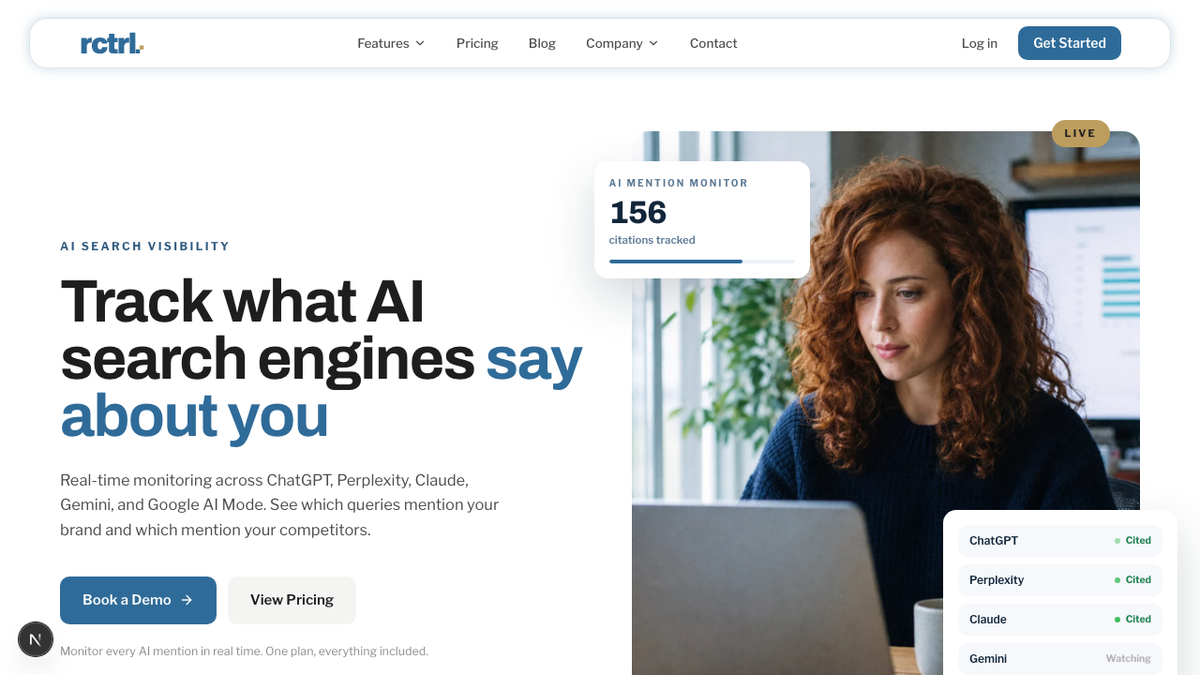
RankControl operates a different layer. It's a pipeline that mines the queries buyers ask, plans titles onto a calendar with cluster structure designed in, generates the articles, publishes them natively to your CMS, drafts backlink outreach from your own mailbox, monitors competitors, and checks your citations weekly across ChatGPT, Perplexity, Claude, Gemini, Grok, and Google's AI surfaces. Nobody sits in it typing; your team reviews what it produces and reads the Monday scoreboard.
| Rytr | RankControl | |
|---|---|---|
| Category | AI writing assistant | AI search visibility pipeline |
| Core loop | You prompt, it drafts, you edit | It plans, writes, publishes; you review |
| Publishing | None; you paste the output | Native to your CMS |
| AI visibility tracking | None | 50 queries weekly across 6 engines |
| Links and outreach | None | Outreach agent plus optional managed add-on |
| Price shape | Free tier; low-cost individual plans | Flat $400/mo, everything included |
Where Rytr Genuinely Wins
Three wins, all real.
Price, by an order of magnitude. A free tier that's actually usable and paid tiers priced for individuals. If the budget is coffee money, this category is where you shop, and nothing in this article should talk a freelancer out of that math.
Micro-copy velocity. Emails, ad variants, captions, rephrases, CTAs, the twenty-small-jobs-a-day writing that fills a marketer's afternoon, where opening a heavier tool would cost more time than the task itself. An assistant in a browser extension beats any pipeline for this job, because the job is interactive by nature.
The blank-page problem for individuals. A solo writer who needs momentum, tone options, a plagiarism check, and a nudge past the empty document gets exactly that, with an interface millions of people apparently find pleasant. G2's recognition of the brand reflects a genuinely liked product.
What those wins share: they're all victories in the writing-assistance category. Which brings us to the category this article is actually about.
See your first AI citation report in under 5 minutes.
No setup calls. No onboarding meetings. Connect your domain and see where AI mentions your brand right now.

The Title Question: What Actually Wins AI Search Visibility
Here's the uncomfortable mechanical truth for any writing tool, ours included: the words are a minority share of what earns AI citations. The engines cite pages they can crawl, from entities they trust, structured for extraction, on topics where the page adds something the existing ten sources don't, discovered through links and mentions, and verified against a consistent brand footprint. That's a pipeline's worth of jobs, and drafting is one station on it.
A writing assistant, by design, performs none of the others. It doesn't know which queries still produce clicks and which the answers absorbed. It doesn't publish, interlink, structure a cluster, or schedule anything. It can't watch what ChatGPT says about you or notice when Perplexity starts citing a competitor's comparison page, and the email to the site those answers keep citing never gets drafted. No criticism intended in any of that; the category boundary simply sits where it sits. Asking Rytr to win AI search visibility is asking the hammer to keep the greenhouse warm.
There's also a subtler risk in assistant-driven SEO content, and it's the one practitioners keep rediscovering: template output at scale converges on the same phrasing and structure as everyone else's template output, and sameness is now the thing both Google's quality systems and AI retrieval filter hardest. An assistant amplifies the writer driving it. Driven well, with your data and your angles, it's fine. Driven as a content strategy, it produces the exact library the engines learned to skip.
The Workflow Test: One Article, Two Paths
Watch the same deliverable, one SEO article meant to earn AI citations, travel through each product, and the category difference stops being abstract.
The Rytr path starts with a human decision nobody instrumented: someone picks the topic, from intuition, a keyword tool, or a meeting. They prompt sections through the assistant, edit for voice, and assemble the piece. Then the invisible half begins: paste into the CMS, format, find internal links by memory, set the meta fields, publish, and hope. Nothing measures whether the target query still produces clicks, nothing places the article in a cluster, and nothing reports whether any engine ever cites it. The writing took an hour; the operation around it took three more, and its most important decisions ran on guesswork.
The pipeline path inverts the ratio. The topic arrives on the calendar because real buyer queries demanded it, with cluster position and internal links designed before drafting. Generation happens without a prompt session, the piece publishes natively with its links and metadata in place, and the following Monday the citation check reports whether the engines noticed, which feeds the next planning pass. The human contribution is a review, plus whatever judgment or data they add, which is exactly the part humans are best at.
Neither path produces magic words. The difference is that one embeds the words in a system that makes them findable, and the other hands you excellent words and wishes you luck with the system.
The Map: What "AI Content Tool" Spans Now
Buyer confusion in this category is structural, so here's the map. At one end sit writing assistants, Rytr among the best-known, built for interactive drafting help. Next come SEO writing tools, which add keyword and SERP awareness to the drafting. Then visibility trackers, which measure AI citations and recommend actions without producing content. And at the far end, pipelines, which run planning, production, publishing, links, and measurement as one system. RankControl lives at the pipeline end; Rytr anchors the assistant end; the two are as far apart as the category stretches.
The map matters because vendors at every point describe themselves with the same vocabulary. "AI content for growth" can mean a sentence finisher or an operating system, and the price tags, from free to four figures, track the category position rather than the quality. Place any tool on this map before comparing it to anything, and half the confused comparisons dissolve, this one included.
Your competitors are building backlinks while you read this.
Organic outreach, social mentions, and link exchanges, with managed backlinks available as an add-on. Grow your domain authority without running the campaign yourself.

Five Questions That Sort Any Tool In This Space
Whichever end of the map you're shopping, these five separate the label from the job.
- Who decides what gets written? You, a keyword export, or a system mining real buyer queries. This one decision predicts the library's fate.
- What happens after the draft? If the answer is "you paste it somewhere," the publishing operation remains your job, unbudgeted.
- Where do internal links come from? Memory and good intentions, or structure designed before writing.
- How do you know it worked? A tool with no answer to this is a cost center wearing a growth label, whatever it does well.
- What happens in month three if you stop pushing? Assistants go quiet the day you stop prompting. Pipelines keep publishing and measuring, which is the operational definition of the category line.
Measurement: The Category Difference In One Question
Ask each product "am I being cited by AI engines this week?" Rytr has no opinion; the question is outside its world. RankControl's entire reason for existing is answering it: per-engine citation history, share of voice against competitors, description language, and the weekly deltas, on a scoreboard your team actually opens. In 2026, when a model update can reshuffle half your citations in a week, visibility work without measurement is archery in the dark. This single difference decides the title question before features enter it.

You're getting AI traffic. But do you know where it comes from?
RankControl credits every visit to the assistant that sent it: ChatGPT, Perplexity, Claude, Gemini, Copilot, or Grok. Full source attribution, next to your Google traffic.
Pricing: A Pencil and a Printing Press
The price gap is the first thing every buyer notices, so let's treat it honestly. Rytr costs what a streaming subscription costs, and sometimes nothing. RankControl costs $400/month flat. If those numbers feel comparable, the comparison has already gone wrong, because they buy different things: one buys assistance for a person who writes, the other buys an operating pipeline that plans, produces, publishes, and measures for a business, with 100 pages a month and weekly six-engine tracking included.
Wait, back up to the actual decision for a second: are you funding a person's writing or a company's visibility? A freelancer expensing a tool funds the first. A B2B company that needs to show up when buyers ask AI engines about its category funds the second, and typically spends more than $400 today on the coordination the pipeline deletes.
Who Should Pick Which
Pick Rytr if you're an individual writer or freelancer, your need is drafting speed and tone across many small pieces, your budget is personal-tool sized, or you're testing whether AI writing helps you at all, which the free tier answers for nothing.
Pick RankControl if you're a business that needs AI search visibility as an operation: content planned from real buyer queries, published on schedule to your own CMS, links earned, competitors watched, and citations measured weekly across the engines your buyers actually ask.
Use both if your team runs the pipeline for the visibility program and keeps an assistant in the drawer for micro-copy. The jobs barely overlap, which is exactly why the combination is coherent.
The Common Trajectory
Worth naming, because we see it constantly: teams don't usually choose between these products once. The typical arc starts with an assistant, because it's free and the need feels like "writing help." Six months later the founder is personally running topic selection, publishing, internal links, and a spreadsheet of pasted AI answers, and the realization lands that the writing was never the bottleneck. The operation was. That's the moment this comparison actually gets searched, and the honest advice for anyone mid-arc: the assistant wasn't a mistake, it was the cheap way to discover which job you actually needed done. Keep it for the micro-copy. Hand the operation to a system built for operations, and let the weekly scoreboard tell you within a month whether the handoff paid.
The Verdict
So, the title question. RankControl wins AI search visibility, and it's barely a contest, because only one of the two products competes in that event. Rytr wins its own event just as clearly: fast and affordable writing assistance that individuals clearly enjoy, at a price no pipeline will ever match. The real takeaway for buyers is the category lesson: "AI content tool" now spans everything from a browser extension that finishes your sentences to a system that runs your entire visibility operation, and knowing which job you're hiring for saves you from comparing prices across a category line.
If the job is visibility, put your own queries on the scoreboard and let the first weekly check show you where you stand.
We'll show you exactly where your brand stands in AI search.
No commitment. $0 due today, cancel anytime. See how ChatGPT, Perplexity, Claude, Gemini, Grok, and Google AI Mode talk about your brand today.