
A customer messaged a store owner in r/ecommerce last month asking about a bundle the store had dropped over a year ago. ChatGPT had recommended it, at an old price of $149 instead of the current $189. One reply guessed the old product page was still live somewhere, quietly feeding the answer.
That's the uncomfortable part of ecommerce AI SEO. The AI is reading your store whether you planned for it or not. The question is which of your pages it reads, and whether they say what you want.
So we tested it. In October we ran 10 everyday product questions through ChatGPT search, from stand mixers and hiking packs to dog food and headphones, and logged every search, source and citation. Here's what store pages it cited and what that means for how you build yours.
What we ran
Two of the questions came from an earlier run of ours, on running shoes and mattresses. The other eight we ran on October 19 through OpenAI's API with web search on, one run per question. Every answer was the kind a shopper actually asks, like "what's the best office chair for back pain?"
Across the ten, ChatGPT cited 34 pages. We sorted each one by who owns it.
| Who owns the cited page | Pages | Share |
|---|---|---|
| Brands and retailers | 24 | 71% |
| Review publishers (RTINGS, Food Network, Runner's World) | 5 | 15% |
| Health and safety authorities (AAD, OSHA, Merck, VCA, The Lancet) | 5 | 15% |
That's the headline. When people ask ChatGPT what to buy, most of the pages it cites belong to the companies that make or sell the product.

Built by the team that got cited in 48 hours.
Content generation, backlink building, AI visibility tracking, and Google rankings. One platform, zero guesswork.
How ChatGPT shops for an answer
The searches explain the result. ChatGPT usually ran one broad search first, often naming a review site like Wirecutter or RTINGS, to build a shortlist. Then it went straight to the makers.
Of its 43 searches in our eight new runs, 19 targeted a single brand's site, like Steelcase, Fellow or Gregory. Another batch asked for "official specifications" by name. For the headphones question it looked up the official battery life and weight of five models, one search each.
It also cared about dates. ChatGPT added "2026" to its searches in six of the eight questions, even though no shopper typed a year. A buying guide titled for last year, or a product page with no sign of being current, starts behind one that shows a recent update.
So the review sites decide who's on the list, and your own pages decide what ChatGPT says about you. If your product page doesn't state the number it's looking for, it can't quote you, and it'll quote someone else's page about your product instead.
The store pages that got cited
The 24 brand and retailer citations weren't all product pages. Here's the split.
| Store page type | Times cited | Examples |
|---|---|---|
| Product page | 15 | CeraVe, Fellow, Baratza, Steelcase, Gregory, Purina |
| Buying guide on the store's own site | 3 | REI, ASICS, Herman Miller |
| Support or spec page | 3 | Sony, Bose, Brooks |
| PDF hosted on the store's site | 2 | Ankarsrum, Purina |
| Collection or category page | 1 | ASICS stability shoes |
Each type earns its place differently, so they're worth taking one at a time.
Product pages with the numbers in plain text
Product pages won most often, and most of the ones cited answered spec questions directly. Fellow's grinder page, Baratza's Encore page and Haworth's Fern chair page were cited after ChatGPT searched for specifications or price.
That means the details buyers compare should sit in readable text on the page. That covers dimensions, weight, battery life, materials, what's in the box and the current price. A spec table built from images, or hidden behind a tab that loads with JavaScript, is easy for a person to read and hard for a crawler.
Buying guides on your own domain
REI's guide to the best backpacking packs was cited for the weekend hiking question. It's a store page in every sense, written by REI, linking to products REI sells.
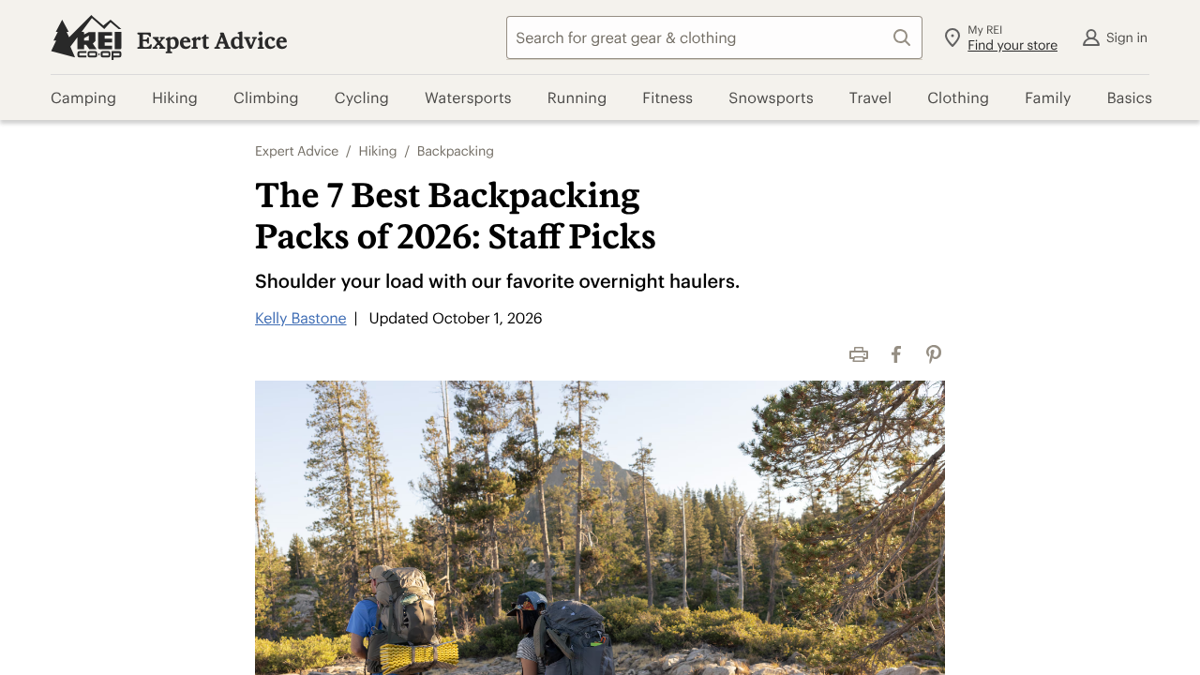
Look at what sits above the fold. The title carries the year, there's a named author, and the page shows when it was last updated. ASICS's guide to running shoes for flat feet and Herman Miller's Aeron buying guide were cited the same way.
If your store doesn't have guides for its main categories, that's probably the biggest gap to close. A guide that compares your products honestly, and names the problem each one solves, is the page ChatGPT reaches for when the question is "which one should I buy?"
Support and spec pages
Sony's specifications page and Bose's support article were both cited for the headphones question, and Brooks's help-center article on footwear for plantar fasciitis was cited for running shoes. Stores rarely think of these pages as marketing.
Keep them public, crawlable and current. A help center behind a login, or one that renders only in the browser, can't be cited.
PDFs on your own domain
Two PDFs were cited. Ankarsrum had a PDF on its own site that ChatGPT cited right next to the mixer's product page, and a Purina product label PDF was cited for the dog food question.
If you have a spec sheet, a lab result or a third-party review worth showing, host a text-based PDF on your own domain and link to it from the product page.
See your first AI citation report in under 5 minutes.
No setup calls. No onboarding meetings. Connect your domain and see where AI mentions your brand right now.

Where stores lost to someone else
Three patterns cost stores citations in our test.
The first was health. For the mattress question, ChatGPT searched for medical guidance and randomized trials and cited one clinical study in The Lancet, with no brand at all. For dog food, oily skin and office chairs it cited a vet manual, the American Academy of Dermatology and OSHA alongside the brands. On health-adjacent products, a store page works best when it cites the authority in its own text. A dog food page that names the veterinary guidance its formula follows, or a skincare page that quotes the dermatology advice on oil-free moisturizers, gives ChatGPT both halves of the answer in one place.
The second was review-led categories. The robot vacuum question cited one page, an RTINGS roundup. When a category has a dominant independent tester, getting your product reviewed there matters more than anything on your own site.
The third was Reddit, and it's the surprise. Reddit made up 73 of the 390 sources ChatGPT pulled up across our eight new questions, the single biggest domain. It wasn't cited once. A Max Planck Institute study of real ChatGPT and Grok chats in September found the same thing in its own data, with Reddit and YouTube among the most common search results. Reddit shapes what the model reads, but in our test it never became the link a shopper sees.
Feed the shopping results too
Citations in answers are one surface. ChatGPT also shows a product carousel, and OpenAI's shopping help page explains how it picks. It considers structured metadata like price and description from first-party and third-party providers. When several stores sell the same item, it ranks merchants by availability, price, quality and whether they're the maker or main seller.
For Shopify stores, OpenAI says product data already flows in through Shopify Catalog. Other merchants can apply to send a direct product feed. For the Google side, our ecommerce SEO guide shows which store pages rank there instead. Our guide to Shopify stores in ChatGPT product answers covers the feed side, and our post on how to rank on ChatGPT covers the crawler settings that decide whether your pages can be read at all.
Clean up what AI already says about you
The r/ecommerce owner's problem is common, and the fix is plain. Search ChatGPT for your own products and category, open the Sources panel, and see which pages it used. If an old product page or an outdated roundup is feeding the answer, redirect the page or update it with the current price in text.
Small stores feel this the most. A candle store owner asked r/ecommercemarketing whether anyone was actually getting orders from ChatGPT, and said one answer described their store with year-old information.
Is anyone actually getting orders from ChatGPT?
Small Shopify store, candles and diffusers, 3 years in, just me and one part timer. Organic has been going down for us like a few people posted about and meta has been unreliable all year so I have been looking at everything lately. Everyon...
One reply had the right first step. Run 15 buying questions in ChatGPT and Perplexity, note which brands get named, and check whether your details are current.
The ecommerce AI SEO checklist
Here's the order we'd work in, based on what got cited.
- Put specs, price and availability in plain text on every important product page.
- Write a buying guide for each main category, with the year, an author and an update date.
- Make your help center and spec pages public and crawlable.
- Host spec sheets and test reports as text-based PDFs on your own domain.
- Get your products in front of the review sites that dominate your category.
- Check that your product feed is live and your robots.txt allows OAI-SearchBot.
- Ask your top 15 buying questions every month and fix any outdated answer at its source.
What this costs in hours
Rewriting 20 product pages with clean specs takes about 10 to 15 hours. Each category buying guide is four to six hours, and a support-page audit is another afternoon. Then comes checking, about an hour a week to rerun your buying questions across a few AI engines and note what changed.
You can do all of it by hand. Or RankControl's agents can do it for you every month, writing and publishing buying guides and comparison pages on your store and checking six AI engines every week, while you focus on your product. Our AI visibility tracking checks 50 buyer questions weekly across ChatGPT, Perplexity, Claude, Gemini, Grok and Google AI Mode.
Your competitors are building backlinks while you read this.
Organic outreach, social mentions, and citations from Editorial Circle member sites, with managed backlinks available as an add-on. Grow your domain authority without running the campaign yourself.