In early October we ran 10 everyday buyer questions through ChatGPT search and logged every search it wrote along the way. "How much does a new roof cost?" turned into a search for 2026 average roof replacement costs in the United States, with HomeAdvisor, Angi and Forbes named in the query. The answer cited one page out of the 20 it read, an Angi cost guide with "[2026 Data]" in its title.
That gap between the question you'd expect and the search the model actually ran is where LLM SEO happens. Most guides give you general advice about structure and authority. This one takes each strategy from something we watched ChatGPT do, using the logs from that run. If the vocabulary is the confusing part, our explainer on LLM SEO, GEO, AEO and AIO sorts out the terms first.
What 10 buyer questions taught us
The run covered four software questions, two product questions and four cost questions. ChatGPT ran one search per question and rewrote every one of them. Here's a sample of what came back.
| Buyer question | The search ChatGPT wrote | What it cited |
|---|---|---|
| Best CRM for a small business | 2026, "official pricing", plus five vendor names | HubSpot's pricing page and a small site's "8 Tools Reviewed" list |
| Best payroll software for a small business | 2026, four vendor names, "official pricing" | Gusto, OnPay and ADP product pages |
| Best mattress for back pain | Medical guidance and randomized trials | One clinical study |
| How much a new roof costs | 2026 average cost, asphalt shingles, cost sites by name | Angi's "[2026 Data]" guide |
| What a personal injury lawyer costs | Typical contingency fee, bar association | Two American Bar Association pages |
Across all 10, ChatGPT read 304 pages and cited 20 of them, or about one in fifteen. We also checked the cited sites against Google's top 10 for the same everyday searches, and only 3 of 18 overlapped.
Ahrefs reached the same place in its own study of ChatGPT citations. The pages that got cited were the ones whose titles and content matched the searches ChatGPT ran behind the scenes, and each strategy below is a way of making that match.
1. Write for the search the model writes
The buyer typed "best CRM for a small business". ChatGPT searched for the best CRM for small businesses in 2026, official pricing, and five named vendors. A page that only answers the first wording is matching a question nobody fed the search engine.
You can often see these searches yourself. Practitioners on r/SaaS describe running a question in ChatGPT, then opening the browser's developer tools and finding a "queries" field in the network response that lists the searches behind the answer. It doesn't always show up, and OpenAI can change it any time, but when it works, do it for your ten most important buying questions and note the words that keep appearing beyond what you typed.
Those extra words are your brief. If ChatGPT keeps adding "for agencies" or "pricing" or a competitor's name, the page you need has that word in its title and its first paragraph. For the crawler, product and local side, our guide on how to rank on ChatGPT works through what OpenAI's own docs say.
How often does ChatGPT mention your brand?
Most founders have no idea. The answer might surprise you.

2. Put the year on pages that answer buying questions
Eight of the ten searches added "2026" without being asked. The model was looking for pages that are visibly current, and the roof answer shows what wins that test.
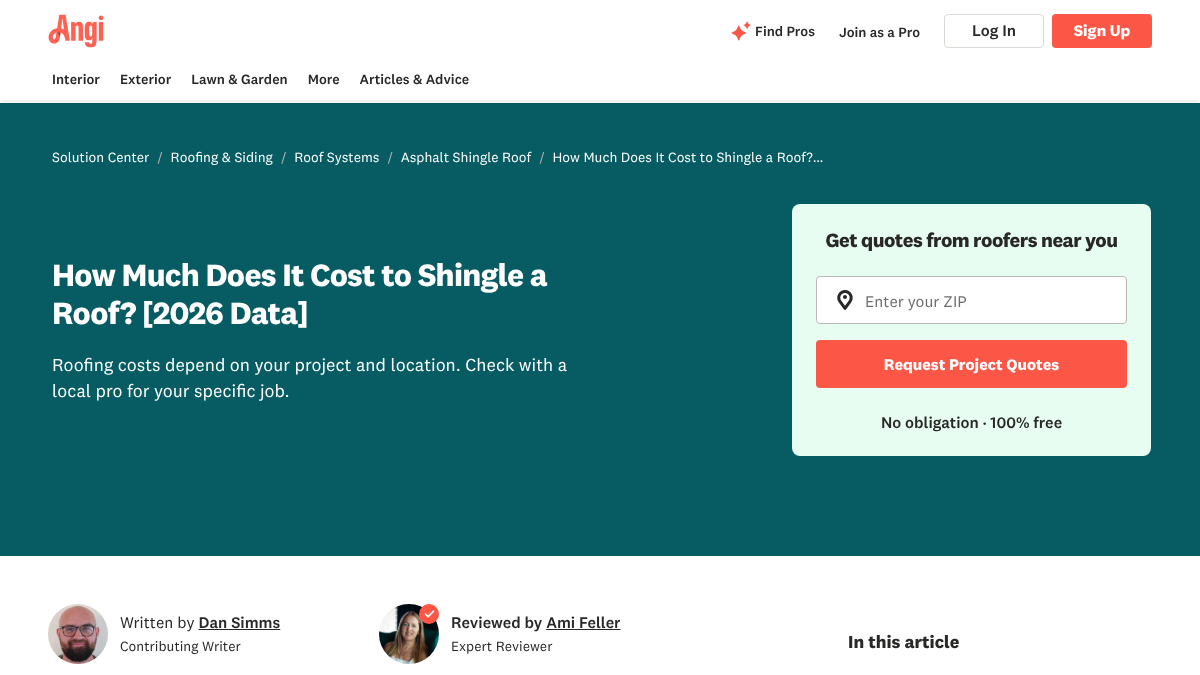
Angi's page carries the year in its title, a named writer and a named expert reviewer, all above the fold. Do the same on your pricing page, your comparison pages and any guide that answers "how much" or "which one". Change the date only when you've actually updated the numbers on the page.
3. Publish your prices in plain text
Five of the ten searches asked for "official pricing", and the model went straight to the source when it could. HubSpot's pricing page was cited for the CRM question, and Omnisend's pricing help page was cited for the email question.
If your pricing sits behind a "book a demo" button, ChatGPT can't read it, so it reads a review site's guess instead. A plain-text price, the date you set it and what each plan includes give the model something it can quote. This is one of the few LLM SEO changes that takes an afternoon.
4. Get on the shortlist the model already names
All four software searches added four to six vendor names before ChatGPT had read anything. The CRM search named five vendors, HubSpot and Salesforce among them, so those five were in the running before a single page was read.
That shortlist comes from what the web already says about your category. You get onto it the slow way, through other sites mentioning you. Two moves help most.
- Get listed on the comparison and "best of" pages that show up for your category searches. A small site's "8 Tools Reviewed" list was cited for the CRM question, right next to HubSpot's own pricing page.
- Publish your own fair comparison pages that name the rivals buyers compare you with, so you appear in the same breath as them.
For the outreach side, RankControl's Link Control finds sites worth pitching for each published article and drafts the emails from your own inbox.
5. Bring the evidence the topic expects
For the mattress question, ChatGPT skipped every mattress brand and searched for medical guidance and randomized trials. It cited one clinical study. For the lawyer fee question, it searched for the bar association and cited two American Bar Association pages.
The model matches the kind of source to the kind of question. Health questions get studies, legal questions get bar associations, and cost questions get dated cost guides. If you're writing in a field like that, cite the primary source by name inside your page and quote its numbers. A page that carries the evidence is easier to cite than one that only points at it.
6. Answer in the first two sentences
Being read isn't enough. Of the 304 pages ChatGPT read, 284 were read and passed over, so most of the competition happens after your page is already in front of the model.
Look at the titles that won. Every cited cost page was built around one question, stated plainly, with nothing else competing for the top of the page. Put the direct answer in the first two sentences under each heading, then add the detail, and write headings that read like the follow-up questions a buyer would ask.
RankControl's content engine writes each article against the pages already ranking for its keyword and scores it for how easily AI engines can quote it, with a fix list. If you're doing it by hand, read your top five pages aloud and ask whether a stranger would get the answer before the second paragraph.
15 hours a week manually. Or 15 minutes with RankControl.
Track citations, monitor competitors, and fix content gaps across every AI search engine. Automatically.

7. Don't count on your Google ranking carrying over
Only 3 of the 18 cited sites held a first-page Google spot for the matching everyday search. The model ran its own, longer search and picked from what that returned.
So a page ranking fourth on Google for "best CRM for small business" can still miss the ChatGPT answer, because the search ChatGPT ran included pricing and five brand names. Check your important pages against the searches you collected in strategy one, not against the keyword you rank for.
The slow clock behind all of this
Everything above works on the live search, which can move in weeks. Models also answer from what they learned in training, and that clock runs on release cycles. It's the reason the software searches named the same five vendors before reading anything.
You influence that layer through mentions across the open web, on sites that end up in crawled training data. Our guide on getting into LLM training data covers Common Crawl and the robots.txt choices that decide whether you're even eligible. Plan for both clocks, and don't expect the slow one to show results this quarter.
Cited and recommended aren't the same thing
One more trap showed up in a r/SaaS discussion of the Ahrefs study. A founder reported that ChatGPT cited their article in an answer that then recommended a competitor. A citation means your page was a source, while a recommendation means your name is the answer.
Track both. A fixed set of questions checked every week, logged per engine, shows you whether you're moving from source to answer. RankControl's AI visibility tracking checks 50 questions weekly across ChatGPT, Perplexity, Claude, Gemini, Grok and Google AI Mode, and a new citation sends you a notification. To see where you stand today, the free AI visibility check runs three questions from your market through ChatGPT.
What this costs to do by hand
Collecting the searches for 10 questions takes about two hours. Rewriting five key pages with dates, prices and direct answers is another 10 to 15 hours, and earning a few list mentions can take weeks of outreach. Then the checking starts, roughly an hour a week to rerun the questions and log what changed.
You can do all of it manually. Or RankControl's agents can do it for you every month, finding the questions buyers search, writing and publishing the pages and checking six AI engines every week, while you focus on your product.
AI search traffic grew 835% this year. Is your content ready?
RankControl generates 26 content formats optimized for ChatGPT, Claude, and Perplexity. Published on your domain, matched to your brand.