
I don't think generative engine optimization is as mysterious as it sounds. Under the hood it's a short run of steps, and most of them are over within a couple of seconds of someone hitting enter. Once you can see them, you can sort the parts you can work on from the parts that are out of your hands.
So we traced it instead of defining it. On September 27 we put one buyer question to OpenAI's API with web search on, then again with search off, then to Perplexity, and saved everything each engine did along the way.
The question was: "What's the best password manager for a 30-person company that uses Google Workspace?"
Step 1: The engine decides whether to search
The first step is a choice between searching and answering from memory. OpenAI's ChatGPT search help page says ChatGPT "may search the web automatically when your question would benefit from current information." Anthropic's web search docs for Claude describe the kinds of questions that usually trigger a search, among them current prices and details about specific products or organizations "that might have changed." Settled facts and coding questions usually get answered from memory.
When the engine answers from memory, you're getting its training data, and training data stops at a cutoff. Anthropic gives June 2026 as the cutoff for its newest model, which came out that September, so anything that changed after the cutoff isn't in it.
You can see what that costs in our trace. With search off, the model still put 1Password Business first, followed by Bitwarden, Keeper and Dashlane. The answer had no links and no prices, though, and it hedged on anything that might have changed, saying Google Workspace provisioning worked "depending on setup."
With search on, the same model made the same top pick and backed it with real prices and four sources. The verdict didn't change, but only one of the two answers gave you receipts.
Step 2: It rewrites your question into searches
I'd spend the most time on this step, because it decides which of your pages ever get looked at. Nobody sends a whole question to a search index, so the engine rewrites it into search queries first. OpenAI's own example has a researcher asking about drugs that target CCR8 for cancer. ChatGPT might start with "CCR8 immunotherapy drug development 2025," then send narrower follow-up searches once it has read the results.
The rewrite can also draw on things you've told it before. In another OpenAI example, if you've shared that you're vegan and live in San Francisco, asking for nearby places you'd like may lead ChatGPT to search "good vegan restaurants San Francisco." Two people asking the same question can send different searches.
Google calls this query fan-out. Its AI features documentation says AI Overviews and AI Mode may issue "multiple related searches across subtopics and data sources" to build a response.
Our password manager question became 12 searches spread over 5 rounds. The first round sent four at once, and they already named brands the question never mentioned:
- best password manager for small business Google Workspace SSO SCIM 1Password Bitwarden Keeper Dashlane pricing 2026
- 1Password Business Google Workspace SSO SCIM pricing
- Bitwarden business Google Workspace SSO SCIM pricing
- Keeper business Google Workspace SSO SCIM pricing
After that, the searches narrowed. One round stayed on a single site, searching only 1Password's support site for how its Google Workspace sign-in works. Other rounds added the word "official" to find each vendor's own documentation on security audits and single sign-on.
If you're a marketer, those later rounds matter most, in my view. With a shortlist in hand, the engine quit gathering opinions and went hunting for evidence.
Step 3: It reads the pages that come back
The searches bring back pages, and the engine reads them. Partway through our trace it skipped searching altogether and opened 1Password's business pricing page directly.
Where the results come from depends on the engine. Google's AI features use Google's own index, while OpenAI's help page names Microsoft and Shopify among ChatGPT's search partners. Perplexity says it runs its own crawler and also "partners with third-party crawlers to help build our search index." Anthropic doesn't say which search provider Claude uses.
The one hard requirement at this step sits on your side: the engine has to be able to reach your pages. ChatGPT reads through OpenAI's crawler, and OpenAI says sites that block it "will not be shown in ChatGPT search answers." You'll find the user agents to check in our AI crawler list.
Google's bar is the ordinary one. It says a page must be indexed and eligible to show in Google Search with a snippet to appear as a supporting link in AI Overviews or AI Mode. Beyond that, there are "no additional technical requirements." A page that can't show a snippet in normal results won't be a source in the AI answer either.
AI search traffic grew 835% this year. Is your content ready?
RankControl generates 26 content formats optimized for ChatGPT, Claude, and Perplexity. Published on your domain, matched to your brand.

Step 4: It writes the answer and attaches citations
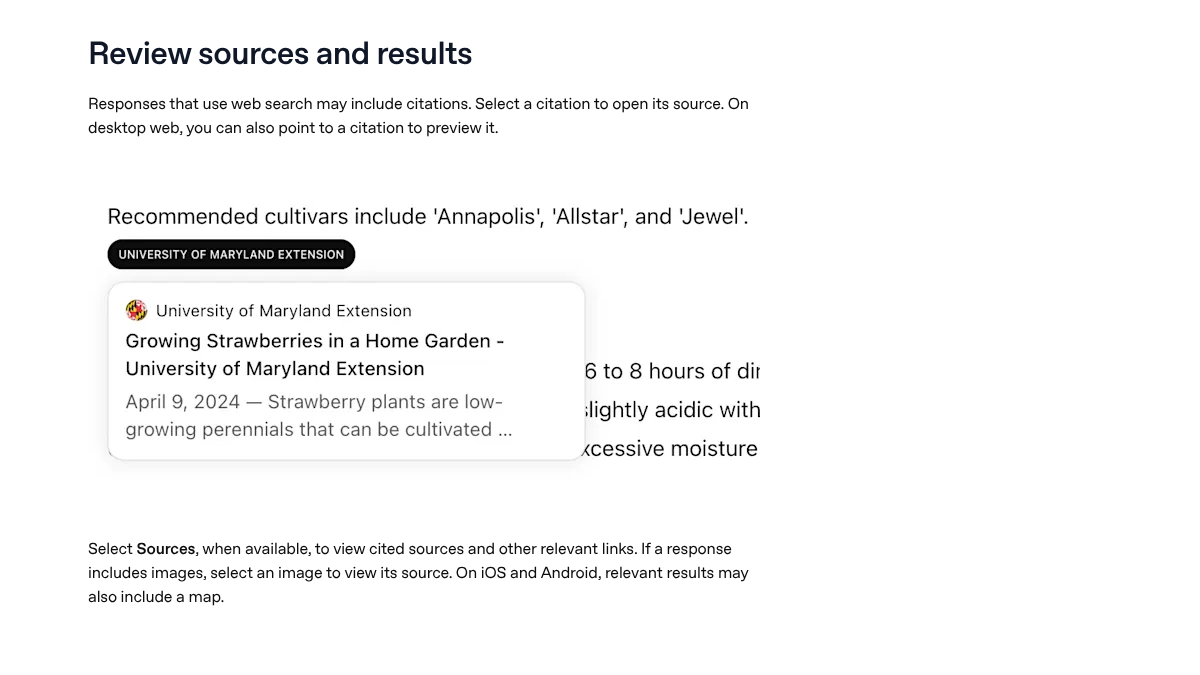
What I like about the last step is how precise the citations are. The model writes the answer and ties each source to a specific sentence. In ChatGPT those appear as small source labels you can hover over or click, with a Sources list underneath.
Our search-on answer cited four pages, and each one backed a single sentence rather than the whole answer:
| Cited page | What it backed |
|---|---|
| 1Password's business pricing page | $8.99 per user per month, billed annually |
| Bitwarden's business pricing page | $6 per user per month for its Enterprise plan |
| 1Password's support article on provisioning | Single sign-on and automated provisioning are separate features |
| Keeper's single sign-on page | Keeper supports Google Workspace sign-in |
We checked both prices against the live pages, and they matched. Look at what got cited: two pricing pages and two product documentation pages, with no blog posts and no roundups among them. The engine cited the pages it had gone looking for as proof.
Because each link sits right after the sentence it supports, you can check every claim against its source, and I'd do it. OpenAI itself warns that citations "can be incomplete, outdated, or incorrect."
Same question, different engine
Perplexity disagreed, and I think that's the most useful result for you in the whole trace. Its top pick was NordPass Business, with Keeper and Bitwarden as alternatives. Its 10 sources looked nothing like OpenAI's either: review and roundup sites such as PCMag, Security.org and Cybernews, a Google Workspace Marketplace listing, and two posts from LastPass's blog. Not one was a vendor's own pricing or documentation page.
One question produced two winners because the two engines read two different piles of pages. That's normal, and it's why checking a single engine tells you little about the rest.
The same engine can change its mind as well. Every run repeats the searches, and small differences in what comes back change the answer. In a separate test we asked OpenAI's model five times for the best webinar platform for SaaS product demos, and it named Demio in two runs and Livestorm in three. Our guide to checking ChatGPT citations covers how many runs you should use.
What GEO works on, step by step
Laid side by side, the steps make the job clearer:
| Step | What happens | What you can do |
|---|---|---|
| Search decision | The engine picks memory or live search | Little. Questions about prices and products tend to trigger search |
| Rewritten searches | One question becomes many narrow searches | Have a page for each narrow thing a buyer checks |
| Pages read | The engine reads what the searches return | Let AI crawlers in and get indexed |
| Answer and citations | Sentences get linked to the pages that prove them | State facts plainly, in sentences that stand on their own |
In our trace, the pages doing the work were receipt pages: the pricing page, the single sign-on docs, the provisioning article. An engine opens them to confirm a claim once it already has a shortlist. If you run a B2B site, you probably have pages like these, but they're often thin or out of date, or scattered across PDFs and support tickets.
Third-party pages count as well, as Perplexity showed. A marketing manager in r/OpenAI spent a month testing ChatGPT recommendations in their category and found that competitors with more forum threads and third-party blog mentions showed up more often, even with weaker SEO.
How does ChatGPT decide which businesses to recommend? I've been testing it for weeks and can't figure out the logic
Marketing manager, been systematically testing ChatGPT recommendations in our category for a month... competitors show up consistently, we barely appear despite stronger traditional SEO. Reverse engineered what they have that we don't... he...
If you want the signals behind recommendations, see how ChatGPT decides which websites to recommend. To turn the searches an engine runs into a content plan, see using AI search queries to plan content.

Built by the team that got cited in 48 hours.
Content generation, backlink building, AI visibility tracking, and Google rankings. One platform, zero guesswork.
Doing it yourself or handing it off
You can run this trace yourself, and I'd start there. Ask your five most important buyer questions with search on and note which pages get cited. Then check whether your own receipt pages exist and whether they say what the answers need them to say. Fix the gaps, and check again next month.
Or RankControl can cover both halves. Our content engine writes each article against the pages already ranking for its keyword and scores it for how easily AI engines can quote it, with a fix list. Then we publish the article on your own site. Our AI visibility tracking checks up to 50 buyer questions every week across seven AI engines and records which sources each answer cited. For a first look, run the free AI visibility check.
See your first AI citation report in under 5 minutes.
No setup calls. No onboarding meetings. Connect your domain and see where AI mentions your brand right now.