If you searched for "generative engine optimization pdf," you probably want the paper itself, so here it is: the PDF on arXiv. It's 12 pages in its current version, trimmed from 19 when it became the KDD 2024 camera-ready in June 2024. Most people who cite it quote "up to 40%" and stop there.
That figure is real, but it comes from one metric in a simulated search engine, and the paper's other famous number, 37%, comes from a different metric on a different engine. We read the tables so you don't have to, then turned the nine methods it tested into a generative engine optimization checklist for B2B SaaS pages.
What the GEO paper is
Six researchers from Princeton, Georgia Tech, the Allen Institute for AI and IIT Delhi posted "GEO: Generative Engine Optimization" in November 2023. They built a benchmark called GEO-bench with 10,000 queries pulled from nine sources, including MS MARCO, Natural Questions, ELI5 and Perplexity's Discover feed. About 80% of those queries are informational, with the rest split between transactional and navigational.
To run the tests, they built their own answer engine. GPT-3.5 Turbo read the top five Google results for each query and wrote an answer citing them. The team then rewrote one source page at a time with each of nine methods and measured how much of the answer that page earned.
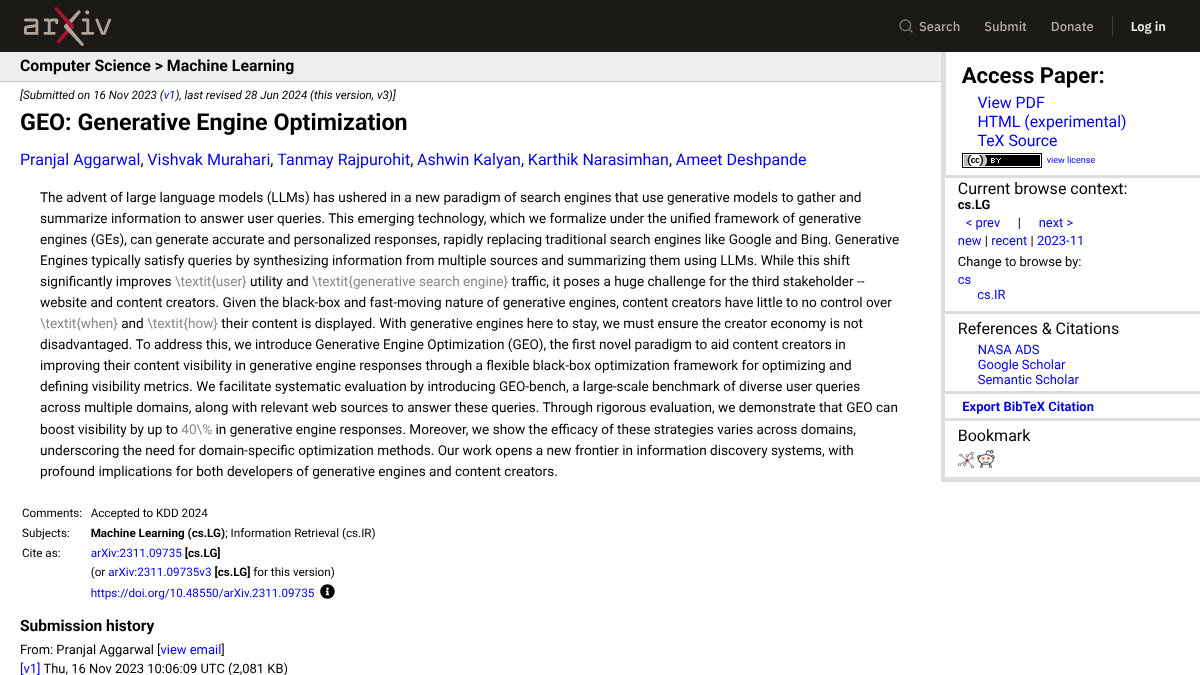
Visibility got scored two ways. Position-Adjusted Word Count counts the words in answer sentences that cite your page, and a citation near the top counts for more. Subjective Impression is a score GPT-3.5 gives on its own judgment, covering things like relevance and how likely a reader is to follow up on the source.
The nine methods, with numbers straight from Table 1
Here's how each method did against the unoptimized baseline in the simulated engine:
| The paper's method | What it changes | Word count metric | Impression metric |
|---|---|---|---|
| Quotation Addition | Adds quotes from credible sources | +41% | +28% |
| Statistics Addition | Swaps vague claims for numbers | +31% | +23% |
| Fluency Optimization | Smooths the writing | +28% | +13% |
| Cite Sources | Adds citations to credible sources | +27% | +13% |
| Technical Terms | Adds domain vocabulary | +18% | +11% |
| Easy-to-Understand | Simplifies the language | +14% | +6% |
| Authoritative | Makes the tone more persuasive | +10% | +19% |
| Unique Words | Adds unusual words | +6% | +6% |
| Keyword Stuffing | Repeats the query's keywords | -8% | +5% |
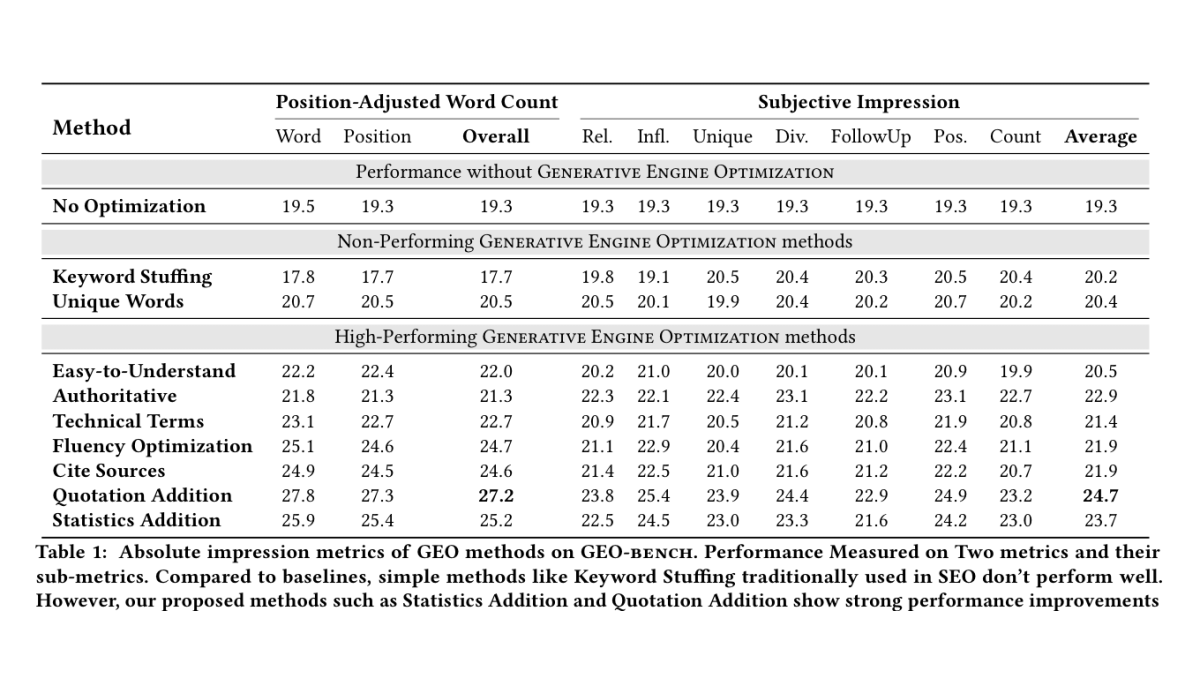
Two results stand out. Keyword stuffing is the only method that lost ground on the word count metric, which is the paper's plainest message for anyone coming from classic SEO. And the authors say a more persuasive tone gave "no significant improvement," which they read as a sign that answer engines already shrug off that kind of polish.
The "up to 40%" headline is Quotation Addition on the word count metric, 27.2 against a 19.3 baseline. The 37% people also quote comes from a smaller test on Perplexity, where the team uploaded source text as files and ran 200 samples, and Statistics Addition lifted the impression score. When a vendor deck stacks those two numbers side by side, it's mixing two engines and two metrics.
The rank-five dividend
For a smaller B2B brand, Table 2 matters more than Table 1. It breaks the results out by where each source page ranked among Google's top five. The fifth-ranked page gained the most: Cite Sources lifted its visibility 115.1%, while the same change left the top-ranked page 30.3% worse off on average.
Quotations and statistics followed the same shape, each close to doubling visibility for fifth place. We call this the rank-five dividend, and the authors frame it as a way for small companies to compete without winning the backlink race. If you sit fourth or fifth for "best [category] for [use case]" behind G2 and a big incumbent, those are the pages where this work pays most.
Read the size of the effect loosely, though. The test engine only ever saw five results, and the paper itself expects that as models read more sources, search rankings will matter less to what gets cited.
We'll show you exactly where your brand stands in AI search.
No commitment. $0 due today, cancel anytime. See how ChatGPT, Perplexity, Claude, Gemini, Grok, Google AI Mode, and Google AI Overviews talk about your brand today.

What held up after 2023
Three later sources are worth knowing before you build a plan on this paper.
C-SEO Bench, a benchmark accepted at NeurIPS 2025, tested conversational SEO methods across question answering and product recommendations. It found most of them "largely ineffective" and sometimes harmful, and it found traditional SEO significantly more effective. Its sharpest result is about crowding: as more sites adopted the same tactic, the gains shrank, since one page's win comes out of another's share. We covered the benchmark and the paper's code in our GEO GitHub resources post.
A University of Toronto team published a separate study in September 2025. It found that AI search shows "a systematic and overwhelming bias towards Earned media," meaning third-party coverage, over brand-owned pages, and Google's results were more balanced than the AI engines'. For a SaaS marketer, that means review sites, analyst mentions and press coverage carry more weight in AI answers than in plain Google.
Google, for its part, says its AI features need nothing extra: "There are no additional requirements to appear in AI Overviews or AI Mode, nor other special optimizations necessary." The GEO paper was about answer engines in general, and Google's own surfaces run on its ranking systems.
Buyers have noticed the gap between the paper and the pitches. A thread in r/b2bmarketing last November asked how anyone proves GEO worked after paying a vendor, and drew 95 comments. The blunt top answer was that anyone promising a set percentage of growth is lying, the same as in SEO.
How do you know GEO works?
Like actually? at the end of the day dominating Google or other authority domains is the only way to land in ChatGPT with regularity. So when you use these vendors that promise x% growth etc how do you actually prove what you’ve paid them t...
A small check we ran on September 26
We wanted to see whether the paper's advice shows up in what gets cited today. We ran five B2B SaaS questions through Perplexity's API, from "how to reduce customer churn for a saas business" to "how to price a saas product," and fetched every page it cited. Then we fetched Google's top ten for the same questions and set aside any page Perplexity hadn't cited.
About half of the cited pages (18 of 35) carried a sourced statistic or an attributed quote. Among the Google top-ten pages Perplexity skipped, it was just under a third, 10 of 31. Cited pages came out ahead on four of the five questions and tied on the fifth.
That's directional, not proof. Our detector was a pattern match, not a human read, and the cited pages skewed toward big publishers like Stripe and HubSpot that write carefully and get cited for plenty of other reasons. One side note: for "best crm for small business," Perplexity's sources barely overlapped with Google's top ten at all.
The GEO checklist for B2B SaaS pages
Here's the paper turned into work you can assign, ordered by its own results:
| Checklist item | The paper's method | Where it goes on a SaaS site |
|---|---|---|
| Add one attributed quote to each key page, from a customer, analyst or named expert | Quotation Addition | Use-case pages, comparison pages |
| Replace vague claims with a number and its source | Statistics Addition | Pricing pages, ROI sections, feature pages |
| Link the sources behind your claims | Cite Sources | Guides, docs, benchmark posts |
| Edit for flow after the facts are in | Fluency Optimization | Every page, last pass |
| Use the terms your buyers search with, and define them once | Technical Terms | Docs, integration pages |
| Shorten sentences on pages written for evaluators | Easy-to-Understand | Homepage, product overview |
| Cut repeated keywords | Keyword Stuffing (avoid) | Old SEO landing pages |
| Start with pages ranking fourth to tenth | Table 2 finding | Category and "best for" pages |
| Earn mentions on review sites and in trade press | Toronto study | Off-site |
| Re-check citations every quarter | C-SEO Bench finding | Tracking |
Order matters within a page. In a follow-up test on a 200-query subset, the best pair was Fluency Optimization with Statistics Addition, which beat any single method by more than 5.5%. Cite Sources was weaker than quotations on its own, but it averaged a 31.4% gain when combined with other methods.
The checklist also stays light on schema and llms.txt, because the paper never tested them. If you want the technical side, our AI search readiness checklist covers crawler access, rendering and entity data. To see how a GEO pass differs from an SEO pass on the same page, read our one page, two playbooks test.
Budget about two hours per page for the first pass on your top ten pages, so 20 hours or so, then two to three hours a month to check citations and refresh the numbers.
Know exactly what AI says about your competitors.
RankControl's Recon Agent monitors competitor citations across ChatGPT, Perplexity, Claude, Gemini, Grok, Google AI Mode, and Google AI Overviews. See where they show up and you don't.

What the paper can't tell you
The authors say outright that they "didn't evaluate how GEO methods affect search rankings." Their argument is that text edits are unlikely to hurt rankings, which is reasonable, but it's an assumption. Your Google positions are yours to watch.
The engine was GPT-3.5 Turbo with a fixed prompt, which is several model generations behind what ChatGPT runs now, and 80% of the queries were informational. B2B buying questions like "best SOC 2 tool for a 50-person startup" are commercial, and the paper tested few of those. Rich Tatum's summary when the paper came out still holds up: quit keyword stuffing and put real information on the page.
I know others have gotten to this before me, but this is an important paper to read, especially if you worry that the future of #SEO is in jeopardy... GEO: Generative Engine Optimization (see my reply to this tweet for link)... Some of my top takeaways: ❯ STOP KEYWORD
 Rich Tatum »∵«@RichTatumAug 7, 2024
If you're deciding who on the team owns this work, our post on GEO for B2B SaaS growth covers roles and budget.
Running it every month
You can work this checklist by hand. Pick your ten pages, add the quotes and sourced numbers, then ask ChatGPT and Perplexity your buyer questions each month to see whether your pages get cited.
Or RankControl can do most of it for you. Its content engine writes each article against the pages already ranking for its keyword and scores it for how easily AI engines can quote it, with a fix list. Its AI visibility tracking checks up to 50 buyer questions every week across seven AI engines and shows which sources each one cited, so you can see whether your citations hold after competitors start doing the same work.
26 content formats. Published on your domain. Matched to your brand.
Guides, comparisons, listicles, case studies, and more. RankControl generates content that gets cited by ChatGPT, Perplexity, Claude, Gemini, Grok, Google AI Mode, and Google AI Overviews.