
A founder posted in r/SaaSMarketing this summer with a problem plenty of SaaS teams share. They'd set up their SEO, the basics were in place, and they were getting fewer than five clicks and almost no signups. What should they focus on next?
SEO is set up, but my SaaS is getting almost no traffic or signups, what should I focus on next?
Hey everyone, I’m building a SaaS product and currently trying to figure out how to grow traffic and get my first consistent users. I’ve already worked on SEO and the basic setup seems to be in place, but growth has been very limited. I’m s...
The useful replies agreed on one thing. Stop chasing traffic and go after the searches people make when they're ready to buy. One said those searches have low volume and convert far better. Another said that under five clicks means SEO isn't working yet, so talk to buyers directly first.
That's the core of SaaS content marketing in 2026, and it raises a practical question. At each stage of a buyer's search, who are you actually up against? We checked 15 real buyer searches in October to find out.
What we checked
We pulled Google's live results for these searches on October 19, five for each stage of the buying journey. How-to searches came first, like "how to reduce customer churn". Then best-of searches, like "best crm for small business". Last came comparison searches, like "hubspot vs salesforce" and "zendesk alternatives". For each, we sorted the top organic results and every AI Overview citation by who owned the page.
| Stage | Software companies in top results | AI Overview citations from software companies | AI Overview citations from Reddit and YouTube |
|---|---|---|---|
| How-to | 57% | 8 of 16 | 5 of 16 |
| Best-of | 45% | 17 of 44 | 5 of 44 |
| Comparison | 63% | 6 of 16 | 8 of 16 |
All 15 searches showed an AI Overview. That alone tells you how much of SaaS buying now starts with an AI answer at the top of the page.
Our SaaS SEO playbook covers which pages to build and in what order. This guide is about the competition you meet on each one.
Volume versus value at each stage
Search volume and click value point in different directions, which is why traffic is a poor guide. These are US monthly searches and average cost per click from Google Ads data for a few of the searches we checked.
| Search | Stage | Monthly searches | Cost per click |
|---|---|---|---|
| how to create an invoice | How-to | 2,900 | $18.79 |
| how to run a sprint retrospective | How-to | 30 | $0.11 |
| best crm for small business | Best-of | 2,900 | $44.02 |
| best payroll software for small business | Best-of | 1,600 | $174.21 |
| asana vs monday | Comparison | 1,600 | $14.84 |
| zendesk alternatives | Comparison | 720 | $141.18 |
The five best-of searches added up to about 5,900 searches a month, the five comparison searches about 5,300, and the five how-to searches about 3,100. Almost all of that how-to volume came from a single search about invoices.
How-to content is where SaaS blogs still win
Software companies own the how-to searches. On "how to reduce customer churn", Amplitude, Chargebee and Baremetrics all ranked. On "how to write a sales follow up email", HubSpot, Salesforce and Zendesk took three spots, and the AI Overview cited Salesforce, Zendesk and Atlassian.
The catch is the money. Most of these searches are small, and advertisers barely bid on them. "How to run a sprint retrospective" gets about 30 searches a month at 11 cents a click, per Google Ads data.
One how-to search looked different. On "how to create an invoice", four of the top eight results were YouTube videos, and the AI Overview cited Canva, a free invoice generator, Reddit and YouTube. People wanted to make an invoice right now, so tools and templates beat articles. If a how-to search in your space works like that, build the free tool or template first and write the guide around it.
So write how-to content close to what your product does, where the reader is one step from needing you. A payroll company writing about tracking employee hours is in the right place. The same company writing about office culture isn't.
200+ SaaS teams already track their AI citations.
They know exactly when ChatGPT mentions their brand, and when it stops. Do you?
Best-of searches belong to lists, so get on them
Best-of searches were the hardest for vendors. Software companies held 45% of top results, and publishers, review sites and affiliate lists took most of the rest. On two of the five, the AI Overview cited 17 or 18 sources, mostly other people's lists.
These are also the most valuable searches we checked. "Best payroll software for small business" costs advertisers about $174 a click, and "best help desk software" about $121.
Two things work here. Publish your own honest best-of list for your category, and work to get included on the lists that already rank. Our post on the listicle strategy for SaaS covers how to approach list authors without being annoying.
Comparison pages are your own territory
Head-to-head searches came out best for software companies' own sites. On "hubspot vs salesforce", HubSpot's comparison page ranked second and Salesforce's sixth. On "gusto vs adp", ADP's page ranked first and Gusto's fifth, and the AI Overview cited both.
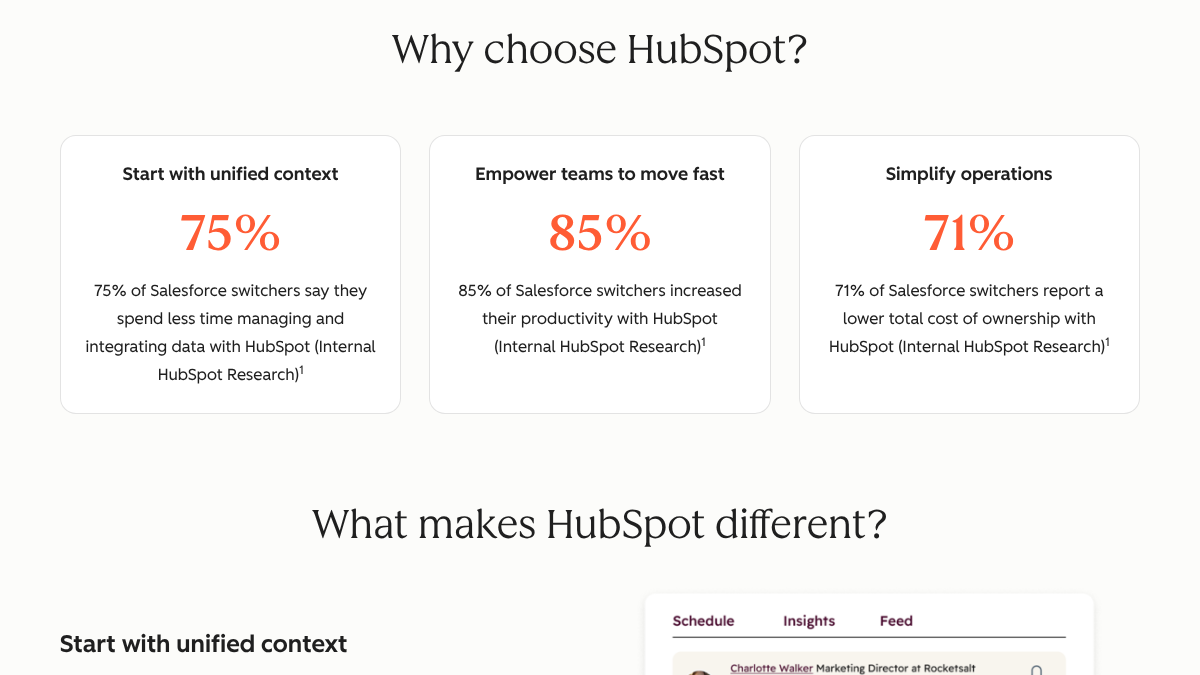
Look at how HubSpot's page opens. It leads with three numbers from a survey of customers who switched from Salesforce, each labeled as internal research. That's a vendor arguing its own case, and Google ranked it anyway, because the person searching wants to hear each side.
A reply in r/aeo explained why these pages pay off. Your own "us vs them" page mostly helps conversion rather than traffic, unless the rival is very popular. Another reply warned that pages which trash every competitor on every metric are exactly what Google's spam updates and AI tools are getting better at spotting. So be fair and specific, and say where the other product is a better fit.
Alternatives searches go to Reddit
"Alternatives" searches flipped the pattern. On "zendesk alternatives", all three AI Overview citations were Reddit threads. On "mailchimp alternatives", two of four were. Across our five comparison searches, Reddit supplied 8 of the 16 citations.
Competitors still rank organically for these with their own alternatives pages, and the clicks are expensive. "Zendesk alternatives" costs about $141 a click. But the AI answer on top is built from what real users say about switching.
That means two jobs. Keep an alternatives page for each big competitor on your own site, though our competitor analysis example shows a vendor ranking three times for its own alternatives search and still not being cited. Then make sure your product gets mentioned honestly in the threads where people ask, by answering questions where your team has real experience.
How often does ChatGPT mention your brand?
Most founders have no idea. The answer might surprise you.

Measure signups, not traffic
The r/SaaSMarketing replies were right to call traffic a vanity number. A SaaS founder in r/SaaS showed how to measure what matters from AI search. ChatGPT tags the links it shows with utm_source=chatgpt.com, so GA4 keeps that source through the session, including the signup. In their last 30 days, ChatGPT sent at least 14 visitors and 5 created an account.
Their setup needed three fixes first. The signup event had to fire in the browser, the marketing site and app domain had to be linked in GA4, and the login provider had to be listed as an unwanted referral. Replies added two caveats. Mobile in-app browsers often drop the tag, and many people click later through a branded Google search instead.
So treat ChatGPT signups as a floor, and watch branded search and direct visits to deep pages alongside them. Our post on AI referral traffic and conversions covers what the wider studies show.
A content mix for a small SaaS team
If you publish eight pieces a month, here's how we'd split them based on what we found.
| Content type | Per month | Why |
|---|---|---|
| Comparison and alternatives pages | 2 | Your own site wins head-to-head searches, and the clicks are worth the most |
| How-to guides close to the product | 3 | Software companies own these, and they feed AI answers |
| Your category best-of list, plus updates | 1 | Publishers lead here, so one strong list beats many weak ones |
| Original data or customer stories | 2 | Gives list authors and AI answers something to cite |
Early-stage teams with no traffic yet should start narrower. Our guide on what early-stage SaaS should publish first covers that case.
What this costs in hours
A good comparison page takes four to six hours, since it needs a fair look at the competitor's current pricing and features. A product-adjacent how-to runs three to four hours. Add an hour a week for Reddit, and another to check rankings and which AI answers name you. Eight pieces a month comes to roughly 35 to 45 hours.
You can do all of this in-house. Or RankControl's agents can do it for you every month, writing and publishing comparison pages, alternatives pages and guides on your own domain and checking seven AI engines every week, while you focus on your product.
15 hours a week manually. Or 15 minutes with RankControl.
Track citations, monitor competitors, and fix content gaps across every AI search engine. Automatically.