
You open the quarterly report and organic sessions to the blog are down again. Someone in the leadership meeting asks the obvious question: if AI answers stop people from clicking, why are we still paying for content?
It's a reasonable question, and the numbers behind it are real. But "no clicks, no content" is the wrong conclusion for a SaaS company, because it treats all content as one thing. Some of it has lost most of its value. Some of it is now doing more work than ever, just without showing up as a session in your analytics. An AI search content strategy starts with telling the two apart.
The case for cutting content, at its strongest
The click loss isn't imagined. In a study of 900 US adults and nearly 69,000 searches, the Pew Research Center found that people clicked a traditional search result in 8% of visits when an AI summary appeared. Without the summary, they clicked nearly twice as often. Clicks on a link inside the summary itself happened in just 1% of visits.
The damage is concentrated on the top result, too. Ahrefs compared 300,000 keywords in early 2026 and found the top-ranking page got 58% fewer clicks on average when an AI Overview appeared, up from 34.5% in its April 2025 version of the study. Ahrefs sells SEO software, so it has no reason to understate the problem, but that's still a large sample. Our roundup of zero-click search statistics covers the rest of the numbers, including which ones to stop quoting.
So if your content plan was "rank for broad questions, collect the traffic, convert a small share," the math has changed. A post answering "what is customer onboarding" is now competing with a summary that answers it before anyone scrolls.
People doing the work feel this. In a September thread on r/marketing that drew nearly 200 comments, a B2B tech marketer whose team had held off on letting AI replace human-written content asked whether content marketing was finished.
Is content marketing dead? Seeing no light at the end of the tunnel today
Hey all. I'm in B2B tech in Silicon Valley, so the heart of AI pandemonium. We've been integrating it over time and seen benefits, but largely haven't used AI to replace human-written (or at least guided) content to date, in part because of...
Where the argument breaks: AI answers are built from pages
The cutting argument skips one thing: an AI answer has to come from somewhere, and for most buying questions it comes from pages someone published.
Google's own position is that clicks are holding up. Liz Reid, who runs Google Search, wrote in August 2025 that "total organic click volume from Google Search to websites has been relatively stable year-over-year," and that "average click quality has increased."
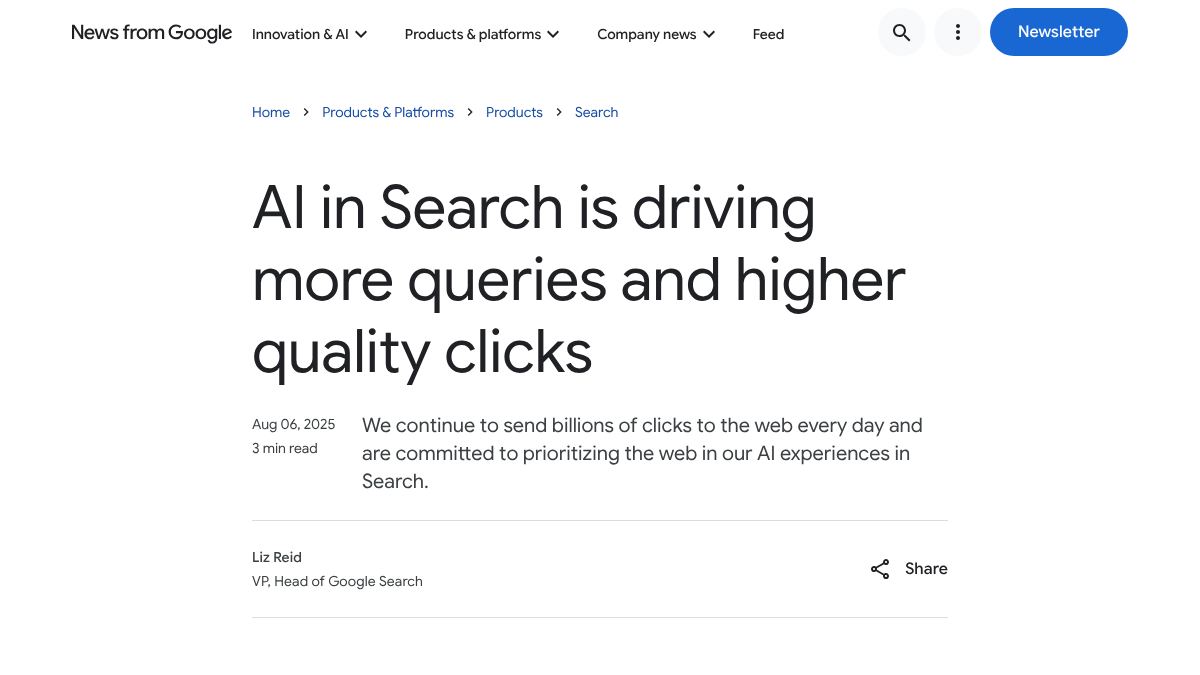
Google has every reason to say that, and it didn't publish the data behind it, so treat it as Google's claim. The more useful part of the post is the other thing it says: people are asking longer, more complex questions. Those are exactly the questions a buyer asks when they're close to picking a tool, and they're answered by specific pages.
If you stop publishing those pages, buyers still get an answer. It just cites a competitor's page or a third-party site instead of yours, which is what happened on one of the four questions below.
What four live AI Overviews cited
We wanted to see which kinds of pages Google's AI Overviews pull in for real B2B buying questions, so on September 27, 2026 we pulled the AI Overview for four of them in the US. The citations looked like this:
| Buying question | Sources cited | What got cited |
|---|---|---|
| "salesforce vs hubspot for a 20 person sales team" | 11 | Both vendors' own comparison pages, four third-party comparison posts, four YouTube videos, one Reddit thread |
| "best applicant tracking system for small business" | 8 | One vendor's product page, a competing vendor's buying guide, a trade association directory, four YouTube videos |
| "how much does asana cost for a team of 50" | 7 | Asana's pricing page, two Asana help articles, two SaaS spend sites with per-seat price tables, two pricing blogs |
| "notion alternatives for engineering teams" | 3 | Two small third-party listicle sites, one inline link to a rival's product page |
Three things stood out. The pricing question was answered largely from Asana's own pages, including two help center articles most marketers wouldn't think of as content. Both HubSpot and Salesforce had their own comparison page cited, side by side, in the same answer. And the alternatives question is the warning: neither Notion nor rivals like Linear had an "alternatives" page cited, so two thin listicle sites filled the gap.
YouTube was the largest single source, with 8 of the 29 citations. G2, Capterra and TrustRadius didn't appear at all.
Four questions is a small sample, and we'd be wary of anyone who built a strategy on it alone. Other, larger studies find review platforms among the most cited sources for generic "best X software" questions, which our post on SaaS marketplaces and directories covers. What the sample does show is narrower and harder to argue with: when a vendor has published the exact page a buying question needs, the AI Overview uses it.
See your first AI citation report in under 5 minutes.
No setup calls. No onboarding meetings. Connect your domain and see where AI mentions your brand right now.

The clicks that are left come from further down the funnel
The second hole in "no clicks, no content" is that it counts clicks as if they're all the same. The clicks AI answers remove are likely to be the quick-definition kind, since that's the part a summary does well. The ones that survive tend to come from people who need more than a summary.
The best independent evidence on this is a peer-reviewed study by Kaiser and Schulze, published in Marketing Science in July 2026. They looked at 973 e-commerce sites and found that ChatGPT referrals converted better than paid social but worse than every other traditional channel. That's more modest than the "AI traffic converts 10x" claims you'll see from vendors, and our breakdown of the AI traffic trickle goes through why.
The study describes these visitors as having "niche informational needs," which is a polite way of saying they already know roughly what they want.
B2B buying adds another layer. Forrester reported in January 2026 that 94% of B2B buyers now use generative AI in their buying process. Much of the research happens before anyone visits your site.
That matters because of when the decision gets made. In 6sense's 2025 buyer survey, buyers purchased from a vendor on their day-one shortlist 95% of the time. 6sense sells intent data, so it benefits from that finding, but the direction matches what most B2B marketers see in their own deals. If AI answers are where the shortlist forms, the pages those answers cite are doing sales work even when nobody clicks.
One search agency that tracks about 10,000 keywords for its clients found the same pattern in click data. On queries with an AI Overview, organic CTR fell from 1.41% to 0.64% year over year. When a client was cited inside the Overview, though, CTR rose from 0.74% to 1.02%. It's a living tracker from a firm that sells this work, so the numbers move, but being cited was worth something measurable.
Split the bucket: verification pages vs traffic pages
The fix is to stop asking whether content still works and start asking which content. We sort it into two groups.
Verification pages are the ones a buyer, or an AI answer acting for them, uses to check a choice. Pricing and help docs are the obvious ones, and comparison pages, alternatives pages and original data belong here too. They answer a specific question with specific facts, and AI answers keep citing them because they're the only places those facts live.
Traffic pages are the ones written mainly to rank for a broad question and collect visits: "what is X," "10 tips for Y," the listicle rewritten from whatever already ranks. These are the pages AI summaries replace most easily, because the summary can say everything they say.
| Make more of | Make less of |
|---|---|
| Pricing pages with real numbers and per-seat examples | "What is [category]" explainers aimed at head terms |
| Help center articles that answer setup and limit questions | "Top 10 tips" posts with nothing a summary can't repeat |
| Your own comparison and alternatives pages | Listicles rebuilt from the current top ten results |
| Original data, benchmarks and customer research | Trend roundups that restate other people's stats |
| Short videos for comparison questions | Posts published mainly to hit a monthly quota |
This isn't a new argument inside marketing teams. On r/b2bmarketing, one marketer asked whether most B2B content was busy work, contrasting teams that publish 50 or more pieces a month with a few focused assets, like calculators and ROI tools, that do the converting.
Is most B2B content marketing just busy work?
Feels like we’re all creating blogs, LinkedIn posts, and case studies nonstop… But how much of it actually drives pipeline? We’ve seen teams publish 50+ pieces/month and still struggle with conversions. Meanwhile, a few focused assets (like...
AI search makes that argument sharper. A calculator or a pricing page has facts a summary needs to borrow, while a generic post has only phrasing, which the summary can produce on its own.
What an AI search content strategy looks like on the calendar
Start with an audit, not a publishing freeze. Pull your last 30 or so published pieces and label each one verification or traffic. If your blog grew during the traffic era, expect most of it to land in the traffic column, because those were the pages that used to bring in visits.
Then list the questions buyers ask right before they pick. Sales calls and support tickets are the best source: "how much for 50 seats," "does it work with Salesforce," "how is it different from X." For each one, check what an AI answer cites today. If the answer cites a third-party site or a competitor's page instead of yours, that's the next page to write. Our guide to comparison pages that get cited covers how to build the "vs" pages, which is where most teams find the biggest gaps.
Don't forget the pages that aren't on the blog. Asana's help center showed up in our check twice. If your docs, pricing and integrations pages are thin, outdated or only readable after JavaScript runs, fixing them may do more than any new blog post.
Plan for the time. The first audit takes about a day for a site with a few hundred pages, and checking your main buying questions across the AI engines by hand takes another three to four hours. After that, keeping up is two to three hours a month, plus the writing. Our post on whether the publish-more era is over covers how to think about volume once the mix is right.
Your competitors are building backlinks while you read this.
Organic outreach, social mentions, and citations from Editorial Circle member sites, with managed backlinks available as an add-on. Grow your domain authority without running the campaign yourself.
Where we'd push back on our own argument
A few limits are worth stating, because this post argues for something RankControl sells.
YouTube had more citations in our check than any other kind of source. A writing team can't fix that by publishing more pages, and if your buyers watch comparison videos, some of your budget belongs there.
Verification pages only work if the facts on them are real. No content team or tool can write a good pricing page for a product with confusing pricing, or a comparison page that wins for a product that loses. If your pricing needs a sales call to explain, fix the pricing model before you rewrite the page.
And some traffic pages still earn their place. A broad guide that brings in the right readers, earns links or gets cited for a definition you want to own is doing its job. The point is to know which job each page has, then measure it that way, which is what our post on what to track in zero-click search is about.
So, do you stop publishing?
No. You stop publishing pages that exist only to collect visits a summary now takes, and you put that budget into the pages AI answers have to borrow from. For most SaaS companies, that means fewer posts overall and a lot more attention on pricing, docs, comparisons and data.
The harder part is that it isn't a one-time fix. AI answers can change the sources they cite from one week to the next, and a comparison page that's cited this month can lose its spot to a competitor's rewrite next month.
Doing it yourself or handing it off
You can run all of this by hand: the audit, the buyer questions, a monthly check of what each AI engine cites. It works, and for a small site it's a few hours a month.
RankControl does the ongoing part. Our AI visibility tracking checks up to 50 buyer questions every week across seven AI engines, marks whether each answer mentions you, cites you or both, and records every source each answer used, so you can see when a competitor's page or a thin listicle is being cited instead of yours. Our content engine writes the missing pages against what already ranks for each keyword and publishes them on your own site.
You're getting AI traffic. But do you know where it comes from?
RankControl credits every visit to the assistant that sent it: ChatGPT, Perplexity, Claude, Gemini, Copilot, or Grok. Full source attribution, next to your Google traffic.