
Hyperping is an uptime monitoring company run by a small, self-funded team. Its About page shows four people. On September 27, 2026, we searched Google for "status page tool with pagerduty integration under $200 a month" and read the sources behind the AI Overview. Four of the ten were Hyperping pages: its pricing page, two comparison pages and a blog post comparing it with PagerDuty.
None of those pages is a 5,000-word guide. They're the pages a buyer checks when they have a specific requirement and a budget. That's the good news for small teams: AI answers to buying questions cite precise pages, and you don't need a content department to make them. You need to make the right few, mostly from material you already have.
Why a small team can compete
AI search rewards precision more than volume. When ChatGPT answers a buyer question, it rewrites it into narrow searches and goes looking for the page that answers each part. OpenAI's help page says ChatGPT "typically rewrites your query into one or more targeted queries" and may then send "additional, more specific queries."
That's why its citations skew so heavily toward vendors' own pages. In our test of 12 software buyer questions, OpenAI's model cited 94 pages, and nearly all of them were vendors' own pricing, help and product pages. Our post on why AI search cites fewer listicles has the breakdown.
Google's AI Overviews showed the same pattern for small vendors. We checked 10 buyer questions around three bootstrapped companies: Hyperping, Featurebase (whose About page describes "a young & hungry team of 3") and Instatus. An overview appeared every time. A small vendor's page was cited inside the overview in three of the ten, and every one of those citations was a comparison page, an alternatives post or a pricing page.
It's a small sample, so treat it as a direction rather than a rule. But the direction is clear enough: the bigger rivals won the broad questions, and the small teams got in through specific ones.
Ranking wasn't the same as being cited, either. Instatus had its own alternatives posts on page one for two of its questions, fifth and ninth, and neither made it into the overview. Hyperping's self-published "best uptime monitoring software" list ranked second for its question and wasn't cited there. The Hyperping pages that did get cited had prices and head-to-head details in them, which is what a buyer with a requirement needs.
The inventory pass: pages you've already half written
Before you write anything new, do what we call an inventory pass. Most small teams already have the raw material for their best AI search pages, scattered across tools nobody thinks of as content.
| What you already have | The page it becomes |
|---|---|
| Support tickets from trial users | Help articles answering "can it do X?" before someone buys |
| Sales call notes and lost-deal reasons | Comparison pages for the two or three rivals you lose to most |
| Pricing page copy and billing FAQs | A pricing page with every plan limit and price in plain text |
| Integration setup docs | One page per major integration, with what it syncs and what it doesn't |
| Your changelog | A dated page whenever a plan, price or name changes |
Sales notes are the most underused source on that list. The questions prospects ask on calls are the same questions they ask ChatGPT before they book one. If three prospects this quarter asked whether you work with HubSpot, you've found a page to write.
Support tickets are close behind. A trial user asking whether exports include custom fields is asking a question someone else is typing into an AI assistant right now. The answer probably already exists in a reply your support person wrote. Turning it into a public help article takes an hour.
Keep the shape simple when you do. Use the buyer's question as the title, answer it in the first two sentences, then add the steps and the limits: what the feature doesn't do, which plan it needs and what it costs. The limits matter most, because a buyer's question usually carries a requirement, and a page that states its limits plainly is the one that answers it.
26 content formats. Published on your domain. Matched to your brand.
Guides, comparisons, listicles, case studies, and more. RankControl generates content that gets cited by ChatGPT, Perplexity, Claude, Gemini, Grok, Google AI Mode, and Google AI Overviews.

Which few pages first
With limited hours, this order gets the most out of them:
- Your pricing page, with every price, limit and plan difference in the page's text rather than in images or a script-loaded table.
- Comparison pages for the competitors that come up most in sales calls.
- Integration pages for your three most-requested integrations.
- Help articles for the five most common pre-sales questions.
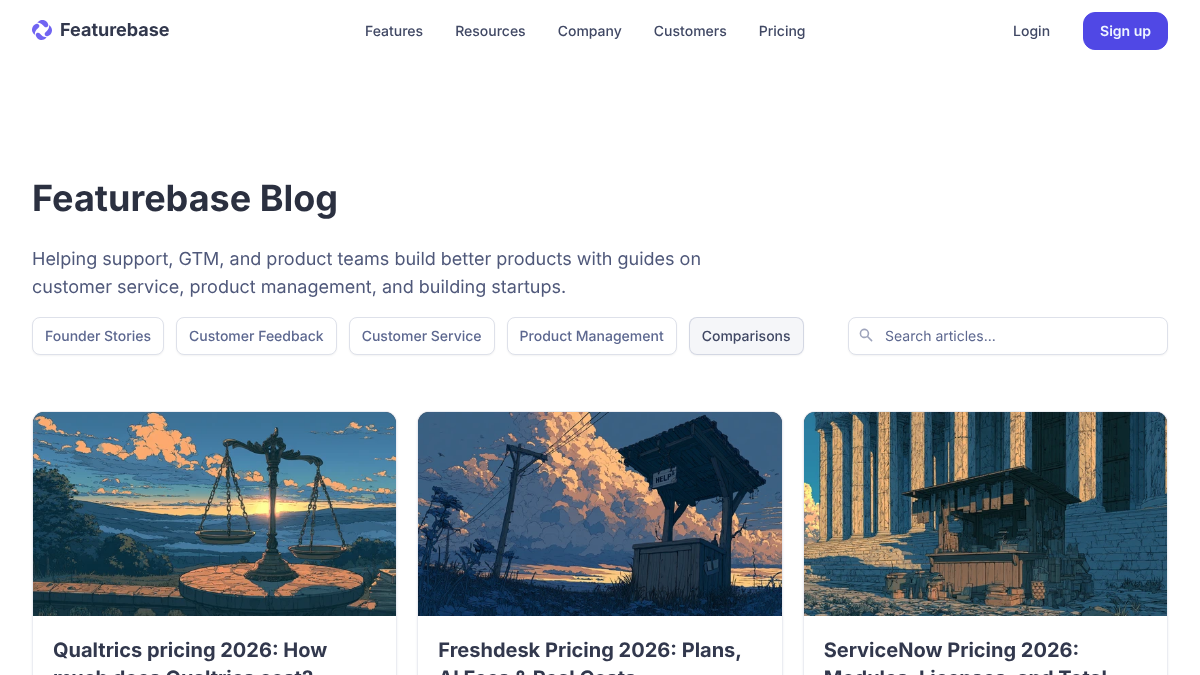
Featurebase is a good example of the second step. Its blog has a comparisons section, and that hub was cited in Google's AI Overview for "featurebase vs canny vs upvoty." It also publishes pricing explainers for bigger names in its category.
Write comparison pages carefully, though. Buyers and AI engines both see through a page that only praises you. State the rival's real prices and strengths, then say plainly who you fit better. Our guide to building AI search visibility without listicles goes deeper on these page types and the order to build them in.
What to stop doing
A small team's biggest cost isn't the pages it doesn't write. It's the hours spent on pages that were never going to be cited.
Stop filling a keyword calendar with posts that don't answer a buyer's question. In one r/SEO thread from a one-person SEO team, the most practical reply named the usual problem with inherited content: generic blog posts with no clear intent, which rarely rank or bring qualified traffic.
Stop writing broad definition posts in a category the big players already own. In our 90-day check of new SaaS blog posts, ChatGPT answered 6 of 10 target questions, mostly definitions, from memory without searching at all. A small team can't win those in a quarter.
And don't try to make up the difference with bulk AI-generated pages. Google's spam policies call it scaled content abuse when "many pages are generated for the primary purpose of manipulating search rankings and not helping users," however they're made.
Update or write new?
With limited hours, every page is a choice between fixing something and making something. A simple rule works: if a page on your site already answers the question but has stale facts, update it. If nothing on your site answers it, write a new one.
When you update, change the substance first. Google's helpful content guidance asks whether you're "changing the date of pages to make them seem fresh when the content has not substantially changed." It also questions adding or removing lots of content just to make a site seem fresh, and answers its own question bluntly: "No, it won't."
Most updates for a small team are quick anyway: a new price, a renamed plan, an integration that now syncs something it didn't. Our post on content refreshes and reindexing covers how long it takes each engine to notice.

Your competitors are getting cited by AI. You're not.
Every day without citation tracking is a day your competitors pull ahead in ChatGPT, Perplexity, and Claude.
A realistic week
Here's a routine that fits around a full job, at about three hours a week.
| When | Time | What |
|---|---|---|
| Monday | 30 minutes | Read this week's support tickets and sales notes and pick one buyer question |
| Midweek | About 2 hours | Turn it into a page, or update the page that should already answer it |
| Friday | 30 minutes | Ask five buyer questions in Google, ChatGPT and Perplexity and note who's cited |
That's one solid page a week, roughly 50 a year, each built on a question a real buyer asked. Our guide for one-person marketing teams covers where to start if you're setting this up from zero, and the Friday check doesn't need to be more elaborate than a spreadsheet.
Owners without a marketing team tend to land here on their own. In an r/growmybusiness thread about doing SEO without one, the most common answer was to set up the basics once, write a few pages that clearly explain what the business does and add more when time allows. The difference with AI search is only which pages come first.
Doing it yourself or handing it off
By hand, the inventory pass takes an afternoon, and the weekly routine takes about three hours. Over a quarter that's around 40 hours for a dozen pages and a steady view of where you're cited.
Or RankControl can carry most of it. Our content engine writes each article against the pages already ranking for its keyword and scores it for how easily AI engines can quote it, with a fix list, then publishes it on your own site. Our AI visibility tracking checks up to 50 buyer questions every week across seven AI engines and records which pages each answer cited. For a quick first look at who ChatGPT cites in your market, the free AI visibility check on our site takes a minute.
200+ SaaS teams already track their AI citations.
They know exactly when ChatGPT mentions their brand, and when it stops. Do you?