
Programmatic SEO and answer engine optimization both promise more visibility for a SaaS brand, and they pull a content budget in opposite directions. One builds thousands of templated pages. The other builds a smaller number of pages written to be quoted by ChatGPT, Perplexity and Google's AI answers.
So we tested what AI engines do with programmatic pages today. On September 26, 2026, we ran eight questions through the APIs behind ChatGPT and Perplexity and through Google's AI Overviews. Each one targeted pages that Wise or Zapier, two well-known programmatic SEO players, have built at scale. Wise's money-transfer pages got cited almost everywhere. Zapier's "connect app A to app B" pages got cited in 2 of 6 chances. The difference between the two explains most of this comparison.
Programmatic SEO and AEO in one table
Here are the two approaches side by side before we get into the test.
| Programmatic SEO | Answer engine optimization | |
|---|---|---|
| What you build | Many pages from one template and a dataset | Fewer pages, each written for a buying or research question |
| Goal | Long-tail Google rankings at scale | Being cited and named in AI answers |
| Classic SaaS example | Integration pages, template galleries, currency pages | Comparison, pricing, alternatives and docs pages |
| Where it wins | Queries where the answer is data you own | Questions where buyers compare and decide |
| Main risk | Google's scaled content abuse policy | Slow to scale, harder to measure |
| How you measure it | Indexed pages, rankings, organic traffic | Citations, brand mentions, AI referral visits |
Programmatic SEO took off because Google rewarded pages that matched long, specific searches. AEO grew because a growing share of those searches now ends in an AI answer instead of a list of links.
What programmatic SEO still does well
Programmatic pages work when each page carries something the others don't. Wise is the textbook case. Its currency converter and "send money to" pages each hold live rates and fees for one pair of countries. When we searched "usd to eur exchange rate today," Wise ranked first in Google. For "best way to send money from us to india," its page ranked first too.
Those same pages did well in AI answers. ChatGPT's API, Perplexity and Google's AI Overview all cited Wise's India transfer page for the money-transfer question. Perplexity cited the USD to EUR converter page directly. For "is wise cheaper than a bank for international transfers," Google's AI Overview cited four Wise pages, and Perplexity cited more than a dozen.
Plenty of founders still report good results from templates built on real data. One indie founder on X described taking a startup to 2.15 million Google impressions in three months by turning a proprietary dataset into thousands of long-tail pages, with a clear view of the line: "google doesnt penalize automated pages. it penalizes the 'thin' ones."
i took my startup from 0 to 2.15 million google impressions and 6,000+ clicks in 3 months, purely through seo and gseo everyone thinks seo is dead because ai overviews now sit on top of the results and answer the question before anyone clicks. its not dead. the game just split https://t.co/ZqRBYseWKX
 Om Patel@om_patel5Jul 11, 2026

The risk that comes with scale
Google's spam policies define scaled content abuse as "when many pages are generated for the primary purpose of manipulating search rankings and not helping users," and add that this applies "no matter how it's created." Google announced the stronger version of that policy on March 5, 2024, with enforcement from May 5 of that year.
The policy lists examples, and several describe lazy programmatic SEO almost word for word: pages generated with AI tools "without adding value for users," content stitched together from other pages, and "many pages where the content makes little or no sense to a reader but contains search keywords."
The fallout can be fast. Someone who works on Swivl, a field-service software company, posted a postmortem in r/TechSEO this September. Their Google clicks dropped from 207 a day to 13 within 48 hours during the August 2025 spam update. They cut their sitemap from 74,876 URLs to 9,311. Before the drop, the programmatic sections brought in almost all their organic clicks, but at a 0.3% click-through rate from an average position around 18. The pages were being shown and almost never chosen.
Programmatic SEO postmortem: 74,876 URLs to 9,311 after a 95% traffic collapse
Disclosure: I work on Swivl. There is no product link here. I’m sharing the technical teardown because the failure was more useful than the traffic graph ever was. The event Our Google Search Console performance dropped roughly 95% as the A...
That low click-through rate is the warning sign worth watching. In Swivl's case, it was sitting in Search Console well before the drop.
15 hours a week manually. Or 15 minutes with RankControl.
Track citations, monitor competitors, and fix content gaps across every AI search engine. Automatically.

What answer engine optimization does well
AEO pages are built to be quoted. They answer one question in their opening line, carry specific facts with sources, and match the way buyers phrase what they're asking. Google says its AI features need nothing special beyond that. Its AI features documentation says there are "no additional requirements to appear in AI Overviews or AI Mode, nor other special optimizations necessary."
The pages that do best in AI answers for SaaS buyers are rarely templates. In our earlier tests, ChatGPT's API cited vendors' own pricing pages for software questions, and Google's AI Overviews cited comparison posts, review roundups and videos. We covered those patterns in GEO for ChatGPT and how to rank in AI Overviews.
What we saw when we tested both
Here's what each engine cited for the questions aimed at Zapier's and Wise's templated pages.
| Question | ChatGPT's API | Perplexity's API | Google AI Overview |
|---|---|---|---|
| how to connect slack and google sheets | Slack's help docs | Zapier's Sheets + Slack integration page | A Zapier community forum post |
| can I connect hubspot to airtable | Airtable's help docs | Airtable's help docs and rival integration pages | Zapier's Airtable + HubSpot integration page |
| best way to send money from us to india | Wise's India transfer page | Wise's India transfer page | Wise's India transfer page |
| zapier vs make for non technical users | Zapier's and Make's pricing pages, a review site | Zapier's comparison page, Make's comparison page | Zapier's comparison page, plus blogs and Reddit |
| best integration platform for a small ops team | Pricing pages from Zapier, Make and Workato | Third-party roundups | Named Zapier in the text, but linked no Zapier page |
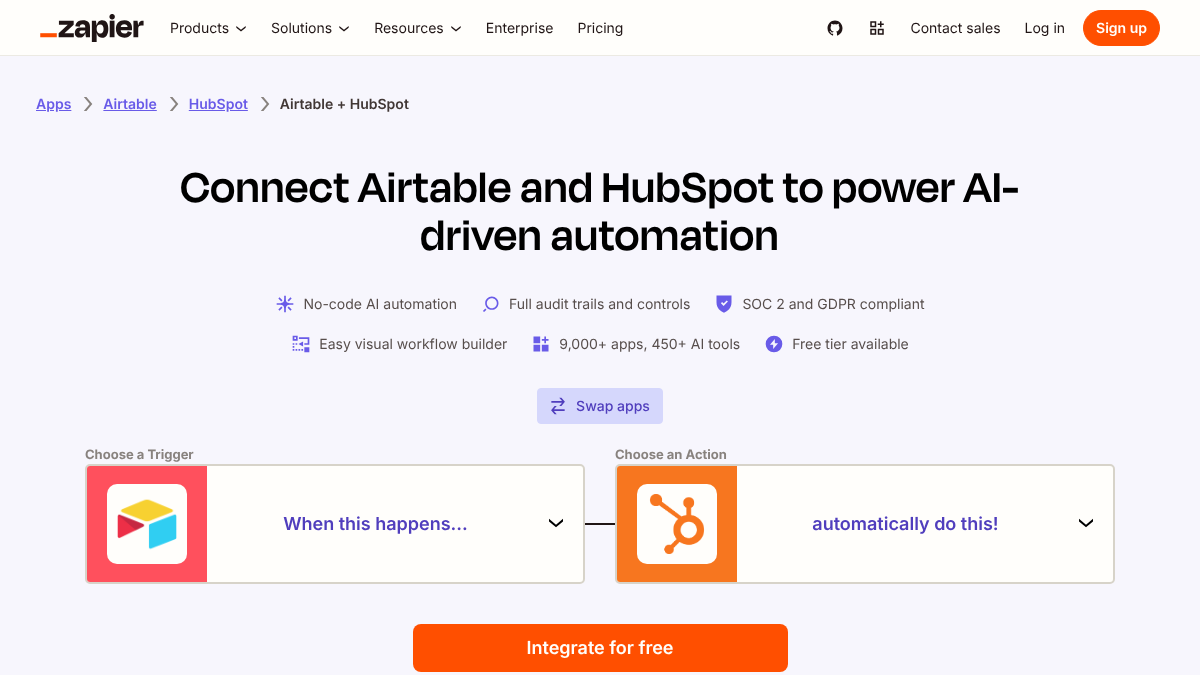
We'd split programmatic pages into two kinds. Answer-shaped pages hold the answer itself: a live exchange rate, a fee, a price. Query-shaped pages are built to match a search phrase, and the actual answer sits somewhere else. Wise's pages are answer-shaped, so every engine could cite them. Zapier's integration pages are mostly query-shaped. The answer to "how do I connect HubSpot and Airtable" lives in the apps' own help docs, and that's where ChatGPT and Perplexity went.
Query-shaped pages also compete with near-identical pages from rivals. For HubSpot and Airtable, Perplexity cited integration pages from five rivals: Whalesync, Integrate.io, Tray.ai, Unito and Make. It also cited listings in HubSpot's app marketplace, and it skipped Zapier's page. For Slack and Google Sheets, Zapier's page made the list as one of about eight integration pages built on the same idea. When every tool has the same page, the engine only needs one or two of them.
Two more things stood out. Zapier's own "Zapier vs Make" page, templated in form but written for a buying question, was cited by both Perplexity and Google. And being the obvious answer didn't guarantee the link. For "best integration platform for a small ops team," Google's AI Overview named Zapier in its text while linking only to third-party pages. For "how to automate workflows between apps without code," Zapier ranked second in Google's regular results, and the AI Overview still linked someone else's page about Zapier.
When to choose which
Start with the question your buyer is asking, then look at what you can put on the page.
Choose programmatic pages when you own data that makes each page different and useful on its own. That covers rates, prices, benchmarks, directory listings or live product data, anything a reader can't get from the next page over. Those pages can rank and get cited, as Wise shows.
Choose hand-built AEO pages for questions where buyers compare and decide: "X vs Y," alternatives, pricing, "best tool for this situation," and integration questions where your docs hold the real answer. Templates handle these badly, because the answer depends on judgment, not a data field.
For most B2B SaaS companies, that means AEO first. A few dozen strong comparison, pricing and integration pages usually do more for AI visibility than a few thousand templated ones. Programmatic pages come second, if you have the data to make them answer-shaped.
AI search traffic grew 835% this year. Is your content ready?
RankControl generates 26 content formats optimized for ChatGPT, Claude, and Perplexity. Published on your domain, matched to your brand.

A worked example: an HR software company
Say you run marketing for a mid-size HR and payroll platform. Here's how we'd split the work.
The programmatic candidates are the pages where you own the data. If your product processes payroll, anonymized salary ranges by role and city could power thousands of answer-shaped pages, each with its own numbers. Payroll tax rates and filing deadlines by state are another good fit, since each state's page holds different facts. A buyer or an AI engine asking "what's the payroll tax rate in Ohio" gets the answer from the page itself.
The AEO candidates are the buying questions. "Gusto vs your product for a 40-person company," "alternatives to your main competitor," your pricing page and a page for each payroll integration with your accounting tools all need judgment. They should be written by hand, with real prices and real trade-offs.
The one to skip is the lazy middle: "HR software for dentists," "HR software for bakeries" and 200 more industry pages that differ only by the industry name. Those are query-shaped, they invite Google's scaled content policy, and our test suggests AI engines would cite someone else's version anyway.
What each approach takes to run
Programmatic SEO is front-loaded. You need a clean dataset, a template a developer builds and maintains, and a review step that samples pages before and after each batch goes live. Once that's running, adding the next thousand pages is cheap, and keeping the data fresh becomes the main job.
AEO is steady work. Each comparison or pricing page needs research, writing and updates when prices or features change, so the cost grows with the number of pages. The upside is that a few dozen well-built pages can carry most of your buying questions.
The measurement differs too. Programmatic SEO lives in Search Console: indexed pages, impressions, click-through rate by section. AEO needs you to check the AI answers themselves, because a citation or a mention often never shows up as a click.
How to combine them without getting burned
If you do build programmatic pages, borrow from AEO. Write each template so the first sentence states the answer with the page's own number in it, since that's what an engine lifts. Give every page at least one fact the others don't have. Publish in batches you can check, not all at once, and watch click-through rate by section in Search Console for the early warning Swivl's team saw too late.
Keep an eye on overlap as well. If fifty of your pages differ only by a city name or an app name, they're query-shaped, and both Google's spam systems and AI engines will treat them that way. Our earlier piece on programmatic AEO goes deeper on the quality checks for data-driven templates.
For the hand-built side, the patterns are covered in comparison pages that rank in ChatGPT and in how each AI engine chooses sources.
Where RankControl fits
RankControl isn't a programmatic page generator, and we'd steer you elsewhere if templates at scale are what you need. It works on the AEO side. The content engine plans titles from the questions your buyers ask and writes up to 100 pages a month, including comparison, alternatives and pricing-style pages, each built against the pages already ranking for its question.
AI visibility tracking then checks up to 50 buyer questions every week on seven engines, including ChatGPT, Perplexity, Google AI Mode and Google AI Overviews. That tells you whether your pages, your templates or someone else's page gets cited.
You can run the same checks by hand, of course: search your top questions in each engine every week and log what gets cited. Thirty questions across seven engines comes to about five to six hours a week.
For a quick baseline, run a free check of your brand in AI answers.

Built by the team that got cited in 48 hours.
Content generation, backlink building, AI visibility tracking, and Google rankings. One platform, zero guesswork.