
On September 26 we gave OpenAI's API the same request ten times. We asked for the opening two paragraphs of a blog post for a B2B SaaS company that sells customer onboarding software, on how to reduce customer churn in the first 90 days.
All ten drafts opened with the words "The first 90 days." All ten began their second paragraph with a sentence that started with "Reducing" and led to "starts with." Four contained the same clause, word for word: "If onboarding feels confusing, slow, or disconnected from their goals." Not one draft included a number, a source or a customer example.
Each draft was fluent and on topic. The trouble is that ten SaaS companies using the same tool with the same brief would publish close to the same post. So the useful question about AI content generators for SaaS marketing is which parts of the work they should do, and which parts only your team can supply. Sources were checked on September 26, 2026.
What the ten drafts had in common
Here's how often the same patterns showed up across the ten drafts:
| Pattern | Drafts |
|---|---|
| Opened with "The first 90 days" | 10 |
| Second paragraph started "Reducing ... churn ... starts with" | 10 |
| Talked about reaching value quickly | 10 |
| Recommended "the right" onboarding software | 7 |
| Called the period "the most critical" | 6 |
| Contained any statistic, source or customer example | 0 |
Why did ten separate runs land so close together? A generator writes the most likely version of the answer, and the most likely version is the one every competitor gets too. The prompt gave it no facts, so the drafts contained none.
We ran the prompt with no web search and no company details. Better inputs fix most of this, and our piece on why context beats clever prompts covers how.
How often does ChatGPT mention your brand?
Most founders have no idea. The answer might surprise you.

Where AI generators earn their place
None of this means SaaS teams should avoid AI generators. The ranking data is fairly settled. In a study of 600,000 pages, Ahrefs found that 86.5% of top-ranking pages contained some AI-generated content, and that the correlation between a page's share of AI content and its ranking position was 0.011, effectively zero.
Google's own guidance points the same way. It says generative AI can be particularly useful for researching a topic and adding structure to original content, and it puts the risk on generating many pages without adding value for users.
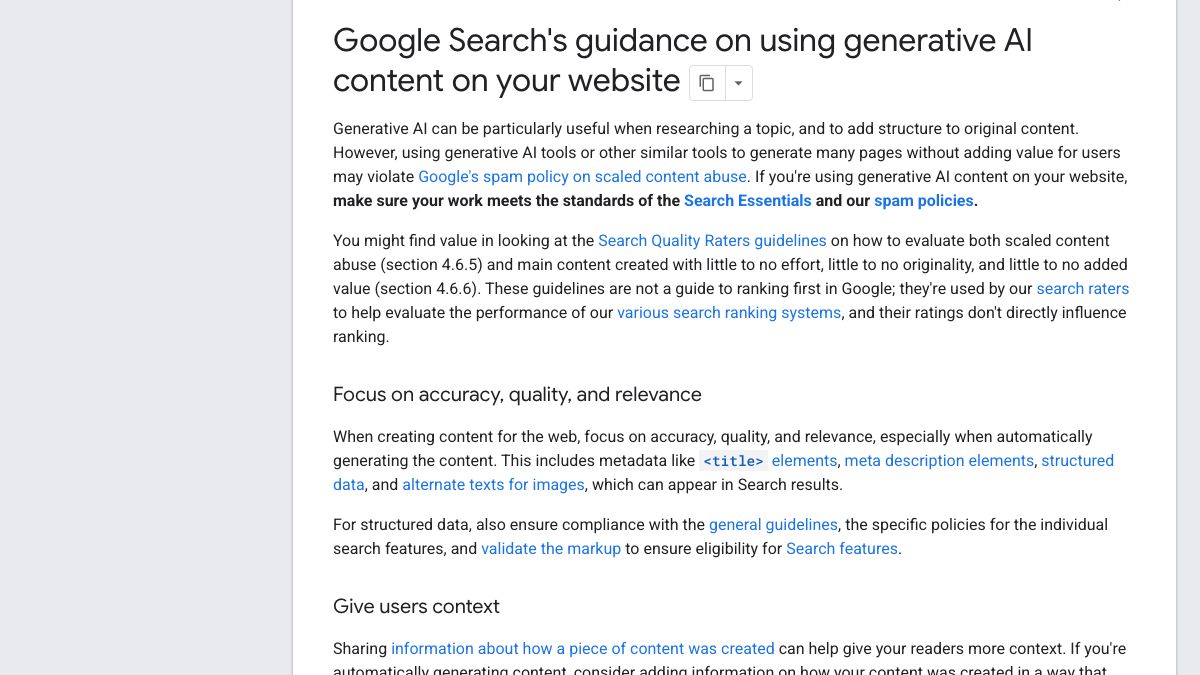
Our look at whether Google targets AI content or low-quality content goes further into that policy.
In practice, generators do well on work where the facts already exist and the job is to organize them:
- Researching what already ranks for a keyword and what those pages cover.
- Turning that research and your notes into an outline and a first draft.
- Writing titles and meta descriptions.
- Repurposing a finished article into social posts and email copy.
These steps repeat for every article, so they're where automation saves the most hours.
What to keep human
The drafts in our test were missing the same things every time, and they're things a generator can't know. We call the boundary the input line: work that depends on facts only your company has stays on the human side of it. Our look at what AI generated marketing content still gets right found the same pattern across search, LinkedIn and email.
Four kinds of input sit on that side:
| Input | Why a generator can't supply it |
|---|---|
| Product facts | Prices and limits change, and generators fill gaps with plausible guesses |
| Customer evidence | Results, quotes and stories come from your customers |
| Original data | Survey results and usage benchmarks exist only if you collect them |
| A point of view | Which approach you'd recommend, and why, is a business decision |
The point of view is the input teams skip most easily, because a draft reads fine without one. It's also what separates a page a buyer remembers from one they skim, since an opinion backed by your own experience is the one thing no competitor's generator will produce.
In May, a thread in r/content_marketing asked whether anyone still invests in human writers. One reply said teams still pay for human content, "just more carefully now," focused on interviews, customer stories, opinion pieces and original data. It added that one B2B article built from a customer call brought in leads for months.
Is anyone still investing heavily in human content writers, or are you using AI-assisted content now?
With AI tools getting better, I’m curious what people are actually doing in real projects. Are you still paying for fully human-written content, or are you using AI to generate drafts and then personalizing it with real insights, experience...
Product facts deserve special care. A solo SaaS founder described their setup in r/SaaS in August: every article generation pulls in one file listing the product's real pricing and shipped features. They called that file the difference between usable articles and confident nonsense, because ungrounded models invent features.
We saw a version of this in AI answers too. In a recent check, two AI engines described a help desk vendor's prices from a mix of annual, monthly and outdated listings, and our guide on how to check your AI visibility walks through that case.
Where automation goes wrong
The failure mode is volume without inputs. Our guide to automated content creation found 34 live store and travel listings where chatbot text went straight to the public. A growth agency that measures AI writing with a detector estimated in May 2026 that about half of new articles published online are now primarily AI-generated.
Search results look different. The same agency's earlier analysis found that human-written articles made up 86% of those ranking in Google Search. Detector-based numbers are rough, and Ahrefs's detector drew a different picture of top pages, so treat both as directional.
Lily Ray has been tracking the other side of this: AI content programs that grew fast and then collapsed. In September she noted how many of the case studies behind those sites talked about unique content and proprietary data, and that it didn't seem to save them.
Working on a presentation about AI content case studies that succeeded at first, but backfired and tanked m several months later Incredible how many of them talk about “unique content” “E-E-A-T” “proprietary data,” etc. It doesn’t seem to save them…
 Lily Ray 😏@lilyraynycSep 15, 2026
The common thread in those collapses is scale: many near-identical pages published faster than anyone could add something new to each.
Google also indexes less of it. In April, Aleyda Solis shared a summary of Google's Search Central Live event in Toronto. It said AI lowered the barrier for creating content, so Google raised the bar for what gets indexed, and that the "Crawled - currently not indexed" status is rarely a rendering issue. More often, it's a quality signal.
👀 Google Search Central Live Toronto Slides & Summary by @ChouinardJC 👇 * The Indexing & Quality Bar Selective Indexing: AI has lowered the barrier for content creation, forcing Google to raise the bar for what actually gets indexed. * Crawl vs. Index: “Crawled – Currently https://t.co/FkrKLW6uws
 Aleyda Solis 🕊️@aleydaApr 23, 2026

15 hours a week manually. Or 15 minutes with RankControl.
Track citations, monitor competitors, and fix content gaps across every AI search engine. Automatically.

A split that works for SaaS content
Put together, the split looks like this for a typical SaaS content program:
| Task | Automate | Keep human |
|---|---|---|
| Keyword and question research | Yes | Pick the topics that matter to sales |
| Competitor and search results analysis | Yes | |
| Outline and first draft | Yes, from a fact-rich brief | Supply the facts and the angle |
| Pricing and product limits | Yes | |
| Customer stories and quotes | Yes | |
| Original data | Analysis and charts | Collecting it |
| Titles and meta descriptions | Yes | |
| Publishing and scheduling | Yes | |
| Review before publishing | Spot checks on routine posts | Full review where claims carry risk |
| Repurposing for social and email | Yes | Approve before posting |
| Tracking rankings and AI citations | Yes | Decide what to do next |
The research row has a human half for a reason. A generator can rank questions by search volume, but only your sales team knows which questions come up just before a deal closes, and those are often the ones worth writing first.
The review row needs the most judgment. Reviewing everything slows publishing to the pace of your busiest editor, and reviewing nothing lets mistakes about your own product go live. A workable middle path is to review every post that states prices or regulated claims, and spot-check the rest.
How to brief a generator so the output isn't average
So what goes into a brief that changes the output? The things the model can't guess. Before generating, add:
- Two or three product facts the piece depends on, copied from your own pages.
- One real customer example, with permission to use it.
- One number you own, such as a usage figure or survey result.
- The position you want the piece to take, in one sentence.
Then compare the draft with the top-ranking pages for the same keyword. If you could swap your company name for a competitor's without changing anything else, the draft needs another round of inputs. Our piece on why "make it sound more human" is a bad AI prompt covers the editing side.
Keeping the automatable half running
Done by hand, publishing eight solid articles a month takes 16 to 24 hours, and checking 50 questions on seven engines takes about six hours a week. Those are rough estimates, and most of those hours sit in the automate column above.
RankControl handles that column. The Radar agent finds the questions your buyers actually search, checks them against real search data and plans titles onto your content calendar. The content engine writes each article against the pages already ranking for its keyword, matched to your brand voice, and publishes it on your own domain. Auto-publish is off by default, so you choose whether articles wait for review.
You can run this split yourself with a generator, a brief template and a spreadsheet. Or RankControl's agents can run the automatable half every week while your team supplies the facts and stories only it has.
AI search traffic grew 835% this year. Is your content ready?
RankControl generates 26 content formats optimized for ChatGPT, Claude, and Perplexity. Published on your domain, matched to your brand.