
In September, a marketer asked r/b2bmarketing how to avoid AI slop in their copy. LinkedIn had filled up with posts that opened "I am proud to announce" and reused the same few sentence shapes. The odd part, they noted, was that some of those posts still converted.
B2B marketers, how do you avoid AI slop when making the copy?
When I open LinkedIn nowadays, it is impossible to not see dozens of posts with fully AI generated: “I am proud to announce”, “this milestone is not only.. but”, and etc. posts. But surprisingly some of them still get conversion. At this po...
One reply went further than the usual advice to cut stock phrases. The tell isn't the words, it said. It's that the post has no cost to publish, because nothing in it could embarrass the author. Add a number that isn't flattering, or a decision you reversed.
That reply lines up with the 2026 data better than most AI content advice does. This guide covers how much marketing content now involves AI and how readers respond to it. It then covers what separates the content that works from the content people skip, and a test you can run on any draft. Sources were checked on September 27, 2026.
Most marketing content now involves AI
AI use is no longer the exception, so it can't be what separates good content from bad.
In search, Ahrefs studied 600,000 top-ranking pages in 2025 and found 86.5% contained some AI-generated content. Only 4.6% were fully AI-generated, and the correlation between AI use and ranking position was 0.011, effectively none.
On LinkedIn, Originality.ai analyzed 5,000 long-form posts from July 2026 and classified 81.2% as likely AI-written, up from about half in earlier samples. LinkedIn has started rolling out a "seems like AI slop" option in its post menu, and its chief product officer has called AI slop a top priority.
Google's position hasn't changed since it published its guidance on AI content in 2023:
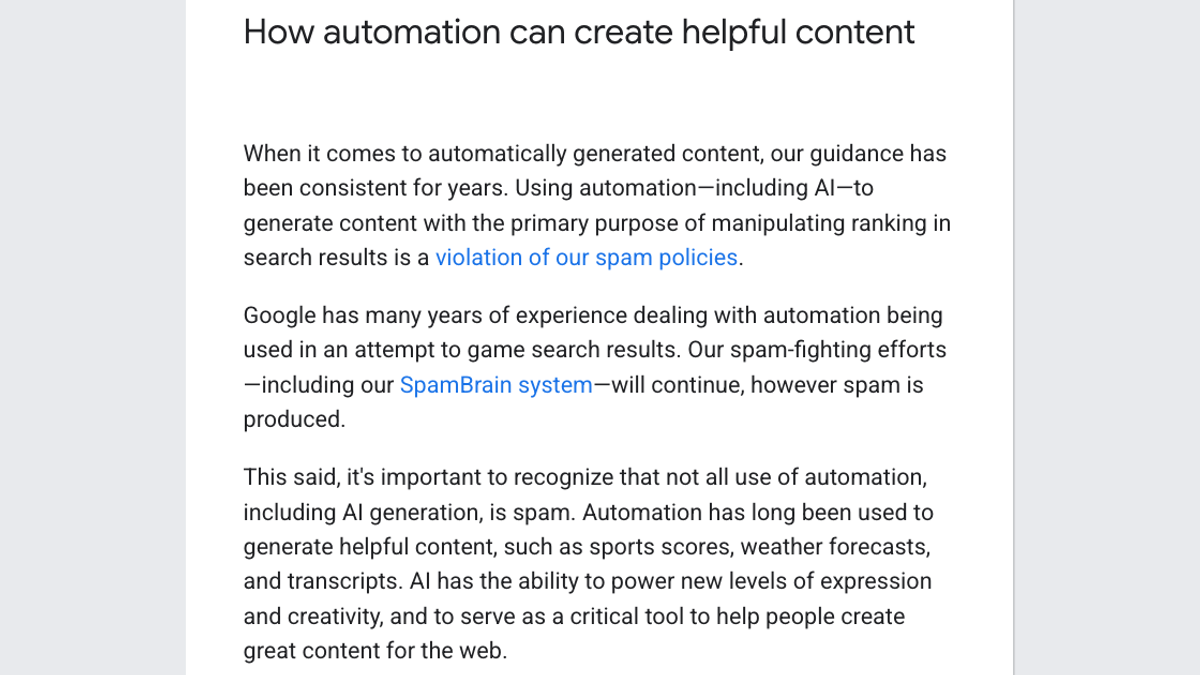
The same post says Google rewards high-quality content however it's produced. The question has moved from whether to use AI to what the content says. Our piece on whether Google targets AI content or low-quality content goes through the evidence in more detail.
We'll show you exactly where your brand stands in AI search.
No commitment. $0 due today, cancel anytime. See how ChatGPT, Perplexity, Claude, Gemini, Grok, Google AI Mode, and Google AI Overviews talk about your brand today.

Readers can't tell, until they're told
A University of Michigan study reported in March 2026 showed more than 1,300 US adults AI-written personal messages, such as an apology email. Most people didn't notice AI had written them. When they were told a message was AI-written, though, they rated the sender as lazy and insincere, while the same text credited to a person read as genuine and thoughtful. The researchers call this the AI disclosure penalty.
For marketers, that splits content into two kinds. Brand content, such as guides, product pages and help articles, isn't expected to come from one person's hand. Personal content, such as a founder's email or a post under someone's name, carries the penalty if readers find out it was generated. The risk sits in the channels where people expect a person.
Wording didn't decide rankings in our check
A lot of advice about AI content focuses on removing tell-tale words. We wanted to see whether those words showed up less on pages that rank.
On September 27, we took Google's US results for six B2B marketing searches, such as "b2b lead generation strategies" and "how to reduce saas churn." We fetched the articles in positions 1 to 10 and 41 to 50, skipping forums and videos. We could read 46 pages from the first group and 25 from the second.
| Signal in the page text | Positions 1 to 10 (46 pages) | Positions 41 to 50 (25 pages) |
|---|---|---|
| At least one stock AI phrase, such as "game-changer" or "ever-evolving" | 7 | 5 |
| Wording that reports original research, such as a survey or the site's own data | 14 | 10 |
Neither signal separated page one from page five. Stock phrases were rare in both groups, and first-hand research claims were actually a little more common lower down. This was a rough check based on phrase matching, and ranking depends on much more than wording, such as links, site strength and how well a page matches the search. But it points the same way as the Ahrefs data. Scrubbing AI-sounding words from a draft isn't what gets it ranked.
What wording does affect is the reader and the AI engines quoting the page. The 2023 research paper that coined generative engine optimization found that adding statistics, quotations and cited sources raised a page's visibility in AI answers by up to 40%. Those are additions of substance, not changes of phrasing.
The competitor swap test
One commenter in a September r/content_marketing thread named their instant reject: any line that could sit on a competitor's page with zero edits. We turn that into a test for every draft.
We call it the competitor swap test. Read each paragraph and ask whether a direct competitor could publish it unchanged. If they could, that paragraph is what readers skim and engines skip, whoever wrote it.
Here's how it plays out for a made-up help desk company. The passing versions are illustrations of the kind of detail a real company would fill in from its own data:
| Fails the swap test | Passes the swap test |
|---|---|
| "Onboarding is critical to reducing churn and driving long-term customer success." | "Customers who connected their inbox in the first week renewed at a higher rate than those who didn't, so our onboarding now asks for that step first." |
| "Our platform helps teams work together across every channel." | "Two people answering the same customer was the top complaint in our trial exit survey, so every conversation now shows who owns it." |
The passing versions only work if they're true for your company. That's the point. A model can't supply them without your input, which is why the fix starts with what you give it.
Know exactly what AI says about your competitors.
RankControl's Recon Agent monitors competitor citations across ChatGPT, Perplexity, Claude, Gemini, Grok, Google AI Mode, and Google AI Overviews. See where they show up and you don't.

What still works, channel by channel
| Channel | AI helps when | It gets ignored when |
|---|---|---|
| Blog and SEO content | Drafts are built on product facts, customer language and a clear point of view | It restates the top results for the keyword |
| LinkedIn posts | A person's real experience, numbers and decisions sit in the post | It uses template openers and could come from any account |
| Cold and founder email | AI speeds up research on the recipient, and the email is edited and sent as yourself | Personalization is a merge field and the rest is boilerplate |
| Repurposing | An existing article is reshaped for each channel | New claims appear that the source never made |
| Product and pricing pages | Facts are checked against the product | Numbers are guessed or out of date |
The pattern holds across rows. AI saves time on structure and first drafts. The parts that earn attention, such as the facts, the examples and the opinions, have to come from the company.
A workflow that keeps AI content specific
Most generic AI content comes from generic inputs. A few changes to the process fix most of it:
- Start from context, not a prompt. Give the model your product facts, your positioning and what you know that competitors don't. Our guide to better AI content through better context covers what to include.
- Feed it your customers' words. Sales calls, tickets and reviews describe problems in terms buyers use, as our guide to using customer language in AI content shows.
- Add one first-hand element per section: a number, an example, a customer quote you have permission to use or a decision you made.
- Run the swap test on the draft and rewrite every paragraph that fails.
- Keep personal channels personal. If a post or email goes out under someone's name, that person should shape it.
Asking the model to sound more human doesn't replace any of these steps. It changes the surface and leaves the substance where it was, as our piece on why "make it sound more human" is a bad prompt explains.
Done by hand, publishing eight solid articles a month takes 16 to 24 hours, and checking 50 questions on seven engines takes about six hours a week. Those are rough estimates.
RankControl's content engine writes each article against the pages already ranking for its keyword, matched to your brand voice, and publishes it on your own domain. AI visibility tracking runs your 50 questions every week on seven engines and marks each one as mentioned, cited or both, so you can see which pages AI answers actually use.
You can run the swap test and this workflow yourself with a shared document and an editor. Or RankControl's agents can handle the drafting and publishing while your team adds the facts and decisions only you can supply.
26 content formats. Published on your domain. Matched to your brand.
Guides, comparisons, listicles, case studies, and more. RankControl generates content that gets cited by ChatGPT, Perplexity, Claude, Gemini, Grok, Google AI Mode, and Google AI Overviews.