
Run a page through almost any SEO plugin and you'll see a keyword density score. Too low, and it turns orange. Hit somewhere between 1% and 3%, and it turns green. It looks scientific, so plenty of writers chase it.
Google has never published that number. It has published warnings about repeating words too often, and it has said what it does want, which is writing that sounds natural to people. AI search engines care about density even less.
This guide covers what keyword density is, what Google says, where the 1-3% rule came from and what our own count of top-ranking pages shows. Then it covers what to do instead.
What keyword density is
Keyword density is how often a keyword appears on a page, as a share of all the words.
Keyword density = (times the keyword appears ÷ total words) × 100
So a keyword used 10 times in a 1,000-word article has a density of 1%. Used 30 times, it's 3%. Phrases make it messier. For a two-word keyword, some tools count each use as one word and others count both words, so two tools can give the same page different scores. That alone says something about how solid the number is.
It's easy to measure, which is a big part of why it caught on. The question is whether it measures anything Google cares about.
What Google says
Google's SEO Starter Guide, updated December 10, 2025, lists keyword repetition under things you shouldn't focus on. "Excessively repeating the same words over and over (even in variations) is tiring for users, and keyword stuffing is against Google's spam policies."
The spam policies themselves define it. "Keyword stuffing refers to the practice of filling a web page with keywords or numbers in an attempt to manipulate rankings in Google Search results. Often these keywords appear in a list or group, unnaturally, or out of context."
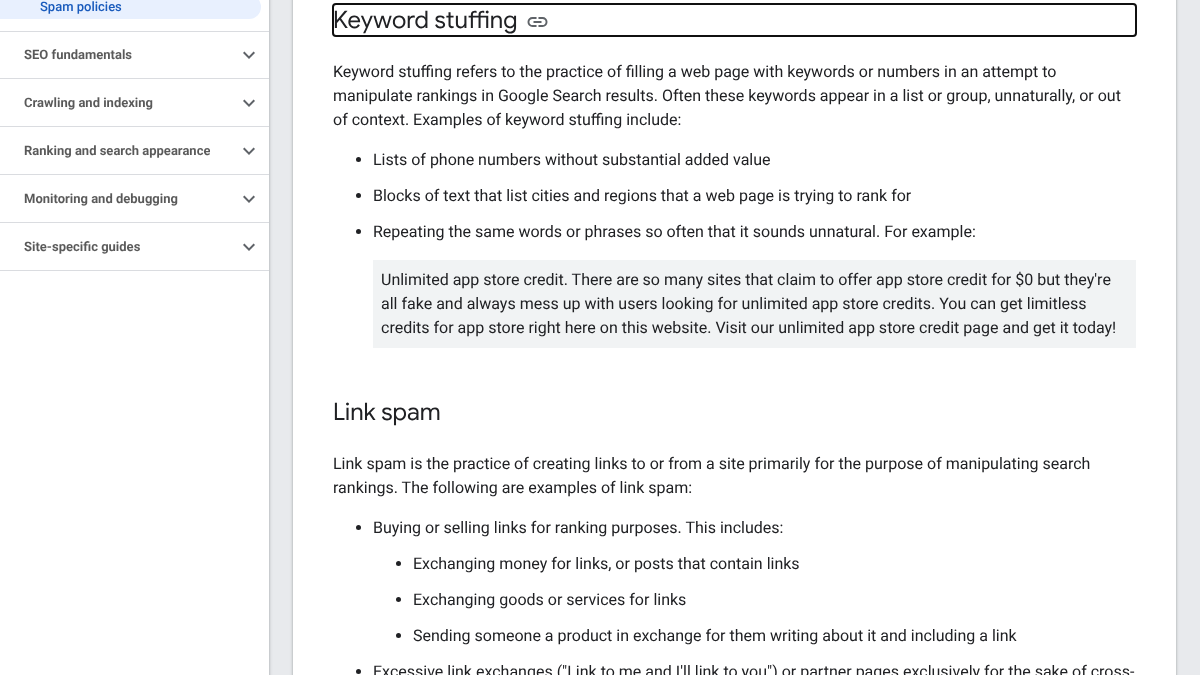
The examples Google gives include "blocks of text that list cities and regions that a web page is trying to rank for" and "repeating the same words or phrases so often that it sounds unnatural."
Notice what's missing. Neither page gives a percentage, a ratio or a target. Google tells you what too much looks like, and that's all. Our guide to why LSI keywords are a myth covers the systems Google uses to understand meaning instead of counting words.
AI search traffic grew 835% this year. Is your content ready?
RankControl generates 26 content formats optimized for ChatGPT, Claude, and Perplexity. Published on your domain, matched to your brand.

Where the 1-3% rule came from
Nobody can point to a Google source for 1-3%. The number seems to date from the early days of SEO, when search engines leaned much more on how often a word appeared on a page. Repeating a keyword more really did help then, so people did it, a lot.
That era produced the keyword-stuffed article directories and doorway pages Google later worked hard to push down. The 1-3% range lived on as a rule of thumb, first in SEO courses, then as a green light in plugins.
Practitioners mostly treat it as a relic now. A post on r/SEO from August 2026 asked whether 3% density on ecommerce product pages was pushing it and risked a penalty. The top reply was blunt: "Google doesn't look at keyword density - that's an ancient tactic." Another commenter asked where the poster had even heard about keyword density, and tied it to the old article-directory days.
How do you handle Keyword Density for modern SEO? Is 3% pushing it and what are the risks?
Hey everyone, I’m currently optimizing content for an e-commerce site and ran into a dilemma regarding keyword density. I recently expanded some product descriptions (specifically roofing/gutter supplies) and after checking, my primary keyw...
Do the top pages follow it?
Here's a simple test. If 1-3% were a real ranking rule, the pages ranking for "keyword density" should follow it for their own phrase.
On October 19, 2026, we took four pages ranking for searches about ideal keyword density and counted how often each used the exact phrase "keyword density" against its total word count.
| Page | About how many words | Times "keyword density" appears | Density |
|---|---|---|---|
| Publisher Desk guide | 783 | 6 | About 1.5% |
| Semrush guide | 2,374 | 25 | About 2.1% |
| HubSpot guide | 1,918 | 32 | About 3.3% |
| Mangools guide | 591 | 16 | About 5.4% |
These are rough counts of the rendered page text, including some navigation and other page text, not a precise tool score. But the spread is clear. One page sits under 2%, and one runs past 5%, nearly double the supposed upper limit, and still ranks for its topic.
If the number decided rankings, that spread wouldn't happen. What these pages have in common isn't a density. It's that each one clearly answers the question it targets.
What matters instead
Drop the percentage and use this instead. We call it the read-aloud test: read the paragraph aloud, and if the keyword sounds repeated, it is. If it sounds natural, you're fine, whatever the plugin says.
Beyond that, a few placements do matter.
- The title. Use the main keyword, or a close version, in the title. Backlinko's study of 11.8 million Google results found most first-page titles contain the keyword, and treated that as a ticket to entry rather than a ranking boost.
- The main heading. Same idea. Tell readers and Google what the page is about.
- The opening. Answer the question that the keyword asks in the first paragraph. Our guide to blog introductions covers how.
- Natural variations. Use the words people actually use for the topic, including synonyms. Google's systems understand that "cheese board" and "charcuterie" are related.
- Coverage. Cover the subtopics the top pages cover. That brings in related words without trying.
Our guide to SERP analysis shows how to see what the top pages cover before you write, and our guide to the types of keywords covers picking the main keyword in the first place.

Built by the team that got cited in 48 hours.
Content generation, backlink building, AI visibility tracking, and Google rankings. One platform, zero guesswork.
A before-and-after example
Here's a made-up paragraph written to hit a density target for "dog grooming in Austin."
"Looking for dog grooming in Austin? Our dog grooming in Austin service offers the best dog grooming Austin has to offer. Book dog grooming in Austin today."
That's the phrase, or a near copy, four times in 27 words, a density of almost 15%. It reads like Google's own stuffing example, and it tells the reader nothing.
Here's the same paragraph written for a person.
"We groom dogs of every size at our shop on South Lamar in Austin. A full groom takes about two hours and starts at $65. Most appointments are available within the week."
The keyword phrase barely appears. But the paragraph says where you are, what it costs, how long it takes and when you can book. Those are the facts a buyer wants, and the facts an AI answer can repeat.
What about AI search?
AI search engines don't count keywords at all. When ChatGPT, Perplexity or Google's AI Mode answer a question, they read pages for meaning and lift passages that answer it.
So density does nothing for AI citations. What helps is the same thing that helps a featured snippet: a short, clear answer under a heading that asks the question, naming the topic plainly. Repeating the keyword five more times won't make that passage easier to quote. It may make it harder to read. Our guide to featured snippets covers how to write those answers.
Should you use a keyword density checker?
Keyword density checkers are popular. Keyword tools put "keyword density checker" at about 720 US searches a month, more than the searches for keyword density itself.
They're fine as a smoke alarm. If a checker shows your main keyword at 6% or 8%, take a look, because you may have repeated it more than a reader would like. But don't write to hit a number. And don't add the keyword back in just because a plugin turned orange.
A quick checklist
- Main keyword in the title and the main heading.
- The question answered in the first paragraph.
- Natural variations used where a person would use them.
- The subtopics the top pages cover, covered.
- No sentence that exists only to fit the keyword in.
- Read aloud, and nothing sounds repeated.
If the page passes that, its density is whatever it naturally is. That's the right number. When you're improving pages that already exist, our guide to content optimization covers the rest.
Doing it yourself or handing it off
Writing naturally around a keyword is a habit more than a tool. Good writers do it without counting.
You can check each page yourself with the read-aloud test. RankControl writes each article against the pages already ranking for its keyword, covering what they cover in natural language, and scores it for how easily AI engines can quote it, with a list of fixes. We publish to your site, and our AI visibility tracking checks up to 50 buyer questions every week across seven AI engines. Expect traffic from Google first, with AI citations following more slowly as links and mentions build up.
See your first AI citation report in under 5 minutes.
No setup calls. No onboarding meetings. Connect your domain and see where AI mentions your brand right now.