
An agent in a mid-sized market posted on r/GoogleMyBusiness this summer with a fair complaint. For six months they'd made their Google Business Profile a top priority. Reviews went from about 15 to almost 75, and they posted listings, open houses and local updates every week. Leads they could trace back to Google stayed thin.
Has anyone actually built a consistent lead source from Google Business Profile (real estate)?
I’m a real estate agent in a mid-sized market, and for the past 6 months I’ve made Google Business Profile one of my biggest focuses. Here’s what I’ve been doing:- Increased my reviews legitimately from about 15 to almost 75, which I think...
That's the honest starting point for SEO for real estate. Some searches you can win as a local agent, and some belong to Zillow no matter what you do. We checked what Google actually shows for ten real estate searches in October 2026 to sort out which is which.
What real estate searches look like in 2026
We pulled Google's live results for these searches on October 19, using Austin and Denver as test markets. Four were the searches people use to find homes or agents. Six were questions a buyer or seller asks before they hire anyone.
| Search type | What Google showed | Who ranked |
|---|---|---|
| City listings ("homes for sale austin tx") | AI Overview, no map pack | Zillow, Realtor.com and Redfin in the top three |
| Neighborhood listings ("homes for sale in mueller austin") | AI Overview | A local agent's site at #1, three agent sites in the top nine |
| Agent searches ("real estate agent austin", "best realtor denver") | Map pack, no AI Overview | A mix of portals, brokerages, Yelp and Facebook |
| Questions (cost to sell, closing costs, time to sell) | AI Overview on all six | Agent and brokerage pages cited most |
The split is clear. City-wide listing searches are portal territory. Neighborhood searches and questions are where a local agent can still show up first.
Stop fighting Zillow for city searches
"Homes for sale near me" gets about 368,000 US searches a month, but advertisers pay only about $1 a click for it, according to Google Ads data. That low price tells you something. Almost nobody bothers bidding on a search the portals already own.
The portals win these because they have every listing, fresh, with photos and filters. An agent site with an IDX feed has the same listings, but so do thousands of other agent sites, and Google has no reason to pick yours. Put your effort where your knowledge is different, which is the neighborhoods and the questions.
Neighborhood pages that rank above the portals
The Mueller search showed how it's done. A local agent's Mueller page ranked first, ahead of Zillow, and the neighborhood guide from Eleven Oaks Realty made the top five.
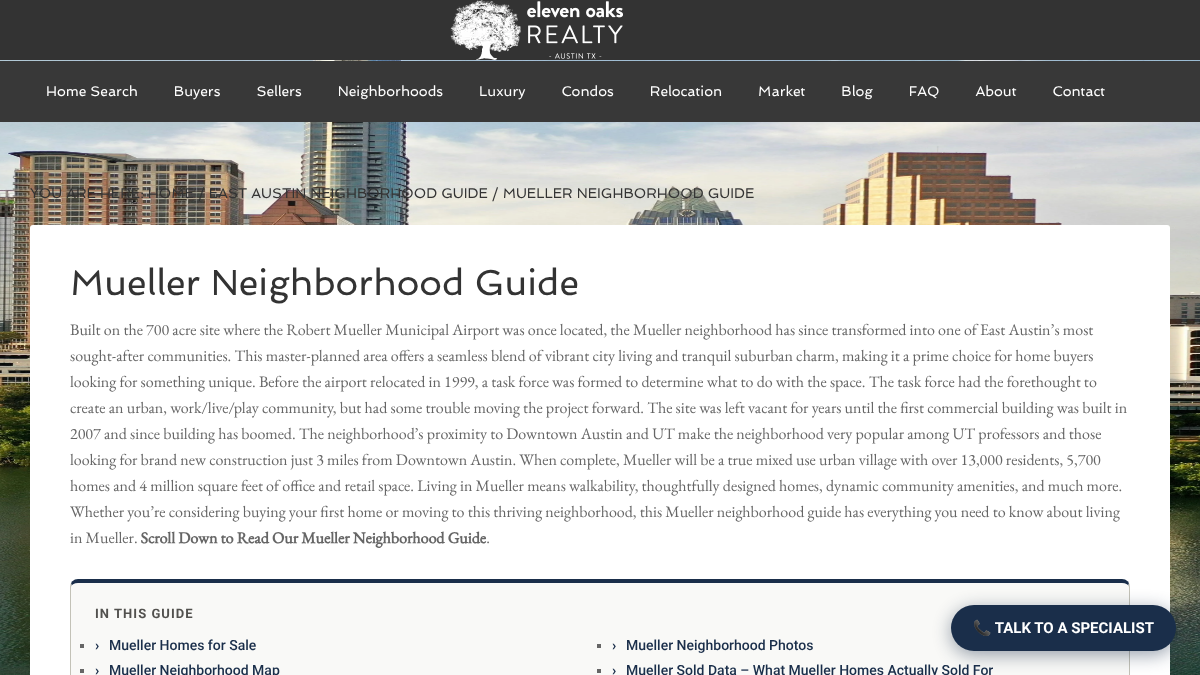
Look at what the guide covers. It explains the neighborhood's history as the old airport site, the planned size of the community, and how close it is to downtown and UT. Its menu links to a map, photos, and a section on what Mueller homes actually sold for. A portal can't write that page, because it takes someone who knows the area.
Build one of these for each neighborhood you actually work. Include current listings, recent sold prices, the commute, parks and amenities, and photos you took yourself.
Keep Fair Housing in mind as you write. Describe the homes, the amenities and the area, not the kind of people you think it suits. Our guide to AEO for real estate covers the Fair Housing rules for content and AI in detail.

Built by the team that got cited in 48 hours.
Content generation, backlink building, AI visibility tracking, and Google rankings. One platform, zero guesswork.
Answer cost questions for your city
The question searches gave agents their best results. On "how much does it cost to sell a house in texas", the AI Overview cited five sources. One was NerdWallet. The other four were brokerage pages, each about a different Texas city, from Dallas and Austin to San Antonio and Houston, and three of them had 2026 in the title.
Across all six questions, the AI Overviews cited 20 sources between them.
| Who the AI Overviews cited | Sources |
|---|---|
| Agent and brokerage pages | 9 |
| YouTube videos | 5 |
| Finance publishers (NerdWallet, MarketWatch, Yahoo Finance) | 3 |
| Other (a Reddit thread, a storage company's city guide, a closing-cost site) | 3 |
Google wanted local, current numbers, and agents had them. One detail stood out. For "how long does it take to sell a house in denver", one of the cited pages came from an Arizona flat-fee broker, a hint that few Denver agents had written a clear answer.
So write the pages your clients ask about on every first call. Good ones cover net proceeds after selling in your city, buyer closing costs in your state, how long homes are taking to sell right now, and property taxes by county. Put the year in the title and update the numbers each quarter.
Sellers are worth the effort. "How to sell my house" costs advertisers about $53 a click in Google Ads data, one of the highest prices in this whole set. A clear local selling guide competes for that seller for free.
Make video for relocation questions
YouTube showed up more than we expected. For "moving to austin from california", all three AI Overview citations were YouTube videos, and the top organic results were Reddit, YouTube and Facebook. Not one agent website made it.
Relocation buyers want to see the place before they visit. If you work a market people move into, a few videos walking through neighborhoods, costs and commutes can reach buyers months before they call an agent. Put the same facts in writing on your site, so the page and the video support each other.
Set up your Google Business Profile correctly
For agent searches, the map pack sits on top, so your Business Profile matters. Google's Business Profile guidelines list real estate agents as individual practitioners, which gives you a few clear rules.
- If several agents work from one brokerage office, the office gets its own profile and each agent can have one using only their own name.
- If you're the only agent at a branded office, Google says to share one profile named "Brand: Your Name".
- A virtual office isn't eligible, and a co-working desk counts only if it has signage and is staffed during business hours.
- If you work from home and meet clients elsewhere, set up a service-area profile and hide your home address.
Those rules have teeth. Someone at a brokerage wrote on r/GoogleMyBusiness in September about the work of getting agents' suspended profiles restored, and a reply pointed to a 2025 Google update aimed at profiles using cloud addresses. Our SEO for dentists guide covers the same practitioner rules from another angle.
Then keep it active. Ask every closed client for a review that names the neighborhood, add photos of homes you've sold, and post your new local guides when they go live.
See your first AI citation report in under 5 minutes.
No setup calls. No onboarding meetings. Connect your domain and see where AI mentions your brand right now.

Portal profiles still matter
You can't outrank Zillow for city searches, but you can show up inside Zillow. Agents in our agent searches appeared through Zillow agent pages, Yelp and Facebook as often as through their own sites.
Keep your Zillow and Realtor.com profiles complete, with your sold history and reviews. Just don't build your business on buying their leads. A former South Florida agent wrote on r/RealEstateAdvice that every portal lead felt like a race against three or four other agents, and that they stopped after spending thousands without knowing if they'd made it back.
Get ready for AI search
Buyers now ask ChatGPT which agent knows a neighborhood or how much it costs to sell in their city. AI tools build those answers from agent websites, portal profiles, reviews and videos, so the same details need to match everywhere.
Our post on real estate content ideas has a longer list of pages worth writing, and the AEO guide linked above covers how AI tools pick agents.
A 90-day plan for one agent
In the first month, fix your Business Profile setup, finish your Zillow and Realtor.com profiles, and ask your last 20 clients for reviews that mention their neighborhood.
In the second month, write guides for the three neighborhoods where you sell most. Use real sold data and your own photos.
In the third month, write four question pages for your city. Cover what it costs to sell, buyer closing costs, how long homes take to sell and property taxes. Then check which of them show up in Google's AI Overviews and in ChatGPT.
What this costs in hours
Setting up profiles and asking for reviews takes about a day. Each neighborhood guide runs four to six hours with photos and sold data, and each city cost page takes about three. Updating the numbers every quarter adds a few hours, and checking where you rank and which AI answers cite you adds an hour a week.
You can do all of this between showings. Or RankControl's agents can do it for you every month, writing and publishing the neighborhood and cost pages buyers and sellers search for and checking six AI engines and Google each week, while you focus on your clients.
Your competitors are building backlinks while you read this.
Organic outreach, social mentions, and citations from Editorial Circle member sites, with managed backlinks available as an add-on. Grow your domain authority without running the campaign yourself.