
A newcomer to local SEO in Palm Beach County searched "dentist near me" last month and posted what they saw on r/localseo. The first three results were ads, one of them dressed up to look like a video. Their question was fair. How do you justify paying for SEO when it shows up below all that?
One reply came from someone who does dental marketing almost exclusively. They said they now push every client to pay-per-click, because SEO is more work for less return each year. Another reply called it renting visibility versus building it.
'Dentist near me' --- PPC gets top slots -- SEO not so much!
Hi Friends, (newby to SEO) I'm in Palm Beach County, and just 'looking around' at Dentist sites. Attached is a sample result using the word "dentist near me" --- The first 3 are sponsored -- Anyone know how to find out what they are paying...
Both are partly right. SEO for dentists in 2026 is less about ranking a homepage. It's about showing up in the map listing, on your treatment pages and in the AI answers that now sit on top of dental questions. We checked what Google shows for real dental searches in October to see which of those matters most.
What dental searches look like in 2026
We pulled Google's live results for ten dental searches on October 19. Three were hiring searches tied to a city, like "dental implants denver", and seven were questions, like "how much do dental implants cost" or "is teeth whitening safe".
Every hiring search opened with a map pack of three practices. Only one of the three, "emergency dentist chicago", also showed an AI Overview, and it cited local practices.
All seven question searches showed an AI Overview. Between them, those overviews cited 22 sources.
| Who the AI Overviews cited | Sources |
|---|---|
| Dental practice websites | 12 |
| Insurers, financing and price sites (Delta Dental, MetLife, CareCredit, GoodRx) | 7 |
| Health bodies (ADA, Cleveland Clinic, NIH) | 3 |
That's good news for small practices. More than half the citations went to ordinary practice pages that answered the question clearly, and two of those were practices outside the US cited on a US search. Google wasn't picking the biggest names. It was picking the clearest answers.

Your competitors are getting cited by AI. You're not.
Every day without citation tracking is a day your competitors pull ahead in ChatGPT, Perplexity, and Claude.
Where the money is
The volumes tell you which pages deserve the most work. These are US monthly searches and the average ad cost per click, from Google Ads data.
| Search | Monthly searches | Cost per click |
|---|---|---|
| dentist near me | 1,830,000 | $14.71 |
| pediatric dentist near me | 201,000 | $11.20 |
| dental implants near me | 90,500 | $38.76 |
| cosmetic dentist near me | 74,000 | $15.81 |
| invisalign near me | 60,500 | $26.29 |
| root canal cost | 27,100 | $8.87 |
| how much do dental implants cost | 18,100 | $10.48 |
Implants stand out. Advertisers pay almost $39 a click for "dental implants near me", more than twice the rate for "dentist near me". When one click costs that much, an implant page that ranks on its own is worth a lot more than another blog post about flossing.
Set up your profiles the way Google wants
For hiring searches, the map pack sits above everything else, so your Google Business Profile matters more than your website. Google's Business Profile guidelines name dentists as individual practitioners, and that changes how a practice should set things up.
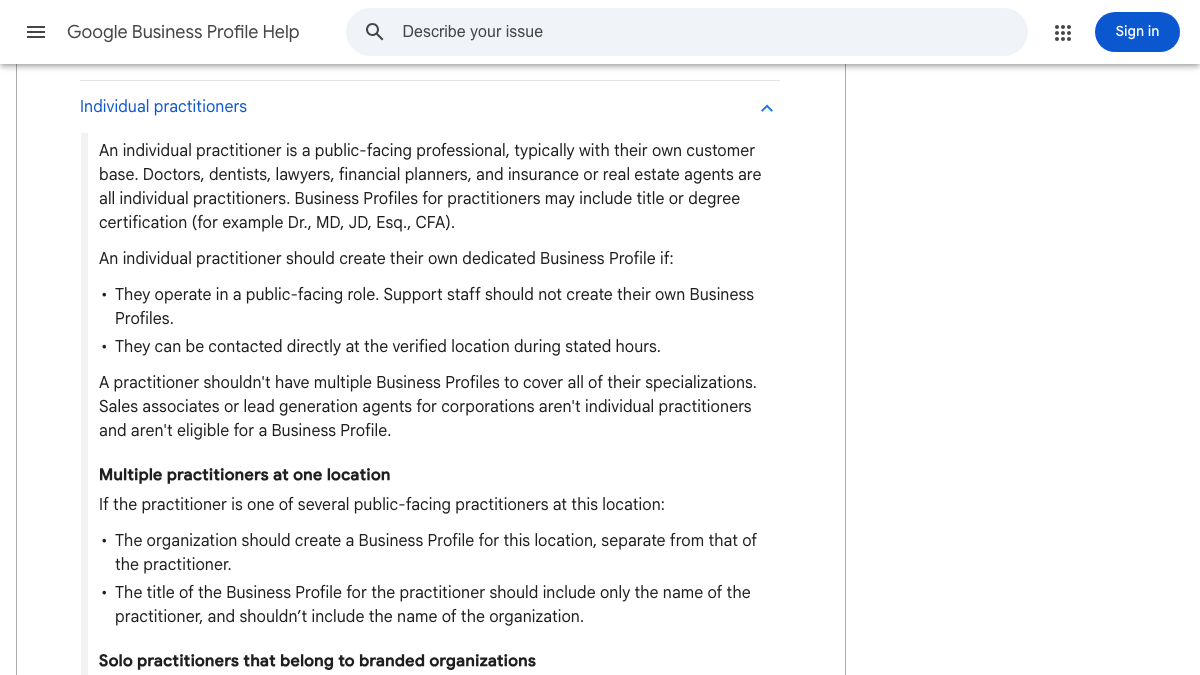
If several dentists see patients at your office, the practice gets one profile and each dentist can have their own. The dentist's profile should carry only their name, not the practice name. If you're the only dentist at a branded practice, Google says to share one profile, named in the format "Practice: Dr. Name".
Support staff shouldn't get profiles, and one dentist shouldn't have a separate profile for each specialty. Our guide to naming and NAP across multiple Business Profiles covers the trickier setups, like an associate who moves to a new practice. Real estate agents follow the same practitioner rules, as our SEO for real estate guide shows.
Then fill in the rest properly. Pick the most specific primary category, list every treatment as a service, add real photos of your office and team, and keep holiday hours current.
Reviews, and the HIPAA trap in your replies
Reviews shape which of the three map listings people click. Ask every happy patient, with a short text and a direct link, and keep it steady rather than in bursts.
Replying needs care. Never confirm that the reviewer is a patient, and never mention their treatment, even to correct them. HHS settled with a Texas dental practice for $10,000 in 2019 over review replies that disclosed patient information, and with a California practice for $23,000 in 2022 over similar replies on Yelp.
A safe reply thanks the person, says you take feedback seriously and invites them to call the office, and stops there. Our guide to HIPAA-safe content for healthcare covers the wider rules.
Patients are also getting better at spotting fake praise. On r/dataisbeautiful this month, a chart of US dental reviews drew a reply from someone who'd booked a dentist with glowing reviews and been pushed hard toward treatment a second dentist said wasn't needed. Looking back, they said most of the glowing reviews read as AI-written. Real reviews, in patients' own words, are worth more than a high count.
Build a page for every treatment you want more of
Below the map pack, practice websites rank with one page per treatment. In the Denver implant search, the first three results were practice pages built around implants, not homepages.
Each treatment page should cover the questions a nervous patient asks before calling. That means what the treatment involves, how long it takes, a realistic price range, which insurance helps, financing options, and what happens at the first visit. Add your dentists' names and credentials, and before-and-after photos where you have consent.
A reply in r/seogrowth gave a good way to decide which pages to build first. Pick three to five neighborhoods your patients actually drive from, search "dentist [neighborhood]", "emergency dentist [neighborhood]" and "invisalign [neighborhood]", and note which practices keep showing up in the map pack across those searches. Then look at what those practices have that you don't.
200+ SaaS teams already track their AI citations.
They know exactly when ChatGPT mentions their brand, and when it stops. Do you?

Answer the cost and insurance questions
Question searches are where small practices can beat big ones. Our check showed the pattern clearly. On "how much do dental implants cost", the AI Overview cited a practice page next to MetLife and CareCredit. On "do dental implants hurt" and "does insurance cover dental implants", all six citations were practice pages.
So write the pages your front desk answers on the phone every day. Good starting points are cost by treatment, which insurers you work with, whether implants hurt, how long Invisalign takes and what to do about a toothache at night. Answer in the first two sentences, give a local price range, and say what changes the price.
Keep health claims careful. For questions like "is teeth whitening safe", the AI Overview cited the ADA, NIH research and GoodRx. You won't outrank the ADA on safety, but you can cite it, and you can answer the local version of the question, like what whitening costs at your office and who shouldn't do it.
Ads or SEO?
The agency owner on r/localseo has a point. If you need new patients this month, ads put you on top today, and nothing in SEO does that. The catch is that the spot disappears the day the budget stops.
We'd advise most practices to run both. Use ads for implants and Invisalign while the treatment pages and reviews build, then shift budget as the map listing and pages start bringing calls on their own. Track calls from your Business Profile separately, so you can see which channel is carrying the load.
Show up in ChatGPT and other AI answers
People now ask chatbots which dentist to see, especially for anxious patients, Saturday hours or a specific insurer. AI tools pull those details from your site, your profile and directories, so they need to match everywhere.
Write those details down plainly on your site. List the insurers you accept, your hours, whether you take emergencies, and how you handle nervous patients. Our guide on how to rank on ChatGPT covers the crawler settings that decide whether ChatGPT can read your pages at all. Our post on local SEO and AI search covers the local side in more depth.
A 90-day plan for a small practice
In the first month, fix the foundations. Clean up your practice and dentist profiles, remove duplicates left by former associates, and ask your last 30 happy patients for a review.
In the second month, build or rewrite pages for the three treatments you most want to grow, usually implants, Invisalign and emergency care. Add one page each for insurance and financing.
In the third month, start the question pages. Write ten answers to the questions your front desk hears most, each with local prices and a clear next step.
How to tell if it's working
Track three numbers monthly. Watch calls, direction requests and website clicks from your Business Profile, and check your map ranking for your main treatments in your nearest neighborhoods. Then ask ChatGPT and Google's AI Mode which dentist they'd suggest for your top services, and note whether your practice comes up.
That last check is the hardest to do by hand, since answers change week to week. RankControl's AI visibility tracking runs it weekly for 50 questions across six AI engines.
What this costs in hours
Cleaning up your profiles and asking for reviews takes about a day. Each treatment page takes three to four hours to write well, and ten question pages run 20 to 30 hours. Then plan on an hour a week for review replies and checking your rankings and AI answers.
You can do all of this yourself, between patients. Or RankControl's agents can do it for you every month, writing and publishing the treatment and question pages patients search for and checking Google and six AI engines each week, while you focus on your patients.
How often does ChatGPT mention your brand?
Most founders have no idea. The answer might surprise you.