When we checked what Google ranks for eight everyday product searches in October, at least seven of the store pages that ranked ran on Shopify. Six were collection pages and one was a single product page. Then there was an eighth Shopify page, Fellow's coffee grinder page, which ChatGPT cited in our ecommerce AI SEO test.
So instead of another list of settings, we pulled the source of those pages and looked at what they do. Some of it is what you'd expect for Shopify SEO. Some of it isn't, especially what's missing from pages that still rank.
What Shopify already does for you
Shopify handles a fair amount of the technical setup on every store. It adds canonical tags, builds a sitemap and serves a default robots.txt.
It also handles a quirk that worries a lot of store owners. On Shopify, the same product can load at two addresses, the plain product URL and a version nested inside a collection. ChatGPT actually cited the nested version of Fellow's page, at a /collections/.../products/... address. The page's canonical tag points to the plain /products/ URL, which is Shopify's default, so search engines know which one to index.
Our Shopify SEO checklist covers the rest of the technical setup. This guide is about the pages themselves.
Your competitors are building backlinks while you read this.
Organic outreach, social mentions, and citations from Editorial Circle member sites, with managed backlinks available as an add-on. Grow your domain authority without running the campaign yourself.

What the Shopify pages that rank have in common
We pulled the HTML of the six Shopify collection pages and one product page that ranked in Google's top 10 for our searches. They came from Six Moon Designs, HardyPaw, Muenster Pet, Photozyme, Desky, Seattle Coffee Gear and Ampex Gear.
| What we checked | Pages with it |
|---|---|
| Title close to the shopper's search | 5 of 7 |
| Buying-guide section with question headings | 3 of 6 collection pages |
| CollectionPage structured data | 2 of 6 collection pages |
| Breadcrumb structured data | 3 of 7 |
| Product and Offer structured data | The product page, yes |
Two patterns stand out, and one surprise.
Titles that match the search
The clearest pattern was naming. Six Moon Designs' collection is called "50L Backpacks" and ranked for "hiking backpack 50l". HardyPaw and Muenster Pet both titled theirs "Sensitive Stomach Dog Food". Photozyme's page title is literally "Best Moisturizer For Oily Skin", the search itself.
Desky and Seattle Coffee Gear used the broader category name instead, "Ergonomic Office Chairs" and "Coffee and Espresso Grinders", and still ranked on the strength of their category. Even the product page fits the pattern. Ampex Gear's product is named "Hiking Backpack 50L", word for word what the shopper typed, and it was the only single product page in the top 10 across all eight searches.
On Shopify, the collection title, page heading and URL usually come from the collection name. So naming a collection after how shoppers search, rather than after your internal category, does most of the work at once.
Guide content below the grid
Half the ranking collection pages had real buying advice under the products. HardyPaw's sensitive stomach page runs through what food sensitivities are, what to consider when buying and a set of frequently asked questions.
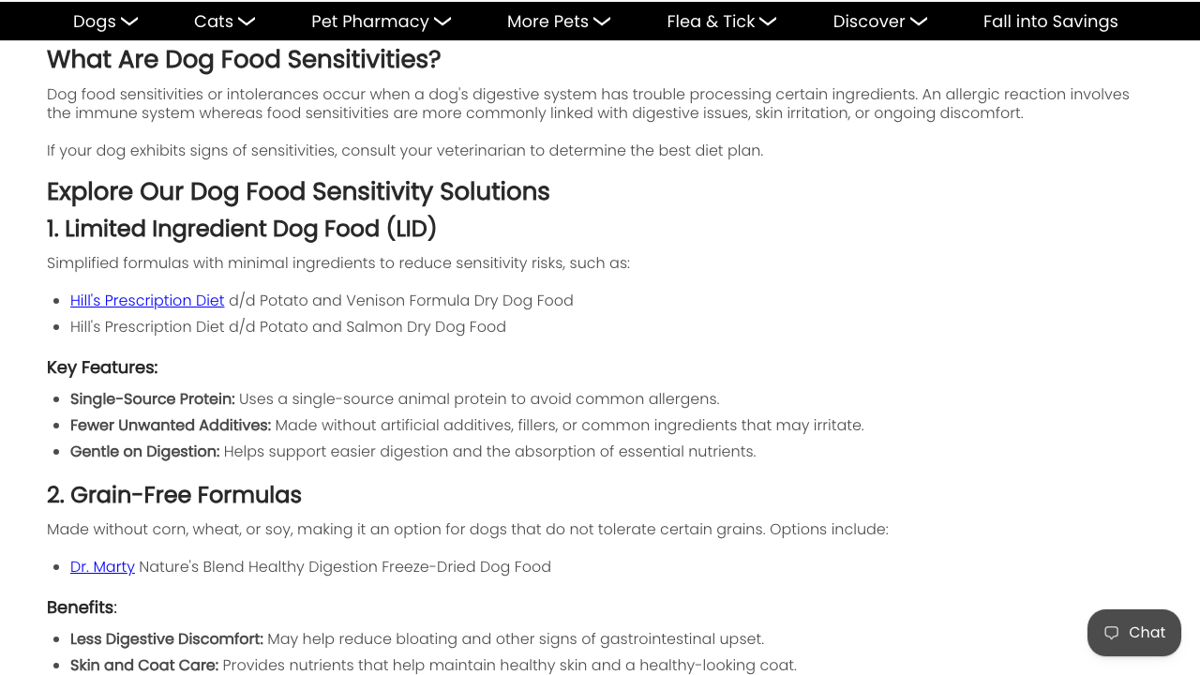
Photozyme's oily skin collection does the same, with sections on why oily skin still needs a moisturizer, which ingredients work and how to layer products. Desky's chair collection answers how an ergonomic chair can help.
This is the move most Shopify stores skip. The theme puts a short description above the grid, and the store leaves it at one line. A few hundred words below the grid that help a shopper choose turns the collection into a page that can rank for the question as well as the category name.
Structured data mattered less than you'd think
The surprise was how little schema some ranking pages had. Only two of the six collection pages used CollectionPage markup, and Muenster Pet's had just basic organization data. Good naming and useful copy carried pages that structured data didn't.
That doesn't make schema pointless. Google says product structured data helps it understand price, discounts and shipping, and the product pages that did best in ChatGPT were well marked up. It just isn't what decides whether a collection page ranks.
You're getting AI traffic. But do you know where it comes from?
RankControl credits every visit to the assistant that sent it: ChatGPT, Perplexity, Claude, Gemini, Copilot, or Grok. Full source attribution, next to your Google traffic.
What Shopify SEO people say in the forums
Store owners and consultants on Reddit land in much the same place. A consultant who said they'd audited more than 100 Shopify stores posted their four biggest problems in r/ShopifySEO. First on the list was collection pages with not even 100 words explaining what the collection is about. They said to treat each collection as a landing page built to rank and convert, rather than a product list.
Their second point was product pages. They said a good one answers what problem the product solves, how to use it, who it's for and why to pick it over the alternatives, and they asked stores to stop copying the maker's description word for word.
When a new store owner asked the same subreddit for the top three things to know, one reply gave a short, practical list. Add copy to collection pages, point internal product links at the canonical product URL, and build real collections instead of relying on tag pages.
That middle tip matters on Shopify. Many themes link products from collections at the nested address, so your own links point at the copy instead of the main page. A reply in the audit thread said that on one store about 1 in 6 URLs turned out to be the same page reached another way. They said to clean that up before spending on content.
What the page ChatGPT cited does
Fellow's Ode grinder page is a good model for the AI side. ChatGPT searched Fellow's own site for the grinder's price and specifications, then cited the page in its answer.
The page carries a lot. It has Product, Offer and AggregateRating structured data and a FAQ marked up as FAQPage, alongside the details a buyer compares. When ChatGPT went looking for the price and specs, they were there to quote.
That matches the wider pattern in our test. Across ten product questions, ChatGPT cited product pages more than any other store page, usually after searching a maker's site for specs or price. For Shopify stores, that means your product pages need to state the facts plainly, even if they rarely rank for broad searches on Google.
Your products in ChatGPT's shopping results
There's a second route into ChatGPT that's specific to Shopify. OpenAI's shopping help page says product data from Shopify merchants already flows into ChatGPT through Shopify Catalog, with no extra work needed.
Store owners are noticing. In an r/shopify thread called "Orders from ChatGPT", a store owner said more and more orders were arriving from ChatGPT and wished they could see what customers typed. One reply pointed to Shopify's Agentic sales channel, which lists recent searches where products appeared.
Orders from ChatGPT
I've been seeing more and more orders come through directly from ChatGPT and I have to admit, I couldn't be happier. I just wish there was a way to see what people typed in to get the referral. I may contact some of my customers that I feel...
Attribution is the catch. In another thread, an owner said a customer found them through ChatGPT but the order showed as direct traffic. Shopify only sees the visit that reached the store, so a shopper who saw you in ChatGPT and typed your URL later looks direct. Asking "how did you hear about us?" at checkout fills part of that gap.
Our guide to Shopify stores in ChatGPT product answers covers the catalog side in more detail.
The Shopify SEO plan, in order
Here's how we'd work through a store, based on what the ranking pages did.
- Rename your main collections after the searches shoppers use, and check the title tag and heading match.
- Add a short buying guide below the grid on your top five collections, with two to four question headings.
- Write specs, price and stock clearly in the text of your best-selling product pages.
- Add a FAQ to products that get the same questions over and over.
- Make sure out-of-season products stay live with a back-in-stock note instead of being hidden.
- Write one buying guide per main category in your blog, and link it to the matching collection.
Steps one and two are where we'd start. They're quick to do in Shopify's admin, and they're what separated the ranking collection pages from the rest. For the wider picture beyond Shopify, our ecommerce SEO guide compares what Google and ChatGPT reward.
What this costs in hours
Renaming and retitling ten collections takes an afternoon. A useful guide section for each of your top five collections runs about two hours each, and cleaning up specs on 30 product pages is another 10 to 15 hours. Then plan on an hour a week to check Search Console and your Agentic channel.
You can do all of this in your Shopify admin. Or RankControl's agents can do the content side for you every month, writing and publishing buying guides and comparison posts to your Shopify blog and checking Google and six AI engines each week, while you focus on your product.
We'll show you exactly where your brand stands in AI search.
No commitment. $0 due today, cancel anytime. See how ChatGPT, Perplexity, Claude, Gemini, Grok, and Google AI Mode talk about your brand today.