
Ask Claude how many people search for "standing desk for small apartments" and it will give you a number. The number is a guess. Connect Claude to an SEO tool over MCP and ask again, and it looks the figure up in the tool's database before answering.
That connection is what an SEO MCP server does. It's why Ahrefs, Semrush and a long list of smaller SEO tools now ship one, and why Claude's connector directory listed 844 connectors when we checked on September 26, 2026. This guide explains what an MCP server is without the developer vocabulary, the two kinds that matter for SEO, how to connect one, and the risks worth checking first.
What an MCP server is, in plain terms
MCP stands for Model Context Protocol. The official docs define it as "an open-source standard for connecting AI applications to external systems," which in practice means a shared way for Claude, ChatGPT, Cursor and similar tools to talk to other software.
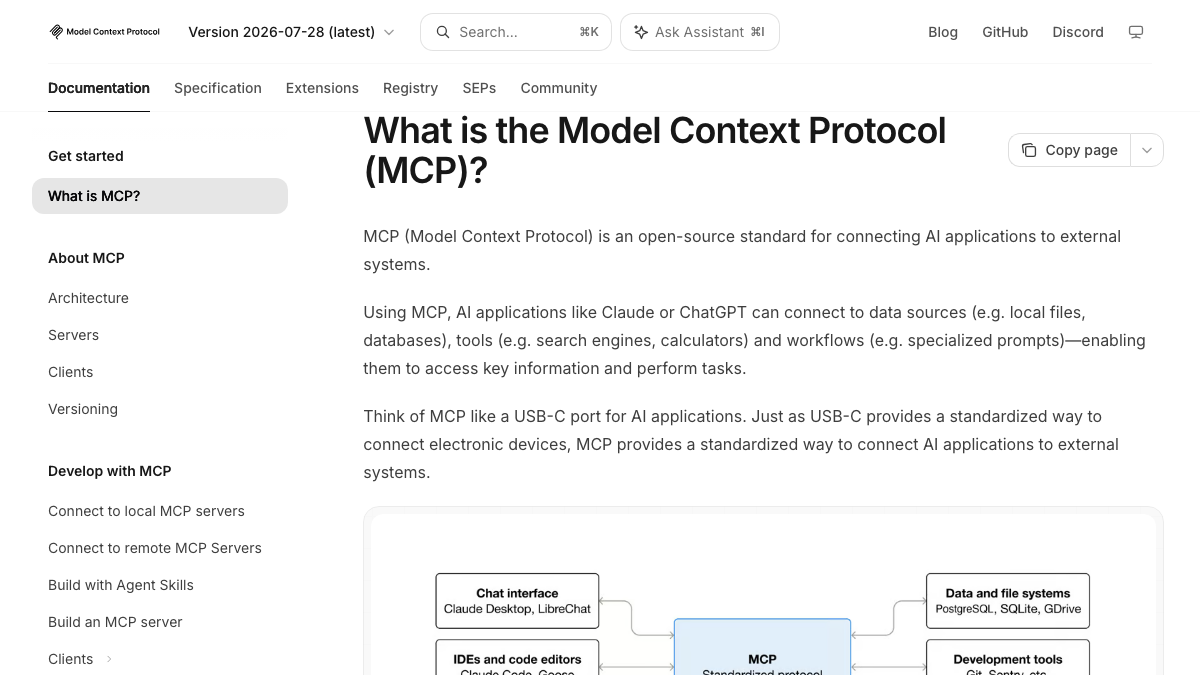
Anthropic introduced MCP in November 2024. In December 2025 it handed the protocol to the Agentic AI Foundation, a new fund under the Linux Foundation that Anthropic co-founded with OpenAI and Block, so no single AI company owns it. By then, according to the Linux Foundation's announcement, there were about 10,000 active MCP servers.
Two pieces make it work. The client is the assistant you type into. The server sits on the tool's side and offers a menu of named tools, each with a short description, such as a tool that returns your visibility score or one that lists your articles. When you ask a question, the assistant reads the menu, picks the tool that fits, calls it, and writes its answer from what comes back.
What makes it an SEO MCP server
An SEO MCP server is simply one whose tools touch SEO work. The more useful split is by what the tools are allowed to do, and we sort them into read servers and write servers.
Read servers fetch data. Ask about keyword volume, backlinks, rankings or Search Console clicks and they return numbers. Write servers change something: they publish a post, trigger a crawl, create a task or put a title on a content calendar. Most write servers can read too, but the write tools are the ones that deserve your attention before you connect.
| Server | Kind | What it's for | What it costs |
|---|---|---|---|
| Ahrefs MCP | Read | Keyword, backlink and Brand Radar data | Paid Ahrefs plan from $129/mo; calls spend API units |
| Semrush MCP | Read | Keyword, domain and trends data | Certain Semrush plans that include API units |
| DataForSEO MCP | Read | SERP, keyword and backlink data | Pay as you go, $50 minimum top-up |
| mcp-gsc (community) | Read | Your Google Search Console data | Free; runs locally with your own Google login setup |
| WordPress.com or Webflow MCP | Write | Drafting and publishing posts | Free on WordPress.com paid plans; free on Webflow |
| RankControl MCP | Read and write | AI visibility checks, content planning and publishing | Included in the $400/mo plan |
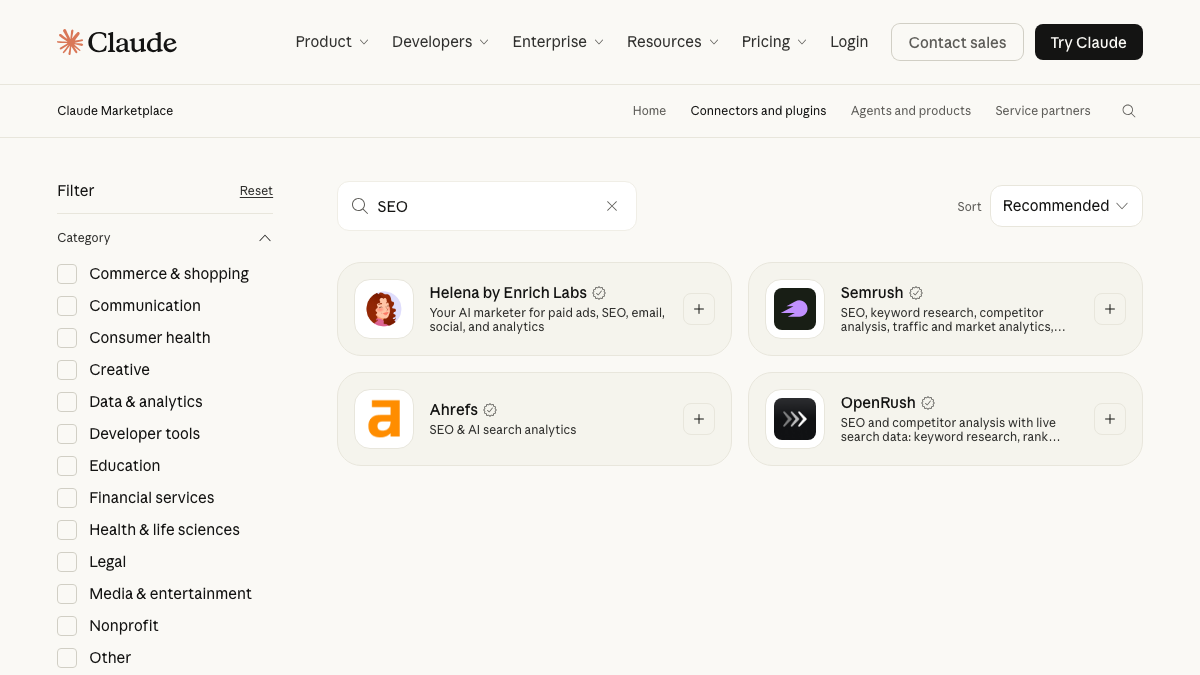
A search for "SEO" in Claude's connector directory returned four results when we checked, with Semrush and Ahrefs among them. Plenty of useful servers never show up in that search because they file under analytics, publishing or design. Our roundup of the best MCP servers for SEO goes through each of the main ones in more detail.

Your competitors are getting cited by AI. You're not.
Every day without citation tracking is a day your competitors pull ahead in ChatGPT, Perplexity, and Claude.
What you can ask one
The point of connecting a server is that you ask in plain English and the assistant does the lookups. A few questions that work once the right servers are connected:
- "Which keywords do we rank 11 to 20 for that get more than 500 searches a month?" (Ahrefs or Semrush)
- "Which pages lost the most clicks in Search Console over the last 28 days?" (a Search Console server)
- "Which AI engines cited us this week, and for which questions?" (RankControl)
- "Propose five article titles for the questions where a competitor gets cited instead of us." (RankControl)
The bigger shift comes from combining servers in one conversation. An indie founder posted in August that they'd started using DataForSEO through Claude's MCP to stop checking each keyword by hand in Ahrefs, and had connected Search Console the same way so Claude could see how their pages actually appear in results.
Day 64/365 on the road to 10K MRR I’ve been slacking on these updates and changing the direction of my efforts to focus more on marketing rather than development. Specifically I’ve started using DataforSEO via the Claude MCP in order to streamline my marketing efforts. This
 ☯️@log0083Aug 4, 2026
It's a common setup: one server for market data and one for your own site's performance, with questions that need both.
Who MCP is really for
Technical SEOs aren't all sold. In r/TechSEO this month, the owner of a domain data service asked whether people would rather use an MCP server or an API. Most replies picked the API, because they want deterministic data from their own scripts. One reply made the case that fits marketers: MCP matters when the user already works in Claude or ChatGPT and wants the data without dealing with auth and API docs.
Are you more tempted by a service that has an MCP and an API?
I have a domain data service and was wondering if people were more swayed by a service that has an MCP available? I have always interacted with APIs and don't see how an MCP would be better than a user pointing their AI at the API docs inst...
That split is fair. If you write code, an API gives you exact control. If you'd rather ask a question and read an answer, MCP puts the same data one sentence away, and it's the only route that lets an assistant chain several tools together without someone writing the glue. Our MCP vs API comparison goes deeper on what each costs per task and how to keep write actions safe.
How to connect one to Claude
There are two kinds of connection, and the difference decides whether you need a terminal.
A remote server runs on the vendor's side. You connect it with a URL and a login, and it works in claude.ai as well as the desktop app:
- In Claude, open Customize, then Connectors.
- Pick the server from the directory, or click the plus button and choose Add custom connector.
- Paste the server's URL if it's a custom connector.
- Sign in to the tool when the login window opens and approve access.
Free Claude accounts can add only one custom connector, per the setup guides vendors such as Lumar publish, so pick the one you'll use most. Team and Enterprise workspaces need an owner to add a custom connector once for everyone.
A local server runs on your own computer through a command, usually with npx, and suits Claude Code, Claude Desktop or Cursor. It's the better choice when you want the server inside a coding tool or a scheduled job. For a walk-through of working this way, see our guide on doing SEO in Claude over MCP.
The risks worth checking first
Connecting a server gives an assistant access to your accounts, so a few minutes of checking up front is worth it.
Start with the write tools. Any tool that publishes, deletes or triggers a job can act on a misread instruction. Good servers show you what they're about to do and wait for your confirmation, and some, RankControl's among them, make publishing a dry run by default. Lumar's MCP docs, for example, flag that creating tasks and triggering crawls are write operations and tell you to review before confirming.
Then check where your data goes. Your data passes through the AI provider you connect, and Lumar's launch post tells users to check whether that provider may train on it, which is typically ruled out on paid business tiers but not always on free or individual plans.
Account rules matter too. In r/FacebookAds earlier this month, a marketer asked whether connecting Meta's official MCP to Claude could get an ad account banned, even with read-only access. The replies were a mix of caution and workarounds: several people stuck to read-only, and one described telling Claude to space out its data pulls by a minute.
Is the Official Meta MCP "REALLY" Safe to Connect to Claude?
Hi everyone, I know it is supposed to be safe but I and probably many others would be interested in hearing about your experience. Have you experienced or heard of any account ban related to the official MCP connection to Claude even with R...
Finally, watch the meter and the numbers. Paid data servers charge per call, and Ahrefs doubled its MCP limits on every plan in September, after heavy agent users complained about running out before the month ended. Semrush's own docs warn that AI responses "may be incomplete or inaccurate," so spot-check any figure you plan to put in a report against the tool itself.
Where RankControl's MCP server fits
RankControl's server is a write server for AI search work. From Claude, Claude Code, Cursor or Codex, your assistant can check your visibility score and recent citations, propose article titles, approve them onto the calendar and publish. Our server has 80+ tools, and nothing goes live until you confirm.
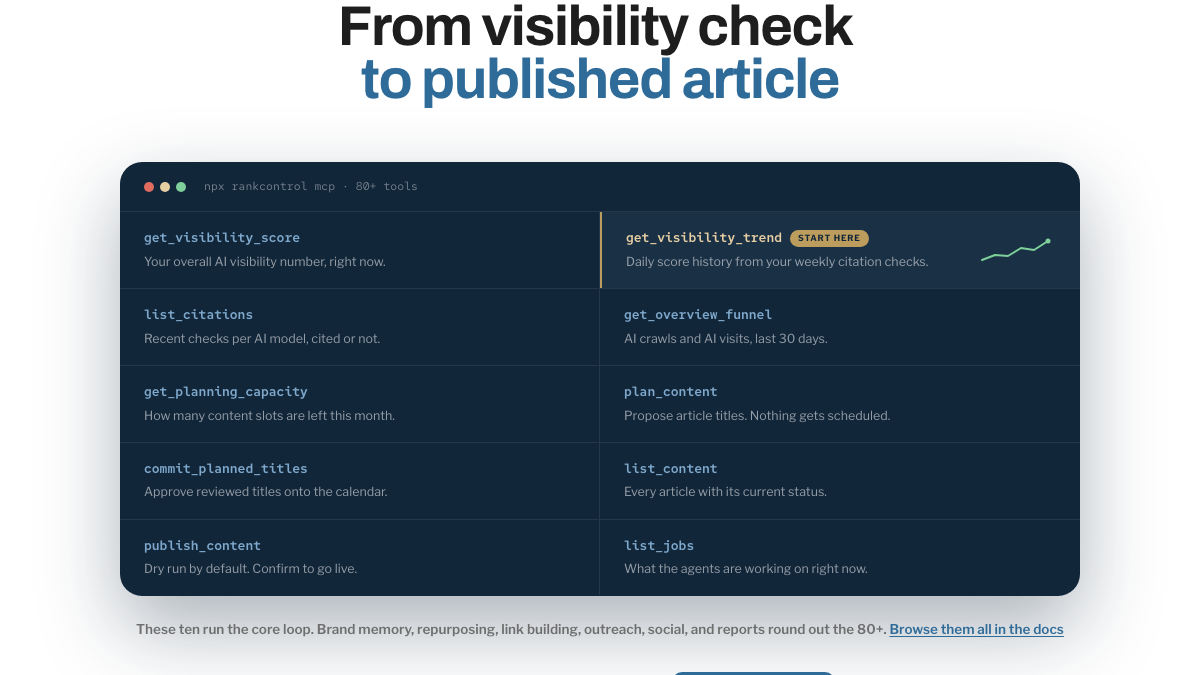
Connecting takes one step in claude.ai: paste https://api.rctrl.com/mcp into Connectors, sign in and approve. The npm package covers Claude Code and CI, and read-only keys can be minted in Settings for scripts or vendors. The server is part of the $400-a-month plan, and your plan limits apply the same way in every tool.
It isn't a keyword database, so most teams connect it next to Ahrefs or Semrush. The questions it answers come from AI visibility tracking, which checks 50 of your buyer questions weekly on seven engines, and the articles it publishes come from the content engine. The MCP page lists what each tool does.
200+ SaaS teams already track their AI citations.
They know exactly when ChatGPT mentions their brand, and when it stops. Do you?

What an MCP server won't do for you
A connected assistant pulls data in seconds. It still leaves the slow part of SEO with you, which is writing and publishing the pages the data points to.
Wiring up two or three servers takes an afternoon. Turning their answers into 20 researched, linked and published articles a month takes 40 to 60 hours, and checking whether AI engines cite those pages across seven engines takes about six hours a week by hand. Those are rough estimates, and no read server shortens either one.
You can run that loop yourself, with Claude and a few read servers doing the lookups. Or RankControl's agents can run it every month while you approve what goes live, from the dashboard or from the same Claude window.
How often does ChatGPT mention your brand?
Most founders have no idea. The answer might surprise you.