
We gave four AI assistants the same five SEO jobs on September 27 and checked every answer. The clearest result came from the dullest task: write a meta description between 150 and 160 characters and say how long it is. Perplexity said 153. We counted 165.
That's the real question behind "best AI for SEO." All of these assistants can write. What separates them is whether you can trust what they tell you about their own work, and whether the sources they cite exist. Here's how ChatGPT, Claude, Gemini and Perplexity did on real SEO tasks, what we couldn't test, and what each plan costs.
The short answer
| Assistant | Best at | Watch out for | Paid plan we'd pick |
|---|---|---|---|
| Claude | Sourced research and fact-checking | Wraps code in markdown fences | Pro, $20 a month |
| ChatGPT | Everyday SEO work, clean output | Couldn't see live Google results | Plus, $20 a month |
| Perplexity | Gathering sources fast | Miscounted its own meta description | Pro, $20 a month |
| Gemini | Not fairly tested (see below) | Gave a dead link with no warning | Google AI Pro, $19.99 |
| Grok | Not tested | Can't say | SuperGrok, $30 a month |
If you only pay for one, Claude or ChatGPT will cover most SEO work. Perplexity earns a place for research. We'd hold off judging Gemini and Grok until they can be tested properly.
How we ran the test
Each assistant got the same five prompts through its API: ChatGPT on GPT-6 Astra with web search, Claude on Claude Opus 5.5 with web search, and Perplexity through its Agent API. We checked every URL, counted every character and parsed every piece of JSON.
Two assistants didn't get a fair run, and we'd rather say so up front. Our Gemini key had no quota for Google's Pro model or for Google Search grounding, so Gemini ran on its Flash model with no live web access. We had no API access to Grok at all, so it's covered from its pricing pages only. Treat Gemini's results as a floor, not a verdict.
Task 1: What ranks for a keyword right now
We asked each assistant what kind of pages rank on Google for "employee onboarding software" and to give three example URLs. Then we checked the answers against the actual top ten.
Claude named three pages from BambooHR, Gartner and Atlassian, and all three were really in the top ten, at positions two, five and nine. ChatGPT named two confirmed ranking pages, from BambooHR and Zapier, plus a Capterra page we couldn't check because Capterra blocks automated requests. Perplexity's headline picks included Zapier's roundup, and its full source list of 30 pages contained the other real top-ten pages.
The important difference was honesty. ChatGPT said outright, "I couldn't retrieve Google's live U.S. results page directly, so this is a current web-search snapshot." Claude gave a similar warning. Gemini, with no search access, listed three URLs with full confidence and no caveat, and none of them matched the real top ten.
None of the four could pull Google's live results page, and only ChatGPT and Claude said so.
Task 2: Clustering 30 keywords
We gave each assistant the same 30 expense management keywords and asked for intent clusters. All four used every keyword exactly once and invented none. ChatGPT and Gemini made six clusters, Claude made seven and Perplexity made five, all of them sensible.
Claude added one thing the others didn't: a visible check at the end, "5 + 2 + 2 + 3 + 2 + 6 + 10 = 30 keywords. Each keyword appears exactly once, and none were added." That's the habit you want from an assistant doing bulk work, because it shows its own audit.
Since all four passed, clustering shouldn't decide which assistant you pay for.
We'll show you exactly where your brand stands in AI search.
No commitment. $0 due today, cancel anytime. See how ChatGPT, Perplexity, Claude, Gemini, Grok, Google AI Mode, and Google AI Overviews talk about your brand today.

Task 3: A title tag and meta description with hard limits
The prompt asked for a title under 60 characters and a meta description between 150 and 160, with a character count for each.
| Assistant | Title | Meta description | Claimed count correct? |
|---|---|---|---|
| ChatGPT | 49 characters | 156 characters | Yes |
| Claude | 57 characters | 158 characters | Yes |
| Gemini | 54 characters | 155 characters | Yes |
| Perplexity | 54 characters | 165 characters | No, it claimed 153 |
Perplexity's meta description ran five characters past the limit, and its own count was off by twelve. We'd call this the self-count test: when an assistant tells you a number about its own output, check it at least once. It's a two-second check, and it's the kind of error that ships quietly to hundreds of pages.
Our post on using ChatGPT for SEO covers which SEO jobs these tools handle well and which need data they don't have.
Task 4: FAQ schema
All four produced valid FAQPage JSON-LD with the right structure for three questions, and none changed the question or answer text. ChatGPT, Gemini and Perplexity returned bare JSON you could paste straight into a page. Claude wrapped its JSON in a markdown code fence, which takes a second to strip but isn't paste-ready.
Schema is another solved task. The bigger risk with AI-written schema is putting it on pages whose visible content doesn't match, and no assistant checks that for you.
Task 5: Fact-checking with sources
We asked when Google Optimize shut down and what Google recommended instead. The answer is September 30, 2023, and Google's help page pointed to integrations with AB Tasty, Optimizely and VWO.
All four got the facts right. The sources are where they split. Claude gave four sources, including two Google help pages, quoted Google's own wording, and every link worked. ChatGPT and Perplexity each gave one working Google help page.
Gemini gave two links. One was a real Google support page. The other, a Google blog URL about "the next generation of experimentation with Google Analytics 4," returned a 404. With no web access, Gemini produced a plausible link that doesn't exist, which is exactly why answers from memory need checking.
Speed, and what the API calls cost
If you use these tools through their apps, speed differences are small enough to ignore. Through the APIs they're easier to see. Here's the total time each assistant took for all five tasks, one call each:
| Assistant | Total time for five tasks | Slowest task |
|---|---|---|
| Perplexity | 39 seconds | Research, 14 seconds |
| Gemini (Flash, no search) | 48 seconds | Title and meta, 17 seconds |
| ChatGPT | 69 seconds | Research, 26 seconds |
| Claude | 78 seconds | Fact-check, 33 seconds |
Claude's slowest task was also its best one. It spent 33 seconds on the fact-check because it searched and read four sources before answering. Perplexity was the only API that returned an exact cost with every call, and all five tasks together cost about one cent.
What each plan costs
We checked every official pricing page on September 27: ChatGPT, Claude, Google AI, Perplexity and SuperGrok. Prices are in US dollars per month.
| Assistant | Free | Mid tier | Top tier |
|---|---|---|---|
| ChatGPT | $0 | Go $8, Plus $20 | Pro from $100 |
| Claude | $0 | Pro $20, or $17 billed annually | Max from $100 |
| Gemini (Google AI) | $0 | AI Plus $4.99, AI Pro $19.99 | Ultra from $99.99 |
| Perplexity | $0 | Pro $20 | Max $200 |
| Grok | Free tier | SuperGrok Lite $10, SuperGrok $30 | Plus $100, Heavy $300 |
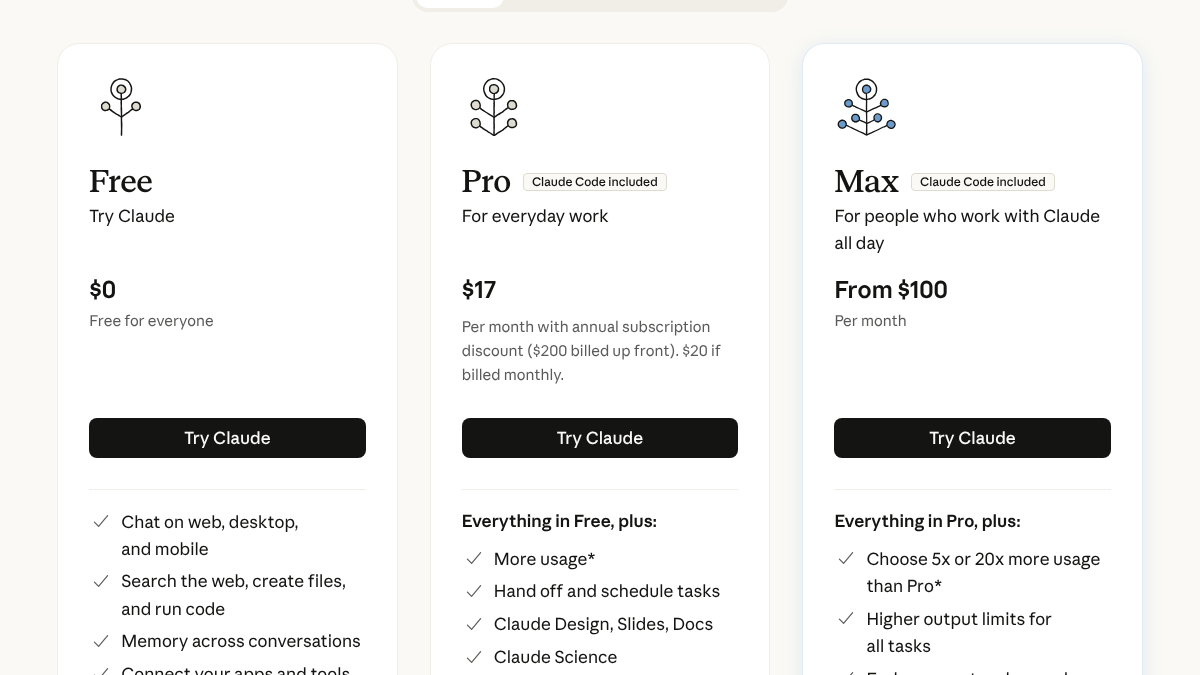
A few details matter for SEO work. ChatGPT's Go plan says it "may include ads." Claude's pricing page lists web search on every tier, including free. Perplexity's page says it "orchestrates multiple top models and selects the best one per query," which matches what we saw: both of its presets we tried routed to one of OpenAI's models.
Google's AI Pro plan is also bundled with 5 TB of storage, which matters if your team already lives in Google Workspace.
Grok: what we could check
Grok's pricing starts at $10 a month for SuperGrok Lite, and every tier advertises real-time web search and live access to posts on X. That X access could make it useful for tracking conversations about a brand. We couldn't test how accurate its SEO answers are, so we won't rank it.
A test to run before you subscribe
You don't need our five tasks to choose. Before paying for a plan, try three quick checks on the free tier:
- Ask for a meta description between 150 and 160 characters with its length, then count it yourself.
- Ask a factual question about your own industry with sources, and open every link.
- Paste 20 of your real keywords and ask for clusters, then check nothing was dropped or invented.
Those three checks take about 15 minutes per assistant, and they'll tell you more than any review, including this one.
Which one we'd use for each SEO job
In practice, most SEO teams end up using two assistants. A Perplexity user on Reddit described the pattern well in January: gather context and sources in Perplexity, then hand that material to another assistant to do the writing. Several replies said they worked the same way.
Does anyone else use Perplexity strictly for research and then switch to Gemini/ChatGPT for the actual work?
Hey everyone, I’m looking for tips on how you integrate Perplexity into your daily tasks. Currently, I use Perplexity exclusively for gathering context because its search/citation ability feels superior. Once I have the info, I feed it into...
Here's how we'd split the work based on the test:
| SEO job | Our pick | Why |
|---|---|---|
| Research with sources | Claude or Perplexity | Real, working citations |
| Keyword clustering | Any of them | All four were accurate |
| Titles and meta descriptions | ChatGPT or Claude | Exact character counts |
| Schema drafts | ChatGPT | Paste-ready output |
| Fact-checking a claim | Claude | Most sources, all verified |
Know exactly what AI says about your competitors.
RankControl's Recon Agent monitors competitor citations across ChatGPT, Perplexity, Claude, Gemini, Grok, Google AI Mode, and Google AI Overviews. See where they show up and you don't.

What none of them can do
No assistant in our test could see your rankings, your Search Console data or which questions buyers ask in your category. An SEO writer asking r/SEO whether to trust Gemini's advice on a site migration got the most sensible answer we've seen on this: Gemini has no special insight into Google's algorithm, its advice is sometimes good and sometimes bad, and you have to understand SEO to use any of these tools well.
Is Gemini SEO advice good?
So for context, my company is doing a site migration and as the seo person for the company (even though im just the seo content writer), im asked to ensure that the seo of the new website is good. Ive been getting seo strategies and advice...
There's a pattern in the wider conversation, too. When we searched X for recommendations on the best AI for SEO, nearly every popular post came from agencies or growth accounts selling a playbook. That's one more reason to run your own small test before picking a tool, even if it's just three tasks and a character counter.
These assistants also don't write in a way that survives scrutiny without a real brief. Our test of the make it sound more human prompt found specific inputs matter more than which model you use, and our SEO keyword research prompts show the same thing for research.
Beyond the assistant
You can build an SEO workflow from these tools yourself: an assistant for drafts and research, a rank tracker for positions, Search Console for clicks, and a spreadsheet to tie it together. For most teams that's a few hours a week once it's running.
Or RankControl can take the parts an assistant can't. Our content engine writes each article against the pages already ranking for its keyword and scores it for how easily AI engines can quote it, with a fix list.
We also track your Google and Bing rankings, and our AI visibility tracking checks up to 50 buyer questions every week across seven AI engines. If you're choosing which engines to show up in rather than which assistant to use, our comparison of ChatGPT, Perplexity, Gemini and Claude as search engines covers that question.
26 content formats. Published on your domain. Matched to your brand.
Guides, comparisons, listicles, case studies, and more. RankControl generates content that gets cited by ChatGPT, Perplexity, Claude, Gemini, Grok, Google AI Mode, and Google AI Overviews.