
An ecommerce site can look fine to shoppers and still be a mess to search engines. Filter pages multiply into thousands of URLs. Product pages say one price and the feed says another. Sold-out products vanish and take their rankings with them.
This checklist is an audit you run against your own live store, on any platform. Every item points to the Google or OpenAI documentation behind it. It covers classic Google search, Google's free shopping listings and ChatGPT's shopping results, since all three now read the same product data. For the site-wide checks every store shares, like crawler access and JavaScript, see our technical SEO audit checklist.
The audit at a glance
| Area | What to check | Why |
|---|---|---|
| Crawl and URLs | Parameters, canonicals, sitemaps | Duplicate URLs waste crawling and split signals |
| Filters and pagination | Faceted URLs, page links | Endless filter combinations, unreachable products |
| Product data | Structured data with price, currency, availability | Rich results and AI shopping answers |
| Reviews | Review markup rules | Fake or self-collected markup loses stars |
| Merchant Center | Feed accuracy, free listings | Shopping tab, Gemini and more |
| Stock | Out-of-stock handling | Disapprovals and lost rankings |
| AI shopping | Feed fields, Shopify Catalog | ChatGPT product results |
| Content and links | Category copy, internal links | Relevance and discovery |
We call the core principle here the three-copy rule. Your product page, your structured data and your feed are three copies of the same facts. Most ecommerce audit findings come down to those copies disagreeing.
How often does ChatGPT mention your brand?
Most founders have no idea. The answer might surprise you.

1. Crawl and URL parameters
Google's ecommerce URL guidance, last updated December 10, 2025, spells out a few rules.
- Use key=value parameters. "Use
?key=valueURL parameters rather than?value, where possible." - Don't link to throwaway parameters. "Avoid internally linking to temporary parameters, such as session-IDs, tracking codes, user-relative values... and the current time."
- Canonical variants to the base URL. "If you use optional query parameters to identify variants, use the URL with the query parameter omitted as the canonical URL."
- Self-referencing canonicals everywhere. "Use a self-referencing
<link rel="canonical">tag on all indexable pages and include those URLs in a sitemap file."
Our guide to duplicate content covers canonicals and redirects in more depth.
2. Faceted navigation and pagination
Filters for size, color and price can create a URL for every combination. Some need indexing. Most don't.
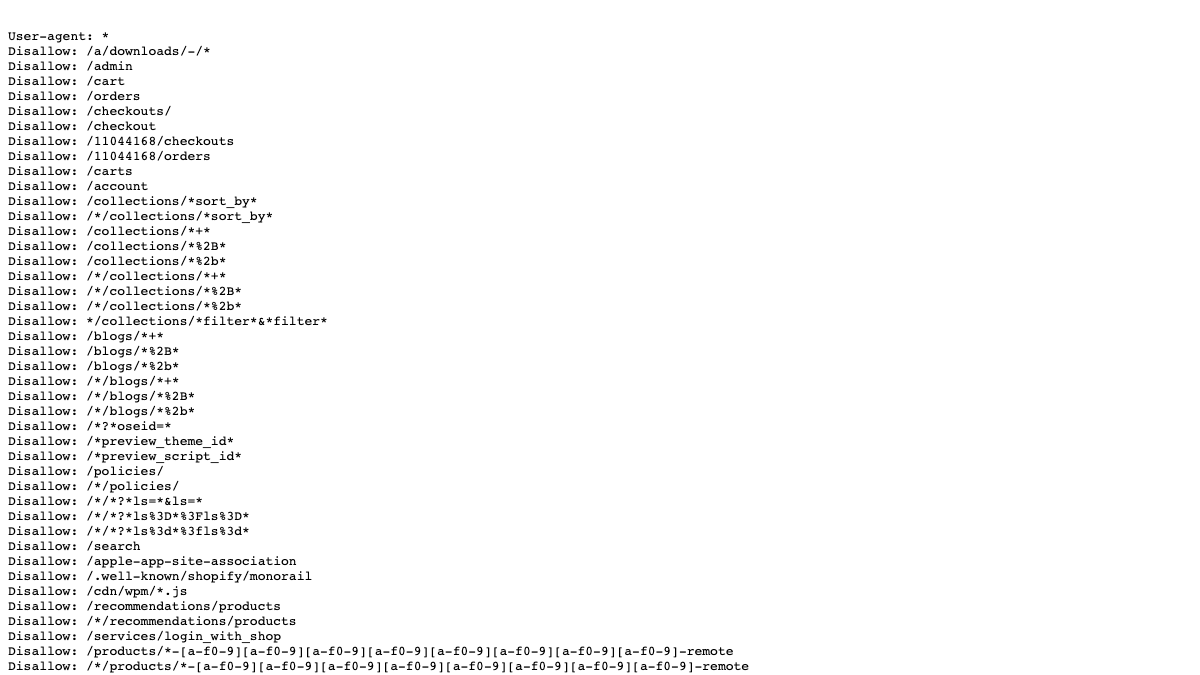
- Block duplicate sort and filter pages. Google's pagination guidance says to "use
noindexmeta tags orrobots.txtto prevent indexing duplicate results with alternative sort orders or filters." Shopify's default robots.txt, above, blocks many sort and filter URLs this way. - Give paginated pages real links. "Google's crawlers don't 'click' buttons and generally don't trigger JavaScript functions that require user actions." A "Load more" button needs plain page links behind it.
- Canonical each page to itself. Don't point page 2, 3 and 4 back to page 1.
- No fragments for page numbers. Use real URLs like
?page=2, not#page2.
3. Product structured data
Structured data isn't required to rank, but according to Google it "increases eligibility for Product rich results."
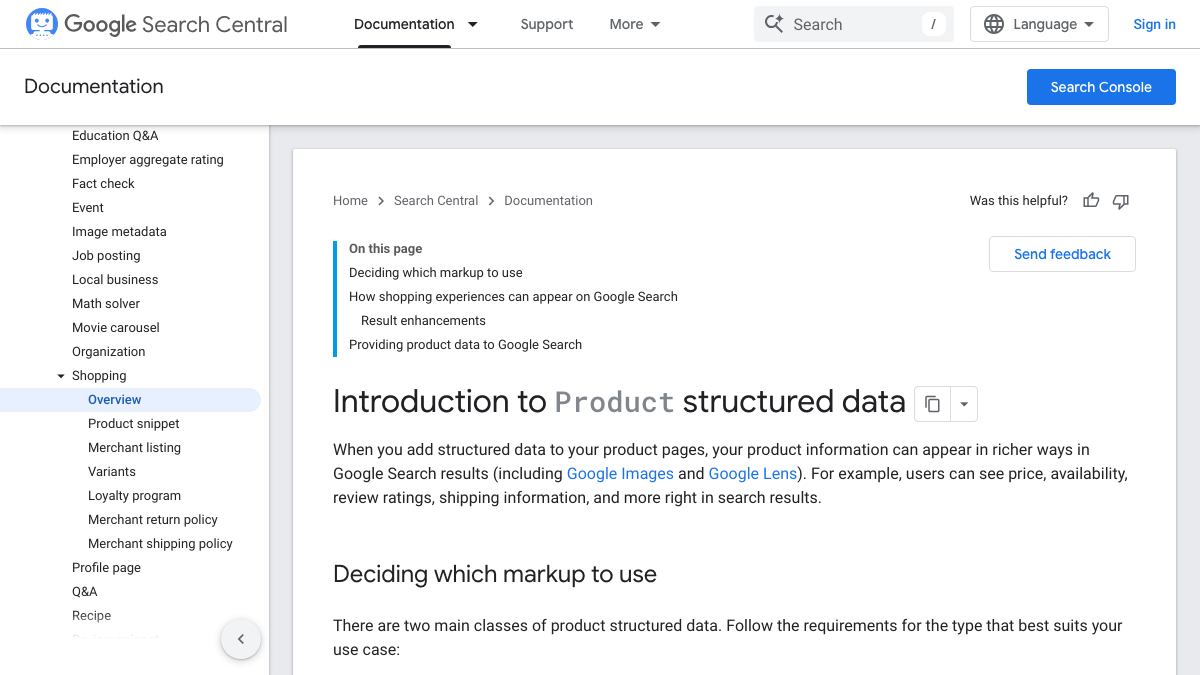
- Mark up every product page with Product and Offer.
- Include price and currency. For merchant listings,
priceandpriceCurrencyare required, and the price must be greater than zero. - Include availability, plus item condition, shipping details and return policy where you can.
- Match the page. The price and stock in your markup should be exactly what the shopper sees.
- Test it. Run key templates through Google's Rich Results Test.
4. Review markup
Stars in search results depend on review markup, and Google's rules, updated September 8, 2026, are strict.
- Include required fields. Reviews need an author, the item reviewed and a rating.
- No fake or undisclosed incentivized reviews. "Don't include fake or undisclosed incentivized reviews on your page or in your structured data markup."
- Don't import ratings from other sites. "Don't aggregate reviews or ratings from other websites."
- Use real customer ratings. "Ratings must be sourced directly from users."
15 hours a week manually. Or 15 minutes with RankControl.
Track citations, monitor competitors, and fix content gaps across every AI search engine. Automatically.

5. Merchant Center and free listings
Merchant Center is required for some surfaces. Google wrote that "participation in Google Merchant Center is mandatory for some Google surfaces, such as listings in the Google Shopping tab."
The free option is broad. According to Google, "With a free listing, the products you sell can appear at no cost on Google Search, Google Maps, Gemini, YouTube, the Shopping tab, Google Images, and Google Lens."
- Set up Merchant Center and submit your products.
- Add return policy and shipping information. Both are needed for free listings in many countries, including the US.
- Fix disapprovals weekly. Check the diagnostics page for item issues.
6. Out-of-stock products
This is where many stores lose rankings. Deleting a sold-out product page throws away its links and history.
- Keep sold-out pages live and mark them out of stock.
- Keep the feed honest. Google's availability rules said "the values in your data source should always match the information on your website," and that if a product is out of stock on the page but
in_stockin the feed, "we disapprove the product." - Use preorder and backorder correctly. Both require an availability date in Merchant Center.
What we found on three live stores
On October 19, 2026, we checked one product page from three large stores on three different setups: Allbirds on Shopify, Gymshark on a headless storefront and Chewy on its own platform.
| Store | Product markup | Price and currency | Availability | Canonical | Ratings in markup |
|---|---|---|---|---|---|
| Allbirds | Yes, with variants | Yes | Yes, per variant | Yes | Yes |
| Gymshark | Yes | Yes | Yes | Yes | Yes |
| Chewy | Yes | Yes | Yes | Yes | Yes |
All three had the basics in place. Two details stood out on Allbirds. Requesting a different colorway through a URL parameter returned the same canonical URL and title, in line with Google's variant guidance. And six of the eight size and color variants we sampled were marked OutOfStock in the markup, kept on the page rather than removed.
For large stores, these basics are standard. This checklist matters most for the many smaller stores that don't have them yet.
7. Readiness for AI shopping answers
ChatGPT now shows products directly. OpenAI's help page on shopping in ChatGPT search said "product results are selected independently by ChatGPT and are not ads," and that it considers "structured metadata from first-party and third-party providers (e.g., price, product description) and other third-party content."
It also explains how stores are picked. "Merchants are ranked based on factors like availability, price, quality, and whether they are the maker or primary seller of that item."
- Shopify stores: OpenAI wrote that "for merchants on Shopify, product data is already integrated into ChatGPT through Shopify Catalog." Keep your Shopify product data clean.
- Other platforms: OpenAI offers a direct product feed. Its spec lists nine required fields: item ID, title, description, URL, brand, seller name, image URL, availability and price.
- Keep prices and stock current. The same three-copy rule applies to any AI feed.
- Earn third-party mentions. Reviews and coverage on other sites feed the "other third-party content" OpenAI mentions.
Our test of which store pages ChatGPT cites covers the AI side in more depth.
8. Content and internal links
- Unique titles and descriptions on every product, not the manufacturer's copy.
- Short, useful copy on category pages, linking to buying guides.
- Link from guides to products and categories, and back.
- Check page speed on product and category templates, especially with apps or heavy scripts.
Our ecommerce SEO guide covers how category and product pages rank, and our guide to ecommerce content marketing covers the content to add.
How often to run it
| Check | How often |
|---|---|
| Merchant Center diagnostics | Weekly |
| Out-of-stock pages and feed | Weekly |
| Structured data on key templates | Monthly, and after theme changes |
| Filters, pagination and crawl | Quarterly |
| Full audit | Twice a year |
A thread on r/SEO asked what goes into a $10,000 SEO audit. The top reply listed what separates expensive audits from cheap ones, including log file analysis, crawl budget, JavaScript rendering, indexation, internal linking at scale and schema.
$10,000 SEO Audit ? What do you guys put in the SEO Audits ?
Hi, so there are a lot of discussions I see on Linkedin and other forums about SEO audits being expensive and other people saying no, they are not. I also remember Lily Ray saying she can take months to make an seo audit. So my question is...
For a quicker start, another practitioner shared a two-hour Search Console audit: filter to pages ranking between positions 8 and 25 with impressions but few clicks, then fix their titles and internal links.
the 2-hour GSC audit i run on every site that's been live for 6+ months. finds quick wins almost every time.
sharing the exact process i use because i've seen it work consistently and it's free. most sites that have been publishing for 6+ months have pages sitting in positions 8-25 for decent keywords. they're getting impressions. google already k...
Doing it yourself or handing it off
Most of this checklist is technical work you do once and then maintain. The content side, buying guides, comparisons and answers to shoppers' questions, is the part that needs steady hours.
RankControl handles that side. We find the questions your shoppers search, write each article against the pages already ranking for it and publish it to your store as a native post, including on Shopify. Our AI visibility tracking checks up to 50 buyer questions every week across seven AI engines. Expect traffic from Google first, with AI citations following more slowly as links and mentions build up.
AI search traffic grew 835% this year. Is your content ready?
RankControl generates 26 content formats optimized for ChatGPT, Claude, and Perplexity. Published on your domain, matched to your brand.