
We ran eight searches through Google AI Mode on September 26 and three of them showed where it's heading. "Book a plumber near me today," asked from Austin, came back with business cards showing ratings, open or closed status, and Call and Directions buttons. "Buy running shoes for flat feet under $150" linked to no outside site at all, only Google Shopping listings. And "how to switch payroll software providers" got a full numbered guide with zero citations.
None of those three needed a click to anyone's website. That's the agentic side of AI Mode: less answering with links, more doing the task from Google's own data. For marketers, it changes what an SEO plan has to cover.
What AI Mode can do on its own now
Google has added agentic features in stages since mid-2025. Here's the timeline from Google's own announcements:
| Date | What launched | Who gets it |
|---|---|---|
| July 16, 2025 | Deep Search reports, and AI calling local businesses for pricing and availability | Deep Search for AI Pro and Ultra subscribers; calling rolling out to all US users |
| August 21, 2025 | Restaurant reservations with real-time availability | US, as a Labs experiment at first; AI Mode itself reached 180 more countries in English |
| November 17, 2025 | Restaurant booking without a Labs opt-in, plus Canvas for trip planning | US |
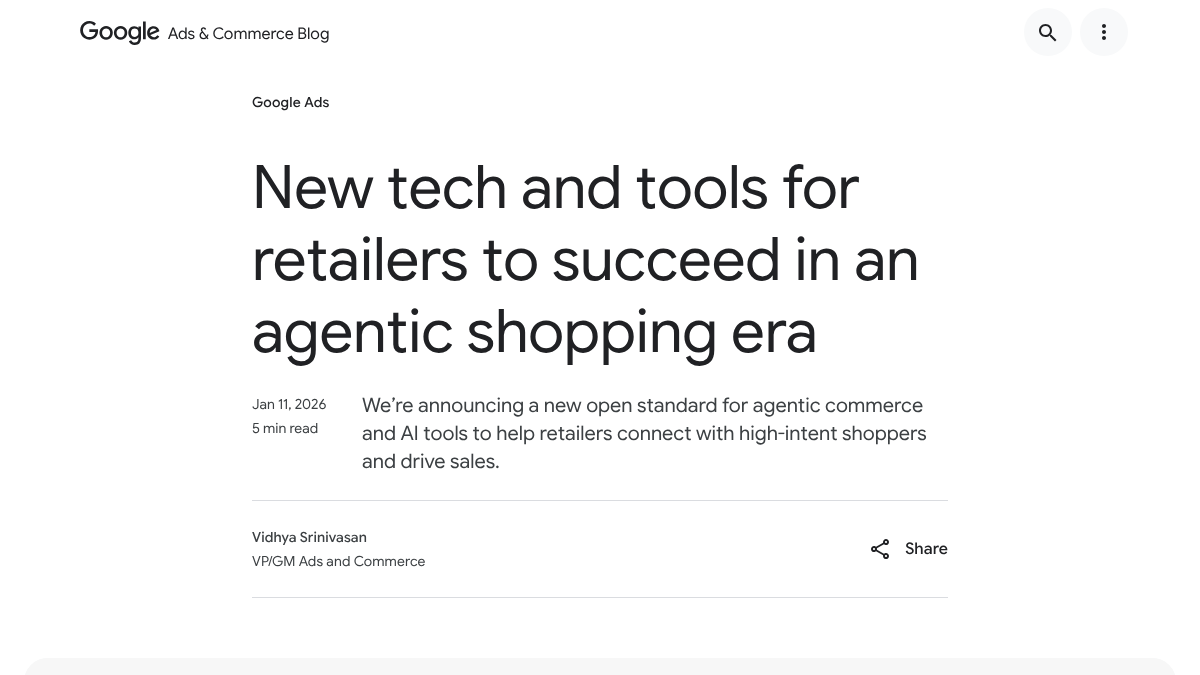
| January 11, 2026 | Agentic checkout with Google Pay, on a new Universal Commerce Protocol | Eligible US retailers |
| May 19, 2026 | Information agents, generative UI and wider booking and calling | Agents for AI Pro and Ultra first; UI free for everyone |
The January launch is the one retailers should read closely. Google built the Universal Commerce Protocol with Shopify, Etsy, Wayfair, Target and Walmart, so shoppers can "check out from eligible U.S. retailers right as they're researching on Google," using the payment and shipping details already saved in Google Wallet.
One oddity is worth knowing. Google's help center still describes "Agentic capabilities in AI Mode" as an experiment for AI Pro and Ultra subscribers in the US, even though restaurant booking went to everyone in the US without a Labs opt-in last November. Google's own docs don't agree on what's still gated, so test the features yourself before you plan around them.
Where the agents get their data
When AI Mode acts, it mostly reads data Google already holds, not your blog. We'd split every query into two layers. The answer layer explains things and cites pages. The action layer books, buys or calls, and it runs on structured data about hours, prices, availability and checkout.
The action layer has three main sources. Business Profiles feed the local cards and the calling feature, and Google's help pages say its AI can call a business to book an appointment, check a restaurant's wait time, or "confirm the price and availability of your products or services." Owners get an email when it happens. The feature covers the US except Indiana, Louisiana, Minnesota, Montana and Nebraska.
Merchant Center and Google's Shopping data feed product answers. In our running-shoe search, every product shown came from Shopping listings, and brand sites got no link of their own. Our guide to AI search engines with visual answers covers which engines show product cards and images, and where they come from.
Partner integrations and live browsing cover the rest. For restaurant reservations, Google says it combines Project Mariner's browsing, "direct partner integrations on Search," the Knowledge Graph and Maps.
Your own pages still matter most for the answer layer. When we asked for the best payroll software for a 20-person company, AI Mode cited Gusto's and ADP's own pages. A small-team project management pricing question drew 11 citations, including Asana's, monday.com's and Trello's own pricing pages.
Know exactly what AI says about your competitors.
RankControl's Recon Agent monitors competitor citations across ChatGPT, Perplexity, Claude, Gemini, Grok, Google AI Mode, and Google AI Overviews. See where they show up and you don't.

How to change your SEO plan
Split your query list into answers and actions
Go through the queries you track and tag each one. "How to switch payroll providers" is an answer query, while "book a plumber today" and "buy X under $150" are action queries. Answer queries still reward good pages. Action queries reward accurate data in Google's systems, and your content plan can't fix a wrong price in a Business Profile.
Treat your Business Profile like a product page
If you run a local or service business, the profile is now what the agent reads before it calls you or books you. Keep hours, services, prices and booking links current, and tell the people who answer your phone that some calls may come from Google's AI asking about availability on a customer's behalf.
Keep your product feed accurate, and check your checkout settings
For ecommerce, the Merchant Center feed decides whether you appear in the Shopping answers at all. Agentic checkout also means a sale can happen without anyone reaching your site. Shopify merchants have been reporting new AI-channel settings in their admin this month, so check your sales channel settings and decide on purpose what's switched on.
Write for longer, more specific questions
Sundar Pichai said on an earnings call that AI Mode queries run about twice as long as traditional searches. People ask it the whole situation at once: "best payroll software for a 20-person company with contractors in three states," rather than "payroll software." Google then breaks that into many smaller searches behind the scenes and stitches the results together.
That changes which pages get pulled in. A generic "best payroll software" roundup competes with hundreds of others, while a page that answers the contractor-in-three-states case directly has fewer rivals for that slice. Look at your sales calls and support tickets for the constraints buyers mention most, like team size, industry, region or an integration they need, and give the common combinations their own sections or pages.
Keep B2B pricing and comparison pages sharp
B2B buying questions still get answer-layer treatment, and AI Mode cited vendors' own pricing pages and their head-to-head comparison posts in our test. Put plans and prices in plain HTML, and keep a comparison page for each competitor your buyers weigh you against.
Measure what Google will show you
Search Console's generative AI performance report shows impressions in AI Overviews and AI Mode by page. Google says it reached all websites worldwide by August 31, 2026. It shows impressions only, no clicks, and leaves out Search Labs experiments, so pair it with your analytics. Our Search Console AI report guide covers how to read it.
26 content formats. Published on your domain. Matched to your brand.
Guides, comparisons, listicles, case studies, and more. RankControl generates content that gets cited by ChatGPT, Perplexity, Claude, Gemini, Grok, Google AI Mode, and Google AI Overviews.

What the click data says
AI Mode doesn't send many visitors, and the evidence points the same way from more than one direction. Moz, which sells SEO software, analyzed about 40,000 AI Mode queries and found that 88% of the pages AI Mode cited didn't appear in the organic results for the same query. So ranking well in classic search doesn't guarantee a citation in AI Mode, and the reverse holds too.
An academic study from the University of Pennsylvania and Northeastern University, published in August, found that routing searchers to AI Mode cut clicks to outside sites noticeably. We couldn't check the paper's own tables, so treat the exact size of the drop with some caution.
Agents meet friction, too
Agentic booking isn't frictionless for the businesses on the other end. In r/FoodNYC this month, a post about people using AI agents to grab restaurant reservations drew more than 300 upvotes, and the top reply credited Resy for "the ban wave" against bots. A booking platform pushing back on automated reservations is a reminder that agents depend on partners willing to let them in.
People are now using AI agents to help them get reservations
If you thought the bot problem was bad enough this will make it near impossible to get a reservation as a person
Consumers are noticing the new capabilities as they arrive. In r/GeminiAI, a post pointing out that AI Mode can now set up agents drew about 150 upvotes, which suggests the agent features are reaching regular users as well as testers.
AI Mode can now apparently set up agents -
hadn't expected this
Google says no special optimization is needed
Google's position hasn't moved. Its guidance says "there are no additional requirements to appear in AI Overviews or AI Mode, nor other special optimizations necessary," and no special schema either. For the answer layer, that's accurate: good pages still win. For the action layer, the work is data hygiene across profiles, feeds and checkout settings, which Google's SEO guidance doesn't cover.
For the wider picture, our post on AI Mode and Gemini's organized results covers what the default-mode tests mean for SaaS, and what agent-ready means for B2B SaaS goes beyond Google.
Keeping track of it all
You can run this yourself: tag your queries, audit your Business Profile and feeds each quarter, and check AI Mode answers for your top questions every month. Budget a few hours a month for a single-location business, more for a store with a large catalog.
Or RankControl can take the tracking. AI visibility tracking checks up to 50 buyer questions every week on seven engines, including Google AI Mode and Google AI Overviews, and shows which sources each one cited. RankControl also tracks your Google and Bing rankings, and its analytics counts AI crawler visits and AI-referred visits, so you can see whether AI Mode sends anyone your way.
For a quick look, run a free check of your brand in AI answers.
Your competitors are getting cited by AI. You're not.
Every day without citation tracking is a day your competitors pull ahead in ChatGPT, Perplexity, and Claude.